Here is the latest For the Birds column, which runs weekly in several New England newspaper.
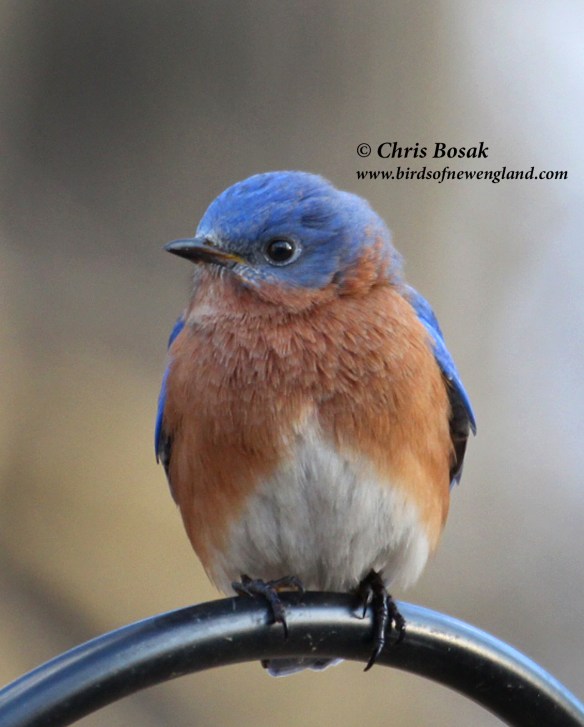
Photo by Chris Bosak An eastern bluebird perches on a pole in New England, February 2020.
Sorry, but I have to go back to writing about bluebirds. After several weeks of writing about bluebirds that other people had in their yards, I finally got some of my own.
I would imagine no apology is necessary, however, as who doesn’t like to hear, read and talk about bluebirds?
I walked into my sunroom and saw through the window just a flash of a bird out of the corner of my eye. The bird had been perched on one of the arms of the feeder pole system and disappeared into woods behind my house.
That was a bluebird, I know it, I told myself, even though I got only the shortest of looks in my peripheral Continue reading →
Photo by Chris Bosak A tufted titmouse looks into a cup for peanuts in New England, February 2020.
For a cold February day, it’s been a pretty good day at the feeder. In all, 14 species showed up already and it’s not even noon. The pileated woodpecker was in the side yard, not at the feeders. I took the photo through a dirty, hence the poor quality. Here’s some photographic evidence of the busy day: Continue reading →
Photo by Chris Bosak A black-capped chickadee eats staghorn sumac berries in Hoosick Falls, N.Y., February 2020.
The temperature when we started our walk was a whole 1 degree Fahrenheit. That number, however, was slowly climbing and there wasn’t a hint of wind to speak of. The sun was shining brightly, and the sky was as blue as you can imagine. In other words, a perfect day to spend several hours outside.
I was visiting my brother in upstate New York near the Vermont border, and two other brothers from out of town were there as well. Paul and I took a relatively short and absolutely birdless walk before returning to Gregg’s house. We both commented on how the single-digit temperatures were having little effect on us because it was a deadly calm day. So why go back inside just because the walk is over?
Gregg lives near an expansive field bordered by woods so Paul opened the hatch to his car and broke out a bag of flying discs. One of his hobbies is disc golf and he’s always Continue reading →
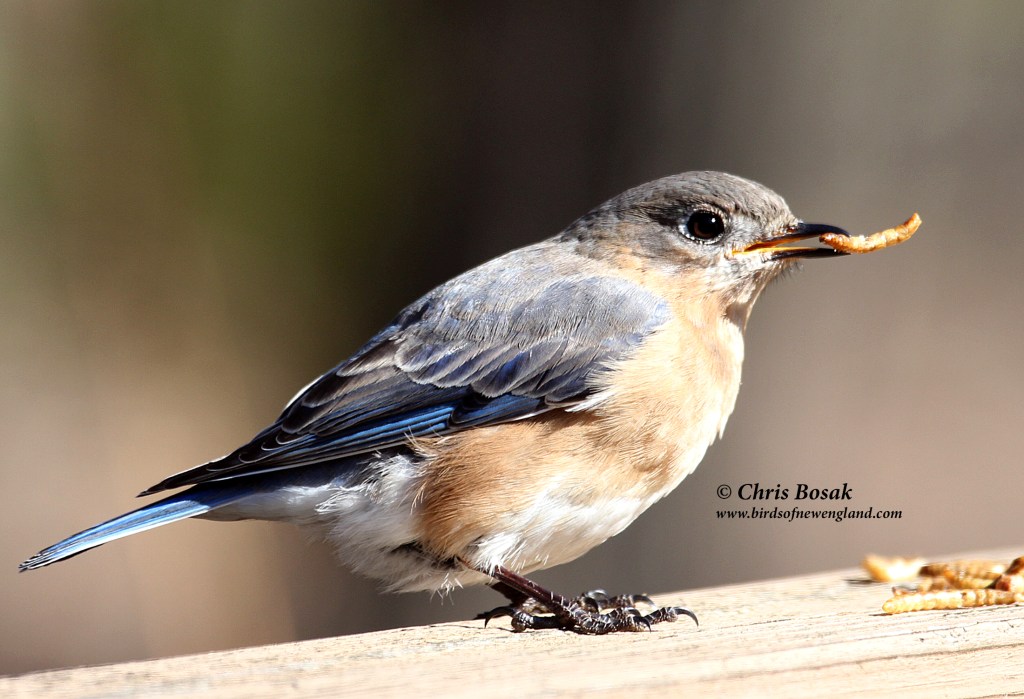
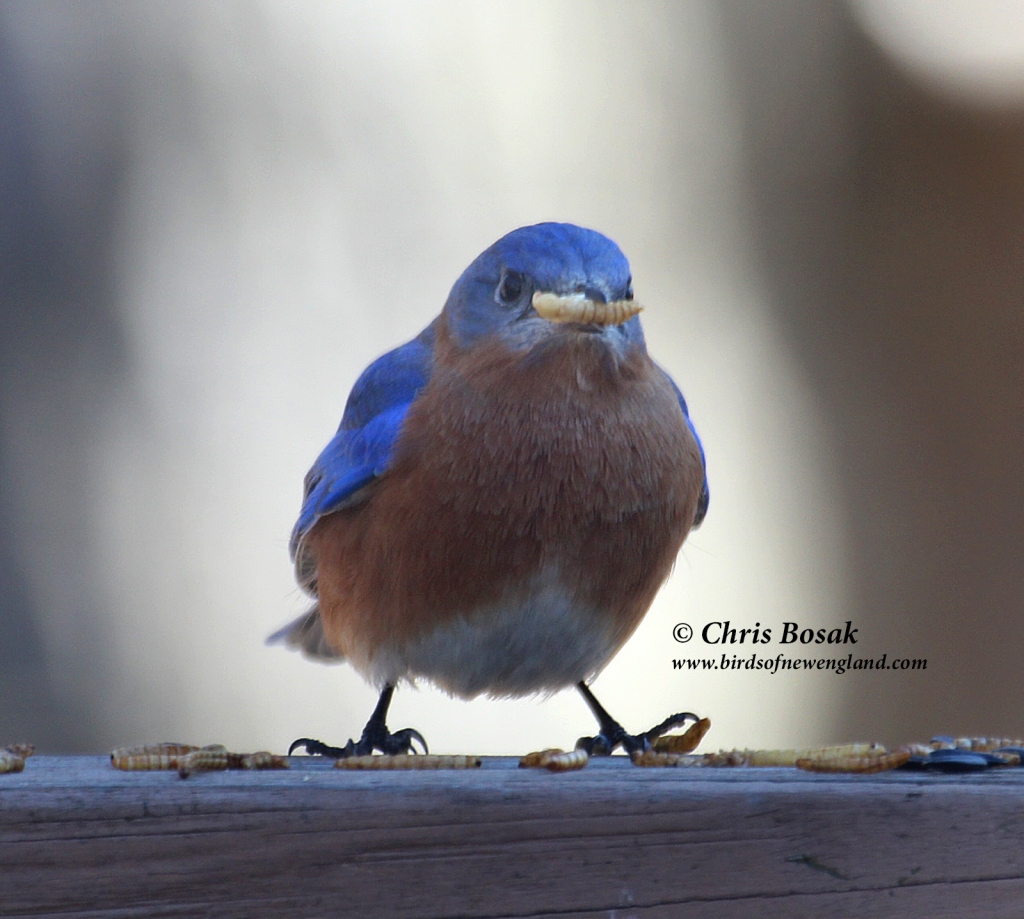
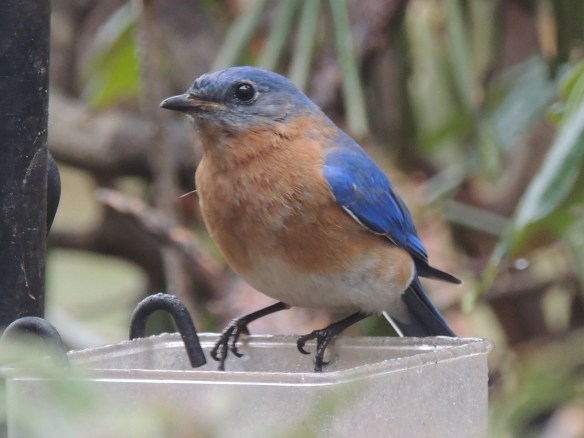
Photo by Chris Bosak An eastern bluebird visits a backyard feeder for mealworms in New England, Feb. 2020.
After several weeks of writing about eastern bluebirds that other people have seen, I finally got a few of my own this weekend. I caught a glimpse of one flying away from my feeding station that includes suet, sunflower seeds and Nyjer seed. My guess is that the bird flew away disappointed as mealworms are their favorite food (at least in terms of backyard feeding.) So, of course, I rushed out there with a handful of mealworms and spread them out on the deck railing. Within half an hour a male and female bluebird were enjoying the dried morsels.
More on this to come! In the meantime, here are a few more shots. Also, feel free to look back on some past posts on this site to see how this has become the Winter of the Bluebird in New England.
Photo by Chris Bosak An eastern bluebird visits a backyard feeder for mealworms in New England, Feb. 2020.Photo by Chris Bosak An eastern bluebird visits a backyard feeder for mealworms in New England, Feb. 2020.
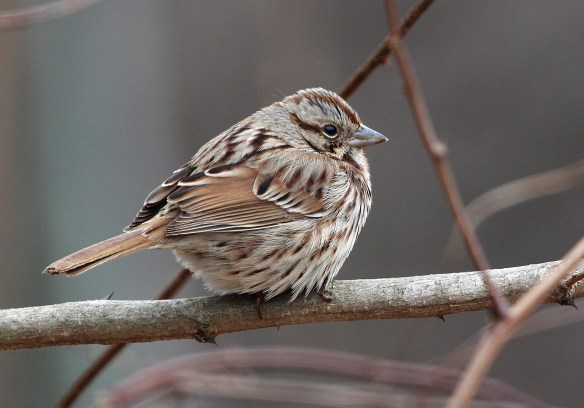
Photo by Chris Bosak A Song Sparrow seen in Selleck’s/Dunlap Woods in Darien, Conn., March 2014.
You always hope for a storm, but sometimes all you get is a flurry or two.
I’m not talking about a high school student who didn’t study for a test and is praying for a snow day. I’m talking about birding, of course.
The other day I visited a preserve in southern New England for the first time. I was struck immediately by the vast fields and several small wooded areas that looked to me like islands among the grassy expanse. My first thought was that this place is probably hopping with bobolinks, bluebirds and all sorts of other birds in the spring and summer.
But this wasn’t spring or summer. It was a dreary, raw winter day and the grass was short and brownish-yellow. Lifeless. The wooded islands were void of leaves and you could see the gray sky through the tangle of trunks and branches.
My plan was to walk along the edge of the wooded areas and see what was lurking in there. The anticipation of the new walk at a new place faded over time as close to an hour had passed and a few crows cawing in the distance was the only sign of birdlife I had noticed. I wanted to zero in on the crows to see if they were mobbing a hawk, owl or some other intruder. I couldn’t even find the crows in the sky, let alone zero in on them.
The anticipation may have faded, but my appreciation of the walk remained high. I spent much of 2019 battling off-again, on-again tendinitis in my right foot and hobbling around by putting pressure on the part of my foot that hurt the least. Walks on uneven terrain were out of the question. To be able to walk pain-free is something I’ll never take for granted again.
So I was enjoying the walk, birds or not. I made plans in my mind where Continue reading →
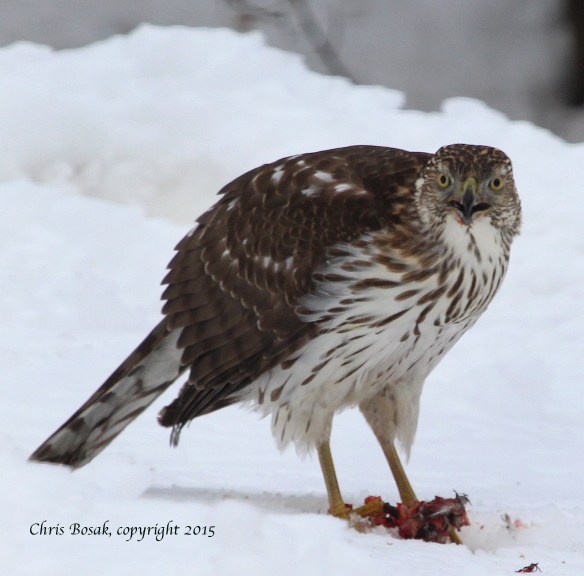
Photo by Chris Bosak A young Cooper’s Hawk eats a squirrel in southern New England in Feb. 2015.
Ah, a New England winter. There’s nothing like it.
Zero degrees one day and mid-50s a few days later. Arctic chill to pleasant spring-like weather in the blink of an eye.
Personally, I enjoy both extremes of a New England winter. I’ve said before that one of the great things about being a birdwatcher is that the hobby can be enjoyed regardless of the weather: hot, cold, rainy, snowy. The biggest impact weather — temperatures, anyway — has on birdwatching plans is whether or not the ponds will be frozen.
In the extreme cold, everything is frozen. Small ponds, large lakes and wide rivers are frozen solid. When that happens, I do my birdwatching at home and in the woods. (Lately, it’s been mostly at home, to be honest.) The feeders get particularly active in bitterly cold weather as birds feed with a sense of urgency to fuel up for the cold night ahead. All the birds you’d expect to see over the course of a winter sometimes show up in one day, especially in extreme weather. Cardinals, blue jays, mourning doves, juncos, white-throated sparrows, house finches and, of course, titmice, chickadees, nuthatches and woodpeckers can all show up on those days. Who knows? A pair of Carolina wrens may even show up.
Those types of frenetic feeder days are often accompanied by a visit from an opportunistic sharp-shinned or Cooper’s hawk, but I haven’t seen them around Continue reading →
Annette Connor of New Hampshire got this shot of an eastern bluebird this winter.
The reports keep coming in so I’m going to ride the Eastern bluebird train for one more week.
In what is shaping up to be the unofficial Winter of the Bluebird, many sightings continue to come in from throughout New England, and beyond. Bluebirds, as I’ve written before, are not uncommon in New England in the winter, but the sheer number of reports this year is unique.
In case you missed the column from a few weeks ago, each winter seems to have a bird that shows up more frequently and noticeably than in typical winters. In recent years we’ve had the winter of the snowy owl, barred owl, American robin and dark-eyed junco. I’m sure you’ve figured out by now that this is highly unscientific and based on my own observations and the anecdotal observations of others.
I’ll run down the most recent sightings sent in and then close with a few fun facts about bluebirds.
Dick and Pat from Westmoreland wrote to say they had four bluebirds on their roof one recent morning, presumably drinking melted snow as it rolled down the shingles.
What’s better than having three bluebirds show up in your yard on a consistent basis in the winter? Having four show up, of course. That’s what Kathy from Swanzey is experiencing this year. She was pleasantly surprised to host three bluebirds last winter; this winter she added one to the count.
“We see them almost every day. It’s wonderful to hear their chirping Continue reading →
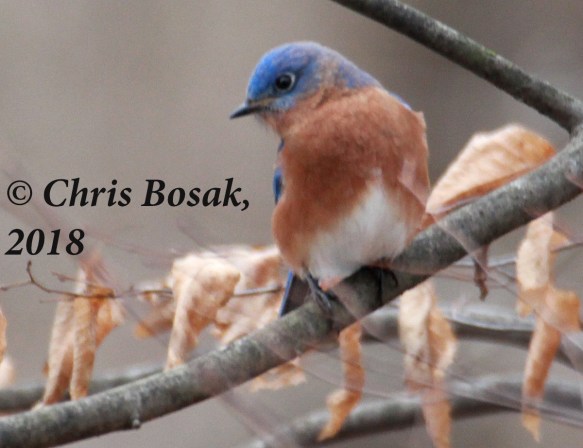
Photo by Chris Bosak An eastern bluebird, Brookfield, CT, fall 2018.
Here’s the latest For the Birds column, which runs in several New England newspapers …
It’s still too early to make any official declarations, but it is looking more and more like the Winter of the Bluebird.
After last week’s hint that it might be heading in that direction I received several more emails from astute birdwatchers finding eastern bluebirds. It’s not that bluebirds are a rare New England winter sighting but it appears that more people than usual are reporting them.
Similar to the American robin, another member of the thrush family, many eastern bluebirds remain with us throughout the winter. The trick is finding them.
Although I have still been shut out of the bluebird frenzy this winter, many others have written to tell me about their encounters. I appreciate the reports. Keep them coming.
Celia from Keene said there was “no missing the blue” of the bluebirds she saw on the rail trail in her city. She said they were the first ones she had seen during the winter.
Celia added that bluebirds nested on her property for the first time last summer. The way she described it explains in a nutshell why I love New England so much: “We put a bluebird house up in our yard overlooking the pumpkin patch …” Who else but a New Englander could start a sentence that way?
Elena from Winchester reported that a friend of hers saw a large flock of bluebirds near the Connecticut River in the Hinsdale area. Elena, like me, has been shut out of the bluebird party this winter so far, but she did report that a small flock of red-winged blackbirds continues to eat suet and sunflower seeders from her feeders.
Marie Anne from Guilford has had bluebirds visit her backyard for the past seven winters. She has had as many as eight but this year she has four “cranky little guys arguing over the mealworm feeder.”
“Their winter presence brings me as much peace and joy as their sweet complaints do during the gardening season,” she wrote.
Last but not least, Andrew wrote to let me know that bluebirds were at Continue reading →
Photo by Chris Bosak
A broken birdbath and several inches of snow made for an ideal canvas to make a face made out of nuts and seeds used to feed birds.
Happy Friday everyone. Here’s a random photo just because.
Photo by Chris Bosak An eastern bluebird scans a yard in Danbury, CT, March 2019.
I thought it was going to be the winter of the junco again, but it’s looking more and more like the winter of the bluebird.
Last year was the winter of the barred owl. As you recall, barred owls were being seen in great numbers all throughout New England. Experts had conflicting theories on why so many of these beautiful owls were being seen, but there is no denying that more than usual were found. On one trip to visit my brother in upstate New York, I found two barred owls. The second owl was perched atop a Welcome to New York sign on the Vermont border.
Several years ago, Christmas Bird Count results were teeming with huge dark-eyed junco numbers. Whereas there are usually hundreds of juncos in a particular count area, there were thousands that year. I dubbed it the winter of the junco and have been on the lookout for similar anecdotal phenomena since then.
Who can forget the winter of the snowy owl a few years back? I can recall robins and pine siskins being highlighted in previous winters.
As I drive to work every day, one stretch of a particular road often has a large flock of juncos. They scatter as I drive by; their white-outlined tails giving away their i Continue reading →






 Birds of New England.com