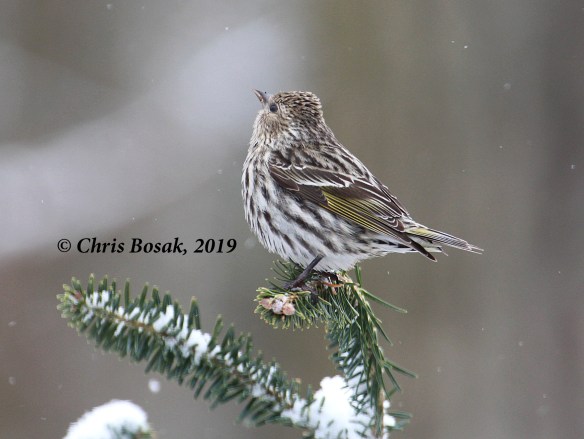
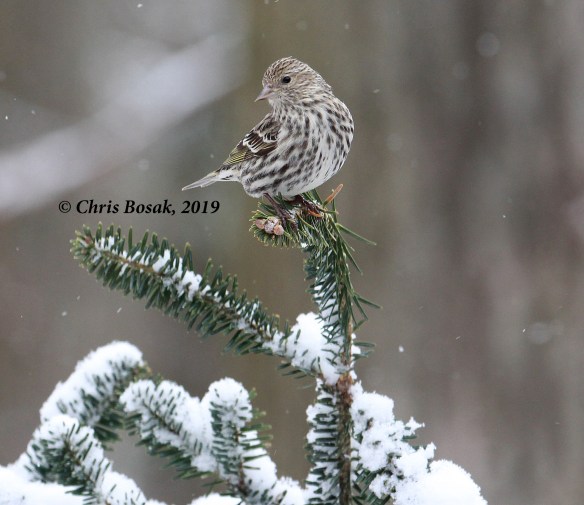
Photo by Chris Bosak A pine siskin perches on the top of an evergreen in Danbury, CT, March 2019.
For the third consecutive day, southern New England was hit by an overnight snowfall. None of the “storms” amounted to much in terms of accumulation but they did create some good bird photography opportunities.
Here are a few to get started. Many more to come …
Photo by Chris Bosak
A pine siskin perches on the top of an evergreen in Danbury, CT, March 2019.
Photo by Chris Bosak
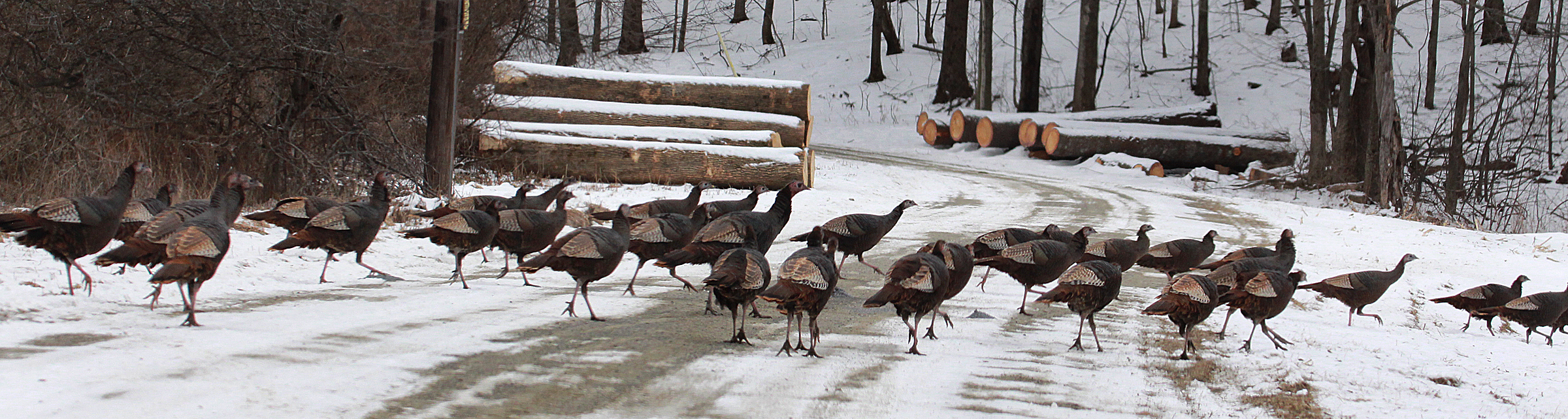
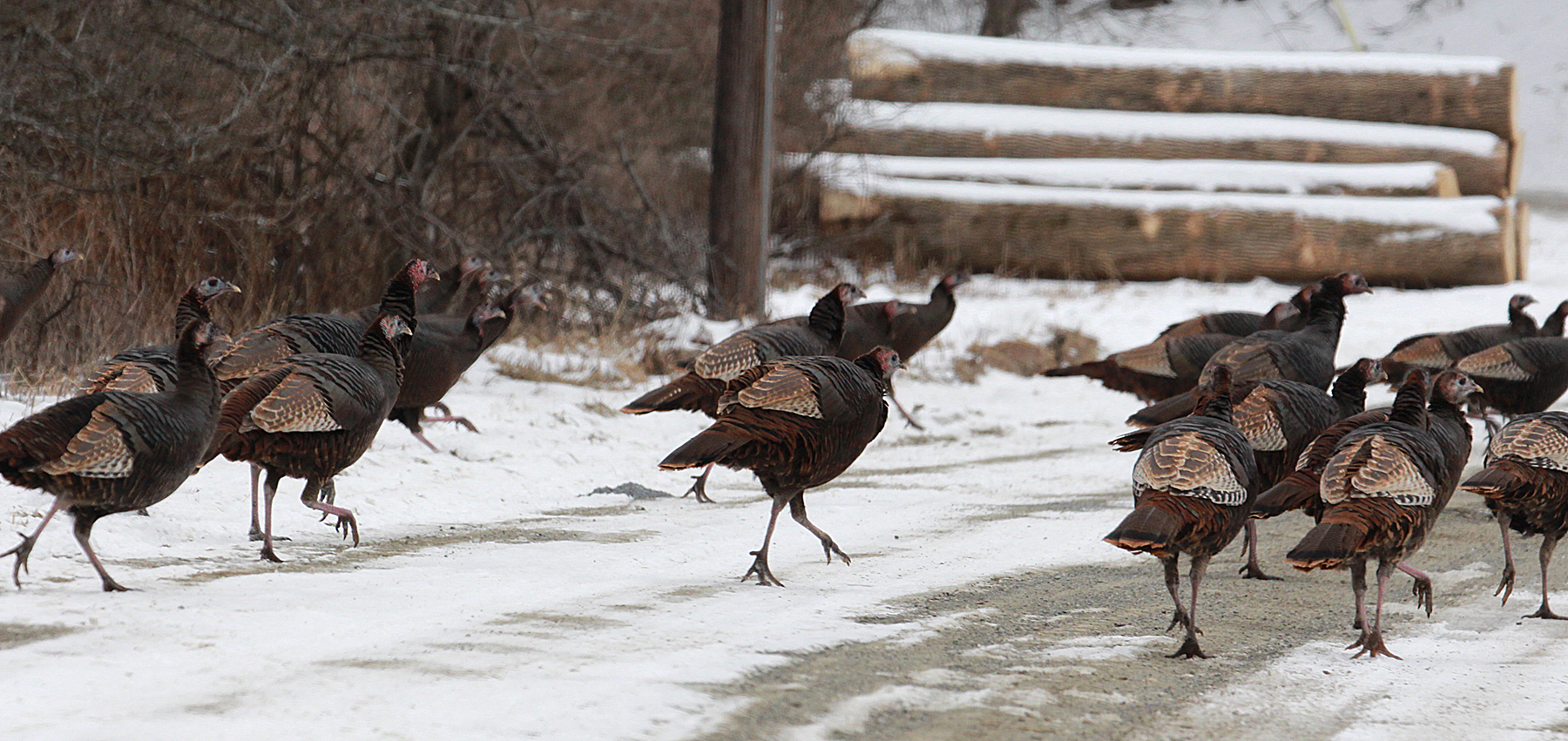
A flock of wild turkeys run into a field in Berlin, N.Y., February 2019.
I alluded to these guys and gals during my barred owl posting a few days ago. Here they are in photos.
For context, here’s what a wrote a few days ago”
“I turned the car around to get another look, but the owl was no longer there, even though I had seen it about one minute before. I drove past the spot and turned onto the next side road to get turned around again. It looked as if the road would lead to a few farms. The largest flock of turkeys I’ve ever seen was gathered in a field alongside the road. The turkeys, about 40-50 of them, seemed fairly wary so I didn’t linger long.”
Photo by Chris Bosak
A flock of wild turkeys run into a field in Berlin, N.Y., February 2019.
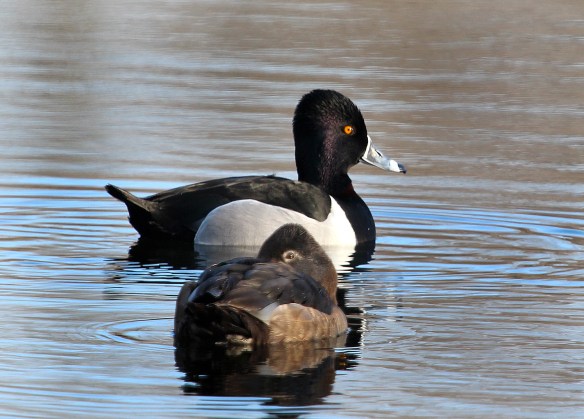
Photo by Chris Bosak A pair of Ring-necked Ducks rest at a pond in Darien, March 2014.
Here is the latest For the Birds column.
I decided to stick to the woods behind my house for the Great Backyard Bird Count. I could have gone off to some nearby birding hot spot to try to log more birds, but I decided to stay put and “bird my patch.”
The action was fairly slow but not terribly so. I didn’t find any out-of-the-ordinary species, but I did get a lot of the common ones. I got my chickadees, titmice, white-breasted nuthatches, downy woodpeckers, red-bellied woodpeckers and American goldfinches. A small flock of pine siskins came to the backyard just as I was wrapping things up. I was glad it arrived for the count as this bird has been a regular visitor all winter.
The highlight of the count for me was checking out the beaver pond at the end of the trail that begins behind my house. The pond was mostly frozen, probably about 85 percent so, but the open water that did exist on the far edge held a lone male hooded merganser and nine ring-necked ducks.
Did I say nine? I meant to say 12. No, make that 13. When getting a precise number of birds is important, such as when doing a bird census like the Great Backyard Bird Count, it is important to check and double check the diving ducks.
When I first looked at the ring-necked ducks, I counted nine. I moved along the edge of the pond to change my angle and suddenly I counted 12. I watched for another minute and another duck popped up its head to make 13. I watched carefully for another couple minutes and the number stayed at 13.
Ring-necked ducks are one of the more common diving ducks we see in New England during the winter. Diving ducks are the ones that, true to the description, dive underwater for their prey such as fish and crustaceans. The other types of ducks are dabblers and they simply tip up and stick their heads in the water in their search for food.
Most of our very common ducks are dabblers. Mallards, black ducks, wood ducks and teal are all dabblers. The divers include species such as the mergansers, bufflehead, goldeneye, and, as mentioned, ring-necked ducks.
Dabblers are sometimes difficult to count because there can be so many of them they tend to crowd each other out. But at least you can always see them. They don’t “disappear” underwater.
When you approach a pond and see a flock of divers, you never know whether you are looking at all of them or not. Not that it would have made a whole lot of difference in the grand scheme of things if I had submitted 12 ring-necked ducks, or even my original count of nine, for that matter. But, of course, I was trying to be as accurate as possible so I’m glad I was able to submit the correct number.
All in all, it was a fun count with a decent number of species. How did you do? Feel free to send me an email and let me know.
For more information and international results of the Great Backyard Bird Count, click here.
Photo by Chris Bosak A barred owl perches on a Welcome to New York sign on the border of Hoosick Falls, N.Y., and Bennignton, Vermont, in February 2019.
As promised, here’s Part II of my “joining the barred owl party” story.
Last week I wrote a column about the Winter of the Barred Owl and followed up with a post showing a few photos sent in by readers of barred owls perched on feeder poles. But, at the time of those postings, I hadn’t yet seen a barred owl myself this winter.
I woke up my teenage son Andrew early (relatively) for a day of skiing at Mt. Snow. My brother lives in a New York town that borders Vermont. As we cruised along the “Bennington Bypass” on this gray, misty morning I pointed out the “Welcome to Vermont” sign to my son. I glanced back quickly at the “Welcome to New York” sign that was now in my rearview mirror. I noticed the huge sign had a lump on the top of it.
Could it be another owl, I thought. Probably just a hawk (not that hawks are uninteresting, but they are rather common along highways) I figured, but I wheeled the car around anyway. Sure enough, it became apparent as we closed the distance that the lump in question was another barred owl. Winter of the Barred Owl, indeed.
I parked in a pull-off spot conveniently located in front of the sign and grabbed a few photos before heading to the mountain.
The first owl on Wednesday was photographed in a New York town that borders New England. The second owl was even closer to the New England border and it may be argued it was half in Vermont. Either way, it was nice to join the barred owl party.
Photo by Chris Bosak A barred owl perches on a Welcome to New York sign on the border of Hoosick Falls, N.Y., and Bennignton, Vermont, in February 2019.
Photo by Chris Bosak
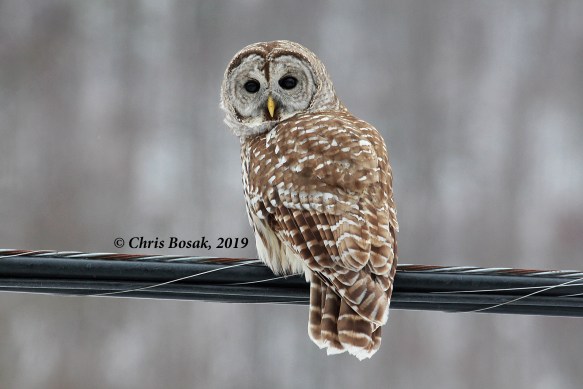
A barred owl perches on a wire in Berlin, N.Y., February 2019.
Last week I wrote a column about the Winter of the Barred Owl and followed up with a post showing a few photos sent in by readers of barred owls perched on feeder poles. But, at the time of those postings, I hadn’t yet seen a barred owl myself this winter.
Then I took a trip on Wednesday to visit my brother in upstate New York near the Vermont border and joined the barred owl party. I was driving up Route 22 through Berlin, N.Y., when I noticed an owl perched on a wire going over the road.
I turned the car around to get another look, but the owl was no longer there, even though I had seen it about one minute before. I drove past the spot and turned onto the next side road to get turned around again. It looked as if the road would lead to a few farms. The largest flock of turkeys I’ve ever seen was gathered in a field alongside the road. The turkeys, about 40-50 of them, seemed fairly wary so I didn’t linger long.
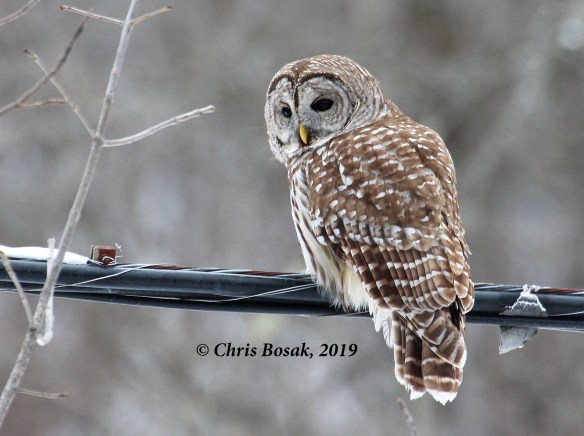
I got back onto Route 22 and headed back toward my brother’s. The owl hadn’t returned to its spot on the wire over the road, but I did spot it on a wire that ran along the road. I pulled over onto the shoulder and grabbed a few shots. This wire was an even better spot as it was lower and made for a better photographic angle. The owl mostly focused on a field under the wire, but did take the occasional look over its shoulder. Again, I didn’t linger long but did get some good close-ups of this handsome bird.
I’ll post Part II of the story tomorrow. Berlin is border town with New England, near the point at which northwest Massachusetts meets southwest Vermont. Part II will bring us even closer to the New England border.
Photo by Chris Bosak
A barred owl perches on a wire in Berlin, N.Y., February 2019.
After my latest bird column published in The Keene Sentinel this week, I received a few additional photos of barred owls from readers in SW New Hampshire. Funny how they are showing up on feeding poles so often.
First (below) is the original photo I received and then two additional ones.
Photo by Bob Sullivan This barred owl perched on a bird feeding pole and took several dives at a vole under the snow in Westmoreland, N.H.Photo by Dale Woodward
This barred owl was spotted on a feeder pole in February 2019 in Walpole Village, N.H.Photo by Rick Allen
This barred owl perched on a feeder pole in Swanzey, N.H., during February 2019.
Photo by Bob Sullivan This barred owl perched on a bird feeding pole and took several dives at a vole under the snow in Westmoreland, N.H.
In recent memory we’ve had the winter of the junco, the winter of the snowy owl, and the winter of the robin.
This seems to be the winter of the barred owl. Throughout New England, barred owls are being seen in greater-than-usual numbers.
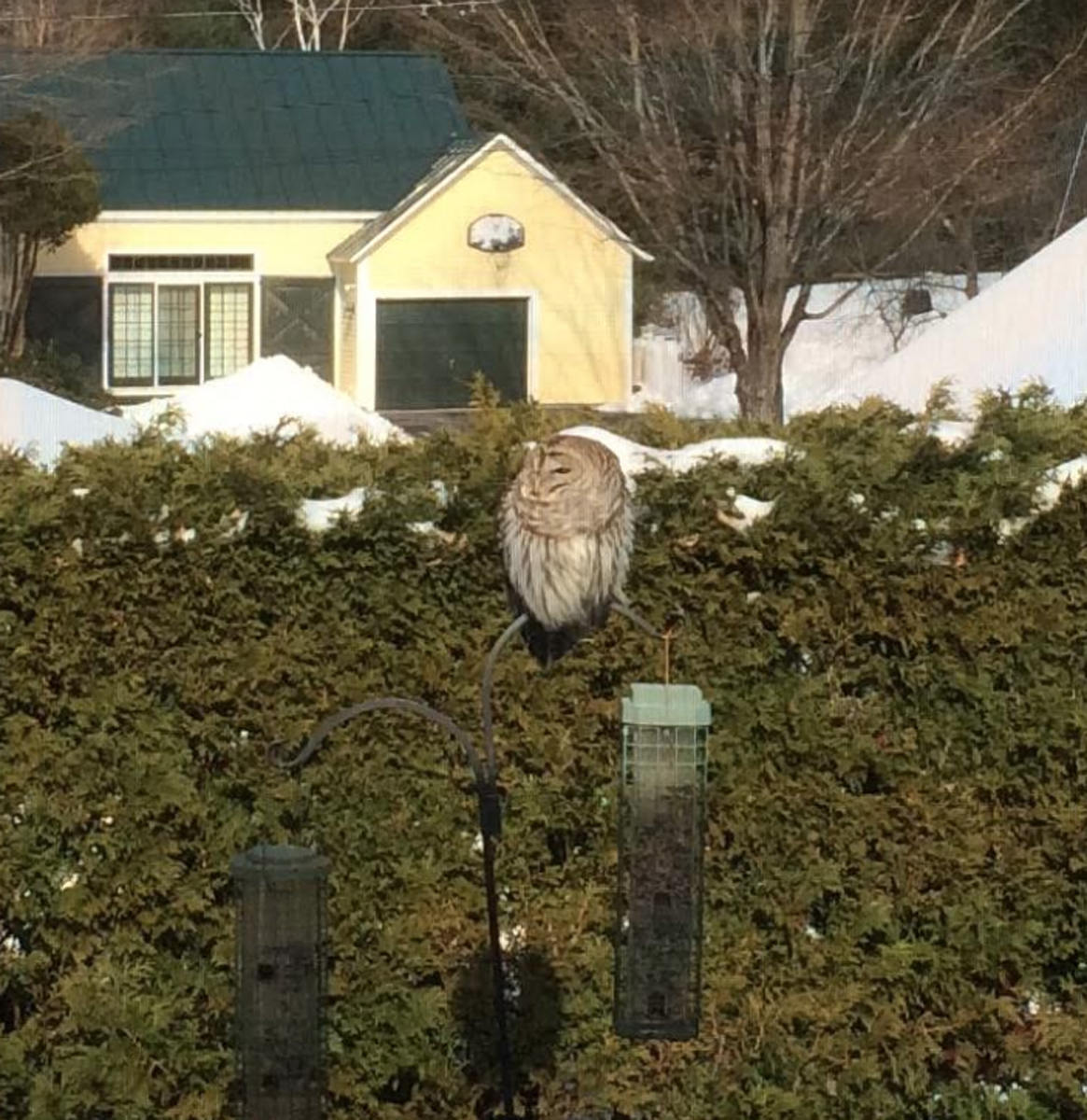
I received an email and terrific photos from Bob of Westmoreland. On Super Bowl Sunday, he noticed a barred owl perched on the bird feeder pole in his yard. But the thrills didn’t stop there. Bob watched as the owl took a few attempts at snagging a vole in the snow beneath the feeder. Alas, the owl never got its prey.
“I kept pausing the Super Bowl every so often to check,” he wrote. “I have plenty of barred owls in the neighborhood, but this was the first time I ever saw one hunting at the feeder.”
Bob noted that smaller birds such as chickadees kept right on using the feeders and the owl paid them no mind.
People think of owls as nocturnal, but they can be active during the day. This is especially true of barred owls, which often call their eerie “Who cooks for you? Who cooks for you all?” hoots during the day.
The spike in sightings has been so pronounced that The Connecticut Audubon Society called on several bird experts to try to explain the phenomenon. Continue reading →
Photo by Chris Bosak A white-breasted nuthatch sits on a bird-shaped birdfeeder during the winter of 2016-17 in Danbury, Conn.
As promised, here are the results of my Great Backyard Bird Count experience this morning. It wasn’t overly successful in terms of finding birds, but it wasn’t too bad either. At any rate, all checklists are valuable, so my 2019 GBBC list is in. Not that participants are limited to one checklist, and I may just do another one tomorrow as the Count runs through Monday.
My species list included: black-capped chickadee, tufted titmouse, white-breasted nuthatch, downy woodpecker, red-bellied woodpecker, dark-eyed junco, pine siskin, American goldfinch, hooded merganser, and ring-necked duck. The waterfowl, of course, I spotted at the pond at the end of the trail behind my house. The pond is 85 percent frozen, but open just enough to hold a small flock of ring-necks.
Since my species list wasn’t so great, here are photos of each bird I saw today. (Note: The photos were not taken today, but these are “file photos.”) Continue reading →
A Red-breasted Nuthatch perches near a bird feeding station in Danbury, Conn., Oct. 2016.
There is still time to participate in the Great Backyard Bird Count. In fact, in recent years the Count has been extended through Monday — so no excuses. It’s a beautiful day in New England (at least where I am) and I’m eager to head out right after making this post. I’ll let you know what I find later today or tomorrow. As always, feel free to send me your highlights.
Remember, if you see a ton of birds or only a few (or none), it’s all good data. Don’t fail to submit results just because you think it was an “unsuccessful” bird walk. Click here for my recent column on that matter.
Many people are concerned that they are not seeing chickadees at their feeder this winter. This is your chance to contribute to data that may help scientists determine if, indeed, there is a problem.
All the information about the GBBC and how to submit your results may be found by clicking here.
Photo by Chris Bosak A Blue Jay eats an acorn at Selleck’s Woods in Darien, Conn., April 2016.
After a three-hour drive to visit my brother Gregg in upstate New York, it was nice to relax and watch the black-capped chickadees forage in theblue spruce trees outside his kitchen window.
A flock of dark-eyed juncos darted past the window and settled at the base of his house where a bare patch of ground offered the only hope for these ground-feeding birds. The rest of the yard was buried under snow and ice.
A glance back at the spruce trees proved what I had thought all along: The chickadees were not alone. It was a mixed flock of chickadees and tufted titmice poking at the Continue reading →







 Birds of New England.com