Photo by Chris Bosak
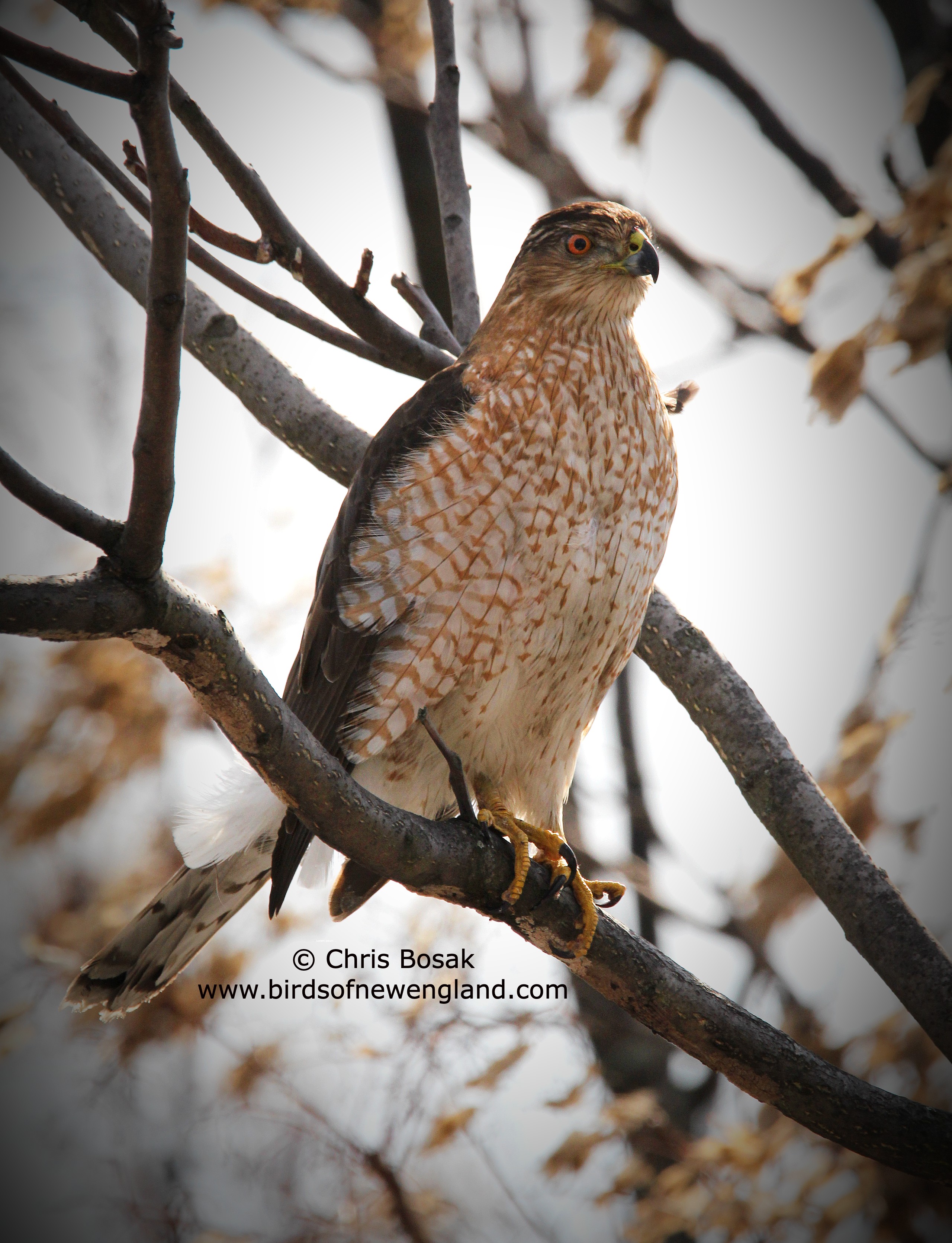
Adult Cooper’s hawk seen in Norwalk, Connecticut, January 2025.
I was walking along a short but windy trail in southern New England the other day in search of overwintering warblers. This short path is known for harboring these tiny songbirds during the winter, as it is adjacent to a water treatment center that features open water on even the coldest days.
I came around one of the many bends and jumped back as I flushed a large bird that was on the ground next to the trail. With my heart racing from the surprise, my immediate reaction was that it was a ruffed grouse. It flushed with the familiar exuberance and noise of a grouse, so my mind immediately went there. Ruffed grouse, however, do not live in that area of New England any longer, and the habitat wasn’t right for the popular game bird.
Photo by Chris Bosak
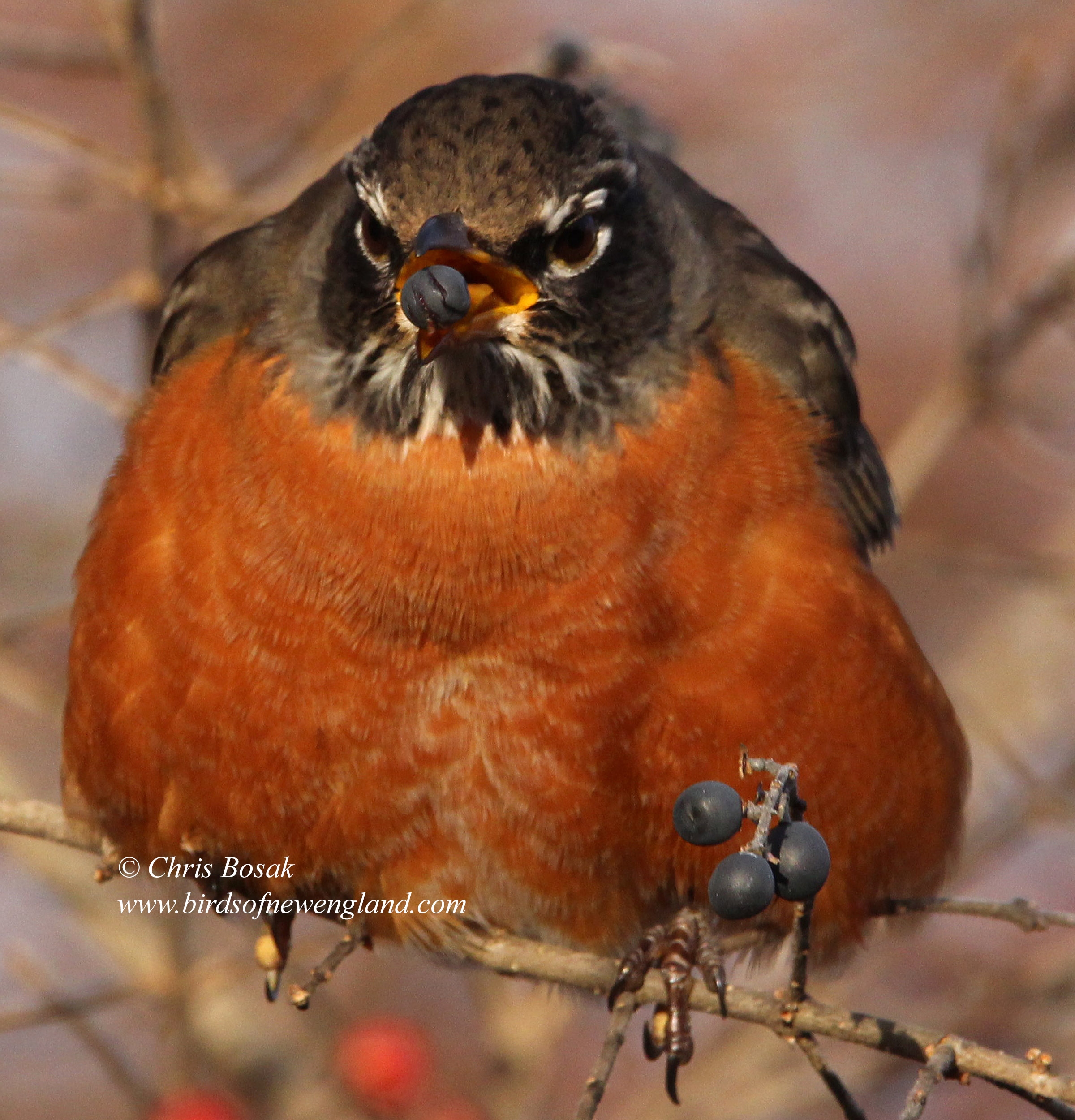
An American robin eats border privet berries in New England, January 2025.
I wrote a few weeks ago about robins being the frontrunner for the Bird of Winter. Click here to find out what that even means. The photo I ran with it showed a robin eating border privet berries. Separately, I also wrote recently about my fascination with photographing birds eating berries. Click here for that one.
Well, here are more photos of those robins eating berries.
Photo by Chris Bosak
An American robin eats border privet berries in New England, January 2025.Continue reading →
Fall is an exciting time for birdwatching with hawkwatches, the southern warbler migration, and, later in the fall, the waterfowl migration.
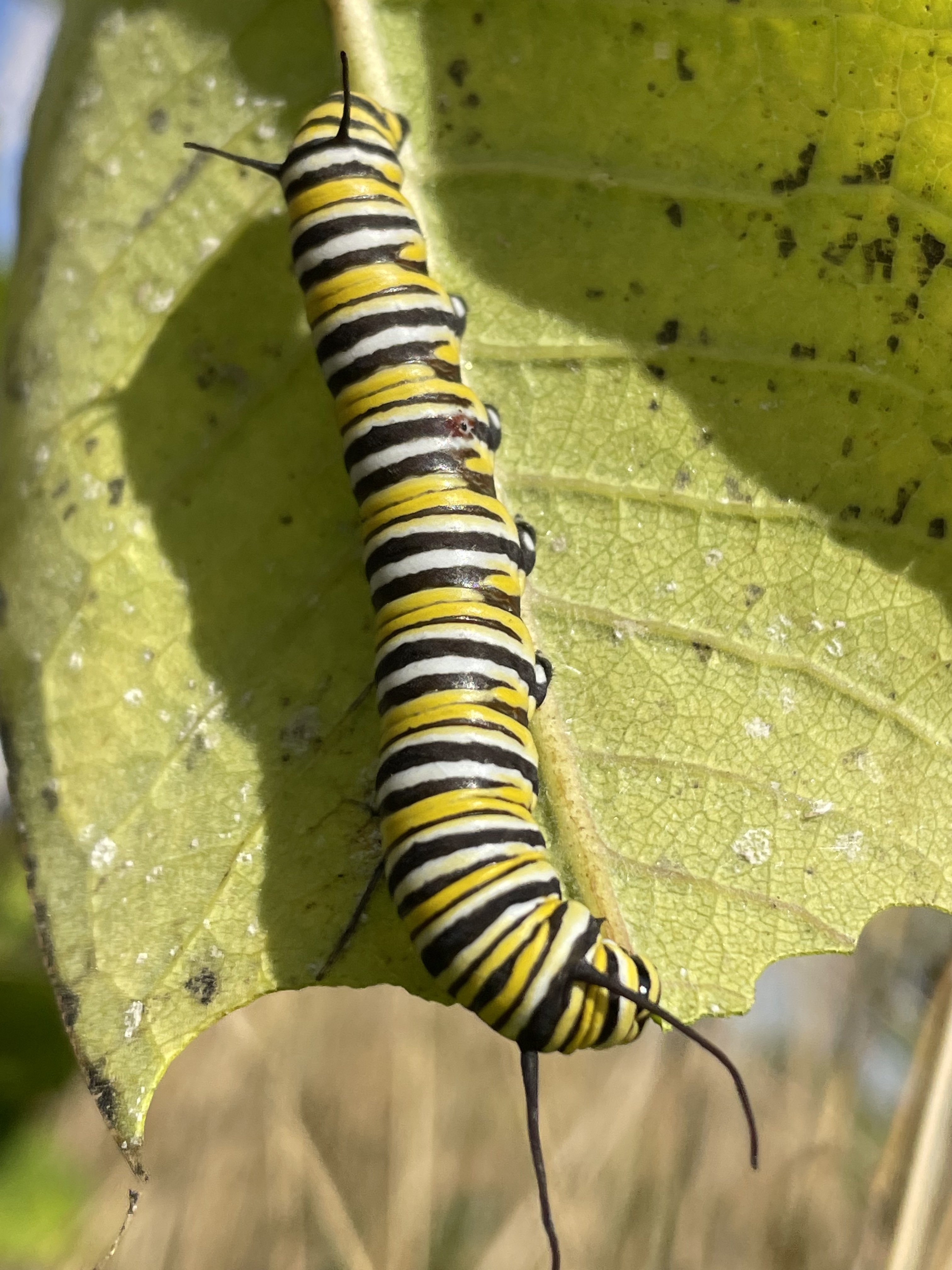
Early fall holds many non-bird surprises in nature as well. On recent walks, I have seen dozens of monarchs and other butterflies. When I walk through fields, I am constantly on the lookout for monarch caterpillars on milkweed plants. Rarely am I lucky enough to spot one, but it does happen on occasion. The other day happened to be one of those occasions.
Monarchs are struggling as a species as habitat loss, pesticides and, potentially, climate change have played a heavy toll on their numbers, particularly out West. I did read an article recently that said the numbers may be rebounding, however. That would be great news.
Photo by Chris Bosak
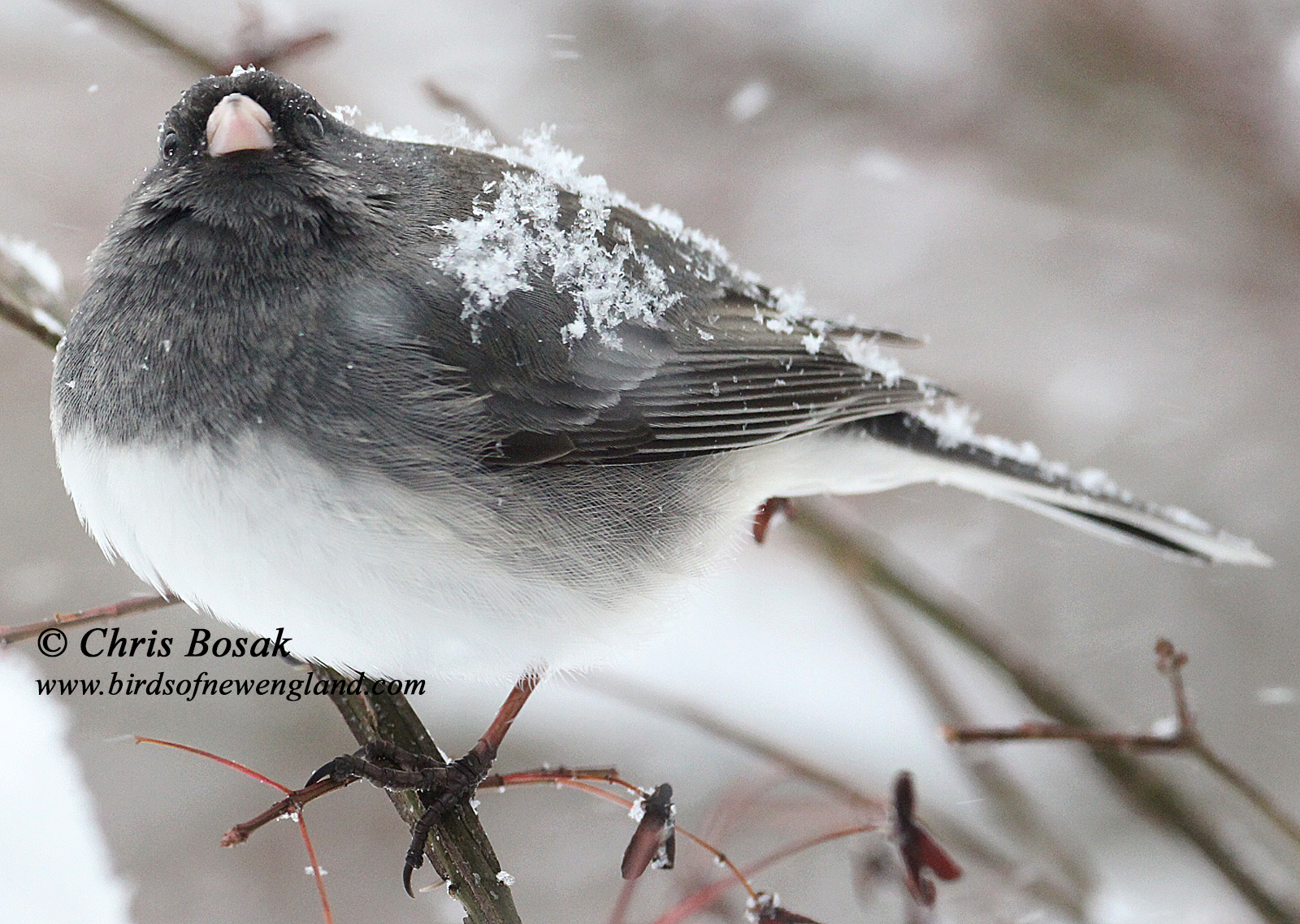
A dark-eyed junco visits a backyard in New England, January 2021.
The junco sat perfectly still in the bush as snow collected on his back. The snow came down hard and the wind whipped it around.
It was the wind that kept the junco motionless in the bush. When the wind offered a rare break, the junco darted to the nearby bird feeder to grab a few sunflower seeds.
He would fly back to his spot in the bush, having shaken off the snow that had collected on him. It didn’t take long for new snow to accumulate on his dark gray feathers.
Snowy days are among the best times to watch the feeders. It is interesting to see how little the elements affect the birds. Tiny birds such as chickadees can withstand extremely cold and windy conditions. They have a variety of mechanisms to protect them from the harsh elements. I have written about those in previous columns and may revisit that topic in the future.
But for now, I’m going to focus on this past storm that hit New England and recall the many birds that visited. The junco I mentioned before was one of more than a dozen juncos that were around that day. Other sparrows included white-throated, song and house. Many people don’t think of juncos as being a sparrow because of their different coloration, but they are indeed members of the sparrow family.
Both nuthatches came and went throughout the day. It is such a thrill to see the red-breasted nuthatches daily this winter. Not that I don’t appreciate the white-breasted nuthatches, but they are much more common and year-round birds where I am. The red-breasted nuthatch shows up only in random years.
Of course, chickadees and titmice were regular visitors. A pair of Carolina wrens entertained me as well. I always like watching their antics in the yard, especially when they make their unique chatter calls outside the window.
It was a heck of a snowstorm — the worst in several years where I am anyway. Will there be more opportunities this winter to watch the birds at the feeder in the snow? That remains to be seen, but I wouldn’t be surprised in the least. In fact, I would be very surprised if we didn’t have more snowfalls. This is New England, after all, and winter is a way of life here.
Photo by Chris Bosak
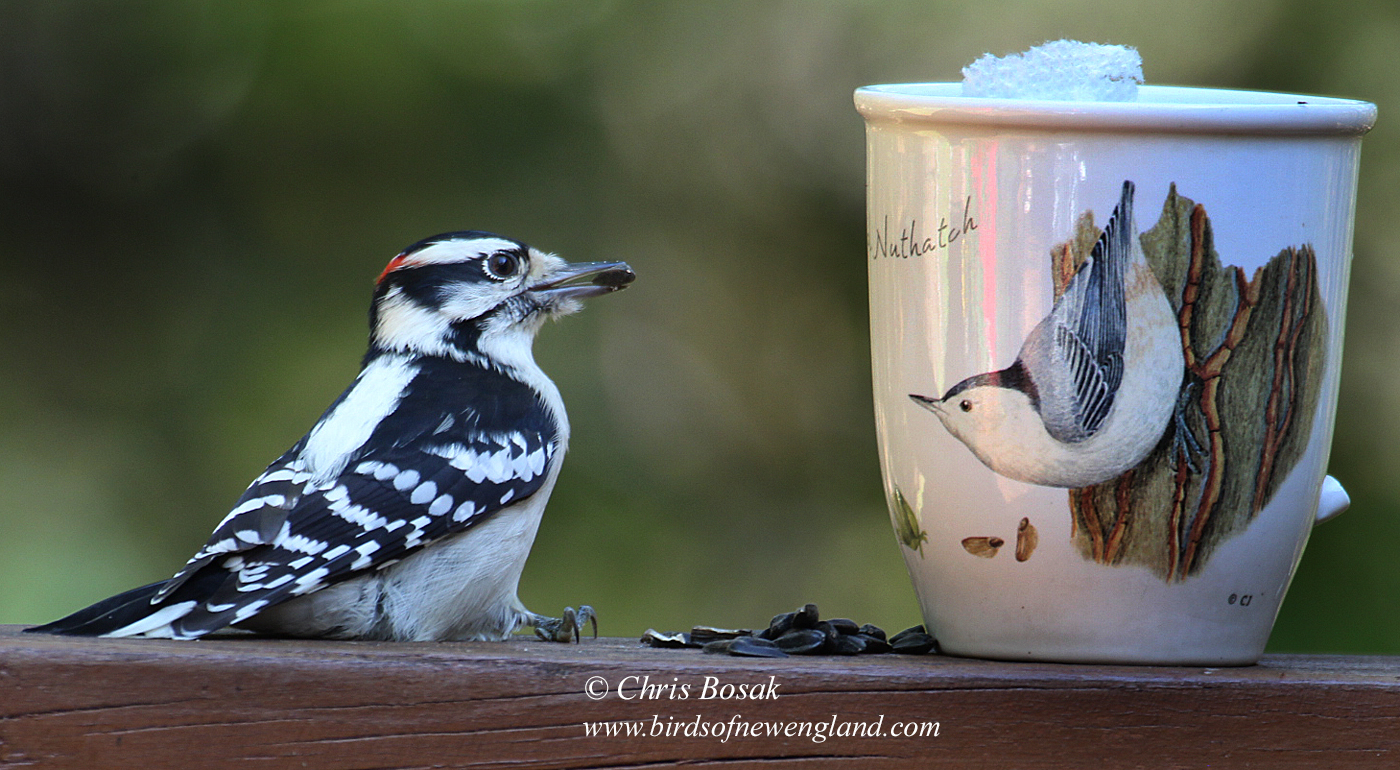
A downy woodpecker grabs a seed and looks at a coffee mug bearing a drawing of a white-breasted nuthatch in New England, fall 2020.
A fun bird photo to get you in the holiday spirit.
Photo by Chris Bosak A male northern cardinal visits a backyard in New England, April 2020.
A Day on Merganser Lake 1
As promised, I’ll start a new series today. I’m running out of COVID-19 lockdown themes so from now until things get back to some semblance of normalcy, I will simply post my best photo from the previous day. You could say it fits because of its uncertainty and challenge. I’ll call the series “A Day on Merganser Lake,” even though that’s not the real name of the lake I live near, it’s just a nod to my favorite duck family.
Plus, it’s a great time to do this because spring migration is picking up steam and new birds are arriving every day. Yesterday, I saw my first chipping sparrow and this morning I saw my first pine warbler (not that I got a photo of either one of them.)
I hope you are doing well through this crisis. As always, feel free to send me your bird or nature photos. I’ll post them on my reader submitted photos page. Leave me your name and town, state.
Here’s an old summer For the Birds column originally published in 2008, reprinted just because …
Photo by Chris Bosak A monarch caterpillar eats a milkweed leaf.
Keep at something long enough and eventually you will succeed.
I learned several years ago that monarch butterflies lay their eggs exclusively on milkweed. Since that time I’ve inspected every milkweed patch I’ve come across in my wanderings in search of monarch caterpillars. That’s a lot of inspecting considering the proliferation of milkweed. It grows in wild places, it grows in gardens, it grows through cracks in the cement.
In fact, a largely overgrown and overlooked stretch of pavement near The Hour’s parking lot is filled with milkweed. One day I noticed a maintenance worker about to weed-whack the entire patch to the ground. I asked the president of The Hour to intercede and he graciously allowed the patch to grow wild, despite its unsightliness (to an untrained eye, anyway.) For the rest of that summer the ugly, often ignored patch of weeds was dubbed “The Chris Bosak Monarch Refuge.” A makeshift sign made by co-workers marked it as so.
The sign is long gone, but the milkweed remains. Every day I drive by the weeds and never once have I seen a monarch caterpillar. In fact, never had I found a monarch caterpillar on any milkweed, no matter the location. I was zero-for-six million in terms of finding a monarch caterpillar. Not a very good average.
Before I go on, let me explain my desire to find a monarch caterpillar. Simply put, they’re cool looking. They’re large, colorful, exquisitely decorated.
Finally, as if you haven’t guessed already, I found one. I wasn’t necessarily looking for it, which is to say I wasn’t inspecting the plant, but I did look at the milkweed as it has become a habit over the years. These days I just look at milkweed without even thinking about it.
Turns out there was no careful inspection necessary to find this caterpillar. I just looked Continue reading →
Photo by Chris Bosak A gray catbird with food perches on a branch in New England, summer 2019.
I heard what I was pretty sure was a scarlet tanager high in one of my oak trees. The thick foliage makes it nearly impossible to find anything up there. Even a brilliantly bright red bird like a scarlet tanager could easily be hidden from view.
I looked with my naked eye for several minutes, hoping to spot some motion to give away the bird’s location and identity. To my frustration, I couldn’t find a thing, even though I knew right where the song was coming from.
So, I figured I’d try scanning the area with my binoculars with the hopes of catching a glimpse of some bright red among the dark green leaves. Picking out a bird among thickly leafed-out treetops is usually a lesson in futility and humility.
But not this time.
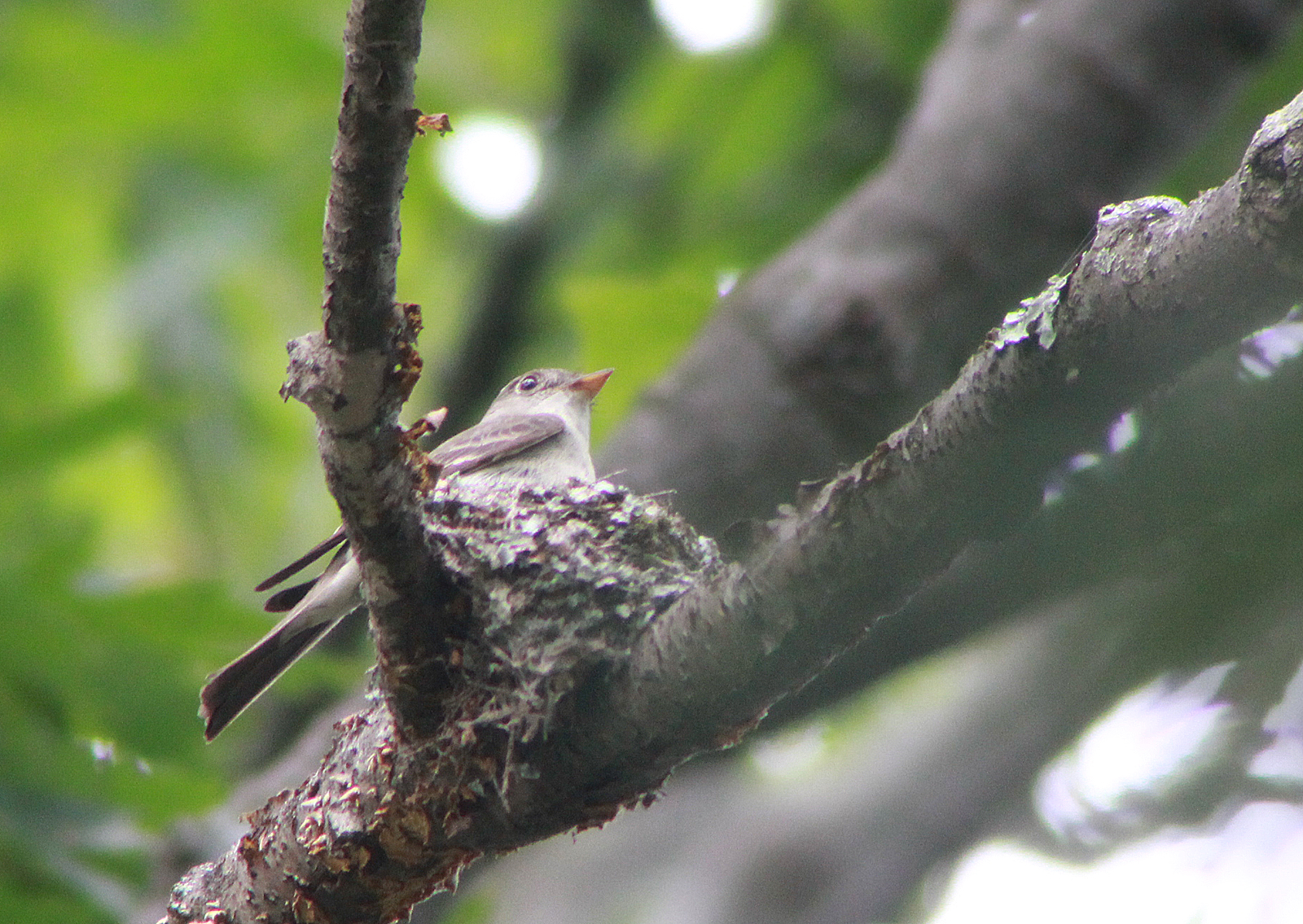
No, I didn’t find a scarlet tanager. I did, however, find the active nest of an eastern wood-pewee. Somehow, my binoculars trained themselves right on the spot. The small, cupped nest is built in the Y of a dead branch sticking out among the impenetrable foliage, about 40 feet high.
I watched the mother pewee for a few minutes before she flew off into the woods. I noticed a bright orange object in the nest. I assumed it was a mushroom of some sort because the dead branch is covered in a white fungus. With my binoculars, however, I discovered it was the mouth of a baby bird waiting to be fed.
Sure enough, about two minutes later the mother bird returned and a few other orange “mushrooms” appeared.
It was the first time I had ever found an active eastern wood-pewee nest Continue reading →
Here are the last two For the Birds columns, mostly focused on what readers have been seeing this spring.
Photo by Chris Bosak A male indigo bunting eats seeds from a platform feeder in Danbury, Conn., in May 2018.
If the past season was the Winter of the barred owl, this is the spring of the indigo bunting.
I’ve heard from numerous readers and friends throughout New England and even Canada about this bright blue bird visiting their backyards. The cause for excitement is obvious as it is one of our more colorful birds, flashing a brilliant blue plumage. The brilliance of the blue plumage is dependent upon the light.
It is also nice to hear that so many of these birds are around and delighting backyard birders in large numbers. Rose-breasted grosbeaks are another popular bird this spring. I’ve had limited luck with indigo buntings this spring, but for me, it’s been a banner year for rose-breasted grosbeaks. I’ve seen as many as three males in a tree overhanging my feeders. A female visits the feeders often as well.
It’s also been a good spring for warblers and nearly every walk last week yielded yellow warblers, common yellowthroats, black-and-white warblers, chestnut-sided warblers, American redstarts and yellow-rumped warblers.
I’m not the only birdwatcher enjoying a productive spring. Here’s what Continue reading →
Photo by Chris Bosak A bobolink perches at the end of a branch in Brookfield, CT, May 2019.
I checked out Happy Landings, an open space of fields and shrubby areas in Brookfield, Connecticut, after dropping off my son Will at middle school the other day. With its huge fields, the protected space is a rare haven for bobolinks in New England. There should be more such field habitat. Anyway, I wanted to see if the bobolinks were back and sure enough, they were — along with plenty of other birds. Take a look …
Happy birding and let me know what you see out there this migration period.
Photo by Chris Bosak A yellow warbler sings from a perch in Brookfield Conn., May 2019.Photo by Chris Bosak A yellow warbler perches on a branch in Brookfield Conn., May 2019.




 I looked with my naked eye for several minutes, hoping to spot some motion to give away the bird’s location and identity. To my frustration, I couldn’t find a thing, even though I knew right where the song was coming from.


 Birds of New England.com