Photo by Chris Bosak
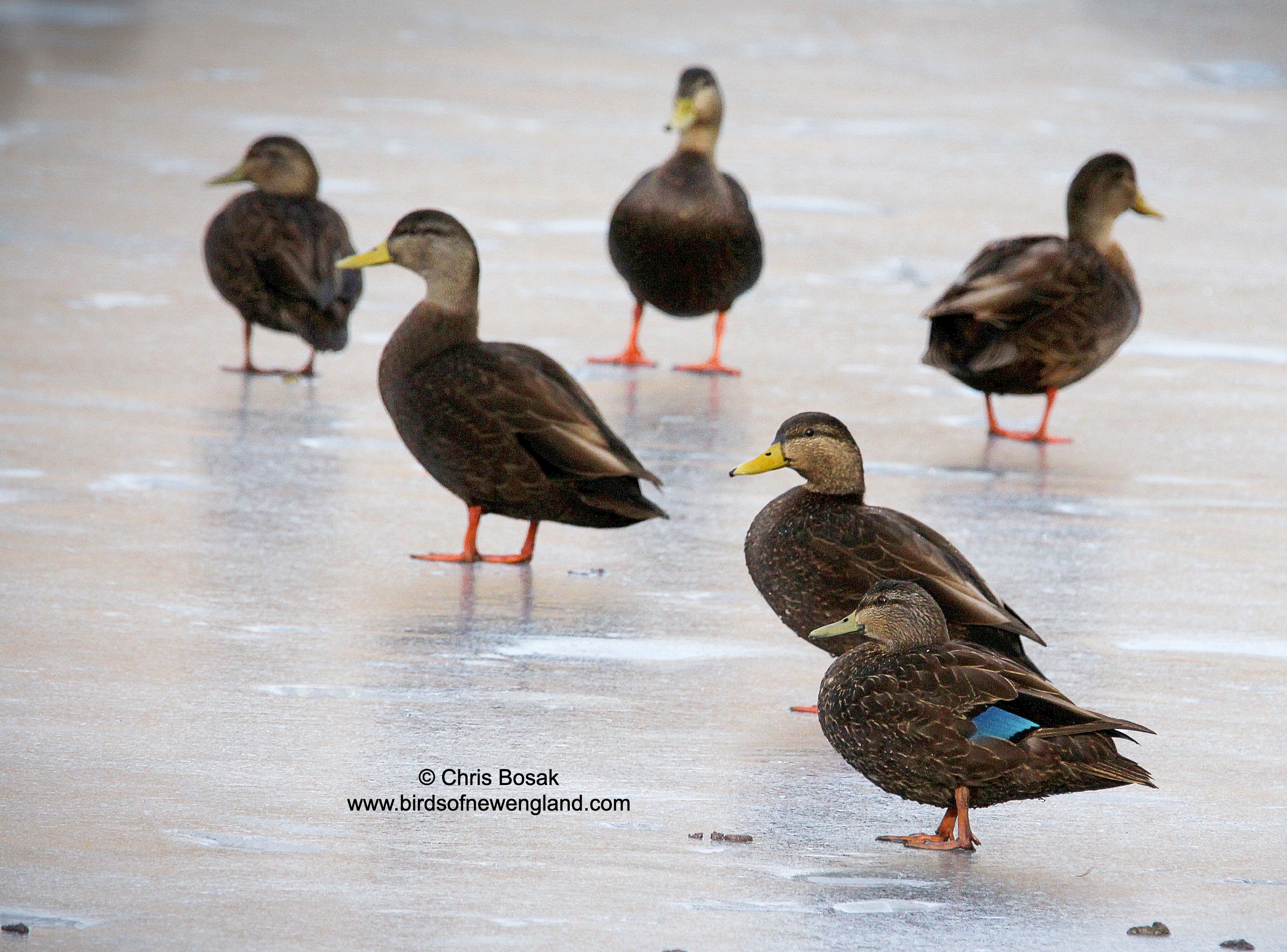
American black ducks stand on a frozen pond in New England last month.
The American black duck is, in my opinion, one of the more underrated birds in New England.
While it is true that black ducks are not the most exciting or colorful ducks in New England, I think the black duck is often overlooked because a lot of people assume it is a mallard. Mallards, of course, are extremely common and tame. Black ducks are not as common and certainly not as tame.
Differentiating an American black duck from a female mallard is one of the more common difficult identifications to make. It is up there with the house vs. purple finch and the sharp-shinned vs. Cooper’s hawk.
Photo by Chris Bosak
Snow goose in New England, March 2025.
I know, same as yesterday, geese are not ducks. They are close enough for this very unofficial birdsofnewengland.com Duck Week celebration. Snow geese gather in massive numbers in some parts of the Atlantic flyway. In many cases, they are uncountable because there are so many. In other parts, however, snow geese are a fairly rare sighting. I live in a part of New England where snow geese are not seen often. In fact, this one I saw at a beach was the first one I had seen in years. Usually, when they are seen where I live, it is a single snow goose within a flock of Canada geese. This one, however, was alone near the beach. I hope it finds more of its kind during migration.
Photo by Chris Bosak
Brant in New England, March 2025.
I know, geese aren’t ducks. But they’re close enough for Duck Week. Brant may be found in huge numbers along the coast of Long Island Sound during the winter. From a distance, or to the untrained eye, they may be mistaken for Canada geese. Closer inspection reveals that brant are much smaller and lack the pronounced chin strap of the Canada goose. Brant are a treat to observe each winter in New England.
Photo by Chris Bosak Lesser scaup drake in a river bay in New England, March 2025.
Scaup congregate in large numbers off the coast of Long Island Sound and its tributary rivers during the winter months. The flocks can be several hundred individuals strong, including drakes and hens. On occasion, a redhead may be found within the flock. Greater and lesser scaup are commonly seen in large numbers throughout New England in the winter.
Photo by Chris Bosak
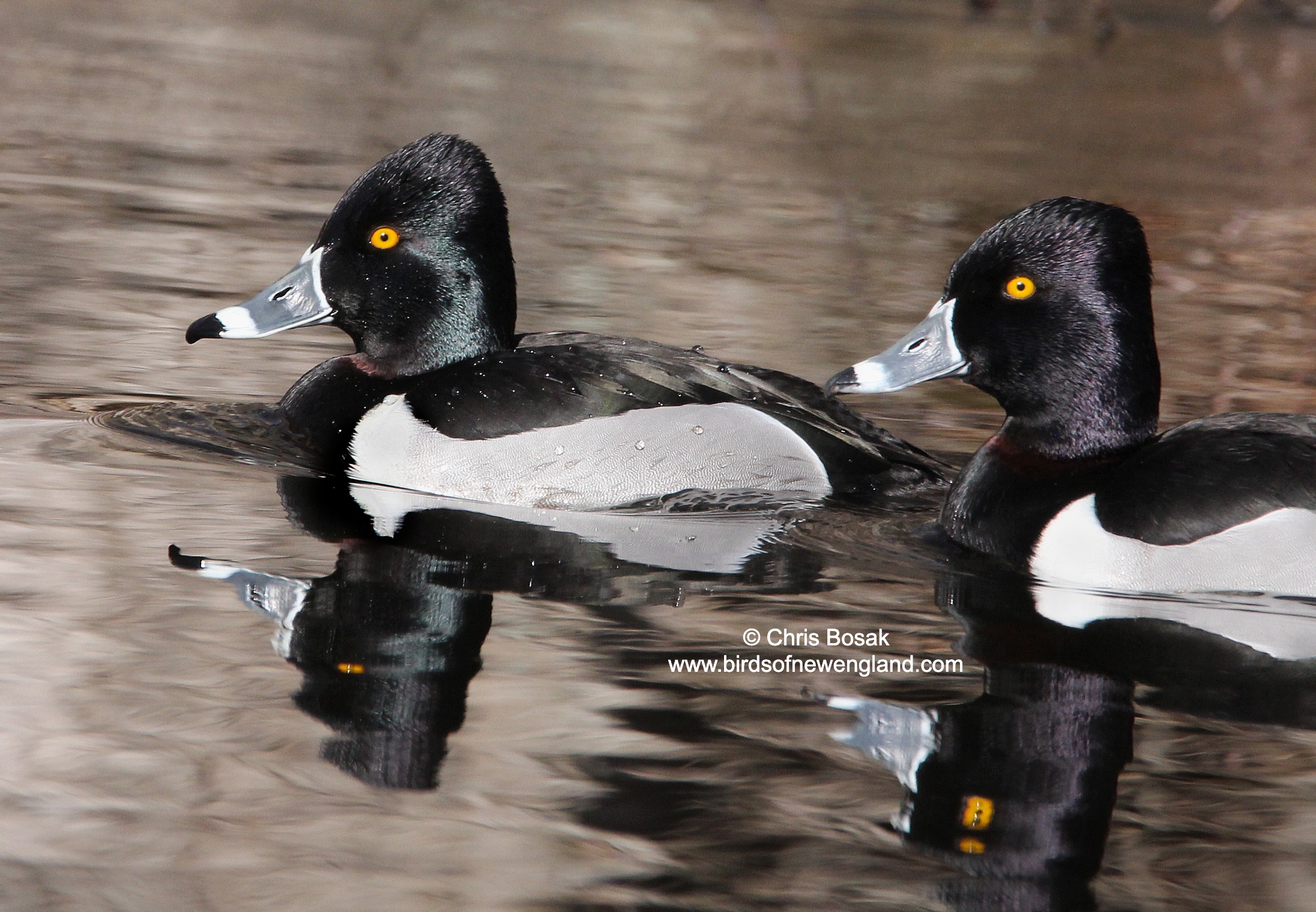
Male ring-necked ducks swim in a pond in New England, March 2025.
The ring-necked duck is next up for birdsofnewengland.com’s Duck Week. This duck may have been better suited to being called ring-billed duck because the ring on its bill is a much easier field mark to see than the one on its neck. But it isn’t, so we’re stuck with ring-necked duck. Just like the hooded merganser, which kicked off Duck Week on Monday, I’ve seen a ton of ring-necked ducks this winter. They were seemingly on every unfrozen fresh-water body a few weeks ago.
Photo by Chris Bosak
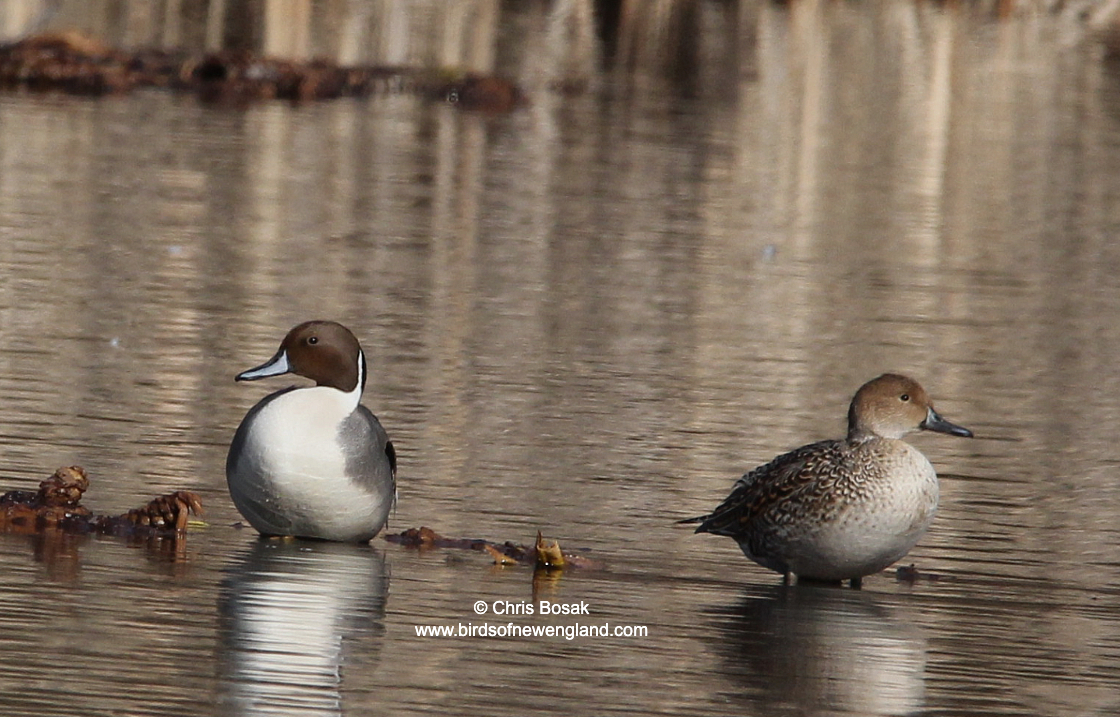
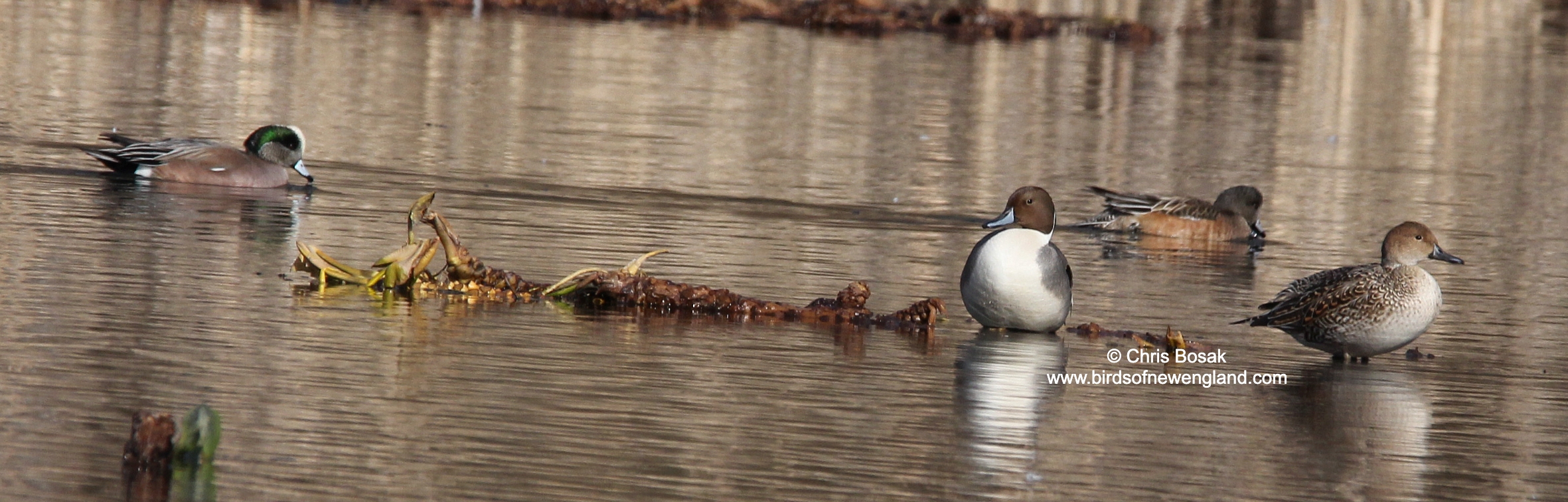
Northern pintail pair at a pond in New England, March 2025.
The northern pintail is the next fowl up for birdsofnewengland’s Duck Week, a very unofficial declaration made by me because I have a lot of recent duck photos that need to be shared. Pintail drakes are one of the most handsome ducks we have in New England. If you missed the first Duck Week post, click here to meet the hooded merganser.
Photo by Chris Bosak
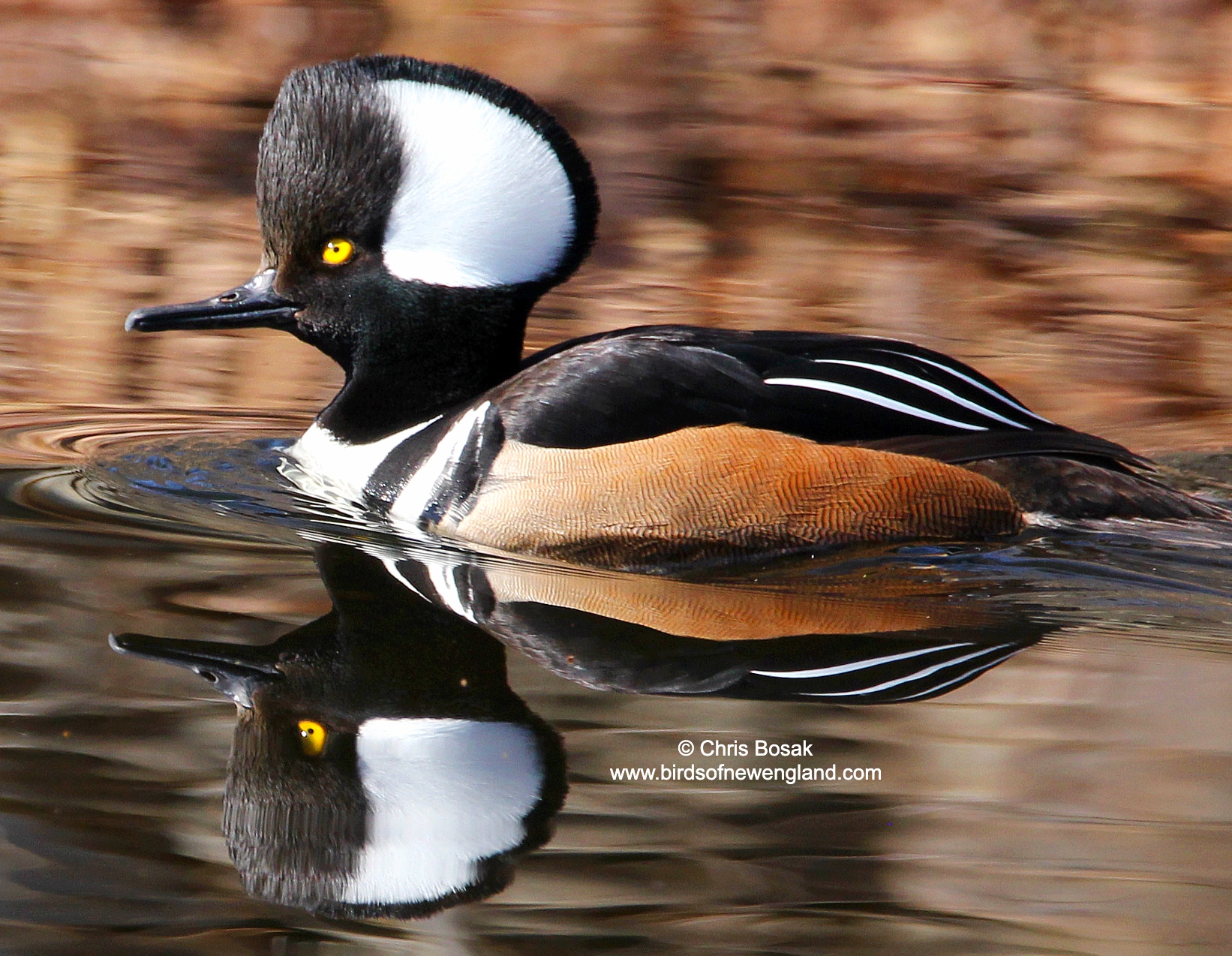
Male hooded merganser in New England, March 2025.
Welcome to Duck Week, birdsofnewengland.com’s very unofficial declaration to celebrate the spring duck migration. Duck Week will be a collection of duck photos I have snapped over the last few weeks. Now seems like a good time, as I’m starting to see fewer ducks as they make their way north to their breeding grounds.
I’ll start with the hooded merganser, one of my favorite birds of all time. I saw a ton of hooded mergansers this late winter/early spring. Look for them in fresh or brackish water, including relatively small bodies of water.
Photo by Chris Bosak
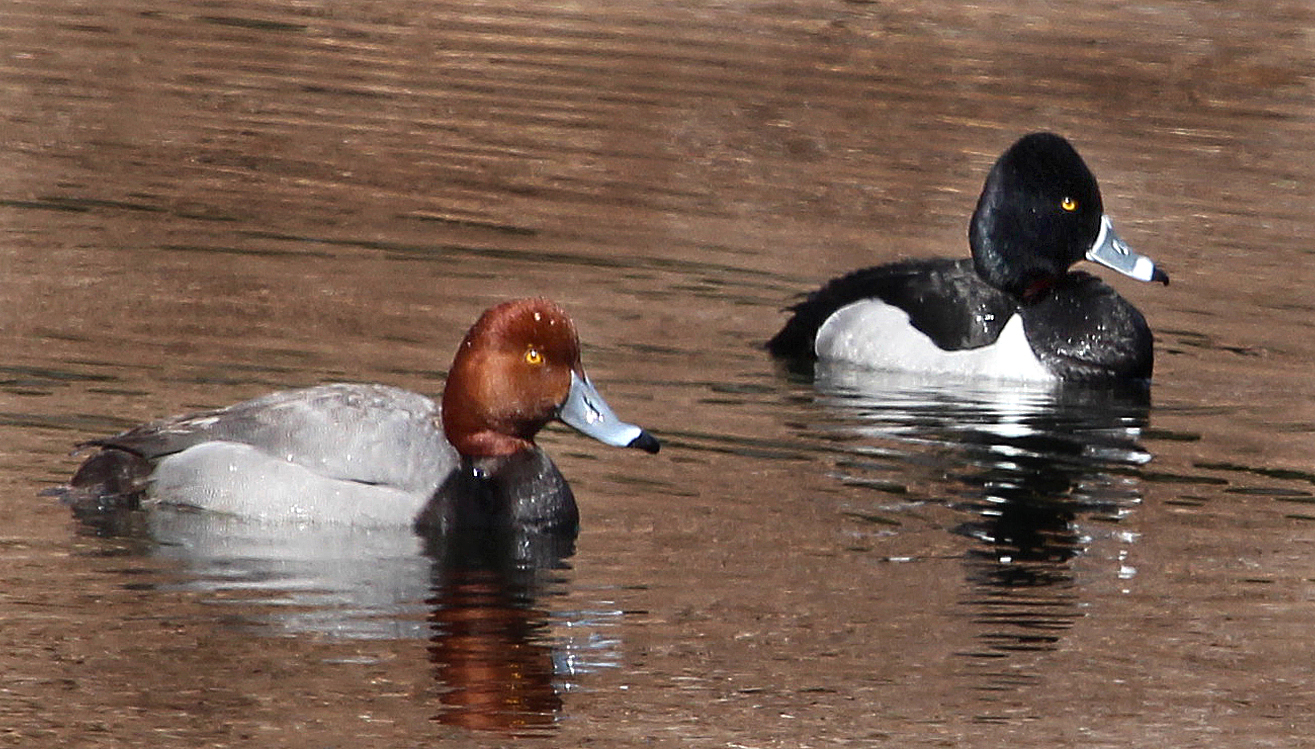
A Redhead swims alongside a Ring-necked Duck in Darien in March 2014.
It’s always good to know where a little open water exists.
Whether the water doesn’t freeze during the winter because of a dam, waterfall, fountain or otherwise, these spots are great for duck watching on even the coldest of days. In fact, the coldest days may be the best time to visit these spots, as very little open water exists elsewhere, and the ducks concentrate in these little oases.
I find it interesting when different species of ducks that usually are not found together congregate in these pools of open water. I’ve seen huge rafts of scaup on Long Island Sound and some large lakes throughout the Northeast. The ducks usually stick with their own kind on these large bodies of water. But when a freeze forces them to find open water, it is not uncommon to see scaups swimming among goldeneyes, buffleheads and redheads.
Photo by Chris Bosak
Male long-tailed ducks on Long Island Sound, February 2025.
You have to mix it up every once in a while. This goes for most things in life, but certainly for birdwatching.
The other day, I pulled into the parking lot of the state park where I do the majority of my walking and birding. I never got out of the car this time. I had a rare several-hour block to myself, and, as I pondered my options, the siren song of water kept calling me.
While I love walking at my local patch, and I know just where to look and what I might find, I was craving something different on this day. My patch is mostly woods with a few fields, like much of New England. It does have a large pond, but it has been frozen solid since December.
I backed out of the parking lot and headed to a reservoir a relatively short distance away. I knew at least some of the water would be unfrozen and undoubtedly holding some ducks. Open freshwater has been hard to come by this winter.
The reservoir, as it turned out, was mostly frozen as well. A small area near the dam was open, and that’s it. This oasis of unfrozen water was, however, a gathering place for a lot of waterfowl. Canada geese were, by far, the dominant species, along with mallards and mute swans. There were also a few buffleheads and ring-necked ducks, along with a lone male wood duck in his splendid breeding plumage. It had been a while since I had seen a wood duck, so that was the highlight of my visit to the reservoir.
Since I had gone that far already and still had time to spare, I figured I’d keep going and pay a visit to Long Island Sound. It wasn’t terribly far and, even though it’s almost always cold and windy in the winter, I knew a lot of ducks and other fowl would be there.
I arrived at the Connecticut state park, and Long Island Sound did not disappoint. I immediately spotted a huge raft of greater scaup and a few small groups of common goldeneye. The odd common loon popped up here and there as well. Common loons are a blend of dull whites and grays in their winter plumage, unlike their iconic black-and-white spotted summer plumage.
Canada geese were there in large numbers, of course, but a massive flock of brant flew past as well. There were also smaller groups of brant hugging the shoreline.
The highlight for me was the long-tailed ducks. Formerly called oldsquaw, long-tailed ducks are another species that look completely different in the winter than in the summer. Not that I’ve ever seen a long-tailed duck in the summer, as they breed well north of New England, but I’ve seen pictures. The male’s winter plumage is a mix of bright white, black and different shades of brown. The bill is dark with a pink patch in the middle. The female’s plumage is more modest with white and brown.
Many of the long-tailed ducks were relatively close to the shore, offering decent photo opportunities. Unfortunately, it wasn’t a great day for photos as it was very gray. Of course, gray can be good for photography as it eliminates harsh shadows, but this was a dull, dark, color-robbing gray. I did my best with the long-tailed ducks nonetheless.
The inland part of the park was good too, with Savannah sparrows, a northern harrier, fox sparrows and a large group of American tree sparrows.
The next day, I was right back at my patch enjoying a walk in the woods. I guess I needed a little change of pace, if only for one day.
The Atlantic coast is not terribly far for a day trip, and Long Island Sound is not that much farther. If the sea is calling your name and you have the time, pack up and go. Let me know what you see.
Photo by Chris Bosak
Male long-tailed duck on Long Island Sound, February 2025.
I took a trip to the coast this morning to check out Sherwood Island State Park in southern Connecticut. I have birded there a lot in the past, but it has been several years since I’ve been to the large park on Long Island Sound. I finished the day with 32 species with a good mix of water and land birds. A few photos from the walk are included below.