For the Birds: Complain and they will come

Photo by Chris Bosak A female ruby-throated hummingbird visits a flower in New England, July 2020.

Here’s the latest For the Birds column, which runs weekly in several New England newspapers …

Apparently, all I had to do to get my hummingbirds back this summer was complain to my neighbor.

I had had frequent visits from both male and female hummingbirds early in the spring. The daily visits continued for a few weeks and then stopped abruptly. Last year, and the year before that, the visits never stopped and I saw them daily until the fall.

This year, June was largely a hummingbird-free month in my backyard. 

During a walk around the neighborhood last week, I noticed a neighbor had bird feeders on her deck so I stopped to chat about what birds she had been seeing. She had a few of the usual suspects but didn’t mention hummingbirds. 

I inquired about the tiny birds and she said: “Yes. I see them every day.”

“That’s great,” I replied. “I haven’t seen mine in a while.”

I went on to bore her with the details of my previous years’ good fortune. She feigned interest, we chatted a little more and then said goodbye. 

The birding gods must have heard me griping and took pity on me because, the very next day, a female hummingbird showed up at my feeder. She has been back every day since, too. It is very territorial as I have seen her chase away other hummingbirds. Another female and a male have started showing up now and then, too, when the queen is away.

In previous years, a female has dominated my feeders throughout the summer so I wonder if she is the same bird I have been seeing for years. At any rate, it is nice to see the hummingbirds back in the yard. It is also nice to know there are several of them, even if I get only brief glimpses of the other ones before they are chased away.

I have a few feeders and several flowers to lure the hummingbirds. She prefers the feeders, but on occasion will sip from the flowers. This year, most of my flowers are red salvia, an annual with tubular shaped blooms. In the past, I’ve seen hummingbirds visit my coneflower and even sunflowers.

Complaining usually doesn’t solve problems and often makes them worse, but in this case, things worked out pretty well. I plan to take a trip to northern New England in a few weeks in the hopes of finding some of New England’s disappearing moose. Maybe I should proactively start complaining now in the hopes of getting the same results for that trip?

For the Birds: Grosbeaks delay closing

Photo by Chris Bosak A rose-breasted grosbeak perches on a branch in New England, June 2020. Merganser Lake.

So much for taking a break from feeding the birds. 

I mentioned in last week’s column that I had taken down my feeders for the summer as my visits had dwindled to a few species. I also mentioned that I continued to maintain a large platform feeder on my deck to keep those few birds happy. Well, that platform feeder is busier than ever. 

One day last week, while working from home and using the outdoor table on my deck as my office for the day, I watched as chickadees, nuthatches, titmice, catbirds, cardinals, blue jays, house finches, downy woodpeckers and red-bellied woodpeckers helped themselves to the offerings. 

The feeder, which is nothing more than a large, flat board I found in the basement, is big enough to hold a variety of foods: sunflower seeds, mealworms, suet nuggets and thistle seeds. I nailed a few small branches around the edge of the board to keep the seeds in place during windy days.

I was already pleasantly surprised by the variety of birds that were coming when a male rose-breasted grosbeak landed on the board. Thankfully, I had the foresight to bring the camera out to the table with me. I was quite sure the strikingly beautiful bird would take off as soon as I lifted my arms to grab the camera off the table as I was sitting only 9 or 10 feet away from the feeder. 

Slowly I moved my arms and watched as the black-and-white bird with a bright red triangular bib looked back at me. I was relieved when the bird looked away and started grabbing sunflower seeds. Still, I couldn’t risk double-checking my camera settings or autofocus point and I started photographing away. The settings were fine, luckily, and I got some nice, full-frame shots of the handsome songbird.

What also made the day special was that many of the birds that visited, especially the chickadees, titmice and downy woodpeckers, were first-year birds still gaining their adult plumage. The young woodpeckers usually arrived with a parent and watched and learned. It was amazing to think that some of these birds were born only a few weeks prior. I hope they visit for years to come and can avoid the many dangers birds face as they grow.

So I guess my summer feeding break isn’t going to pan out, which is fine with me. I’ll continue to enjoy the show as long as it lasts.

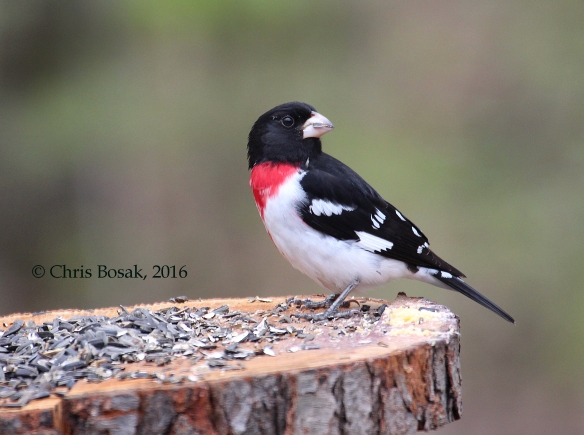
Photo by Chris Bosak A Rose-breasted Grosbeak visits a homemade platform feeder in Danbury, Conn., on May 6, 2016.

Crazy year of bird feeding with many firsts

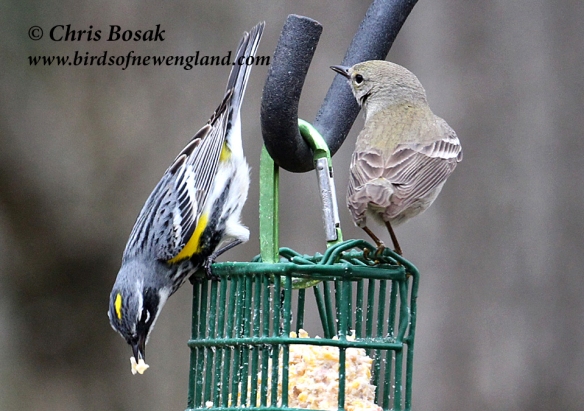
Photo by Chris Bosak A yellow-rumped warbler and pine warbler share a suet feeder in New England, April 2020. Merganser Lake.

I cut back on my bird feeding last week as my visitors have dwindled to a handful of species.

I am still putting out enough to keep those birds coming back and happy, but I retired many of the feeders until the fall. A big, homemade platform feeder is still on the deck keeping the downy woodpeckers (family of four), cardinals, catbirds and house finches around.

At my previous houses, by this time of year only house finches would be coming around so I would stop feeding altogether in the summer. With the nice variety of birds still coming around, I will continue to throw out a little seed and suet.

Taking down some of the feeders made me think about what a strange year it has been for feeding birds, at least in my yard. I have been feeding birds for decades now and this year marked several firsts. It started in February with the eastern bluebirds. I have never had bluebirds at my feeding station before this year, so you can imagine how thrilled I was to see them arrive. They showed up every day from February until the end of May and even brought their youngsters around for most of May. I still don’t know exactly where they nested, but it must have been somewhere fairly close. It was surprising because there isn’t what I would consider typical bluebird nesting habitat anywhere in my neighborhood.

I have seen catbirds at my feeders before, but only on rare occasions and it has been years since the last time. This spring and summer, however, I am getting at least two different catbirds visiting every day eating suet. They are bold and noisy, belting out their cat-like mew from mere feet away from me. Speaking of suet, it was the attraction that lured my first Baltimore orioles. I have tried for years to attract orioles with all of the things that are supposed to attract them, such as grape jelly, orange halves and nectar (similar to hummingbird food but less sugar). No luck. This year, they visited for several days in late April and early May and always went right for the suet. I hear them calling from high in the treetops on occasion still, but I haven’t seen them at the feeders since early May.

I’ve also never had robins at my feeder before. This year, they visit daily to grab a few mealworms. Mealworms were the main food source that kept the bluebirds coming back as well.

Earlier in the spring, I had daily and frequent visits from pine warblers and yellow-rumped warblers. I have had pine warblers in the past, but that was about three years ago. I had never had yellow-rumped warblers before this year and several showed up daily for weeks on end.

After all these years of feeding birds, it seems strange to get so many first-timers and ones I hadn’t seen in so long all in the same year. Could it be that they have been coming all these years and I just never noticed because I’ve been going off to work every day? Has the opportunity to work from home allowed me to see things that I’ve been missing previously? I don’t think that is the case as even in years when I am going to work daily, I still have mornings, evenings and weekends to stare at my feeders.

There must be another explanation. But what is it?

I don’t know the answer, but I will think of some theories as the summer wears on and the birding continues to be relatively slow. At any rate, I am not complaining, of course, it has been great to see all these new birds in the yard.

For the Birds: Right or wrong, appreciate the sighting

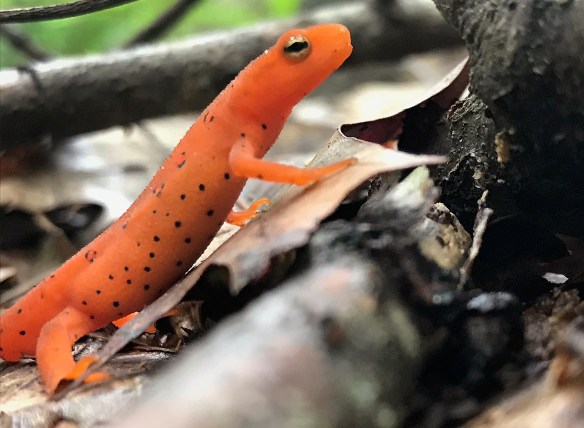
An eft works its way through the woods in Danbury, Conn., during the summer of 2018.
Photo by Chris Bosak An eft works its way through the woods in Danbury, Conn., during the summer of 2018.

To err is human and I am about as human as they come.

Of course, no one is perfect and trying to solve nature’s mysteries is fraught with pitfalls.

I was walking down a trail one morning not too long ago. It had rained heavily the night before and the trail was damp. I had to watch my step because there were so many efts on the trail. I remembered a time when I mistakenly referred to the bright orange amphibians as newts.

I wasn’t completely off base, of course, as efts are the terrestrial stage of the newt. After being born in the water and then crawling around the ground as an eft for a while (sometimes a few years), they return to the water to live out their time as a newt.

That is just one example of many mistakes and misidentifications I used to make. I’m sure there are some things I currently mistakenly identify and there will certainly be things in the future that I errantly call the wrong name.

Here are some examples I often hear from others that are not correct. There is no judgment, of course, as we have already determined that no one is perfect.

I think I hear the “fisher” called a “fisher cat” more often than its proper name. The fierce, large member of the weasel family is simply called a fisher, no “cat” necessary. Indeed, it is not a cat at all. It is a weasel. Now that the red-bellied woodpecker is expanding its range north throughout New England, it is a good time to remind everyone that it is not actually a red-headed woodpecker. The red-bellied woodpecker does indeed have a mostly red head, but the name red-headed woodpecker is already taken by a bird that does indeed have a fully red head. Adding to the confusion is that the reddish-pink belly of the red-bellied woodpecker is not often seen and not an obvious field mark.

Here’s a tough one that took me years and years to get: the difference between a house finch and purple finch. They look very similar and many people automatically default to the purple finch, which is understandable as it is the state bird of New Hampshire and native to New England. House finch, however, is far more common these days even though they are transplants from western U.S. Purple finches are more colorful (at least the males), slightly larger and have more substantial bills. No, not the type of bills that are due every month.

I often hear people think an owl is singing during the day when they hear a mourning cooing. The mourning dove’s song does have an owl-like quality to it, but it is softer and unique to the dove. The owl that typically sings during the day is the barred owl and its song is much more gruff sounding than the cooing of a dove.

Finally, the osprey is sometimes confused with the bald eagle. Both are large, majestic birds of prey with white heads found near water so the confusion is understandable. The best way to tell them apart is by size. As impressive as the osprey is, the eagle is substantially larger. The typical wingspan of an osprey is about five feet, while an eagle’s is six-and-a-half feet. Also, the underside of an osprey is white and that of an eagle is brown. Either way, it’s great to see the population of both species rebounding so significantly.

In the end, whether people get the name or identification correct pales in comparison to the species being noticed and appreciated.

For the Birds: Woodpeckers and rhythm

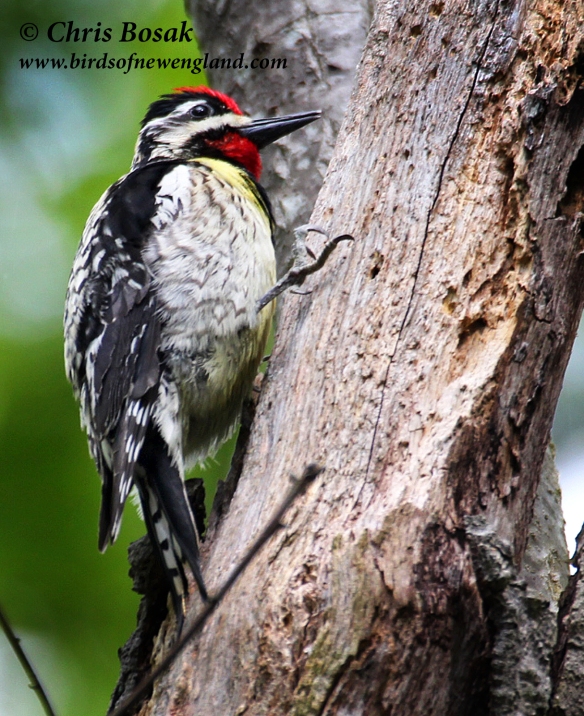
Photo by Chris Bosak A male yellow-bellied sapsucker perches on a dead tree branch in New England, June 2020. Merganser Lake.

I am quite sure I am not his intended target, but when the yellow-bellied sapsucker drums on the hollow branch in my side yard, I come running. I mentioned in last week’s column that I have a yellow-bellied sapsucker that drums on a branch in my side yard and a pileated woodpecker that drums on a branch in the backyard. Woodpeckers often drum on objects such as hollow branches, the sides of houses, gutters, and chimney flashings. They pick objects such as these because the noise resonates far and wide. This drumming is done to attract mates or announce territory. Obviously, they do not tap on gutters or chimney flashings to find food or make homes.

They may pick hollow branches to make homes, naturally, but the territorial and mate-attracting drumming is more rhythmic and the cadence is specific to individual woodpecker species.

I also mentioned in last week’s column that I was impressed the first time I saw a birdwatcher identify the type of woodpecker from its drumming in the distance. I still do not have that skill down very well, but I am getting a lot of practice distinguishing the yellow-bellied sapsucker and the pileated woodpecker. Just as it is exciting when a bird chooses your property to eat, drink, or make a home, it is also exciting when a woodpecker chooses a branch on your property for its drumming.

It may not be so exciting when they return to your siding, gutter or chimney flashing for this purpose, however. If this is happening, there are measures you can take to try to stop it. Of course, nothing is a guarantee when we are talking about wildlife.

There are literally dozens of products on the market to deter woodpeckers from tapping on your house. Do a simple Internet search for “stop woodpecker damage” and they will all pop up.

New England has several woodpecker types. Most of New England has the aforementioned yellow-bellied sapsucker and pileated woodpecker, as well as downy and hairy woodpecker, and northern flicker. Southern New England and increasingly the middle part of the region also has red-bellied woodpecker. The northern part of New England features the black-backed woodpecker and, to a lesser degree, the American three-toed woodpecker.

The red-headed woodpecker is also an occasional sighting in New England. Many people mistakenly call the red-bellied woodpecker the red-headed woodpecker because it does indeed have a red head, or at least mostly red. The red-bellied woodpecker has a faint pinkish wash on the belly, which gives it its name. The red-headed woodpecker, indeed, has a fully red head. They are more common south and west of New England but, as I mentioned, are occasionally seen in our region.

This is just my own theory, and it hasn’t been scientifically proven to my knowledge, but the dreaded diseases that have ravaged so many of our tree species have greatly benefited woodpeckers. They build their nests in dead trees and branches, and sadly, between hemlock woolly adelgid, chestnut blight, Dutch elm disease and locust borers, they have plenty of dead trees to choose from. And, of course, lots of drumming branches.

For the Birds: Robins first at it in the morning

Photo by Chris Bosak An American robin perches in a tree in New England, June 2020. Merganser Lake.

Late spring/early summer is a great time to sleep outdoors. I’m lucky enough to have a porch that is screened from floor to ceiling on three sides. It’s like sleeping outdoors with the comforts of home.
There’s usually not a lot to see as the woods encroach pretty closely on the porch. There wouldn’t be much to see in the dark anyway, of course. But I can hear everything.
I typically sleep through the night but am occasionally jarred awake by a barred owl hooting or opossum trying to get into the compost pile. After years of breaches, I finally have the compost properly secured.
The dawn chorus usually wakes me up. I listen to it for about half an hour and then fall back asleep.
The other morning, it started at 4:21 with a lone robin singing in the nearby woods. An eastern wood pewee soon chimed in with its high-pitched song as if asking the robin to please be quiet. By 4:30, other robins joined in and it was game on.
A tufted titmouse sang its “peter-peter-peter” song from a nearby branch. Titmice are small birds with a big voice. If the robin hadn’t awoken me at 4:21, the titmouse certainly would have.
A cardinal sang in the distance and I heard a turkey gobbling from deep in the woods. I’ve seen turkeys in my yard twice in all the time I’ve lived here so I was surprised to hear them join the fray that morning.
A hermit thrush sang its flute-like song and I recalled the nice poem that a reader had written and sent me last week. Thrushes certainly do have interesting and beautiful songs.
I also heard a song I didn’t recognize. It sounded somewhat like a black-billed cuckoo, but I’m sure it wasn’t that. It’s always nice to know there is more to learn.
Then the woodpeckers started tapping on their territorial branches. They choose branches, or other objects such as houses or chimney flashing, that are loud and reverberate. A yellow-bellied sapsucker favors a dead branch in my side yard and a pileated woodpecker uses one in my backyard. Thankfully, the tappings I heard that morning were coming from deeper in the woods.
Many birders can determine a species of woodpecker by the cadence of its tapping. I was amazed the first time I had seen that and figured I’d never reach that level of expertise. After studying the sapsucker and pileated woodpecker up close, I’m starting to get the hang of it.
Also significant was what I didn’t hear. No leaf blowers, lawn mowers, weedwackers, chainsaws or machinery of any kind. Not even any cars or trucks. These sounds have become so pervasive in everyday life they become like background noise.
But at this time of day, only the birds could be heard. That thought pleased me greatly and I dozed back off to sleep.

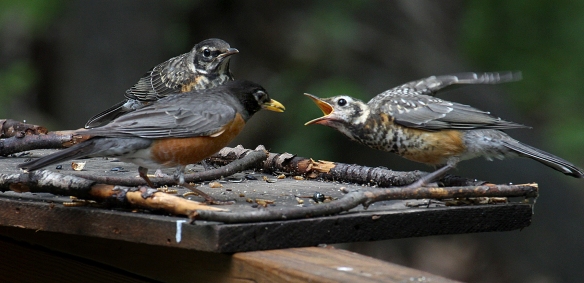
Photo by Chris Bosak An American robin family visits a feeder in New England, June 2020. Merganser Lake.

For the Birds: What others have been seeing

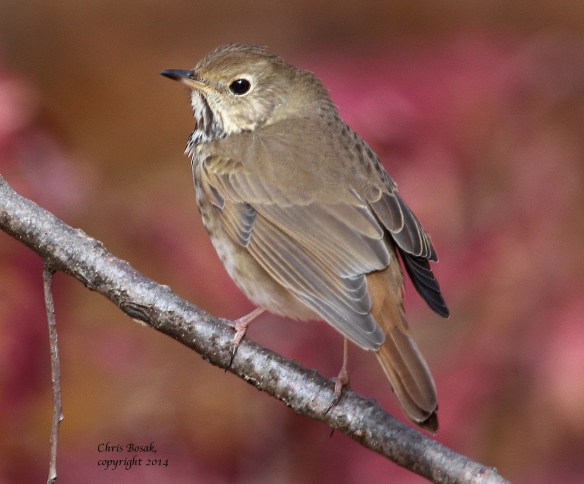
Photo by Chris Bosak A Hermit Thrush perches on a branch at Selleck's/Dunlap Woods this fall.
Photo by Chris Bosak A Hermit Thrush perches on a branch at Selleck’s/Dunlap Woods this fall.

It’s been a busy spring around here for sure. The bluebirds have youngsters, the grosbeaks are regular visitors and the female ruby-throated hummingbird is back to her old tricks of dominating the backyard.

There have been plenty of other highlights, but I want to share what others throughout the region have been seeing.

I received an interesting email from Roxanne of Swanzey. She noticed a blue jay hanging upside down bat-like. She assumed it was sick, injured or dead, but 15 minutes later the bird perched upright and soon after flew away. As it turns out, blue jays sometimes roost upside down. Who knew?

Roxanne sent me a photo of the upside-down bird, which I posted on my website, www.birdsofnewengland.com, under the “Reader-Submitted Photos” tab.

Allen from Fitzwilliam sent in photos of a female purple finch gathering fleece placed into a small cage. The wool comes from a neighbor’s sheep. Birds often gather animal fur to use as nest material.

Allen also sent in photos of a Baltimore oriole eating grape jelly from a feeder. I’ve never had luck attracting orioles to my feeders, but this year I did have a male oriole visit my suet cake feeder several times. I had orange halves, grape jelly and sugar water available as well, but the oriole ignored it all in favor of suet. Even individual birds of the same species have their particular tastes.

Lenny from Greenfield sent in several photos including rose-breasted grosbeaks, purple finches and brown thrashers. It’s been a few years since I’ve seen a thrasher. That’s not a good sign.

Mimi from Troy sent in a nice list of yard birds, including nesting bluebirds. She also had yellow-rumped warblers visit for the first time. In all, she has seen more than 30 species in her yard this spring. She also included a message that I’m sure many would agree with: “Thank goodness the birds are able to bring me joy and solace during these trying times and fill me with joy.”

Celia from Keene was disappointed with the recent snow day in May but was rewarded by seeing an indigo bunting and rose-breasted grosbeak at her feeder at the same time. “Those colorful birds made my day,” she wrote.

I’ll conclude with a poem sent to me by Jackie Cleary of Westmoreland. I’ve seen and heard a lot of thrushes this spring (wood thrush, hermit thrush and veery) so the poem was timely indeed. Thanks to Jackie for the beautiful poem, titled “Thrush Time.”

We keep the thrushes’ hours in summer;

Gently pulled from sleep

By their double rhythmic trills,

Like a pleasant saw

Which severs the night from the day;

And when the break is made

They retire to their hidden woodland business ‘Til they must sing the day to sleep, And us along with it.

We keep the thrushes’ hours.

For the Birds: Patience is key, even though it’s hard

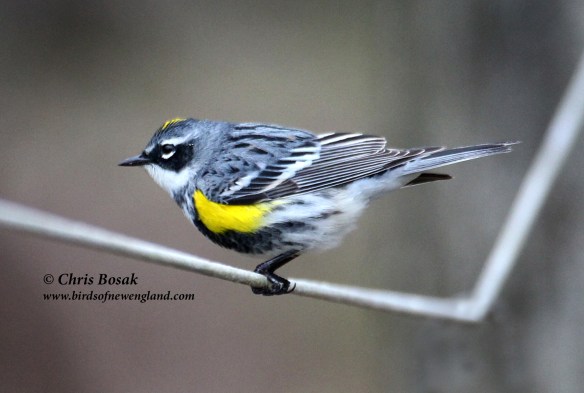
Photo by Chris Bosak A yellow-rumped warbler perches on a clothesline in Danbury, CT, April 2020. (Merganser Lake)

I doubt Tom Petty had birdwatching in mind when he wrote the lyrics “the waiting is the hardest part,” but it sure is appropriate for birders in the spring.


Signs of spring start as early as January or February when a few hardy flowers poke out of the ground. Owls also start their breeding season about this time but that is done in secret and largely unbeknownst to humans. March brings the first spring peeper calls, more flowers, red-winged blackbirds, American woodcock and, finally, eastern phoebes, at the end of the month. March also brings the official start to spring, of course.


April starts off fairly slowly until the first pine warblers arrive. Then it’s warbler season! The problem is, pine warblers are three weeks to a month ahead of most of the other warblers and other colorful migratory songbirds. Palm warblers and yellow-rumped warblers are the exceptions as they closely follow the pines.

Those three weeks to a month can seem like an eternity. We’ve endured winter and have slowly gotten small teases of spring. Bring it on already! We jump Continue reading

For the Birds: Romance with mealworms

Photo by Chris Bosak A male eastern bluebird feeds his mate mealworms in a backyard in Danbury, Connecticut, April 2020. Merganser Lake.

Is there anything more romantic than shoving a few dried mealworms into your mate’s mouth? Not if you’re a bluebird.

“My” bluebirds are still coming around daily. For the past few days, I’ve watched the male feeding the female, even though she could easily get her own mealworms a few feet away. What fun would that be? Where’s the romance in that? How would she really know if he was the one?

It’s part of the courtship, of course, but it’s also fun to watch. Every time I saw them land on the deck railing together I’d wait a few seconds and, sure enough, the male would jump down to grab a few worms and go right back up to feed his mate.

I feel fortunate that the bluebirds are still visiting daily, but they won’t be using the bluebird box I purchased and set up in the backyard. They have checked it out a few times but don’t seem that interested in it. It’s not proper bluebird habitat, I admit. They prefer flat, Continue reading

For the Birds: Beavers helping geese

Photo by Chris Bosak A Canada goose sits on a nest atop a beaver den as another goose remains alert to potential danger in New England this spring.

I received an interesting email the other day from Tricia from Alstead. She relayed that she and a few other people — and a couple of dogs — were taking a walk when they noticed a strange lump on the top of a beaver den.

It turned out that the lump was a Canada goose, presumably sitting on eggs, as the bird remained hunkered down, despite the proximity of the humans and dogs. Tricia hypothesized that the goose nest was built over a vent hole in the den, which kept the eggs warm.

I couldn’t confirm nor deny that hypothesis but it does make sense.

The email did spur me to research the relationship between Canada geese and beavers. It turns out that they have a very beneficial Continue reading