Photo by Chris Bosak
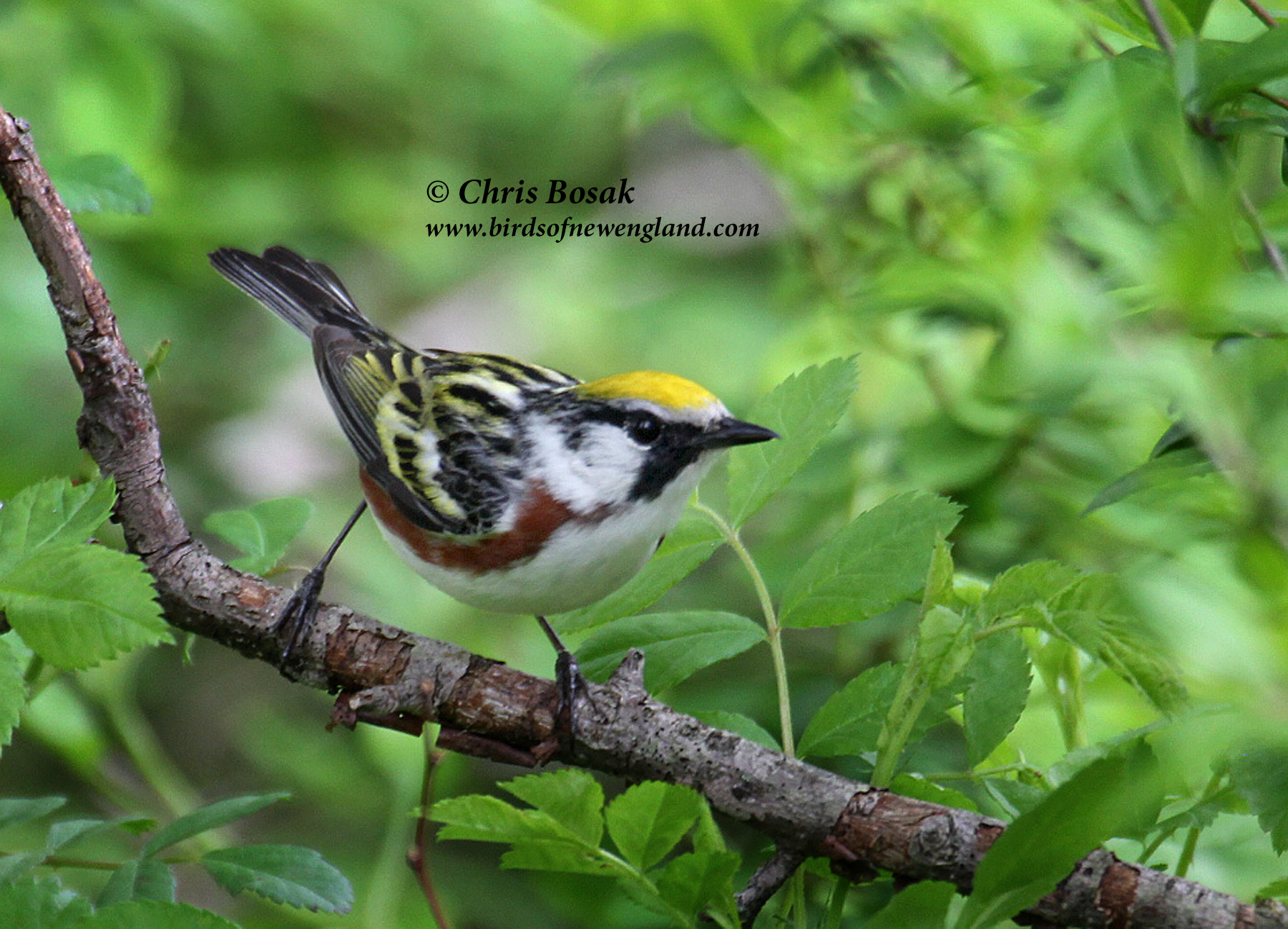
A chestnut-sided warbler lurks in the brush in New England, May 2020. Merganser Lake.
Welcome to May, arguably the best month of the year for birdwatching.
So many exciting things happen in the bird world in May that it’s hard to know where to begin. The breeding season is in full swing and our year-round birds as well as newly arrived migrant birds are either looking for nesting sites or already raising young. Suddenly our feeders are visited by colorful newcomers such as rose-breasted grosbeaks, Baltimore orioles or indigo buntings. Waders are back in full force stalking our ponds and rivers.
When it comes to May, however, talk of the birding world has to begin with warblers, those small and often colorful Neotropical migrants that add life to our neck of the woods every spring. Some of these warblers will simply stop by for a few days before heading farther north to their breeding grounds. Many, however, will find a suitable place to raise young and will be with us until the fall.
I don’t see a lot of press releases now that journalism is no longer my full-time profession, but I did receive a few last week that caught my eye.
One was from Cole’s Wild Bird Products and the other from the Purple Martin Conservation Association. The topics were very different but did have one important commonality: spring.
Cole’s, which makes a red-hot blend that I’ve used and the birds loved, sent some spring bird-feeding tips. Many people stop feeding birds in the spring for a variety of reasons, including bears and not wanting birds to become dependent upon feeders, but I’m a big fan of spring bird feeding. It’s a great way to get close, long looks at birds such as grosbeaks, orioles, buntings and even a few warbler species if you’re lucky.
Photo by Chris Bosak
A wood duck swims in a pond in New England, April 2021.
Only a narrow barrier of reeds separated the fairly busy road from the rain-swelled pool of water bordered by railroad tracks on the backside.
On any other day, this pool of water would be ignored and driven past without a second look. But on this day, something caught my eye and I promptly turned around at the next available safe place to do so. I drove past the water again, this time more slowly, and realized that what had caught my eye was a small group of male wood ducks.
Photo by Chris Bosak
A cedar waxwing perches on a branch in New England, spring 2021.
I had hobbled almost all the way from the car to the entrance of work when I noticed a flock of cedar waxwings picking off leftover berries in a nearby tree.
Even with the persistent tendinitis in my feet acting up, I made my way back to the car to grab the camera. Usually, in situations like this the camera is sitting at home, but this time I was prepared for the unexpected. Cedar waxwings, in my experience anyway, are always unexpected. They are fairly nomadic, and it’s hard to go out looking specifically for them. But they appear now and then and it’s always a thrill to see them.
I retrieved the camera and hobbled back through the parking lot to the tree in question. Of course, the tree was empty when I got back as the waxwings had taken off for parts unknown.
Photo by Chris Bosak
A red-shouldered hawk perches in the wood in Brookfield, CT, March 2019.
I’ve seen a few reports of pine warblers showing up in New England already. The thick of warbler season is still weeks away, however, so let’s put warblers on the back burner for now.
Phoebe reports are bursting all over the region. Those small, rather nondescript songbirds are an early spring migrant and get a head start on the competition by their early arrival. The risk, of course, is that winter lingers into spring in New England, and phoebes have a hard time coping with the weather. It’s all about risk-reward strategy when it comes to migration for birds.
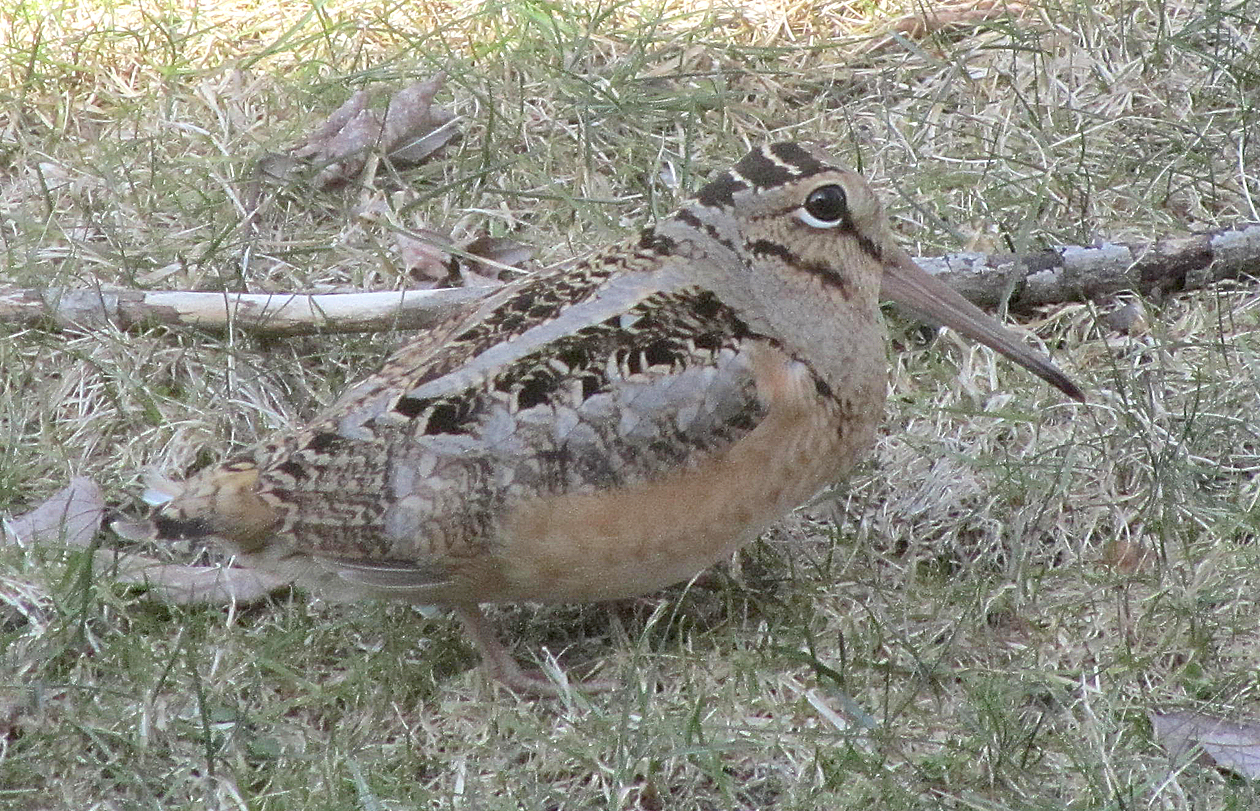
Rosalie Boucher captured this photo of an American Woodcock in her yard in Norwalk, Conn., in March 2014.
Woodcock are being seen and heard at dusk, phoebes are showing up slowly but steadily, mixed flocks of blackbirds are headed north, and the weather is sunny and warm one day and freezing and wet the next. It must be March in New England.
As we get ready for migration to pick up steam, here’s what readers have been reporting over the last few weeks. Bill from Keene wrote to say he’s hearing spring songs from the woods, which is always a good sign and pleasing chorus. Spring peepers, wood frogs and some birds are starting to call. I’ve heard cardinals almost daily now, which is a most welcomed, cheerful song.
Jeannie from Marlow wrote to say she has had upwards of four red-breasted nuthatches visiting her feeders at once. I thought my two-at-a-time visits were good. Jeannie also sent along a terrific photo of a barred owl having its feathers blown around by a strong wind. The photo may be found at www.birdsofnewengland.com under the “Reader Submitted Photos” category.
Jane from Marlborough wrote, questioning whether a small bird of prey she saw take a chickadee could be a merlin. Merlins are small falcons that breed mostly north of New Hampshire, but some do breed in the state and many pass through during fall and spring migrations. So it is very possible that her bird in question was a merlin.
Here’s what the N.H. Fish and Game website says about the merlin’s range: “Expanding range southward in NH. Currently breeds in the north and at scattered locations in central and western parts of the state. Occurs statewide during migration which peaks during September and early October; occasionally winters along the seacoast or in southern suburban areas.”
Thanks to the Keene Lions Club for having me as a guest speaker via Zoom last week at its meeting. I enjoyed meeting everyone virtually and appreciated the many thoughtful questions at the end. A question was posed that I didn’t have the answer for at the moment. I had referenced early in the presentation the 2019 study that shows there has been a decline of 2.9 billion birds in the U.S. and Canada over the last 50 years. The question came up as to what percentage that number represented. I thought it was a great question as numbers are sometimes presented to show a point, but proper context is missing.
I looked back at the study and found out that the 2.9 billion missing birds represent a 28 percent decline — roughly down from 10 billion adult breeding birds to 7 billion. That is a substantial number no matter how you look at it, but when you consider birds of certain habitats have declined by more than 50, the number becomes even more stark. Grassland birds, for instance, have declined by 53 percent since 1970, according to the study. That is fewer than half of the meadowlarks, bobolinks and more of our favorite grassland birds remaining.
On the bright side, which I was reminded of when I looked back on the study, numbers of waterfowl, raptors and woodpeckers have increased in the last 50 years.
The study, by the way, is entitled “Decline of the North American avifauna” and was conducted by researchers from several organizations such as Cornell Lab of Ornithology, American Bird Conservancy and National Audubon Society.
I hope everyone is ready for spring migration. Be sure to let me know what you’re seeing.
Photo by Chris Bosak A northern cardinal perches on a hemlock branch in Danbury.
March is an interesting month for birdwatching. In terms of variety and new birds to be found, it does not rank very highly, but March does welcome our first spring migrants.
Red-winged blackbirds have been around for a few weeks already, and in fact, some had never left and remained with us throughout the winter. American Woodcock have been seen and heard throughout New England already. Their aerial displays at dusk are one of the month’s birding highlights for sure.
In a few weeks, eastern phoebes will show up in New England and for me anyway, that really signals the beginning of spring migration.
In March, we also have our remaining winter birds. Juncos and white-throated sparrows are still around my feeders, and a few red-breasted nuthatches are Continue reading →
Photo by Chris Bosak
A horned lark looks for food in New England, February 2021.
The crossbills were going to have to wait. I wasn’t about to just walk past a field full of horned larks.
Last week, I wrote about my trip to see red crossbills. The target birds were clearly being seen close by as a crush of photographers and birdwatchers were standing on a boardwalk huddled together as much as possible in these days of socially distancing ourselves. I knew the crossbills were there, but to get there I had to walk along the edge of a field where about a dozen horned larks were hopping about looking for food.
One of the larks made the temptation even greater as it flew in closer to the edge of the field where I walked. It proved to be too much as I stopped my progress toward the crossbills and kneeled down to get a better angle of the lark that was now well within photographic range. The lark looked for food and in doing so, kept inching toward me. I held my ground and put the crossbills on hold.
Eventually, the larks flew off as one to the far end of the field. OK, crossbill time, I thought — just as the crossbills flew away from their convenient spot next to the boardwalk. As I wrote last week, the crossbills settled in a tree not far away and offered plenty of quality time to the photographers and birdwatchers, this time including me. Horned larks are named for the horn-like feathers that sometimes stick up from either side of the birds’ heads. The “horns” were not out on the birds I photographed, but the birds still proved to be handsome photographic subjects.
From a distance, horned larks are not much to look at. They are small birds and appear to be rather bland as you see them from across a field. Many people may see them and not give them a second look.
Closer inspection yields a bird that is mostly white underneath and brown above with decorative yellow and black markings on its face, throat and head. Females are similarly patterned but overall more dull in color.
Horned larks are year-round residents in parts of New England, but they are seen most frequently during the winter. They favor open, barren areas so look in low-cut fields and on beaches for the best chance to spot them. Even snow-covered fields are good places to look as larks seek out seeds that still cling to the grasses that poke above the snow or have been blown on the snow’s surface.
Despite favoring open spaces, they can be difficult to spot. In the winter, the grass and weeds are brown, as is the sand, making it a perfect camouflage for the bird. Usually, it’s their movement that betrays them as they are constantly moving around. They typically gather in fairly large flocks as well, making them easier to find.
Winter can sometimes be a difficult season to get through, but larks are one more reason to get out there and make the most of it.
Photo by Chris Bosak
Common Redpolls, Cove Island, Stamford, Ct. Jan. 19, 2013
Here’s a For the Birds column I wrote several weeks ago and neglected to post here for whatever reason. The content is still relevant …
…
Now the reports of redpolls are coming in.
It has been a winter full of rare-bird alerts where the sightings are coming in from the woods as well as people’s backyards. People have been reporting red-breasted nuthatches and evening grosbeaks at their feeders for a few months already. There have also been reports of pine siskins, but not in the great numbers of the big-irruption winters for that bird.
In the woods and fields, and mountains for that matter, pine grosbeaks, white-winged crossbills and red-winged crossbills have been showing up on reports. Boreal chickadees, long a target bird for life-listers south of the Boreal forest, have been found on the mountaintops of the Monadnock Region.
The exceptional winter continues with sightings of redpolls occurring throughout New England. I have heard from a few readers who have seen these small northern birds and have reported them with rightful delight. There are two types of redpolls that occur in New England: common and hoary. Common, as its name suggests, are the ones more frequently seen in New England. Redpolls somewhat resemble sparrows in size and color but have a red-topped head, black spot under the bill and rosy wash throughout that is more obvious in some individuals than in others.
Sarah from Sandwich last week reported having more than 20 redpolls at a time at her Droll Yankee feeders. Some of the redpolls preferred to grab the seeds from the ground, she wrote. Amy from Harrisville also wrote in to say she has had a lone female redpoll at her feeders.
I had dubbed last year’s cold months as the winter of the bluebird because so many people (including myself) were reporting sightings of these cheerful birds in their yards. The year before that it was the winter of the barred owl as those awesome birds of prey were being found in unusually high numbers. I have dubbed other winters in honor of snowy owls and robins.
Perhaps this is the winter of the rarity with so many different rare birds being found throughout the region. I’m using “rare” in a general sense as these birds are not particularly rare in their normal range, but they are somewhat rare sightings throughout New England. Winter typically features an irruption of a species or two, but not always this many. I can’t remember a winter with so many sightings of siskins, redpolls, red-breasted nuthatches and grosbeaks. This winter (really late fall) also featured a flight of purple finches moving sough through the region.
This could all make for some interesting notations on Great Backyard Bird Count and N.H. Winter Bird Survey checklists. I hope you got out and participated over the weekend. I look forward to seeing the results when they are available. In the meantime, keep your eyes open on your feeders and during your walks in the woods. There is still plenty of winter left, so no one knows what might show up next.
Photo by Chris Bosak
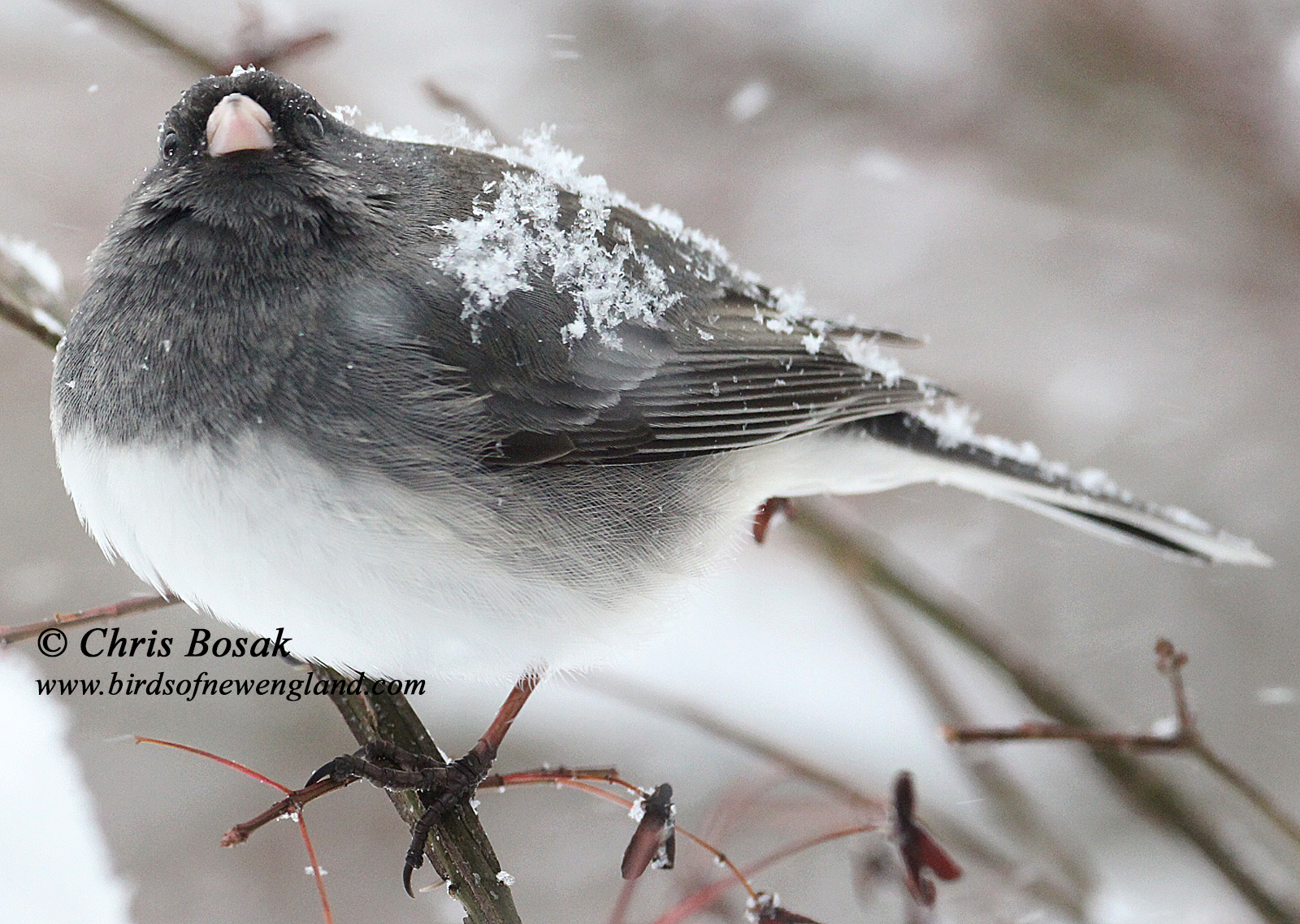
A dark-eyed junco visits a backyard in New England, January 2021.
The junco sat perfectly still in the bush as snow collected on his back. The snow came down hard and the wind whipped it around.
It was the wind that kept the junco motionless in the bush. When the wind offered a rare break, the junco darted to the nearby bird feeder to grab a few sunflower seeds.
He would fly back to his spot in the bush, having shaken off the snow that had collected on him. It didn’t take long for new snow to accumulate on his dark gray feathers.
Snowy days are among the best times to watch the feeders. It is interesting to see how little the elements affect the birds. Tiny birds such as chickadees can withstand extremely cold and windy conditions. They have a variety of mechanisms to protect them from the harsh elements. I have written about those in previous columns and may revisit that topic in the future.
But for now, I’m going to focus on this past storm that hit New England and recall the many birds that visited. The junco I mentioned before was one of more than a dozen juncos that were around that day. Other sparrows included white-throated, song and house. Many people don’t think of juncos as being a sparrow because of their different coloration, but they are indeed members of the sparrow family.
Both nuthatches came and went throughout the day. It is such a thrill to see the red-breasted nuthatches daily this winter. Not that I don’t appreciate the white-breasted nuthatches, but they are much more common and year-round birds where I am. The red-breasted nuthatch shows up only in random years.
Of course, chickadees and titmice were regular visitors. A pair of Carolina wrens entertained me as well. I always like watching their antics in the yard, especially when they make their unique chatter calls outside the window.
It was a heck of a snowstorm — the worst in several years where I am anyway. Will there be more opportunities this winter to watch the birds at the feeder in the snow? That remains to be seen, but I wouldn’t be surprised in the least. In fact, I would be very surprised if we didn’t have more snowfalls. This is New England, after all, and winter is a way of life here.