Photo by Chris Bosak
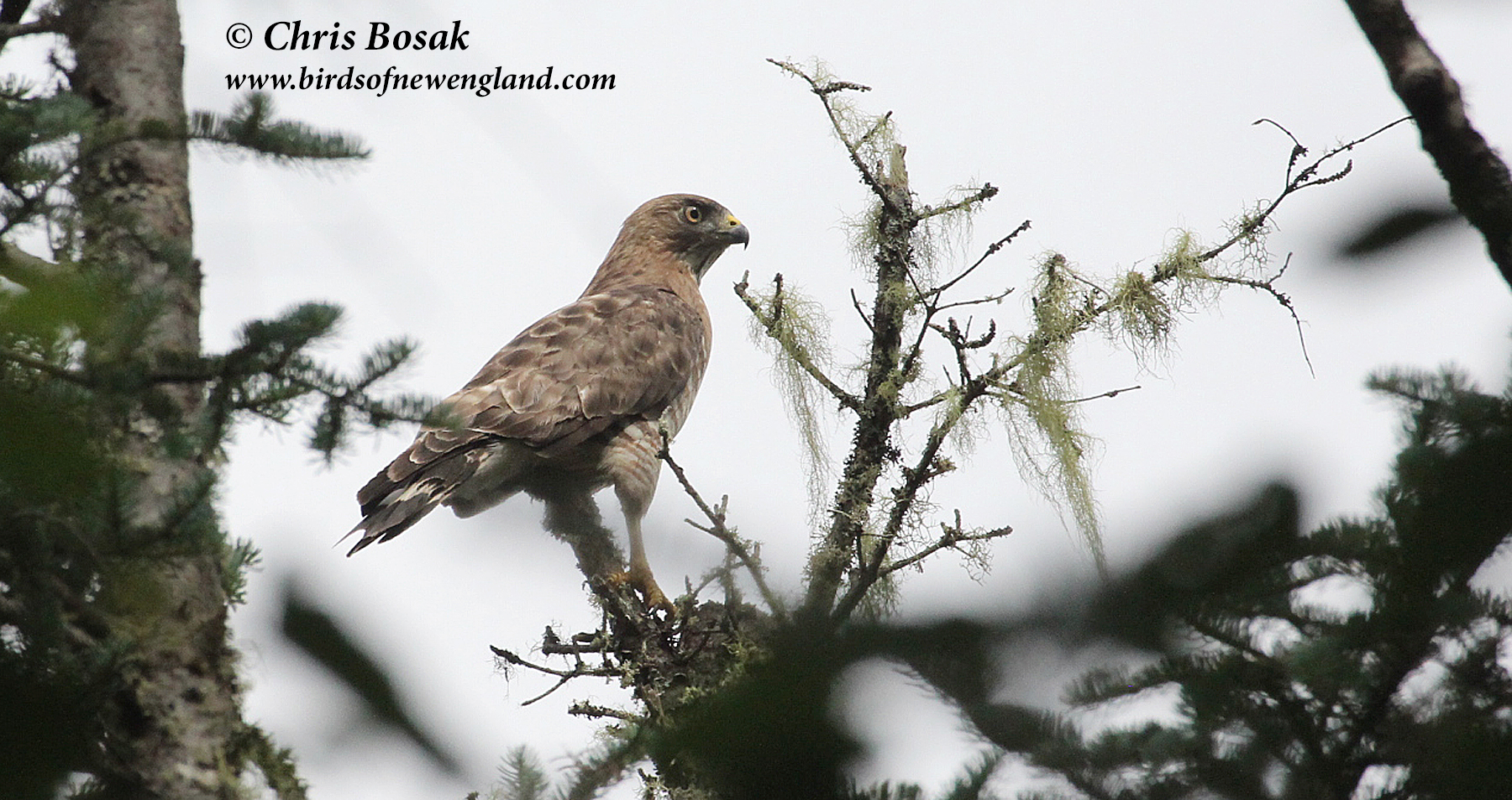
A broad-winged hawk perches in a tree in northern New Hampshire, July 2020.
The fall hawkwatching season is winding down. Raptor sightings at the various dedicated locations are slowing down, with only a handful of birds counted each day as November progresses.
It’s a good time, therefore, to check in to see how the various hawkwatching sites fared this year. New England has several popular sites, but Pack Monadnock at Miller State Park in Peterborough is New Hampshire’s most active and popular site. The hawk count is a project of the Harris Center for Conservation Education in Hancock.
Photo by Chris Bosak
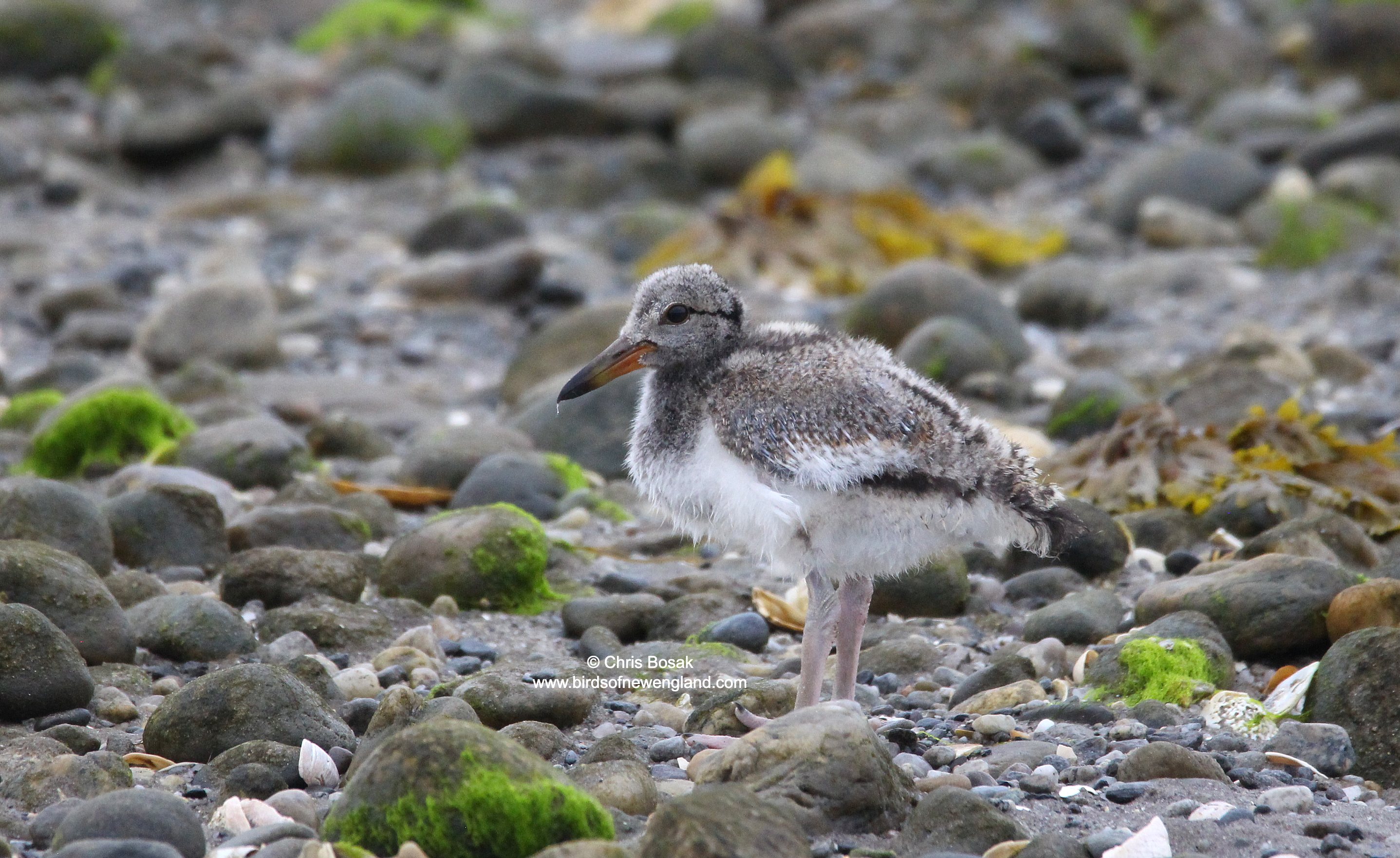
American oystercatcher chick, Milford, Connecticut, summer 2025.
The Cooper’s hawk I wrote about last week was a bit of an anomaly for me.
It’s not that I don’t see Cooper’s hawks often, but I typically see immature Cooper’s hawks. The one featured last week was an adult. Looking back through my photo collection, the vast majority of Cooper’s hawks I have photographed were immature birds.
With many birds, differentiating young birds from adults can be tricky as the time period between immature plumage and adult plumage is relatively short. With Cooper’s hawks, it’s easier as they retain their immature plumage into their second year. Bald eagles, similarly, do not obtain their classic white heads and tails until they are four or five years old.
As immature birds, Cooper’s hawks (as well as closely related sharp-shinned hawks) are brown with tan-streaked white chests and bellies. As adults, they are blue-gray with reddish-streaked white chests and bellies. Immature Cooper’s hawks have yellow eyes, and adults have red eyes. Interestingly, ospreys are the opposite with adults having yellow eyes and immatures having orange-red eyes.
New England’s ospreys left the region weeks ago for warmer temperatures in the south. That doesn’t mean, however, that they are forgotten.
The return of the osprey from dangerously low numbers is another hugely successful conservation story. Last week, in honor of Thanksgiving, I talked about the turkey reintroduction and how wild turkey numbers went from zero to goodness knows how many in New Hampshire over just the last 50 years or so. Ospreys have a similar successful conservation story.
Ospreys were at critically low numbers in the 70s and slowly started making a comeback due to conservation efforts on many fronts. The osprey population is now to the point where it is safe to say it is wildly successful.
I recall working for a newspaper in southern Connecticut in the early 2000s, and a pair of ospreys building a nest on a light tower at a local beach was literally front-page news. Ospreys hadn’t nested in that city in several decades. Now that town, Norwalk, has several dozen osprey pairs nesting in it. A similar story can be told about osprey up and down the Connecticut coast along Long Island sound. Inland osprey numbers are thriving as well.
Here is the latest For the Birds column, which runs in several New England publications.
Photo by Chris Bosak
An osprey eats a catfish at Cayuga Lake State Park, October 2019.
Summer is hanging on, if only by a thread.
It’s always fun to see the nutty people who refuse to dig into their long-dormant jeans pile and insist on wearing shorts even when the temperature dips into the 40s. I see one of those yokels every time I walk past a mirror.
In the natural world, some flowers are still putting on a show, but it’s mostly the late bloomers such as goldenrod and asters. Some, but not many, traditional summer bloomers are toughing it out, but store-bought mums are the most commonly seen flowers these days.
The other day I walked past a pollinator garden and a monarch caterpillar stuck out like a sore thumb on the top of a milkweed plant. I hope the caterpillar does what it has to do quickly before the prolonged deep freezes come. It also made me think of all the fields that have been cut down already and I wonder how many monarch caterpillars lost their homes because of it.
Eastern phoebes, which are one of our first migrants to appear in spring with their late March arrivals, are still seen from time to time. I saw a few perched over a pond and bobbing their tails last week. The tangle of brush a few yards away from the pond was teeming with white-throated sparrows, however; a sure sign of fall and pending winter.
I had another exciting reminder of summer during a recent camping trip I took with some long-time friends. We were having breakfast at the picnic table when Wayne pointed to a distant snag and asked: “Is that a hawk or what?”
We grabbed the binoculars and trained them on an osprey eating a fish. We closed in on the dead tree for a closer look and noticed the bird was eating a fair-sized catfish. No blackened seasoning was necessary as the “fish hawk” tore through the skin and into the meat of the fish. Anyone who has ever caught a catfish knows how tough that skin is. The osprey didn’t struggle in the least.
I attended a presentation last week by Alan Poole, the author of two books on osprey. His latest book is “Ospreys: The Revival of a Global Raptor.”
Poole noted interestingly that an osprey has self-sharpening talons. The hard upper part of the talon, or claw, grows at a faster rate than the softer under part of the talon, leaving the large bird of prey with sharp claws at all times.
The osprey we watched did not push the timetable too far, but most ospreys in New England and nearby states have started their journey south by the end of September. Ospreys are not like most hawks and eagles whereby some individuals remain north throughout winter. All ospreys go south so to see one in October is a nice treat for a birdwatcher.
Poole noted that, while ospreys do mate for life, they go on separate migratory journeys.
Much of Poole’s presentation focused on the amazing comeback of the osprey population. After being nearly wiped out in the 1950s due to heavy pesticide use, the osprey has made a remarkable comeback and is now flourishing in North America and northern Europe, as well as on their winter grounds in South America and Africa.
The population turnaround is welcomed news considering the study released a few weeks ago that shows that North America has lost 29 percent of its birds in the last 50 years.
Poole concluded his presentation with this: “Ospreys are a good example that we can get things right if we pay attention and get organized.
Photo by Chris Bosak
An osprey eats a catfish at Cayuga Lake State Park, October 2019.
There is more coming on this story next week, but here are a few photos of an osprey eating a catfish. Some longtime friends and I went camping a few weeks ago and spotted this exciting scene.
Photo by Chris Bosak
An osprey eats a catfish at Cayuga Lake State Park, October 2019.
Alan Poole at Connecticut Audubon Society’s annual meeting held Monday, Oct, 7, 2019, at Pequot Library in Southport, CT.
I’ve taken a keen interest in the burgeoning osprey population ever since I covered the story about the osprey pair that built a nest at a Norwalk (Connecticut) beach park. The nest was being built high atop a light pole overlooking a softball field. It seemed a peculiar place to build a nest with the giant lights right there.
At the time, however, even more out of the ordinary was that an osprey pair was building a nest in Norwalk, which is a city in southwestern Connecticut on the shore of Long Island Sound. Norwalk hadn’t hosted an osprey nest — and certainly not one that public and visible — in many years, perhaps decades.
That was 2004. Fast forward 15 years and Norwalk is now home to a more than a dozen osprey nests. Connecticut, in fact, now has more than 500 osprey nests. All up and down the East Coast — shoreline and inland — ospreys have come back with a fury.
It is truly a conservation success story. Ospreys were nearly wiped out by pesticides in the 1950s. Now they have bounced back mightily throughout the U.S. and Europe, and their accompanying winter grounds in South America and Africa.
So when I saw that Alan F. Poole, a Massachusetts resident and noted expert/author on ospreys, was going to be the keynote speaker at the Connecticut Audubon Society’s annual meeting, I marked the date on my calendar.
Poole’s informative presentation on osprey included photos, graphs and charts on the incredible comeback of the “fish hawk.” Some tidbits from the presentation:
osprey are the only bird species that eats live fish exclusively
baby osprey take about 50 days to reach full size
in 1940 there were one thousand ospreys in New England; by the end of the 1950s only 90 pairs remained
artificial nesting sites such as man-made platforms and light poles have played a major role in the recovery
ospreys mate for life but do not migrate together
about half of the first-year osprey will die within the first year
osprey nests are made of large sticks and may weigh a half ton or more
osprey are gentle birds for the most part but will fiercely defend its nest
John James Audubon was a big fan of osprey and called them “This Famed Bird”
Osprey have self-sharpening talons as the hard upper layer of the talon grows faster than the soft under part
Poole recently wrote Ospreys: The Revival of a Global Raptor.
In other business, Connecticut Audubon Society (@CTAudubon) reinstated its officers, confirmed new board members and doled out awards to volunteers. It’s a great organization worthy of support.
Poole ended his presentation with an interesting comment. Referring to the study released a few weeks ago about the bird population decreasing by 29 percent since 1970, Poole said: “Ospreys are a good example that we can get things right if we pay attention and get organized.”
Amen to that.
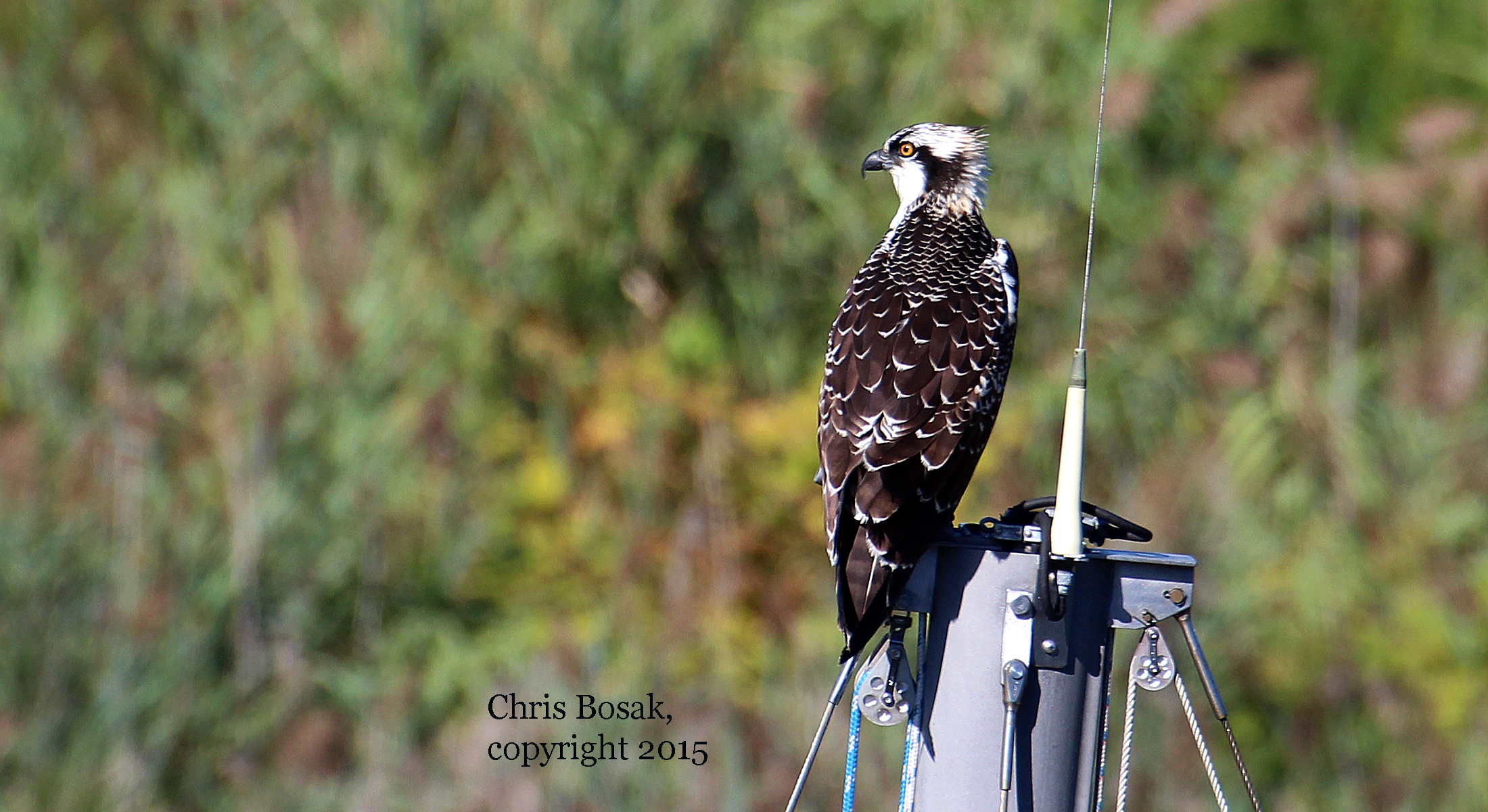
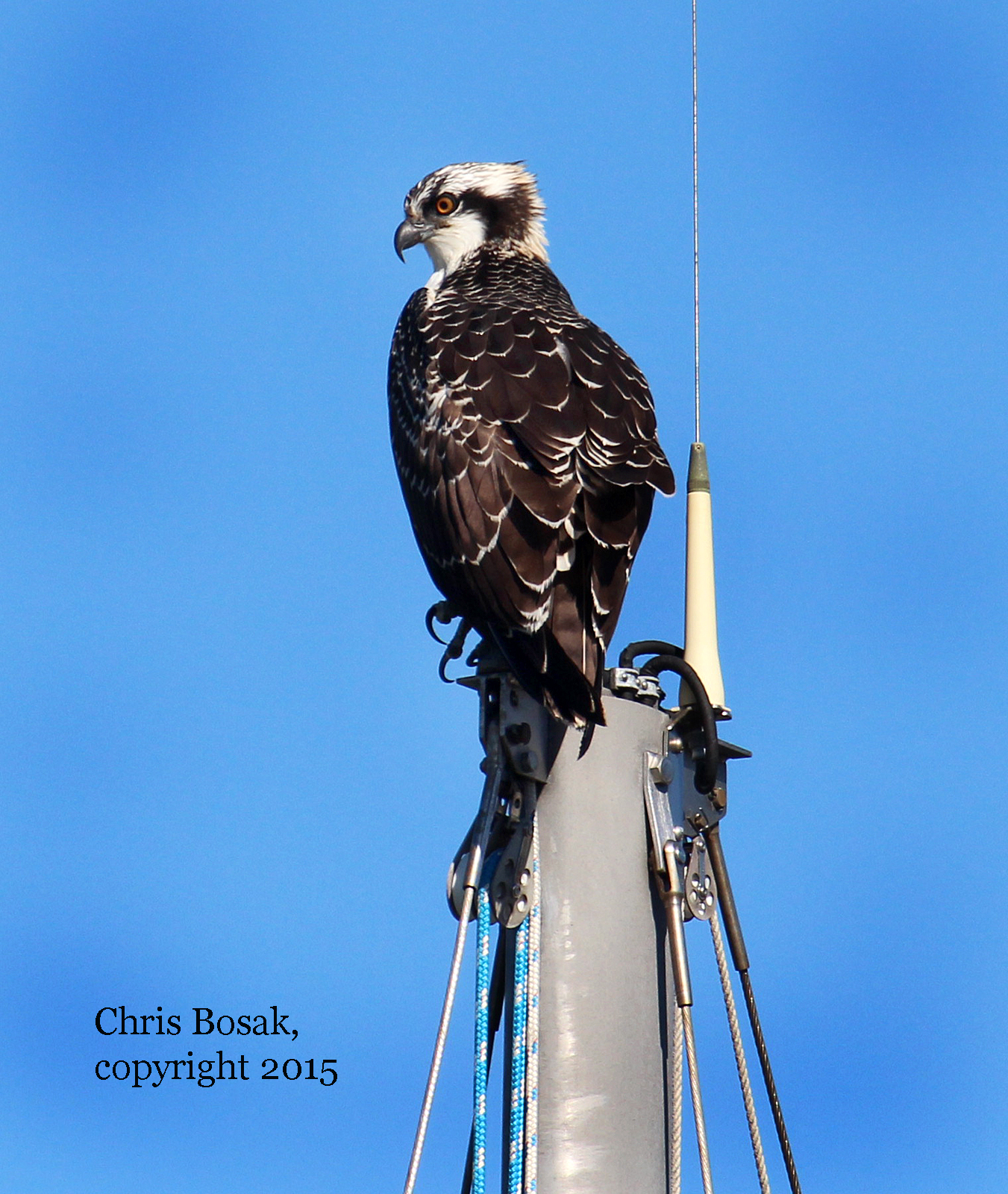
Photo by Chris Bosak A first-year Osprey sits on the top of a sailboat mast along the Norwalk River in Norwalk, Conn., summer 2015.
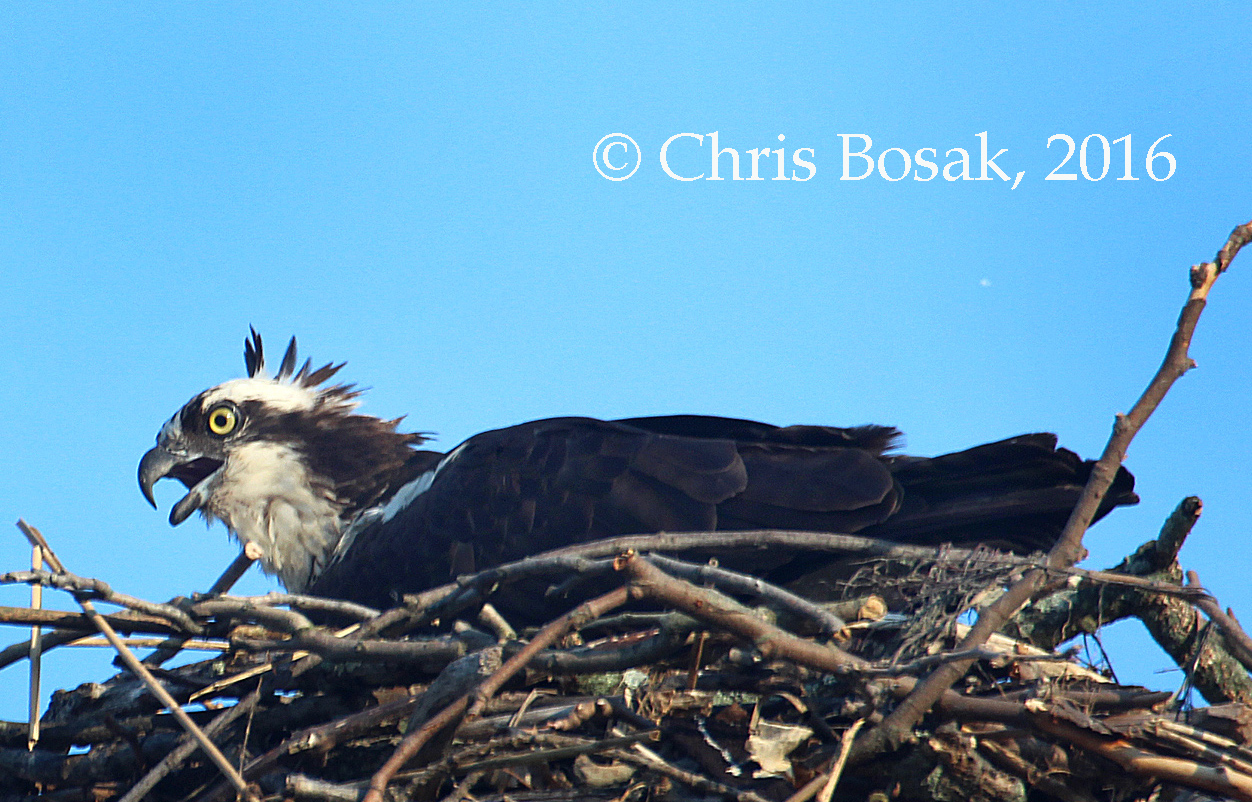
Photo by Chris Bosak An Osprey sits in a nest at Veterans Park in Norwalk, Conn., spring 2016.
You know a bird species is doing well in an area when you take a short break from work to get a nice photo of the bird and return to work a handful of minutes later with good results. The Osprey in coastal Connecticut is one such bird and area. Southern Connecticut, of course, is not the only place where “fish hawks” are thriving. They are doing well up and down the East Coast and many parts inland, too. They nest along salt, br Continue reading →
Photo by Chris Bosak A first-year Osprey sits on the top of a sailboat mast along the Norwalk River in Norwalk, Conn., summer 2015.
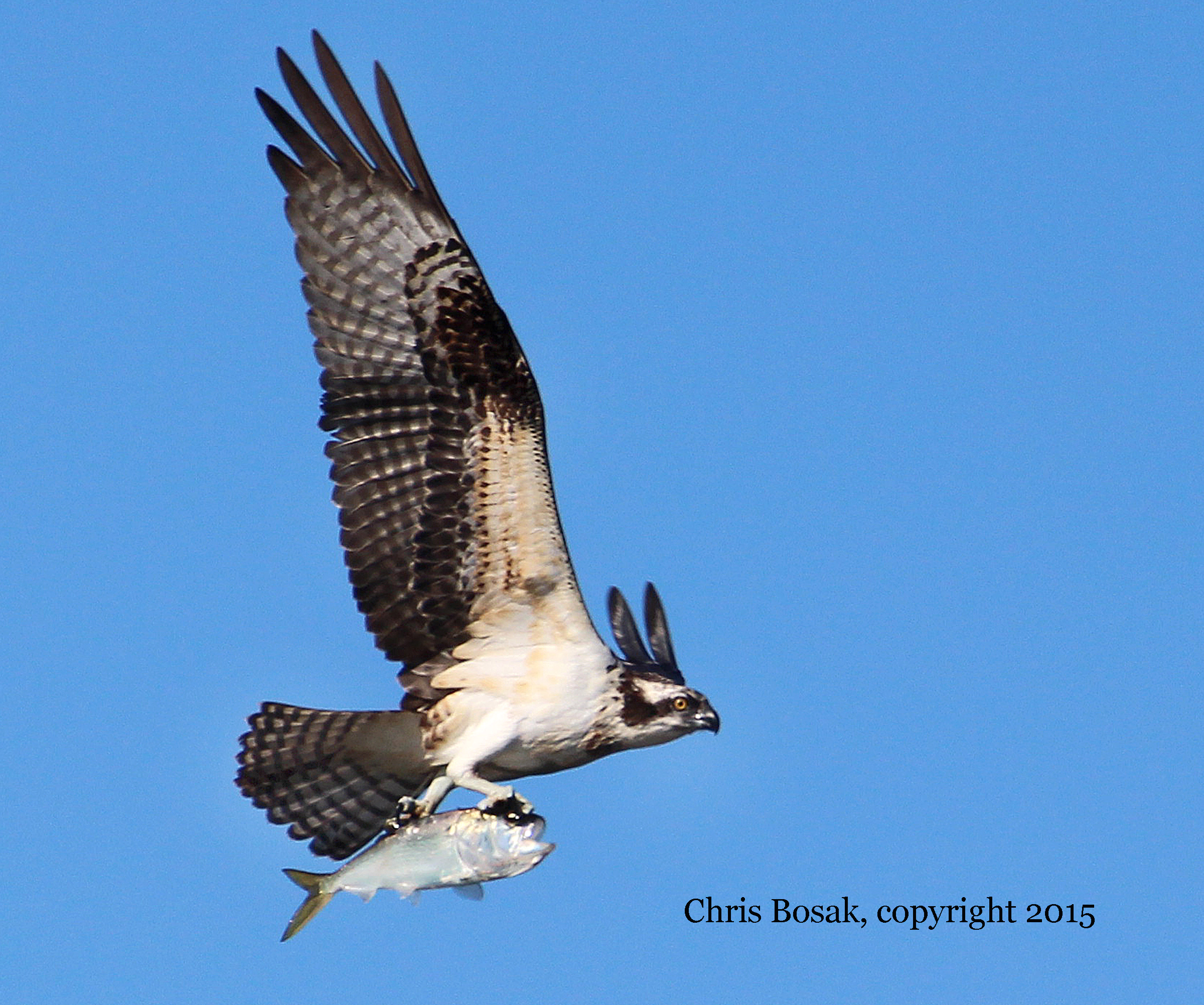
I had mentioned in the previous post that I was photographing a young Osprey on the top of a sailboat mast when I spotted another Osprey overhead carrying a fish in its talons. Naturally I was more excited about the Osprey carrying a fish so I posted that photo first.
So with that photo out of the way, here are some more Osprey photos that I have taken in the last week — yes, including a few of that young Osprey on the sailboat mast.
Photo by Chris Bosak An Osprey flies with a fish in its talons over the Norwalk River in Norwalk, Conn., summer 2015.
Photo by Chris Bosak An Osprey sits near its nest on Fish’s Island off the coast of Darien, Conn., in summer 2015.
Photo by Chris Bosak A first-year Osprey sits on the top of a sailboat mast along the Norwalk River in Norwalk, Conn., summer 2015.
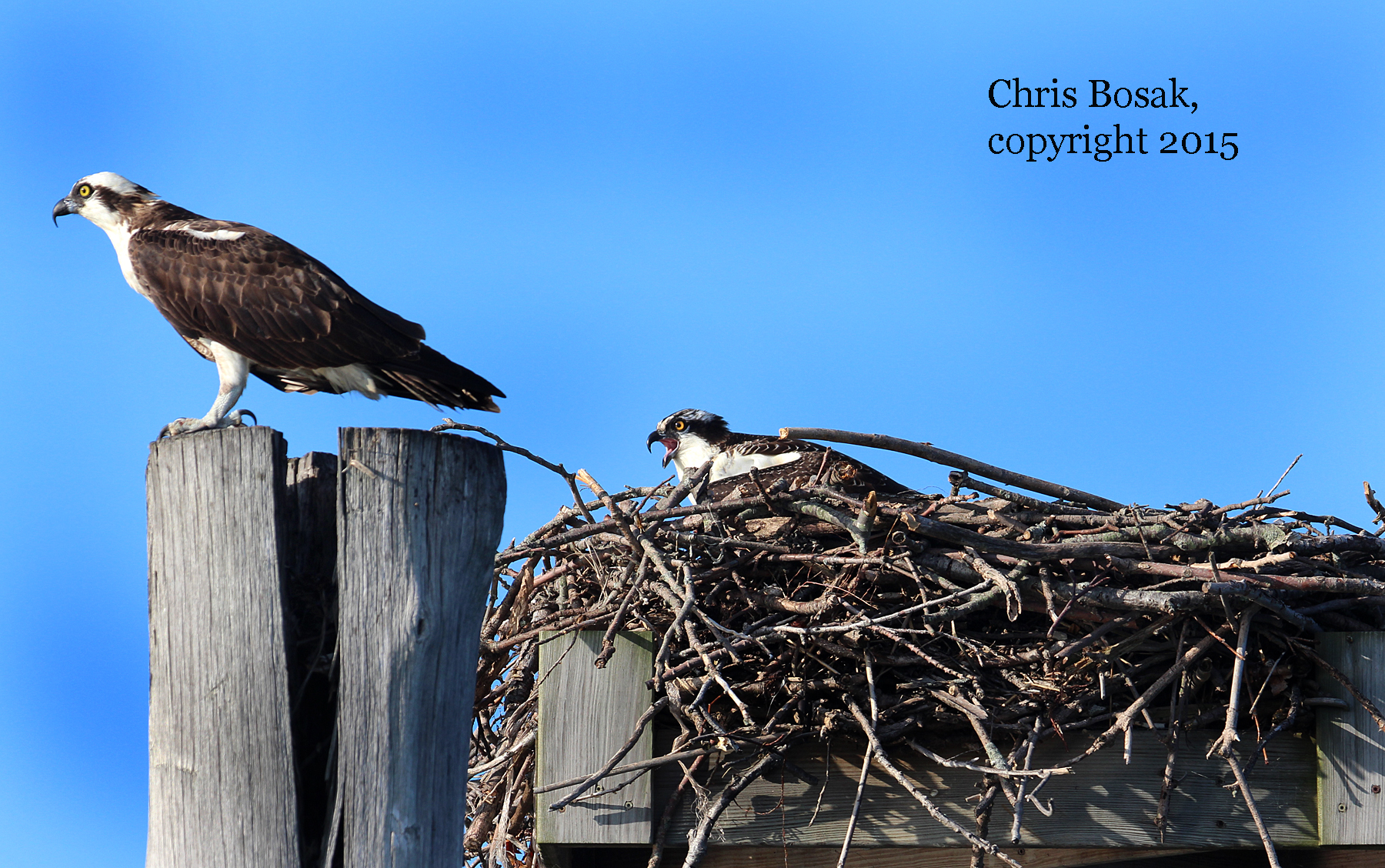
Photo by Chris Bosak An adult Osprey sits on a piling (left) as a first-year Osprey sits in a nest off the coast of Norwalk, Conn., summer 2015.
Photo by Chris Bosak An Osprey carries a fish along the Norwalk River in Norwalk, CT, summer 2015.
I’m pretty good with my birds, but only very average with my fish. I got this photo of an Osprey carrying a fish along the Norwalk River on Friday, Aug. 28, 2015. I was photographing a young Osprey on a sailboat mast when this older Osprey flew by with its prey. The younger Osprey looked up and gave a look as if to say: “I wish I could do that.” The youngster will learn soon enough.
It looks like a fairly good-sized fish, but honestly my fish ID skills are not up to par. Who knows what it is? Thanks for your input.
Photo by Chrisi Bosak An Osprey flies over Veterans Park in Norwalk, Conn., April 29, 2015.
Press release from Connecticut Audubon Society:
Osprey Nation, the Connecticut Audubon Society’s citizen science program, has grown significantly in its second year, with more volunteer stewards documenting, mapping and monitoring considerably more nests than last year.
Statewide, 134 Connecticut residents are volunteering this nesting season to collect bi-weekly and monthly data on the state’s rapidly increasing Osprey population – 31 more volunteers than last year.
These Osprey Nation volunteers have found 492 nests in 2015, 78 more than last year’s 414 nests. They are monitoring 296 of those nests, 122 more than last year’s 174.
And although it can be difficult to observe the inside of distant nests on raised platforms, data submitted so far indicate that 94 pairs of Osprey Continue reading →





 Birds of New England.com