For the Birds: Readers take over again

Photo by Chris Bosak A scarlet tanager perches in an oak tree in Danbury, Conn., spring 2018.

Photo by Chris Bosak
A scarlet tanager perches in an oak tree in Danbury, Conn., spring 2018.

Here is the latest For the Birds column, which runs in several New England newspapers.

The colors just keep on coming this spring.

I’ve been lucky enough to see two indigo buntings, three rose-breasted grosbeaks (although two were males fighting each other), a scarlet tanager, at least three Baltimore orioles, a pair of ruby-throated hummingbirds and a handful of warblers in my yard so far this spring. It’s been a welcomed color bonanza after a long winter.

Now that Memorial Day has passed and we are unofficially in summer, let’s look at what some readers have seen.

Carol from the Monadnock Region sent a photo of an oddly colored hairy woodpecker. Instead of the traditional white and black, this one was black and yellowish brown. A reader from Connecticut sent me a similar photo a few years ago.

My guess is that it is a normal hairy woodpecker with a pigment abnormality. Pigment abnormalities show up in birds every so often, such as orange house finches or white robins. Leucism and albinoism are extreme forms of pigment abnormalities, but more subtle color variations occur.

Don watched as an eagle eyed a pair of common mergansers on Granite Lake. He wondered if the eagle would try to take one of the ducks, but a loud noise distracted the eagle and it flew off. Eagles, which often scavenge for food, can take birds as big as common mergansers.

Norma from Spofford had an indigo bunting visit her feeders this spring. She has been in Spofford for nearly 40 years and has seen buntings only a handful of times.

It’s also been a colorful spring for Lenny of Greenfield, who has seen orioles, rose-breasted grosbeaks and cardinals. A special treat was seeing the oriole and grosbeak at the feeder at the same time.

Dean in Marlborough reported visits from pileated woodpeckers, indigo buntings, cardinals and eastern bluebirds. Another colorful yard in the Monadnock Region.

Lida from Harrisville had a male and female oriole come to her table to feast on oranges. Another reader suggested using grape jelly to attract orioles.

I tried to attract orioles with both oranges and grape jelly this spring, to no avail.

Eric in Surry noticed the usual changing of the guard for ground-feeders as the juncos left and chipping sparrows arrived, with about a two-week overlap. He has also noticed a few warbler species, including a pine warbler carrying nesting material. The material was hair he leaves out for the birds after brushing his dog. He has also seen chickadees, phoebes and nuthatches grab some of the hair.

He had another interesting bird sighting this spring; shortly after filling in small holes in his yard, a Cooper’s hawk swooped in to grab a chipmunk. Eric has also seen a blue-gray gnatcatcher and heard an eastern whip-poor-will. It’s been years since I’ve heard a whip-poor-will so I’m glad someone is still hearing them.

Spring migration is winding down, but not over. Soon, it will give way to nesting season. Let me know what you are seeing out there in this exciting time of the year for birdwatching.

You don’t see this every day

Photo by Chris Bosak  A luna moth clings to a screen in Danbury, Conn., during spring 2018.

Photo by Chris Bosak
A luna moth clings to a screen in Danbury, Conn., during spring 2018.

I went to fill the feeders the other morning when something caught my eye on the outside of the bathroom window screen. It was a luna moth, a first for my house in Danbury and only about the second sighting overall for me. The first came at a gas station, of all places. I may have found a dead one at some point, too, but I can’t remember for sure.

There was no denying this handsome moth, though. There it was in all its awesomeness, just clinging to the screen. It hung around all day and evening, but was gone by the next morning.

Two interesting facts I learned about luna moths since this sighting: The adult form, which this is, of course, lives for only a week. Secondly, the adult form doesn’t have mouthparts and doesn’t eat. Its sole purpose is to mate.

Photo by Chris Bosak
A luna moth clings to a screen in Danbury, Conn., during spring 2018.

Photo by Chris Bosak
A luna moth clings to a screen in Danbury, Conn., during spring 2018.


Another scarlet tanager shot

Photo by Chris Bosak A scarlet tanager sings from an oak tree in Danbury, Conn., spring 2018.

Photo by Chris Bosak
A scarlet tanager sings from an oak tree in Danbury, Conn., spring 2018.

Another scarlet tanager shot .. just because.

Scarlet tanager joins the group

Photo by Chris Bosak  A scarlet tanager perches in an oak tree in Danbury, Conn., spring 2018.

Photo by Chris Bosak
A scarlet tanager perches in an oak tree in Danbury, Conn., spring 2018.

First the rose-breasted grosbeak and the indigo bunting, now this … a brilliant male scarlet tanager visits the yard this spring. Sure, it didn’t visit the feeder, but it was in the oak trees above the house. Good enough for me. Happy birding everyone.

Another indigo bunting shot

Photo by Chris Bosak  A male indigo bunting eats seeds from a platform feeder in Danbury, Conn., in May 2018.

Photo by Chris Bosak
A male indigo bunting eats seeds from a platform feeder in Danbury, Conn., in May 2018.in

Here’s another shot of that male indigo bunting, just because …

The next day this came …

Photo by Chris Bosak  A male indigo bunting eats seeds from a platform feeder in Danbury, Conn., in May 2018.

Photo by Chris Bosak
A male indigo bunting eats seeds from a platform feeder in Danbury, Conn., in May 2018.

I posted my latest For the Birds column yesterday. The day after writing that column — in which I write about seeing my first indigo bunting at a feeder — this guy showed up. Yes, another indigo bunting, but this one a mature male in his awesome breeding plumage. If you recall, the first indigo bunting was a first-year male and sported blotchy plumage (not that I was complaining.) But this new guy really stood out at my feeding station.

Latest For the Birds column: Another backyard first

Here is the latest For the Birds column, which runs in several New England newspapers.

Photo by Chris Bosak An indigo bunting visits a feeder in New England, spring 2018.

Photo by Chris Bosak
An indigo bunting visits a feeder in New England, spring 2018.

No matter how long you’ve been at it, birdwatching always presents firsts.

Wait, I used that sentence to start my column a few weeks ago. Oh well, another birding first happened this week, so I’m going with it again.

This time, it was a new bird to my feeding station. I’ve been feeding birds for a long time, and I’ve seen some great birds eating seeds or suet in my backyard.

Every year I’m thrilled when the rose-breasted grosbeaks show up. This year, a male and female have paid periodic visits for the last couple days.

It took years for me to attract hummingbirds, but now — knock on wood — it seems they are annual visitors.

A few Octobers ago, a small group of pine warblers discovered my suet feeder and stuck around the yard for about three days.

The other day, a new arrival. Settling into my lounge chair on the deck, I noticed a bright blue blotch among the leaves on the branch used by “my” Continue reading

Good backyard visitors so far this spring

Photo by Chris Bosak A male rose-breasted grosbeak visits a feeder in Danbury, Conn., during the spring of 2018.

Photo by Chris Bosak A male rose-breasted grosbeak visits a feeder in Danbury, Conn., during the spring of 2018.

We still have a few weeks left of peak spring migration, so this list is not inclusive (I hope not anyway), but the feeder has been active recently with the following birds: rose-breasted grosbeak (male and female); chipping sparrow; goldfinch; gray catbird; blue jay; cardinal (male and female); indigo bunting (first spring male); red-bellied woodpecker; white-breasted nuthatch; tufted titmouse; black-capped chickadee; downy woodpecker; hairy woodpecker; mourning dove; house finch; ruby-throated hummingbird (male and female); wild turkey; and probably one or two more that aren’t coming to mind at the moment. I bought a new oriole feeder, but no luck yet with that one. What’s been visiting your feeders? Feel free to comment with your list.

Photo by Chris Bosak  A female rose-breasted grosbeak visits a feeder in Danbury, Conn., during the spring of 2018.

Photo by Chris Bosak
A female rose-breasted grosbeak visits a feeder in Danbury, Conn., during the spring of 2018.

Hummingbirds return to New England

Photo by Chris Bosak A male ruby-throated hummingbird visits a feeder in Danbury, Conn., spring 2018.

Photo by Chris Bosak
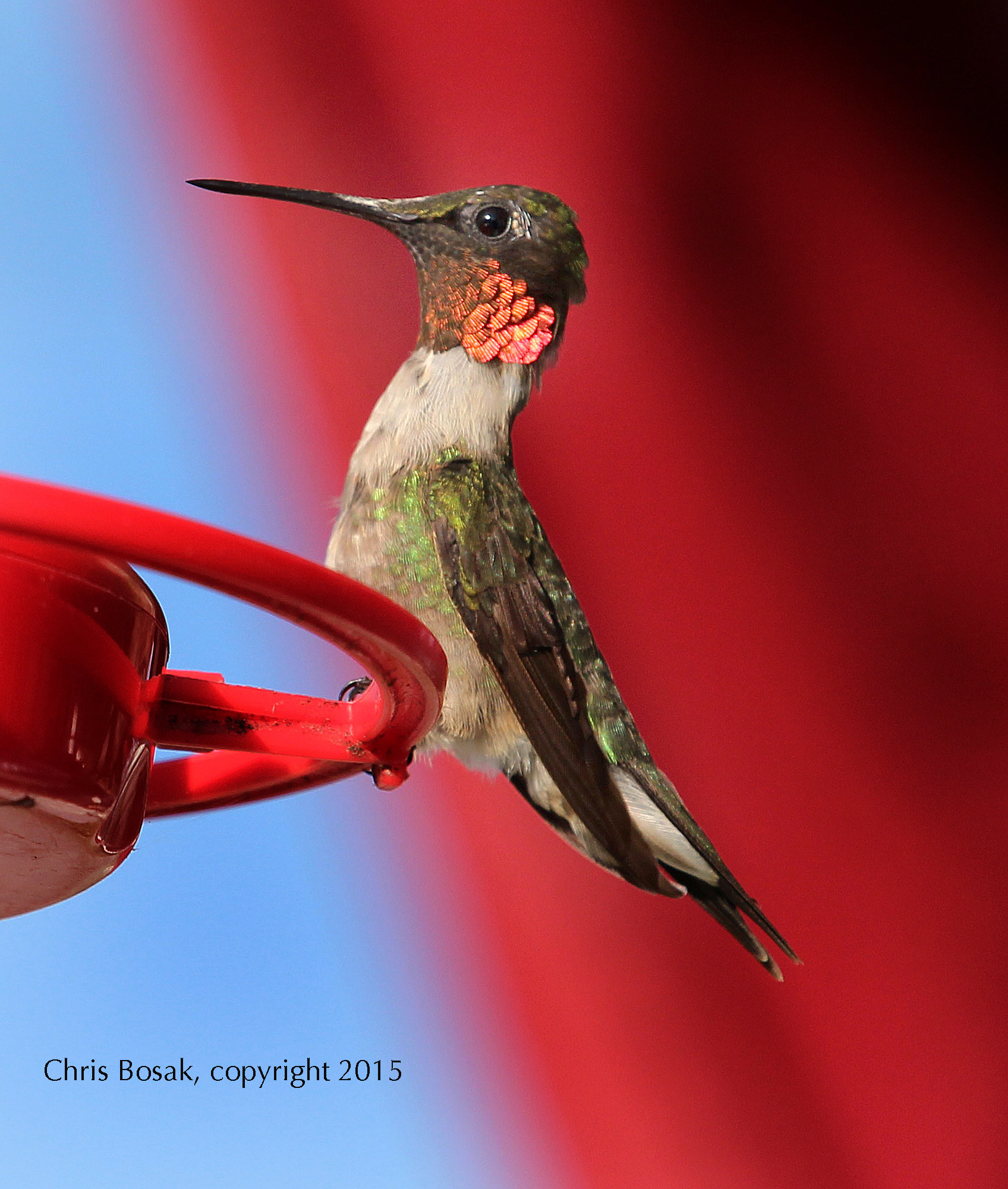
A male ruby-throated hummingbird visits a feeder in Danbury, Conn., spring 2018.

I saw my first hummingbird of the year about 10 days ago. It paid my feeder a quick visit in the morning and I never saw it again. He must have been on his way northward and stopped for a quick pitstop. But now, the hummingbirds are back for real. A male has been visiting my feeder about every 20 minutes for the last three days. A few times it had to fight off a few rivals to keep its territory. Hummingbirds are small and cute, but fiercely territorial.

Here’s a shot a took over weekend. Welcome back.

A few snapping turtle iPhone photos

Young snapping turtle, by Chris Bosak

Camera phones have come a long way. They are not necessarily practical for bird photography yet, but if you get a cooperative subject like these snapping turtles and pickerel frog, phones can be great for nature photography. They are handy for when opportunities present themselves in the woods or during a drive.
Speaking of snapping turtles, keep an eye on the roadways during this time of year for those gorgeous reptiles. Remember, if you see a turtle in the road, snapping or otherwise, and are in a position to safely help, move it to the side of the road in the direction it was Continue reading