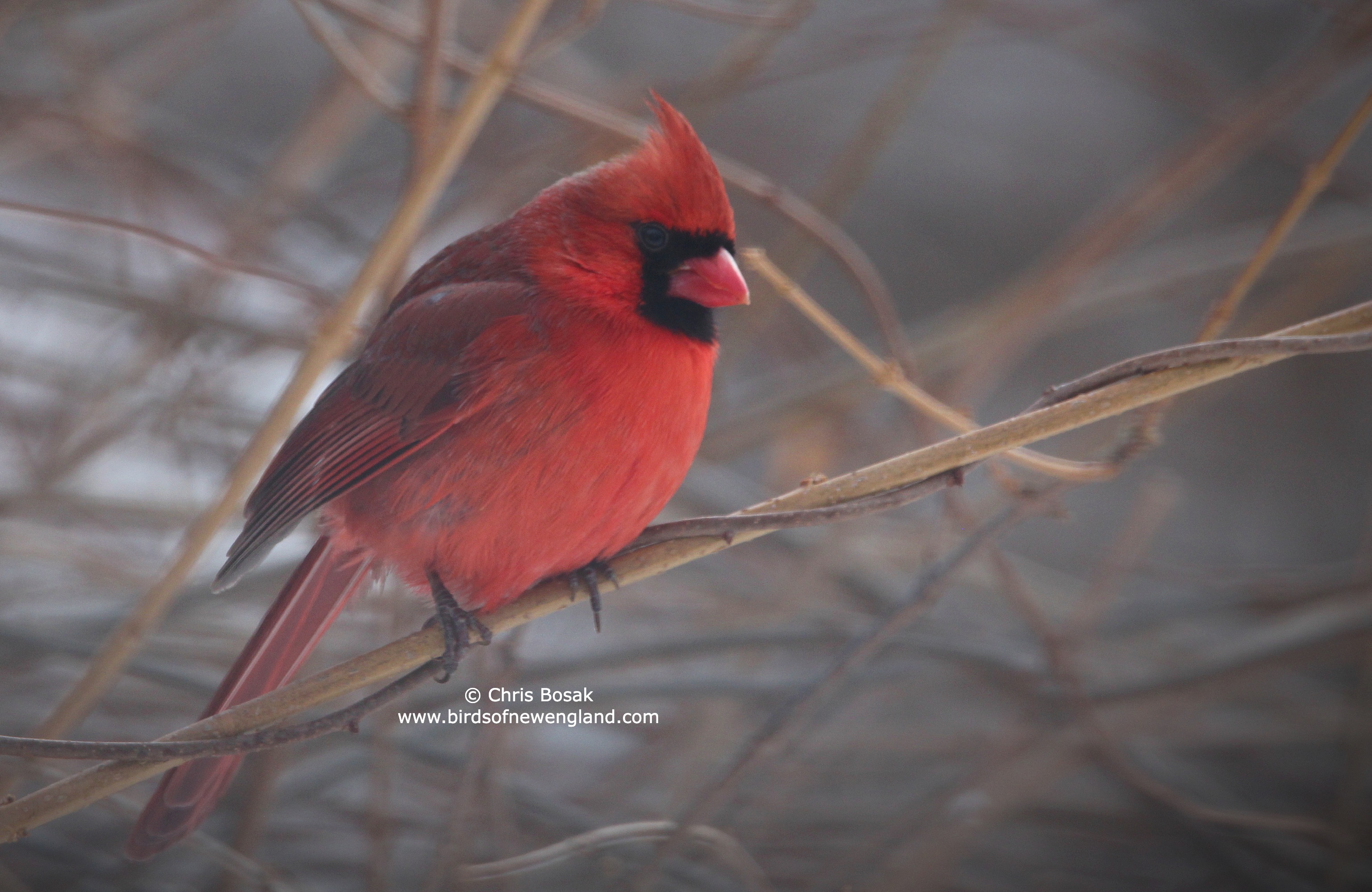
Photo by Chris Bosak
A cardinal eats berries in New England, January 2025.
I’ve seen a ton of robins this winter. On several occasions, I’ve seen them in big numbers attacking bushes and trees and stripping them of fruit.
I’ll always remember the first time I saw this spectacle. It was more than 20 years ago, and I was a relatively new birder. I walked into the woods and the trees were alive with bird life. Birds were darting from tree to tree all around me.
I was finally able to focus on a few and discovered that they were all robins. I was surprised because, at the time, I still thought of robins as spring and summer birds in New England. They are the harbinger of spring, aren’t they?
Photo by Chris Bosak
Adult Cooper’s hawk seen in Norwalk, Connecticut, January 2025.
I was walking along a short but windy trail in southern New England the other day in search of overwintering warblers. This short path is known for harboring these tiny songbirds during the winter, as it is adjacent to a water treatment center that features open water on even the coldest days.
I came around one of the many bends and jumped back as I flushed a large bird that was on the ground next to the trail. With my heart racing from the surprise, my immediate reaction was that it was a ruffed grouse. It flushed with the familiar exuberance and noise of a grouse, so my mind immediately went there. Ruffed grouse, however, do not live in that area of New England any longer, and the habitat wasn’t right for the popular game bird.
February is National Bird-Feeding Month, a time to celebrate and educate the public on feeding wild birds. Here is a quote taken directly from nationalbirdfeedingmonth.com, “We are reminded every February to take extra care of our feathered friends during this particularly harsh month – and throughout all the cold winter months – to ensure they have everything they need to thrive.
To celebrate the month, I want to share the designs for a DIY birdfeeder. It is a mesh cylindrical feeder that requires minimal tools to build and will hold a variety of foods to attract birds. Compliments of my new friend Orsi, author of the article that accompanies the design plans, here is the website with instructions.
Photo by Chris Bosak
Male long-tailed duck on Long Island Sound, February 2025.
I took a trip to the coast this morning to check out Sherwood Island State Park in southern Connecticut. I have birded there a lot in the past, but it has been several years since I’ve been to the large park on Long Island Sound. I finished the day with 32 species with a good mix of water and land birds. A few photos from the walk are included below.
Photo by Chris Bosak
A junco perches on a branch after a snowfall in New England, January 2022.
If it weren’t for the American robin running away with the Bird of Winter title, the dark-eyed junco would be a serious contender.
The Bird of Winter is my very unofficial contest for the bird species seen in unusually high numbers during the winter. As I wrote a few weeks ago, the American robin is far and away the leader this winter, and I continue to see great numbers of robins nearly everywhere I go these days.
The dark-eyed junco, which has won the Bird of Winter title in years past, is making a strong case for honorable mention this year. I see them in my yard, at work, on my walks and all along the roadsides.
Photo by Chris Bosak
An American robin eats border privet berries in New England, January 2025.
I wrote a few weeks ago about robins being the frontrunner for the Bird of Winter. Click here to find out what that even means. The photo I ran with it showed a robin eating border privet berries. Separately, I also wrote recently about my fascination with photographing birds eating berries. Click here for that one.
Well, here are more photos of those robins eating berries.
Photo by Chris Bosak
An American robin eats border privet berries in New England, January 2025.Continue reading →
Photo by Chris Bosak – A Belted Kingfisher seen near the Maritime Aquarium at Norwalk on Sunday during the annual Christmas Bird Count.
What comes to mind when thinking of year-round birds in New England?
My guess is the first species that come to mind are songbirds such as black-capped chickadees, tufted titmice, or white-breasted nuthatches. The next birds that come to mind may be slightly larger, like woodpeckers, cardinals, blue jays, or mourning doves. Then it may eventually get to even larger birds such as red-tailed hawks, barred or great horned owls, mallards or turkey vultures.
Some people’s thoughts may veer off to less obvious year-round species such as eastern bluebirds and American robins, which many people may not realize are found in New England during the winter.
My bet would be that belted kingfisher would not immediately come to mind. It certainly would not have for me. I thought about that when I saw one the other day in a rather surprising place, and it reminded me that they are, indeed, year-round birds in New England.
I was walking to the cafeteria at work when I heard a familiar rattling call off to my right. Along the walkway, two consecutive small bridges span streams, one of which is small and often nothing more than a dried-up bed, and the other is a bit larger and flows meekly in dry times and mightily after heavy rains.
Photo by Chris Bosak
An American robin eats border privet berries in New England, January 2025.
The American robin has secured a spot as the frontrunner for the Bird of the Winter.
I usually announce my Bird of the Winter much later than the second week of January, but I could tell already that the robin is likely to be the winner. The Bird of the Winter recognition, of course, is a very unofficial designation made by yours truly. It goes to the bird, as the name suggests, that is seen in surprisingly high numbers throughout the winter.
Past winters have included snowy owl, barred owl, dark-eyed junco, and eastern bluebird. This year the robin is running away with it.
It started on Christmas Day when I looked out of a window into the side yard and noticed a lot of activity in an eastern cedar tree. The activity, as you probably have guessed, was robins going in and out of the branches, gobbling up the berries in the tree. The robins came and went for hours upon end, and, all told, there had to be over 100 of them.
Photo by Chris Bosak – A gray catbird sits among snowy branches during the winter of 2024.
Welcome to 2025, everyone. Without introductory fanfare, here are my top birding highlights from the past year.
10. I see more and more bald eagles every year. I’m not the only one, of course, as bald eagles are doing well as a species, thankfully. I visited family in Erie, Pennsylvania, over the holiday break and saw five bald eagles at Presque Isle during a single visit. I saw a few more on the drive home along I-86 in New York.
9. Hawks, particularly red-tailed hawks and red-shouldered hawks, are even more common than bald eagles, of course. On a few occasions this year, I came across cooperative hawks and got some good close-up photos. In a later column, I’ll show the differences between zoom focal lengths when photographing birds.
8. Overall, it was a slow year for ducks, which is disappointing considering ducks are my favorite type of bird to watch. My best “duck day” came during the Christmas Bird Count when I got close-up views of long-tailed ducks and American wigeons. I need to do better on my ducks in 2025.
7. A pair of catbirds and four purple finches were regular sightings at my local park throughout January and February. Catbirds do not typically overwinter in New England, but these birds had a reliable food source that kept them here. It was strange to see catbirds with snow covering all the surrounding branches. Purple finches are not uncommon winter sightings, but it was fun to see them daily, nonetheless.