To go along with this website and its accompanying Twitter page (@NewEnglandBirds), a new Facebook page has been added for BirdsofNewEngland.com. Posts to this site will automatically be announced on that Facebook page. Plus, who knows what else will end up on the page. It gives me another avenue to communitication to help spread the word about the wonderful birds and wildlife of New England.
If you have the time and inclination, please “like” the new Facebook page that accompanies this site. Type in “Birds of New England” into the Facebook search bar. Thanks and, as always, feel free to share your bird sightings and photos with me.
For the Birds column: Greenberg to speak about Passenger Pigeon book at Yale
Here’s an excerpt from my latest For the Birds column, which will be in print in The Hour tomorrow. Full story is available online now, click on link below.
….
Joel Greenberg says the story of the Passenger Pigeon is unique in three ways: the species’ sheer abundance; its vast flocks; and its rapid descent to extinction.
To expand on that a bit: The Passenger Pigeon likely numbered in the billions in the mid 1800s. Its flocks were so monumentally large that naturalist John James Audubon wrote that a single flock darkened the sun for three days. Finally, the species went from billions of individual birds to zero in matter of about 40 years.
Greenberg is the author of “A Feathered River Across the Sky: The Passenger Pigeon’s Flight to Extinction,” which was published in January by Bloomsbury USA. He is also working on an accompanying documentary entitled “From Billions to None.”
Species in peril today are protected by various laws and, for the most part, have the human race rooting for them to survive. That was not the case with the Passenger Pigeon.
“Hunters, instead of saying ‘let’s lay off a bit,’ took the other attitude,” Greenberg said. “They said ‘this bird is disappearing so I’m going to kill as many as I can before they are gone.’ There were a handful of individuals expressing concern, but not many.”
But, Greenberg points out, …
Another Snowy Owl sighting in this historic year

Photo by Chris Bosak
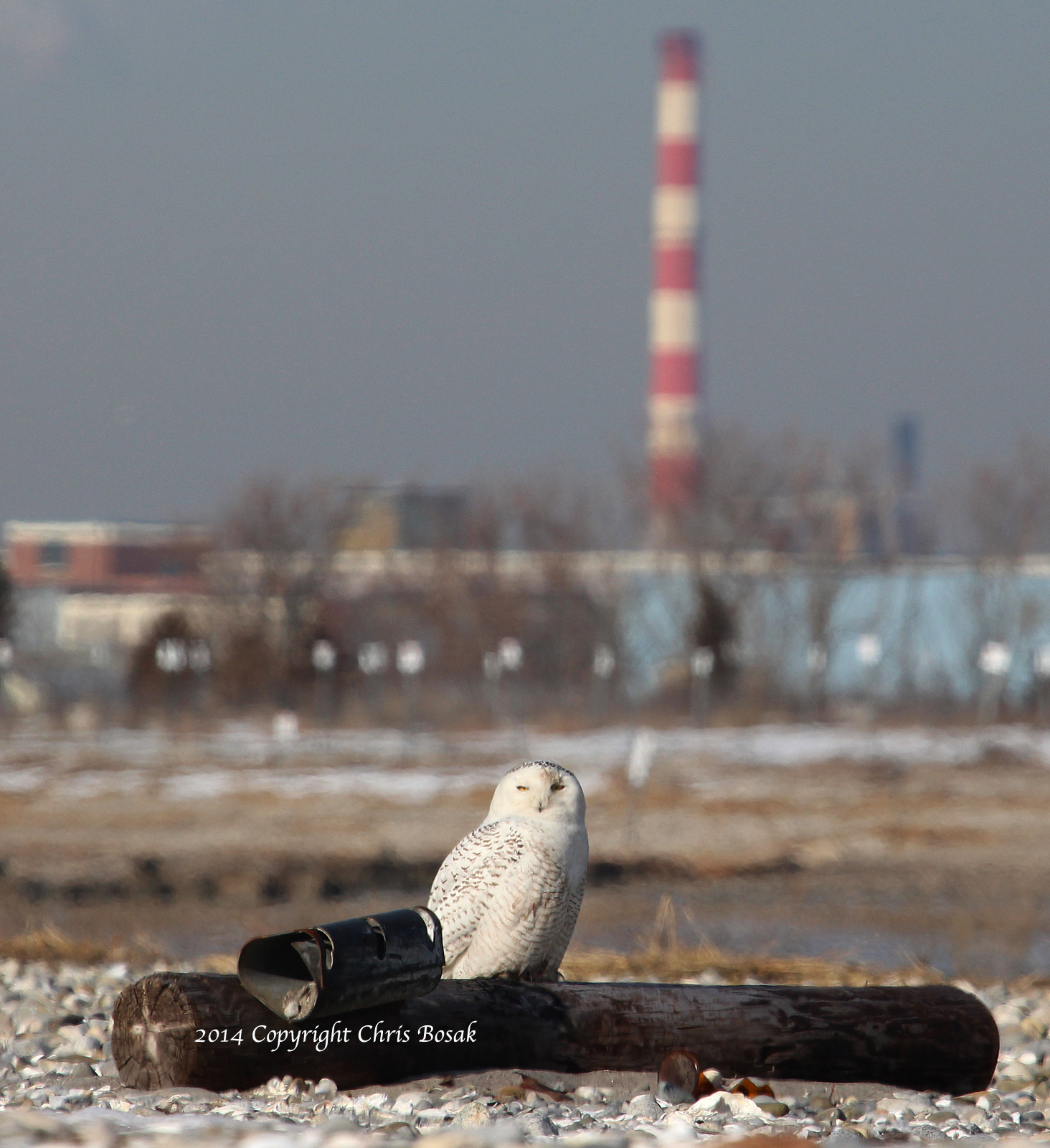
A Snowy Owl sits on an old telephone pole at The Coastal Center at Milford Point in early March 2014. Smoke stacks in Bridgeport loom in the background.
It’s no secret by now that this is a historic winter for Snowy Owl sightings throughout New England and beyond. Snowy Owls are large owls that breed in the Arctic. The irruption of Snowies has gained the attention of nearly all media outlets — small, medium and large; newspapers, magazines, radio and television.
It’s hard to ignore such an avian happening. A couple Snowy Owl sightings in a New England winter is the norm. This year there have been dozens, perhaps hundreds. The most recent Audubon magazine has a great article by Scott Weidensaul. I highly recommend reading it.
I saw my first Snowy Owl of this winter in December in Westport, Conn. I saw a few more in January and February in Milford and Stratford, Conn.
On March 1 I had perhaps my best Snowy Owl sighting of the year. It was at the Coastal Center at Milford Point in Milford, Conn. The owl was on the beach and, while I photographed it from a distance, other beach walkers flushed the impressive bird on occasion. Because of the owl’s impressive size I was able to relocate it each time. Such an impressive bird.
My hope is that as many of these beautiful birds as possible make it back to the Arctic. Perhaps they’ll visit us again another winter.
Enjoy these photos. I hope to have a short video ready soon.

Photo by Chris Bosak
A Snowy Owl flies across the beach at The Coastal Center at Milford Point in early March 2014.
More photos below (click on “continue reading.”)
Why are birds attacking my windows?
My latest For the Birds column was prompted by a question I received from a reader. It was a good question and one I’ve received several times in the past. So here’s my attempt at answering the question: “Why are birds attacking my windows?” (By the way, if you have a bird question for me, feel free to send it to bozclark@earthlink.net.)
…
The good news is that signs of spring are everywhere in the birding world. The bad news is that this winter doesn’t seem to want to loosen its grip.
So for now let’s focus on the signs of spring and think warm thoughts. Not quite bird related, but I’ve noticed several plants poking out of the ground already. A nearby bed of daylilies has produced several of the plants jutting out about an inch already.
In the bird world, yes, American Robins have been seen in large numbers, but they are not necessarily a sign of spring as many robins stick with us throughout winter. To me, a sure sign of spring is hearing cardinals sing for the first time. Cardinals have been “chipping” or calling all winter to keep in contact with each other, but I’ve heard on a few occasions cardinals singing their famous songs. I assume they were male cardinals, but female cardinals also sing. Cardinals also have a variety of loud, whistling songs.
Yes, more Hooded Merganser photos
Over the years I’ve taken tons of Hooded Merganser photos. I just love those little ducks and find them infinitely interesting.
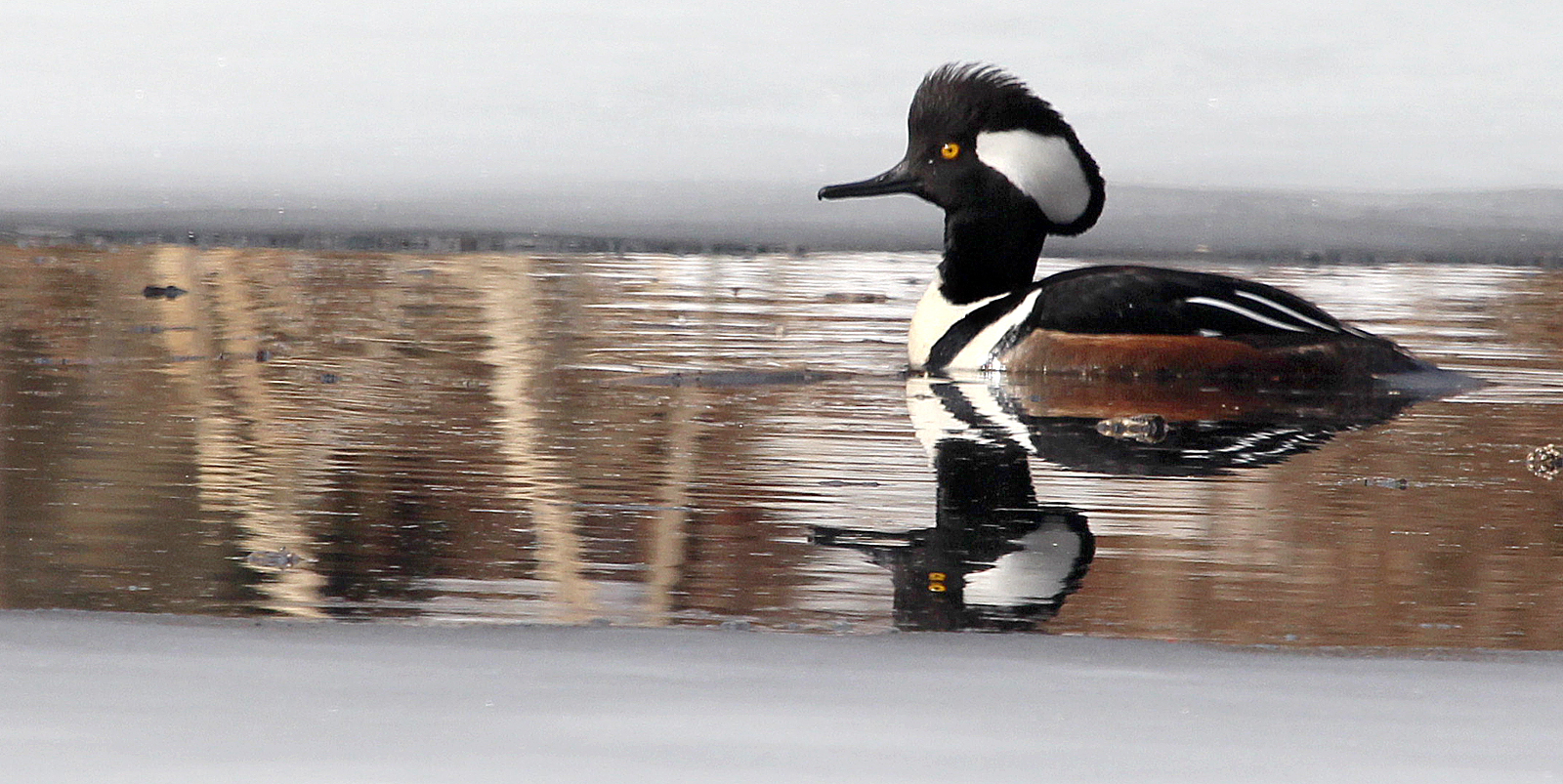
So this weekend, what did I do? I took more Hooded Merganser photos, of course. About five males and four females were utilizing a small pool of unfrozen water on an otherwise frozen lake at Sellecks/Dunlap Woods in Darien, Conn. The males were not displaying, but that time is coming soon. (A video I took last winter of their breeding display behavior is included at the bottom of this post.)
Here are the latest. (Remember, you can always send me your bird photos and I’ll include them on my “Reader Submitted Photos” page. Send me your photos at bozclark@earthlink.net.
Now for those hoodies:

Photo by Chris Bosak
Hooded Mergansers swim in a small unfrozen section of water at Selleck’s/Dunlap in Darien, Conn., in Feb. 2014.

Photo by Chris Bosak
A Hooded Merganser swim in a small unfrozen section of water at Selleck’s/Dunlap in Darien, Conn., in Feb. 2014.
More photos below …
A poem about this New England winter
I hope everyone enjoyed the warm weekend as much as I did. I know I got out and did a little birdwatching without my heavy winter jacket.
But, of course, the warm temperatures were short-lived. It’s colder today already and will only get colder as the week goes on. There’s even the possibility of some more snow later in the week.

Photo by Chris Bosak
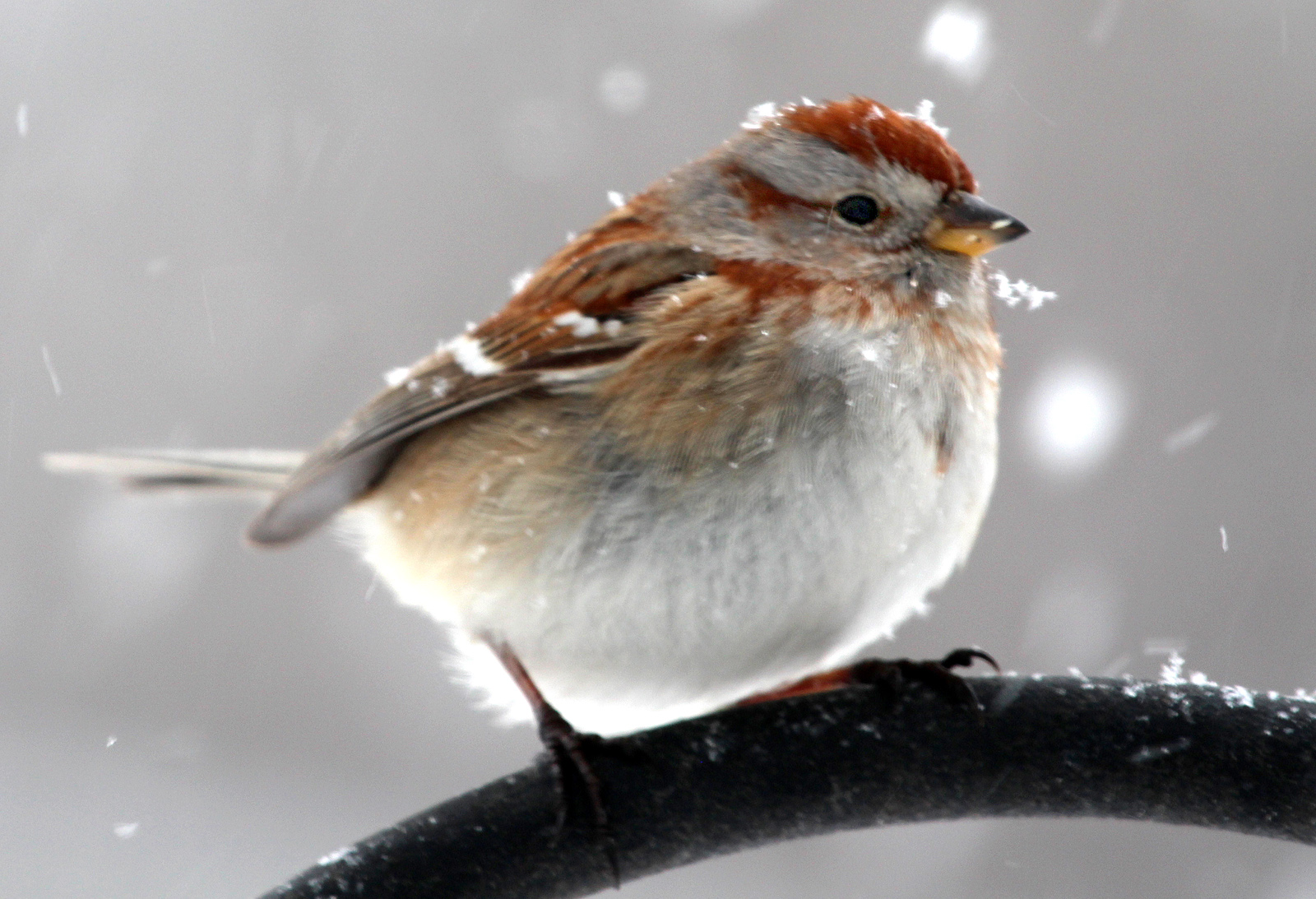
An American Tree Sparrow perches near a feeding station during the snowstorm of Feb. 13, 2014.
So, with that mind, here’s a poem contributed by a reader of my “For the Birds” column.
I’m not from Montana or Alaska –
What’s all this snow – I must ask ya?
I’ve been shoveling snow for weeks –
It’s no surprise my knees feel weak.
Windshield scrapers, snow and ice –
Only a warm fire will suffice.
Bring in the kindling and the wood –
Let mother nature behave as she would.
Poem by Mary Ann Ancker of West Norwalk, Conn.
It’s a robin kind of winter
I’ve written a lot about American Robins this winter — and do so again in this week’s For the Birds column — but the demand for such information is great as everyone seems to be seeing tons of robins this winter.
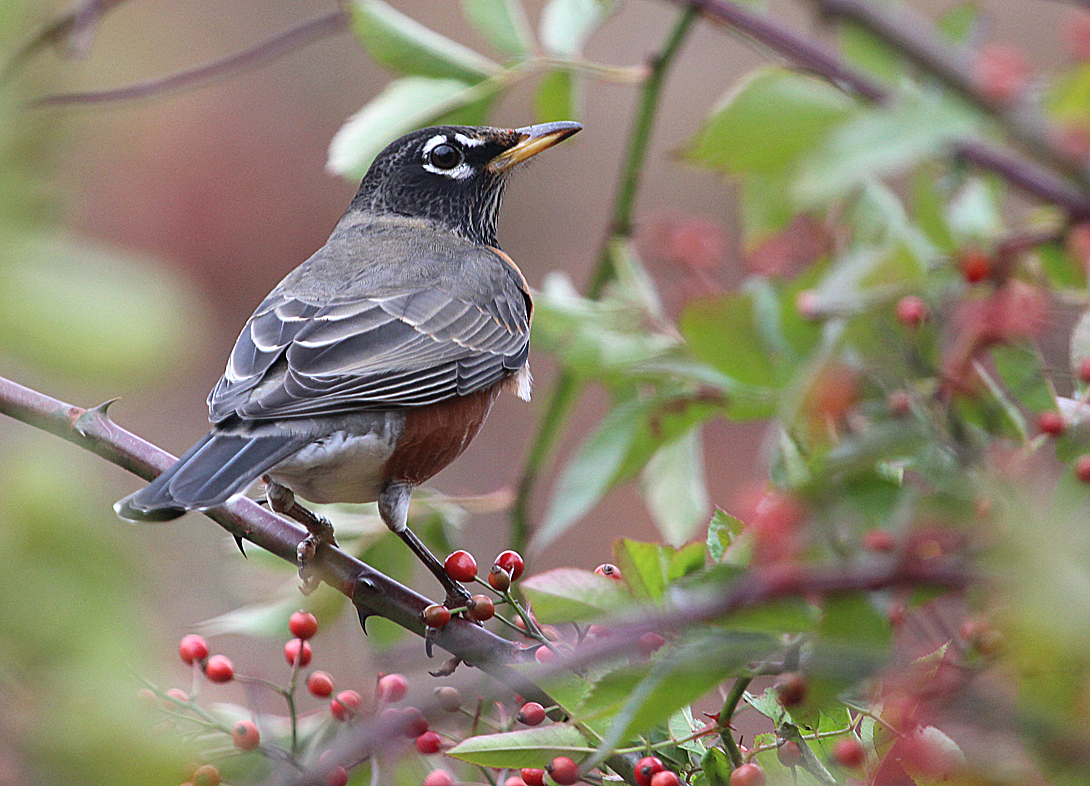
Here’s an excerpt from the column: “True, they are known as a harbinger of spring, but American Robins are with us all year here in New England. Some robins migrate south to warmer places, but many robins stick with us throughout winter, too, surviving on berries, crab apples and other natural foods they can find in the woods and our backyards. Robins are usually found in flocks, some rather impressive, during the winter.”
Click here for the rest of the column.
It was really comments and questions from readers that prompted the column. Here are some comments I have received from readers.
Jack from Norwalk, Conn., wrote: “Saw around 10:30 this AM small flock of Robins just 30 yds West from junction of S Continue reading
A few of my snow birds

Photo by Chris Bosak
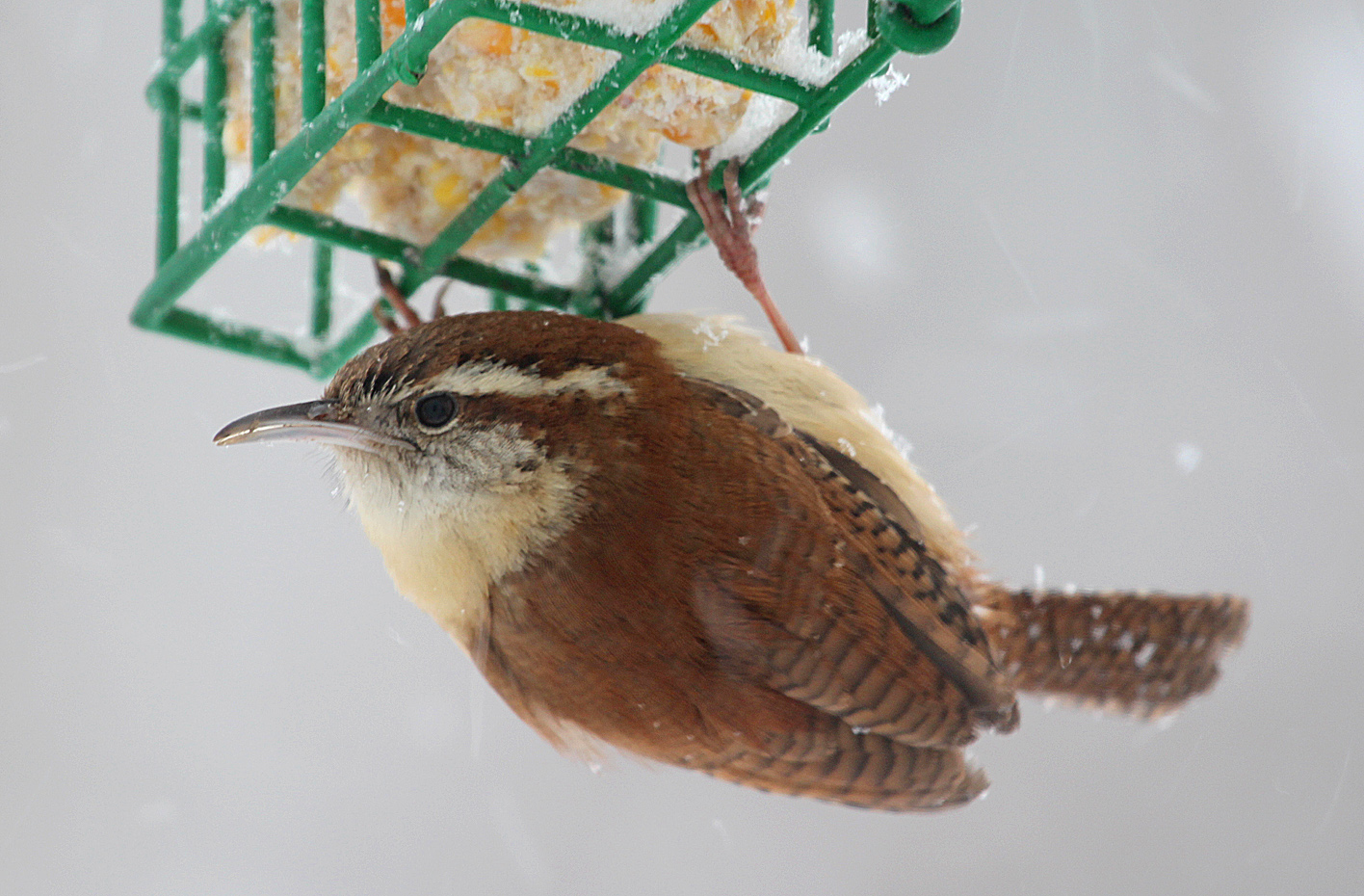
A Carolina Wren holds onto the bottom of a suet cage during the February 13, 2014, snowstorm.

Photo by Chris Bosak
An American Tree Sparrow perches near a feeding station during the snowstorm of Feb. 13, 2014.
It was a busy day at the feeder on Thursday as snow fell hard and steady in the morning and afternoon in New England. It was a beautiful scene and I’m sure it played out at many feeding stations throughout the region.
I had the juncos, White-throated Sparrows, cardinals, and Mourning Doves I expected, but I didn’t see a single chickadee, titmouse or nuthatch. Very odd for winter snow day. Starlings and House Sparrows also paid a visit.
The biggest surprises were a Carolina Wren (actually, not too big of a surprise, but a welcomed sight for sure) and an American Tree Sparrow. Tree Sparrows come down to southern New England in the winter, but they are not often seen at feeders. This guy made a few brief visits, but never got real comfortable and was easily chased away by other feeder birds.
Many people are sick of the snow, I’m sure, but I love it when it comes to birding.
All in all, a good day at the feeders. How did you do with your feeders? Post a comment, or better yet, send me a photo to bozclark@earthlink.net and I’ll use it in the “Reader Submitted Photos” page on this site.
Birds and the cold and snow
Here we go again. Another snowstorm is due to hit New England tonight. That mean’s slippery roads and canceled school (if you’re a pessimist) or sled riding and canceled school (if you’re an optimist or kid).
It also means another tough night for our birds. But don’t fret, the birds will be just fine. They’ve been surviving our winters for years and years and will continue to do so.
Here’s my latest For the Birds column about how birds survive winters such as this:
Granted it’s been only three winters since The Hour has moved its offices to East Norwalk along the Norwalk River, but this is clearly the longest the river has been frozen over in that time. Instead of seeing rippling water and the accompanying ducks, geese and swans I usually see, for the last few weeks I’ve looked out the window and seen only a wide, serpentine-like expanse of white. Yes, this winter has been a tough one in New England. Extended freezing temperatures, short thaws (if any at all) and lots of snow. Humans can simply crank up the heat in their cars and homes if they are cold. But what about the birds? How do they survive tough winters like this? Birds and other animals have been surviving harsh winters for eons. True, a small percentage of birds will perish during the winter. This is particularly true of individual birds of a species that typically heads south for the winter. Most Great Blue Herons move south for the winter. Some stick around New England and brave the cold.
Young Peregrine Falcon picks on the wrong bird

Photo by Chris Bosak
A young Herring Gull chases away a young Peregrine Falcon at Holly Pond in Stamford in Jan. 2014.
The distance and quickness of the event yielded an admittedly lousy photo, but it’s good enough to show that this young Peregrine Falcon has a lot to learn about what prey to target.
I was at Holly Pond in Stamford, Ct., trying to get some photos of a Hooded Merganser pair swimming in a small pool of water surrounded by ice. Suddenly the entire huge flock of gulls (Ring-billed, Herring and a few Greater Black-backed) that had been resting peacefully on the ice rose into the air started making a racket. I assumed at first that someone nearby had a bag of bread to offer the birds, but they all stayed above the water.
Then I noticed that a young Peregrine Falcon had swooped in on the flock. At this point the falcon was trying to single out individual gulls to pursue. Each chase was short-lived as the falcon quickly realized it was smaller than the birds it was trying to take down. Birds of Prey taking down larger prey is not unheard of, but this falcon did not yet have the strength or experience to handle a gull. It tried on three or four bird, got scolded and chased away, and eventually gave up and perched in a nearby tree.
Hey, you can’t blame the falcon. It was hungry and tried for a big, fat meal. Besides, if you don’t try, you’ll never succeed. The falcon learned a lesson and gained some experience. That’s always good in life.