For the Birds: Loving those berries

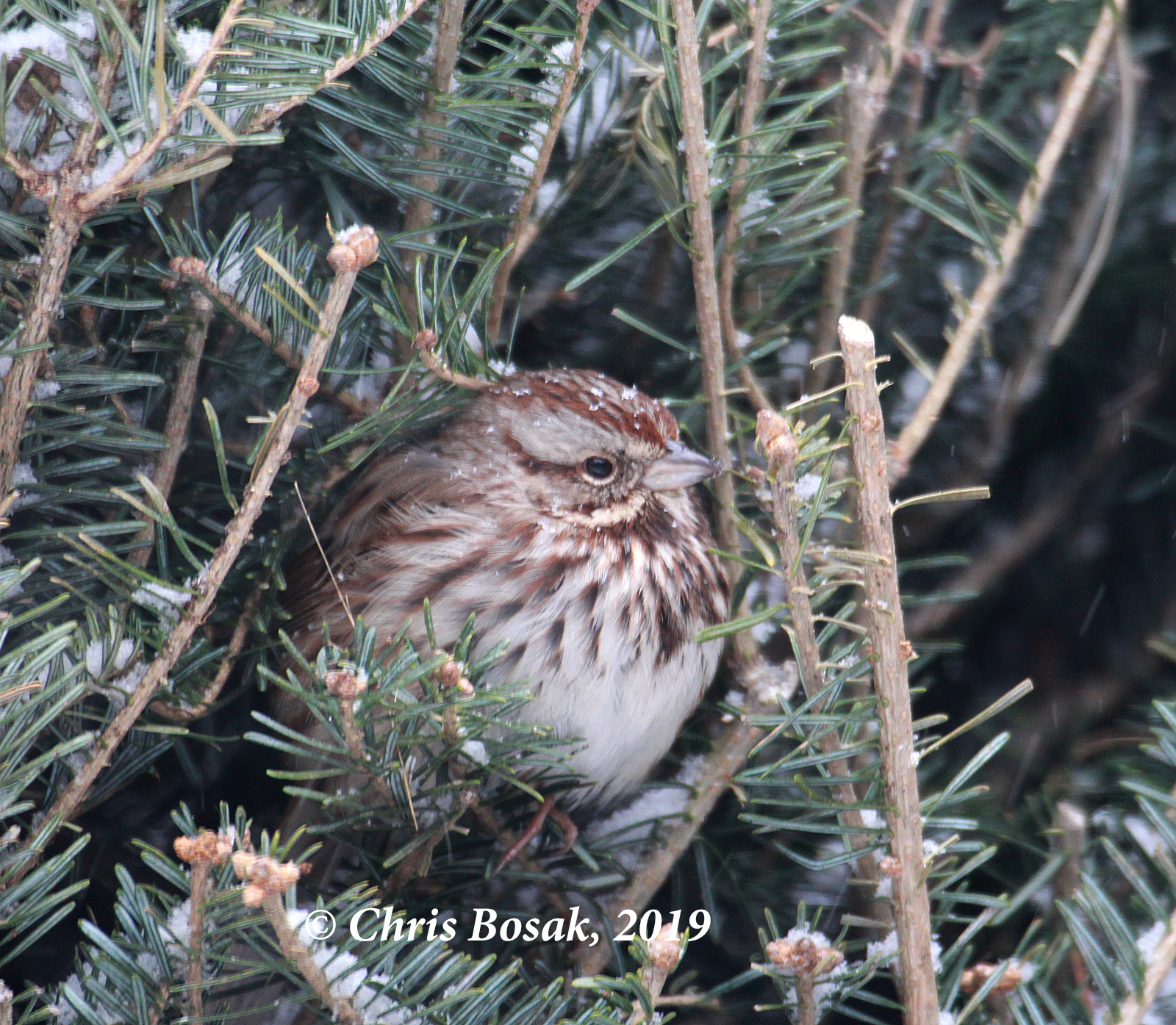
Photo by Chris Bosak A song sparrow eats berries at Dolce Center in Norwalk, Conn.

I had just discovered a new berry tree at work and thought to myself how great it would be to see the birds raid the tree when the berries ripened.

At the time, the majority of the berries were red with a few purple ones mixed in. It wouldn’t be long now, I figured, before they were all purple and the birds would be feasting on them.

About a week later, I went back to check out the tree and it was practically picked clean. Apparently, the berries ripened quicker than I thought they would, and the birds wasted no time in having their feast.

I missed the flurry of activity that had the tree stripped clean, but I did see a lone gray catbird fly in and out to grab a few of the remaining berries. At least I wasn’t completely shut out of the show.

Continue reading

For the Birds: The ‘forgotten’ birds

Photo by Chris Bosak A common yellowthroat perches on a branch in New England, July 2021.

Sometimes the residual birds get unduly forgotten when a bird walk features a highlight species. In other words, the other solid bird sightings get pushed to the back of the memory bank. Then, sometime after the excitement of the highlight species fades, be it hours, days or weeks, the other birds come back to you.

This happened to me the other week when a pair of male indigo buntings highlighted an evening walk. It had been a while since I had seen buntings, and I became singularly focused on them when recounting the walk.

As I looked through the photos of that walk, I was reminded of some of the other birds I had seen. Before I took untold numbers of photos of the bright blue indigo buntings, I had snapped a few photos of a common yellowthroat pair. I had completely forgotten about those birds until I started looking through the photos.

Continue reading

For the Birds: Indigo bunting brightens a summer evening

Photo by Chris Bosak An indigo bunting perches in a tree in New England, July 2021.

The song sounded familiar, but it had been months since I last heard it.

There is an indigo bunting around here somewhere I said to myself and instantly abandoned my plans for a long, strenuous walk. I knew I’d be at that spot for a while.

I couldn’t tell if the song was coming from the left or the right. It sounded like it was coming from both directions. I thought it was just because I’m getting old and my hearing was playing tricks on me.

But sure enough, there were two male indigo singing: one to the left of me and one to the right.

The bunting to the right was in the shade as the evening sun was dipping below the tree line. The bird to the left was illuminated in that magical evening light. I turned my focus to that bird.

Thankfully, the bird was fairly cooperative and even posed for a few photos in a berry tree. It didn’t eat the berries, but rather just used the tree’s branches for a vantage point.

It had been a few years since I was able to get photographs of an indigo bunting. Photographing any bird is enough to get my blood pumping, but a bird like an indigo bunting really gets the heart racing — especially when they are being cooperative.

Male indigo buntings are one of the more striking birds we see in New England, right up there with scarlet tanagers, Baltimore orioles and rose-breasted grosbeaks. Indigo buntings, like many songbirds, are sexually dimorphic, meaning the males and females look different. Also, like most birds that are dimorphic, the female is much duller than the male. The difference between the electric blue male and brown female is stark.

Continue reading

A few more bunting shots

Photo by Chris Bosak An indigo bunting perches in a tree in New England, July 2021.

The upcoming For the Birds column will provide more detail, but until then here are a few more shots of this beauty.

Photo by Chris Bosak An indigo bunting perches in a tree in New England, July 2021.

For the Birds: Sights of summer

Everyone loves summer. Beaches, barbecues, beer festivals.

Birds? Not so much. At least not when compared to spring and fall migration periods, or the busy feeder activity ahead of a New England snowstorm.

Summer is a fun time to watch young birds being raised if you are lucky enough to witness that spectacle. Along with that, however, comes the fact that many birds are trying to stay hidden as much as possible until the young are ready to venture into the world.

The waterfront — with its waders and shorebirds — is usually the best place to be during the summer if you want to see birds. That was true the other day when Katie and I took a walk and heard yellowlegs in the distance and spotted a great blue heron on the top of a pine tree. The dusk sun gave the heron an orange glow.

But this summer is also hopping away from the water. Catbirds, blue jays, cardinals, mourning doves, nuthatches and Carolina wrens are constant companions in my yard. Goldfinches are coming around in force now as well.

Speaking of backyard birds, Stephen from Keene offered a tip in response to last week’s column about cleaning bird feeders. He cleans his feeders regularly using vinegar instead of bleach as he feels it’s safer for the birds. It’s a good and timely tip as feeders should be cleaned frequently in the summer.

In the woods, I’ve heard more veeries than I can ever remember hearing. The veery is a type of thrush with a strange up and down flute-like song that reminds me of the old Space Invaders video game. I’m glad they aren’t invaders from another dimension because I’ve heard so many of them this summer. Every walk seems to be accompanied by the strange song.

One day last week, I pulled into a parking lot and scanned the scene. A black-crowned night heron flew across the far side of a pond and settled into a tree. Grackles and red-winged blackbirds provided action in the foreground. A Canada goose caught my eye in another area of the water. Then I noticed a male wood duck sitting on the grass just beyond the goose. Wood ducks are notoriously wary, but this guy seemed fairly comfortable in close proximity to the parking lot.

Most wood duck sightings are from great distances or of the back end of one flying away with the duck’s “oo-week, oo-week” call tauntingly fading away. I was grateful for the close and long view of this beautiful duck, which was still (or already) in its gaudy breeding plumage.

It also seems to be a good year for eastern kingbirds. I’ve gone entire summers when I’ve seen one or two of the handsome, fierce birds. This summer, it seems, I’ve seen dozens of them in different locations. I think of kingbirds as a rural bird, but several of the sightings have been in very suburban — even bordering urban — locations. I’ll take the sightings where I can get them.

Here’s hoping summer keeps it up. If nothing else, August is a great time to wander into New England’s fields and meadows. The bobolinks are much quieter, but the butterflies, dragonflies and other insects are fun to observe and photograph.

What are you seeing out there this summer? Drop me a line and let me know

A tale of two buntings

Photo by Chris Bosak An indigo bunting perches in a tree in New England, July 2021.

Sorry for the obvious headline, but here are two male indigo buntings: one with the sun (above) and one against the sun (below). No wonder they look a little different every time you see one.

Photo by Chris Bosak An indigo bunting sings from a tree in New England, July 2021.

Nice mid-summer bird sighting

Photo by Chris Bosak An indigo bunting sings from a tree in New England, July 2021.

There will be more on this sighting coming in the next couple of days, but here’s a teaser photo from a recent sighting in Connecticut. Can’t help but get excited about an indigo bunting sighting.

For the Birds: Keep those feeders clean

I’ve been keeping an eye on the news regarding the mysterious disease that has been killing birds in some Midwest and mid-Atlantic states.

It appears that the disease has not reached New England, although nearby states such as New Jersey and Pennsylvania have been impacted. Researchers still do not know what is causing the deaths, but they have ruled out several diseases that commonly afflict birds, such as West Nile, salmonella and avian conjunctivitis.

I did read a report that suggests the situation may be waning, which would be great news. I’d be more than happy if the disease never makes it to New England.

The Cornell Lab of Ornithology, my go-to source for information about birds, does not directly recommend taking down feeders, like so many other organizations do. Rather, it recommends following the guidelines put forth by an individual’s state fish and game commission.

Continue reading

For the Birds: Any walk is worth it

Photo by Chris Bosak A great blue heron stands on a dock.

Even when nothing out of the ordinary is seen, walks in nature are still valuable and memorable.

While my recent walks haven’t been full of extraordinary sightings, many moments stick out in my mind as enduring.

Here are a few:

A friend and I were taking a walk in a large conservation area dominated by wide swaths of fields. Thank goodness for those areas because birds such as bobolinks need that habitat to nest. While bobolinks were indeed plentiful, another sighting remained with me from that walk.

We were about to round a corner of the path that cuts through the field when we noticed something on the trail ahead. It was large and dark, and I thought at first it was a mammal such as a groundhog. Then I thought it was a turkey. Finally, my eyes and mind started to work together, and I realized it was a turkey vulture.

I could tell from its movements that it was eating something. Why else would a turkey vulture be sitting on the edge of a trail in the middle of a field? I peered through the binoculars and noticed the vulture was eating a dead snake. I tried to determine what type of snake it was, but I couldn’t get a clear enough view. It’s highly unlikely that the vulture killed the snake, but rather a hawk, kestrel or some other large predator.

As a supplemental sighting to that one, a second turkey vulture was perched behind us in a snag. It had gone unnoticed until we walked past it. Our heads turned when it flew off its perch and left the dead branch bouncing up and down like that old drinking bird toy. We heard its wings as it flapped past us. A resident red-winged blackbird did not take kindly to the circumstance and chased after the vulture rather aggressively. The vulture rose quickly, which seemed to satisfy the blackbird.

Continue reading

For the Birds: Mystery disease killing birds in U.S.

Photo by Chris Bosak An American Goldfinch with Avian Conjunctivitis visits a birdfeeder in Danbury, Conn., April 2016. A different disease is killing birds in the U.S. this summer.

Something is killing birds in unusually large numbers.

An as-of-yet undetermined disease has taken a heavy toll on birds such as robins, blue jays and grackles in about a dozen Mid-Atlantic and Midwest states. The die-off started in May and, while it hasn’t reached New England yet (as far as we know), officials at conservation organizations are encouraging people to take precautions to protect birds. Among the precautions: Stop feeding birds (or at least wash all feeders with a 10 percent bleach solution) and discontinue the use of birdbaths temporarily.

Disorientation, imbalance, lethargy and encrusted or cloudy eyes are among the symptoms of the birds afflicted with the disease. Young birds appear to have been disproportionately impacted. Researchers have confirmed that this differs from the avian conjunctivitis that has plagued house finches and goldfinches for many years. They have also ruled out many other potential causes, such as bacteria, viruses and parasites that commonly afflict birds.

It’s important to know what is not causing the die-off, of course, but finding out what is causing the event is even more significant. Determining that is still a work in progress.

One theory, which has been applauded by some and discounted by others, is that the die-off is related to the 17-year Brood X periodical cicada emergence. The geography of the die-off and emergence appears to align, and the theory suggests that the cicadas, which have been underground for 17 years, have soaked up pesticides, herbicides and whatever other nasty stuff we’ve been using to control insects and grow our grass and crops. It seems to make sense, but as I’ve mentioned, many researchers do not think the link is plausible.

Continue reading