Photo by Chris Bosak
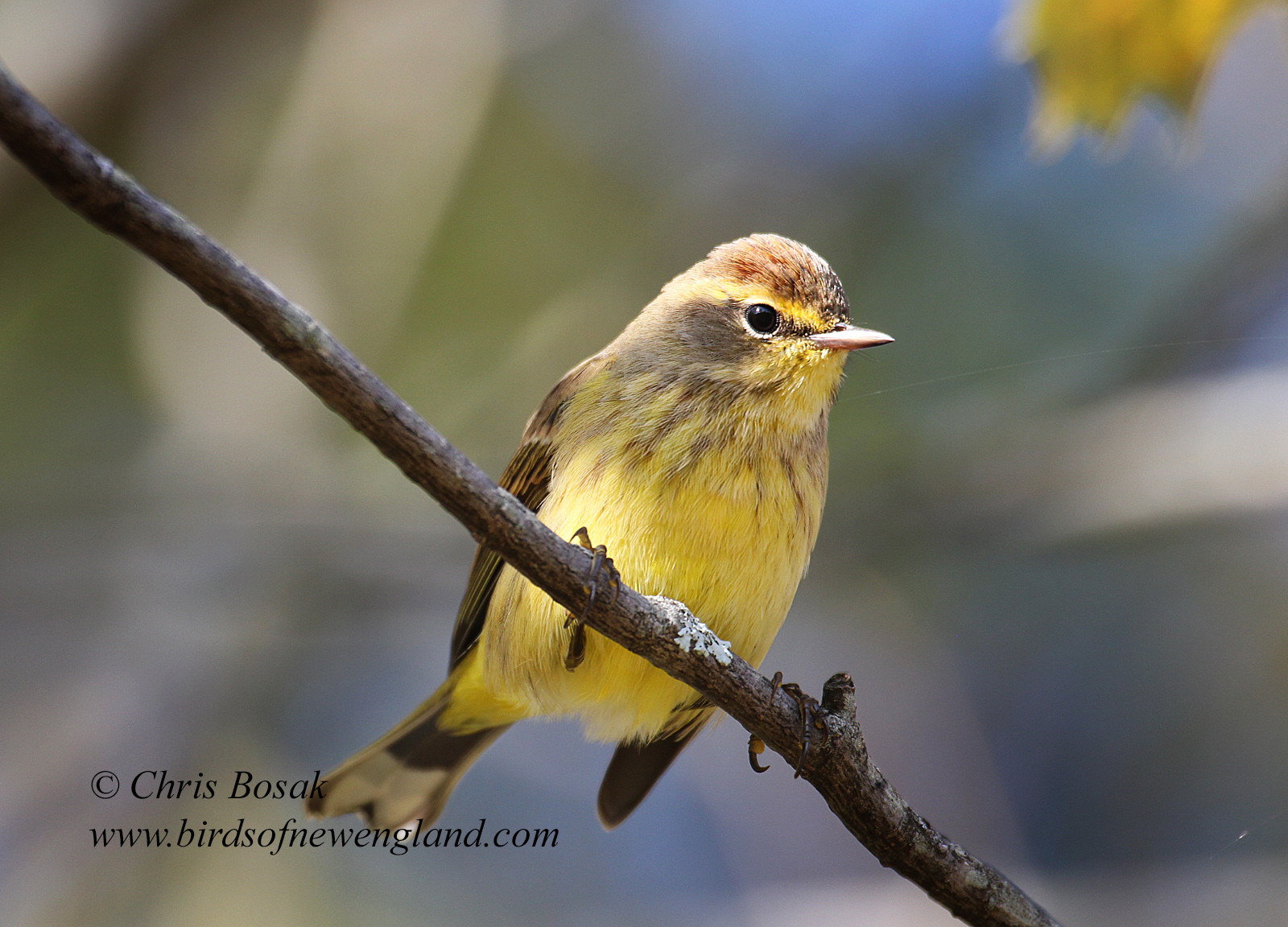
A palm warbler perches in New England, October 2021.
A pair of ruby-crowned kinglets flitted among the brush, and a crow or two flew overhead. That was all the bird action on the early part of the walk.
Then I heard a commotion coming from a nearby tree. It was a huge, dead maple tree with no leaves on its branches, but various types of vines climbed up its trunk and spread out among the limbs. The vines still had their leaves, making the tree look like nature had splattered various shades of red, yellow, orange and green on the venerable old guard.
Something must have been lurking among the brush because the birds were on high alert. I’ve never seen a more varied collection of bird species in one tree before. I could hardly believe it as I counted out the species in my head.
Photo by Chris Bosak
A yellow-rumped warbler eats poison ivy berries in New England, fall 2021.
Any birdwatcher knows that patience and faith are perhaps the two most important components to a successful bird walk.
I started a recent walk with high hopes, as I always do, but as the morning went on and no birds were to be found, I started to lose hope of seeing anything. To compound matters, the field at the park had recently been mowed for the first time of the year, making bird encounters even less likely.
It still would have been a pleasant walk because the autumn morning chill had given way to a beautiful and warm sunny day. But with fall migration in full swing, I was disappointed in the birding results.
Photo by Chris Bosak
An eft works its way across a path in New England, fall 2021.
Orange was the color of the day during a recent morning walk in the woods.
It had rained overnight and the trails were damp in most places and puddled in others. I got a flash of excitement when I saw my first eft. Then I saw another. Then another. Efts were underfoot on every fifth or sixth step.
Efts are eastern newts in the terrestrial stage. Some are brownish but most are bright orange and, despite their small size, very visible on paths in the woods. They can be found any day from late spring into fall, but damp weather is when you are most likely to find them, even if you aren’t looking for them.
Newts have four distinct stages, or life cycles. Females lay eggs on aquatic vegetation in the spring. A month to five weeks later, the eggs hatch and the newts live in water for a few months. At this larval stage, they are less than 1 inch long and have feathery gills. In the fall, they shed their gills, crawl onto land and live as efts for about three or four years. They spend New England’s harsh winters hibernating under logs or rocks.
Photo by Chris Bosak
Yellow-rumped Warbler in Selleck’s Woods, Darien, Conn., April 2014.
Note: This column was originally published in newspapers on Oct. 4.
There was a lot of environmental and bird-related news to come out of Washington this past week.
In case you missed it, the big news was that U.S. Fish and Wildlife Service officials declared the ivory-billed woodpecker extinct. The “Lord God Bird’s” removal from the endangered species list is surprising only because officials are reluctant to declare species extinct. It’s such a powerful word that carries with it such finality it’s a tough tag to put on something.
The dreaded label was also placed on 22 other species of wildlife, including eight freshwater mussels. Sadly, but not surprisingly, 11 species from Hawaii and the Pacific Islands have been declared extinct. That includes many birds.
Fall is an exciting time for birdwatching with hawkwatches, the southern warbler migration, and, later in the fall, the waterfowl migration.
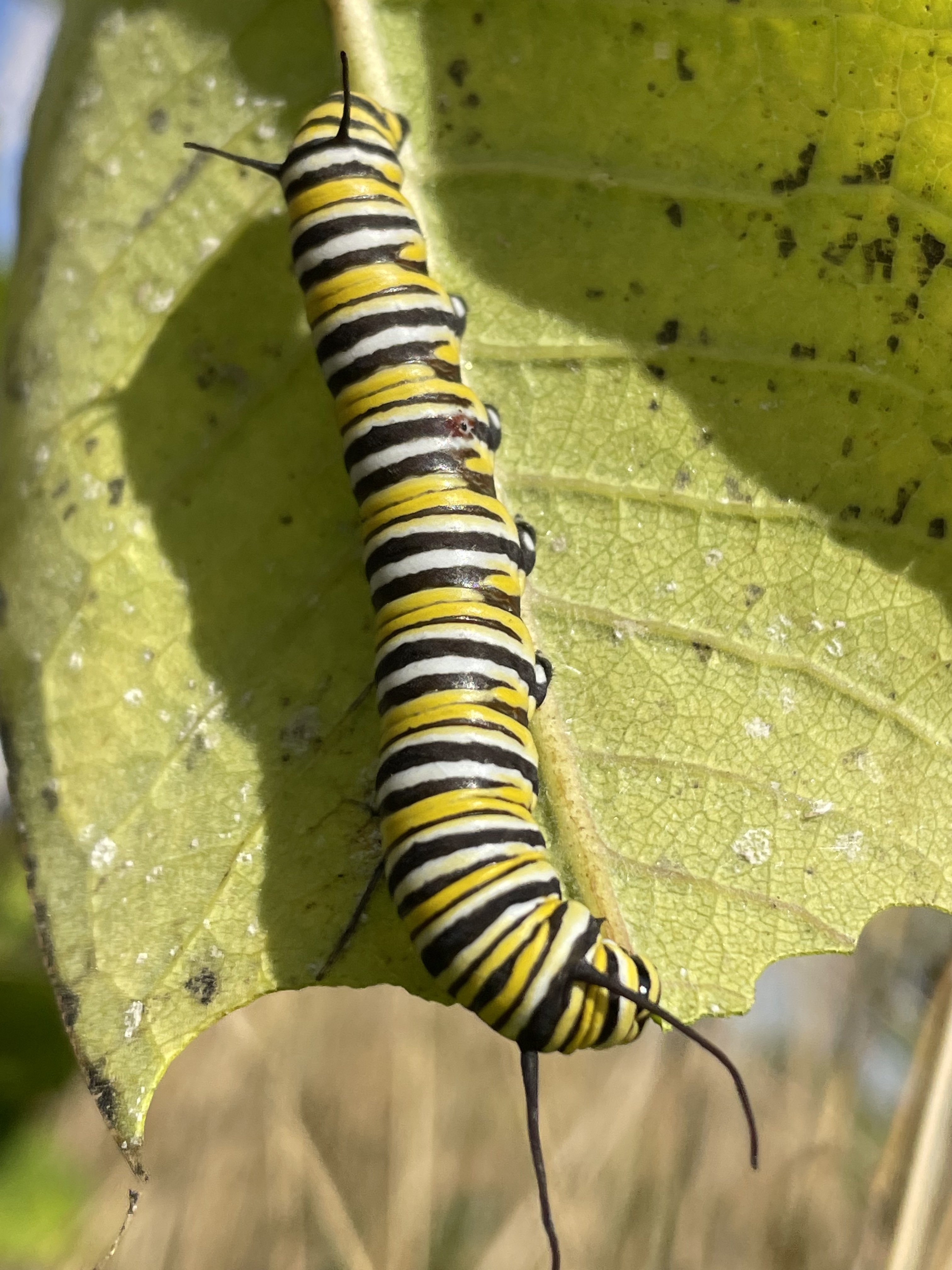
Early fall holds many non-bird surprises in nature as well. On recent walks, I have seen dozens of monarchs and other butterflies. When I walk through fields, I am constantly on the lookout for monarch caterpillars on milkweed plants. Rarely am I lucky enough to spot one, but it does happen on occasion. The other day happened to be one of those occasions.
Monarchs are struggling as a species as habitat loss, pesticides and, potentially, climate change have played a heavy toll on their numbers, particularly out West. I did read an article recently that said the numbers may be rebounding, however. That would be great news.
Photo by Chris Bosak
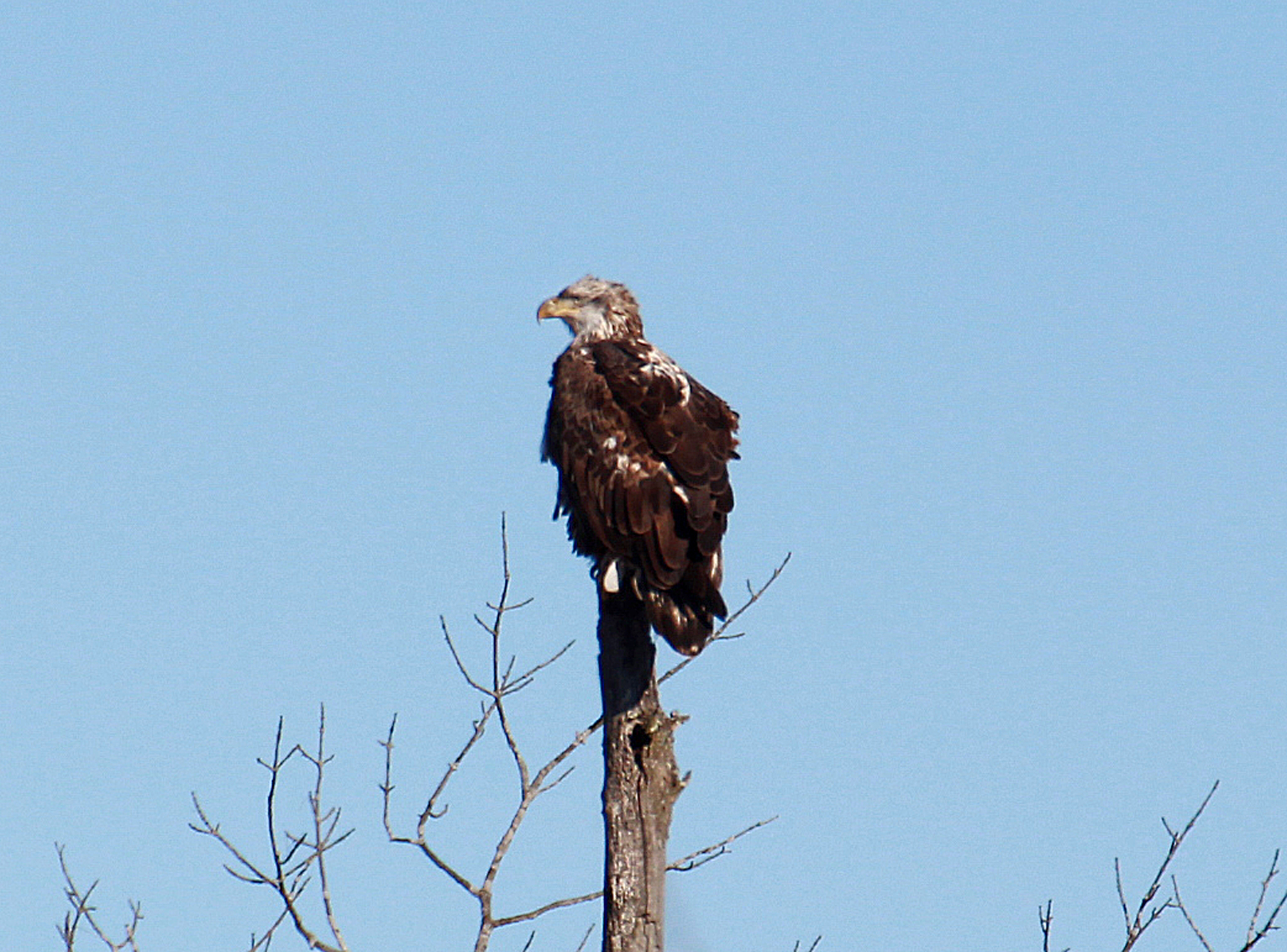
A young bald eagle perches on a dead tree near Danbury Fair mall in Danbury, CT, March 2019.
It was an eagle. There was no doubt about that. I second-guessed myself only for a second because of where the sighting took place.
It was not on a remote lake in northern New England or on one of the islands in Long Island Sound. It was right along a highway.
We are all used to seeing hawks perched along the highway. In fact, when I drive to Pennsylvania a couple of times a year to visit family, I make it a point to count the number of red-tailed hawks I see perched in trees along Route 86. It’s usually between 10 and 15. Hey, it passes the time on a long drive.
I noticed from far away as I approached the scene that there was a bird perched in a tree overhanging a somewhat busy state highway. Even from a significant distance, I could tell it was not a hawk. The only question was whether it was an eagle or a vulture. It did not have the posture of a vulture, but rather the regal stance of an eagle.
Photo by Chris Bosak
A common yellowthroat perches on a branch in New England, July 2021.
Sometimes the residual birds get unduly forgotten when a bird walk features a highlight species. In other words, the other solid bird sightings get pushed to the back of the memory bank. Then, sometime after the excitement of the highlight species fades, be it hours, days or weeks, the other birds come back to you.
This happened to me the other week when a pair of male indigo buntings highlighted an evening walk. It had been a while since I had seen buntings, and I became singularly focused on them when recounting the walk.
As I looked through the photos of that walk, I was reminded of some of the other birds I had seen. Before I took untold numbers of photos of the bright blue indigo buntings, I had snapped a few photos of a common yellowthroat pair. I had completely forgotten about those birds until I started looking through the photos.
Photo by Chris Bosak
An indigo bunting perches in a tree in New England, July 2021.
The song sounded familiar, but it had been months since I last heard it.
There is an indigo bunting around here somewhere I said to myself and instantly abandoned my plans for a long, strenuous walk. I knew I’d be at that spot for a while.
I couldn’t tell if the song was coming from the left or the right. It sounded like it was coming from both directions. I thought it was just because I’m getting old and my hearing was playing tricks on me.
But sure enough, there were two male indigo singing: one to the left of me and one to the right.
The bunting to the right was in the shade as the evening sun was dipping below the tree line. The bird to the left was illuminated in that magical evening light. I turned my focus to that bird.
Thankfully, the bird was fairly cooperative and even posed for a few photos in a berry tree. It didn’t eat the berries, but rather just used the tree’s branches for a vantage point.
It had been a few years since I was able to get photographs of an indigo bunting. Photographing any bird is enough to get my blood pumping, but a bird like an indigo bunting really gets the heart racing — especially when they are being cooperative.
Male indigo buntings are one of the more striking birds we see in New England, right up there with scarlet tanagers, Baltimore orioles and rose-breasted grosbeaks. Indigo buntings, like many songbirds, are sexually dimorphic, meaning the males and females look different. Also, like most birds that are dimorphic, the female is much duller than the male. The difference between the electric blue male and brown female is stark.
I’ve been keeping an eye on the news regarding the mysterious disease that has been killing birds in some Midwest and mid-Atlantic states.
It appears that the disease has not reached New England, although nearby states such as New Jersey and Pennsylvania have been impacted. Researchers still do not know what is causing the deaths, but they have ruled out several diseases that commonly afflict birds, such as West Nile, salmonella and avian conjunctivitis.
I did read a report that suggests the situation may be waning, which would be great news. I’d be more than happy if the disease never makes it to New England.
The Cornell Lab of Ornithology, my go-to source for information about birds, does not directly recommend taking down feeders, like so many other organizations do. Rather, it recommends following the guidelines put forth by an individual’s state fish and game commission.
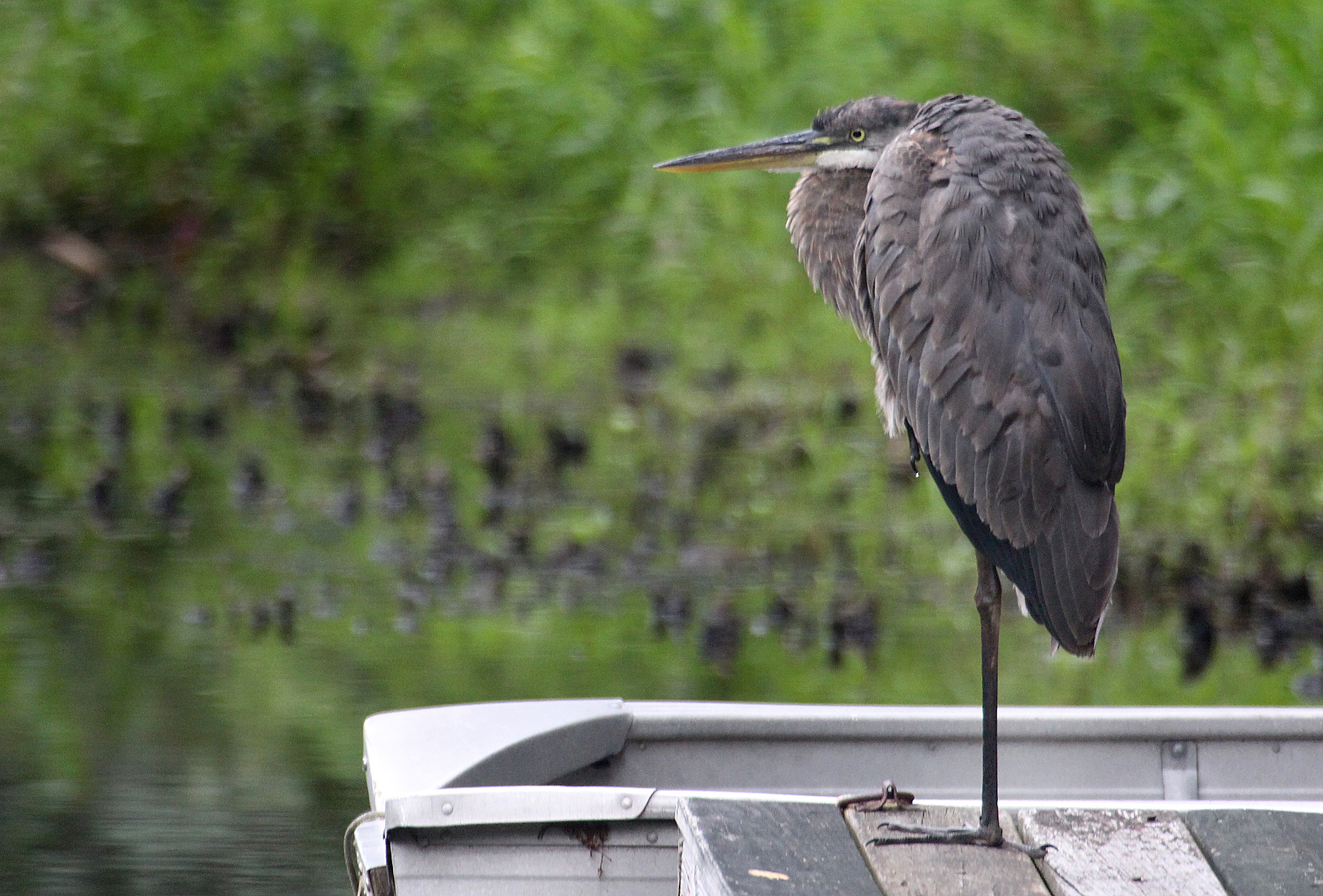
Photo by Chris Bosak A great blue heron stands on a dock.
Even when nothing out of the ordinary is seen, walks in nature are still valuable and memorable.
While my recent walks haven’t been full of extraordinary sightings, many moments stick out in my mind as enduring.
Here are a few:
A friend and I were taking a walk in a large conservation area dominated by wide swaths of fields. Thank goodness for those areas because birds such as bobolinks need that habitat to nest. While bobolinks were indeed plentiful, another sighting remained with me from that walk.
We were about to round a corner of the path that cuts through the field when we noticed something on the trail ahead. It was large and dark, and I thought at first it was a mammal such as a groundhog. Then I thought it was a turkey. Finally, my eyes and mind started to work together, and I realized it was a turkey vulture.
I could tell from its movements that it was eating something. Why else would a turkey vulture be sitting on the edge of a trail in the middle of a field? I peered through the binoculars and noticed the vulture was eating a dead snake. I tried to determine what type of snake it was, but I couldn’t get a clear enough view. It’s highly unlikely that the vulture killed the snake, but rather a hawk, kestrel or some other large predator.
As a supplemental sighting to that one, a second turkey vulture was perched behind us in a snag. It had gone unnoticed until we walked past it. Our heads turned when it flew off its perch and left the dead branch bouncing up and down like that old drinking bird toy. We heard its wings as it flapped past us. A resident red-winged blackbird did not take kindly to the circumstance and chased after the vulture rather aggressively. The vulture rose quickly, which seemed to satisfy the blackbird.





 Birds of New England.com