I pulled into the tire shop for my appointment the other day, handed over the keys and asked how long it would take. The nice gentleman said it would be at least an hour, but that I was welcome to sit in the waiting area and help myself to coffee.
It was an ideal late summer/early fall day and the fall migration was well underway, so I decided to take a walk instead.
I gave the guy my cell phone number, asked him to give me a call when the truck was ready, and set out to find the nearest place where I might find some birds.
Sometimes, or more accurately, rarely, a big surprise happens. You look out at your feeder and a bird you hadn’t seen in years is perched enjoying a meal. Or you are taking a winter stroll on a New England beach and notice a snowy owl resting in the distance.
The other day, I was treated to a few surprises on a much smaller magnitude. They came at a small park with a tiny pond in suburbia that typically has your normal birds. Crows and sparrows are the main birds with a few mallards in the pond.
On this particular day, however, things were a little different.
I normally drive right past the park without stopping or even casting a glance toward the pond, but something big and white caught my eye as being out of the ordinary. It was a great egret standing near the edge of the water. It wasn’t right at the edge where you would typically see an egret but rather 10 to 15 feet into the grass away from the pond. A sizable flock of Canada geese roamed around the grass near the egret.
Photo by Brian Thoele – Brian Thoele of Norwalk, Conn., got this shot of a downy woodpecker on a hummingbird feeder.
Hummingbird feeders, as the name suggests, are meant to attract hummingbirds.
It’s right in the name “hummingbird feeder.”
But, as we all know, it attracts a lot more than hummingbirds. The most common invaders include yellowjackets, hornets, bees, and ants. However, hummingbird feeders also attract larger critters such as bats, squirrels, raccoons, and even bears.
The list doesn’t stop there as a few emails I received this week point out. Other birds enjoy a visit to a hummingbird feeder as well.
Downy woodpeckers are probably the most common other birds that visit hummingbird feeders. Michele from the Monadnock Region wrote in to share that two woodpeckers had dislodged five of the six yellow plastic inserts that go into the feeding ports. The plastic inserts are supposed to keep birds like woodpeckers away, but these woodpeckers found a way around it. Michele did her best to find the inserts and put them back, but the woodpeckers just popped them out again.
Photo by Chris Bosak
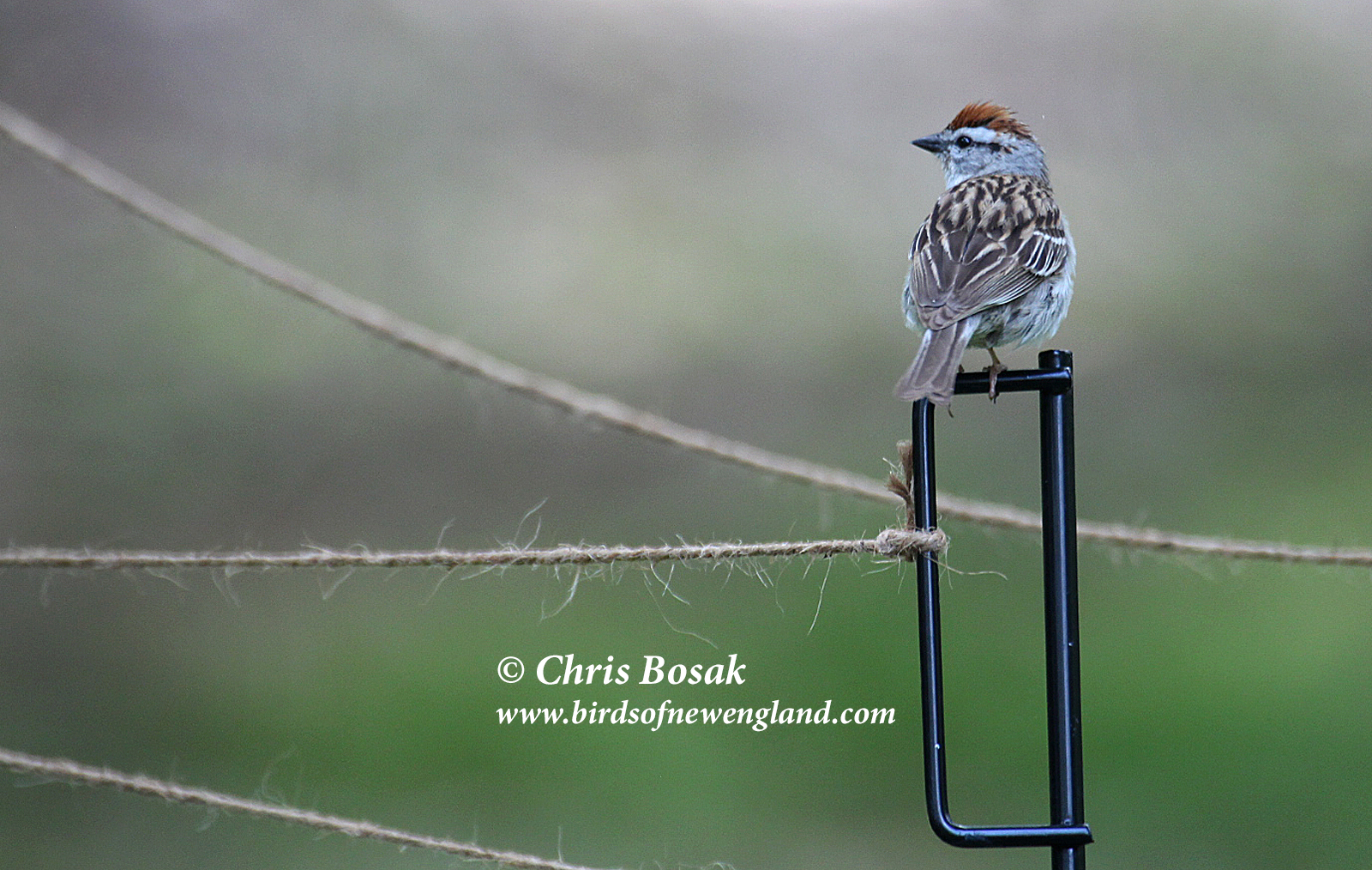
A chipping sparrow perches on a garden stake in New England, July 2020. Merganser Lake.
The chirping was coming from the small tree right next to me. That much was clear. What wasn’t clear was where the bird was exactly or what type of bird it was.
I looked among the leaves for a minute or two to no avail. Then the bird jumped down to a dead branch just above eye level. It was a chipping sparrow. If it had been singing instead of chirping/calling I would have recognized it without having to see it. I can recognize many calls or chips but apparently not the chipping sparrow’s.
I was glad the bird hopped down to offer a good look. Too many times to count I’ve zeroed in on a bird following its song or call only to have the bird eventually fly off with me never having seen it or identified it. It’s one of the more frustrating things when it comes to birdwatching.
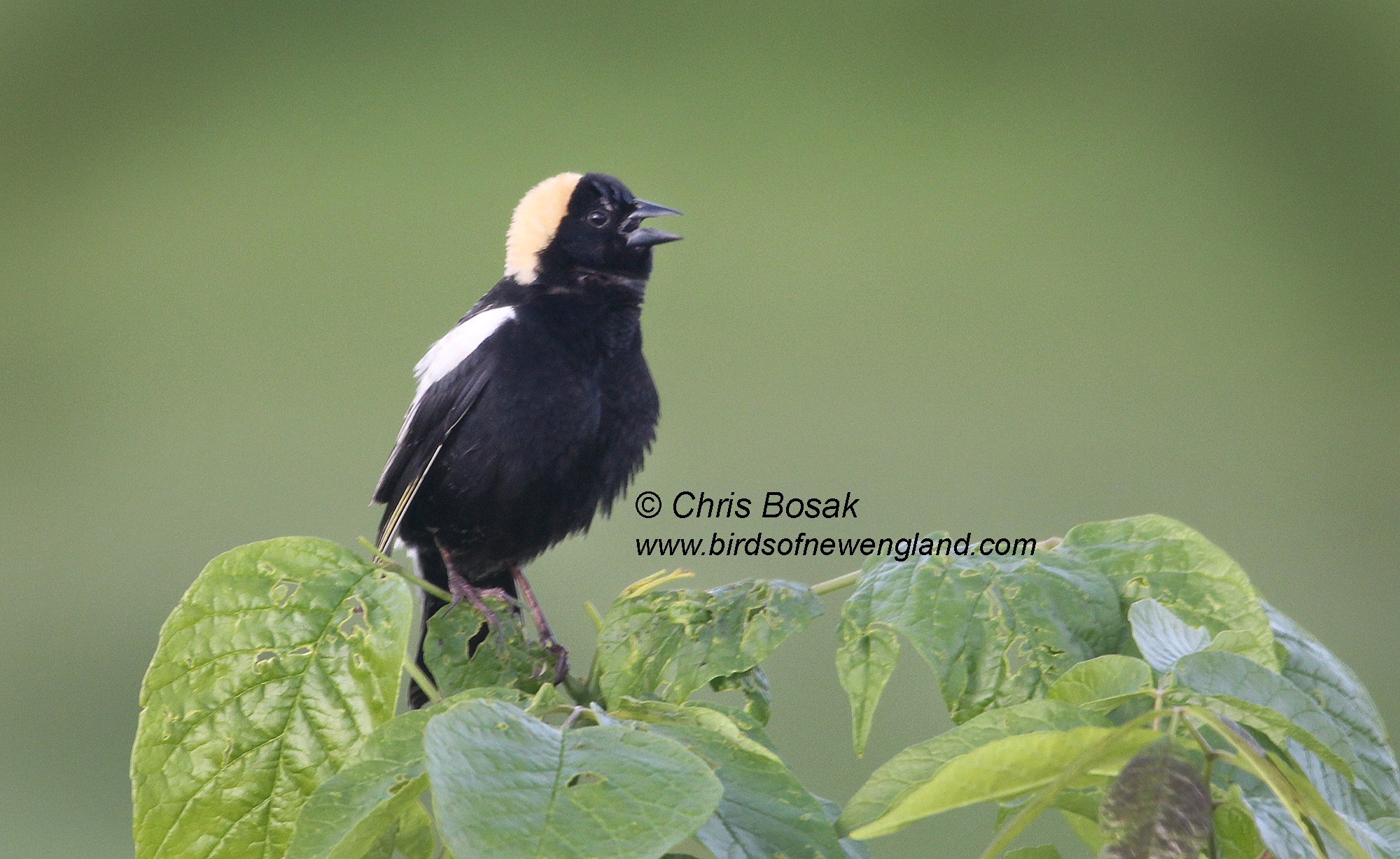
Photo by Chris Bosak – Bobolink in New England field.
House wrens and American goldfinches have been my main source of avian entertainment this past week.
Both of these birds nest, on average, later than most other songbirds. While birds such as phoebes and robins get started in March or April, house wrens and goldfinches start in late spring/early summer. I hear the disjointed, but still rather cheerful, song of the house wren every time I walk out my door. The goldfinches are more quiet, but highly visible in their bright yellow plumage going back and forth to the nest site.
Goldfinches feed their babies a vegetarian/seed diet so the early insect hatch that prompts so many other songbirds to nest is of no practical to goldfinches. Rather, they must wait until flowers to bloom and go to seed before raising their young. Their primary diet consists of milkweed, thistle and other “weeds.”
Photo by Chris Bosak
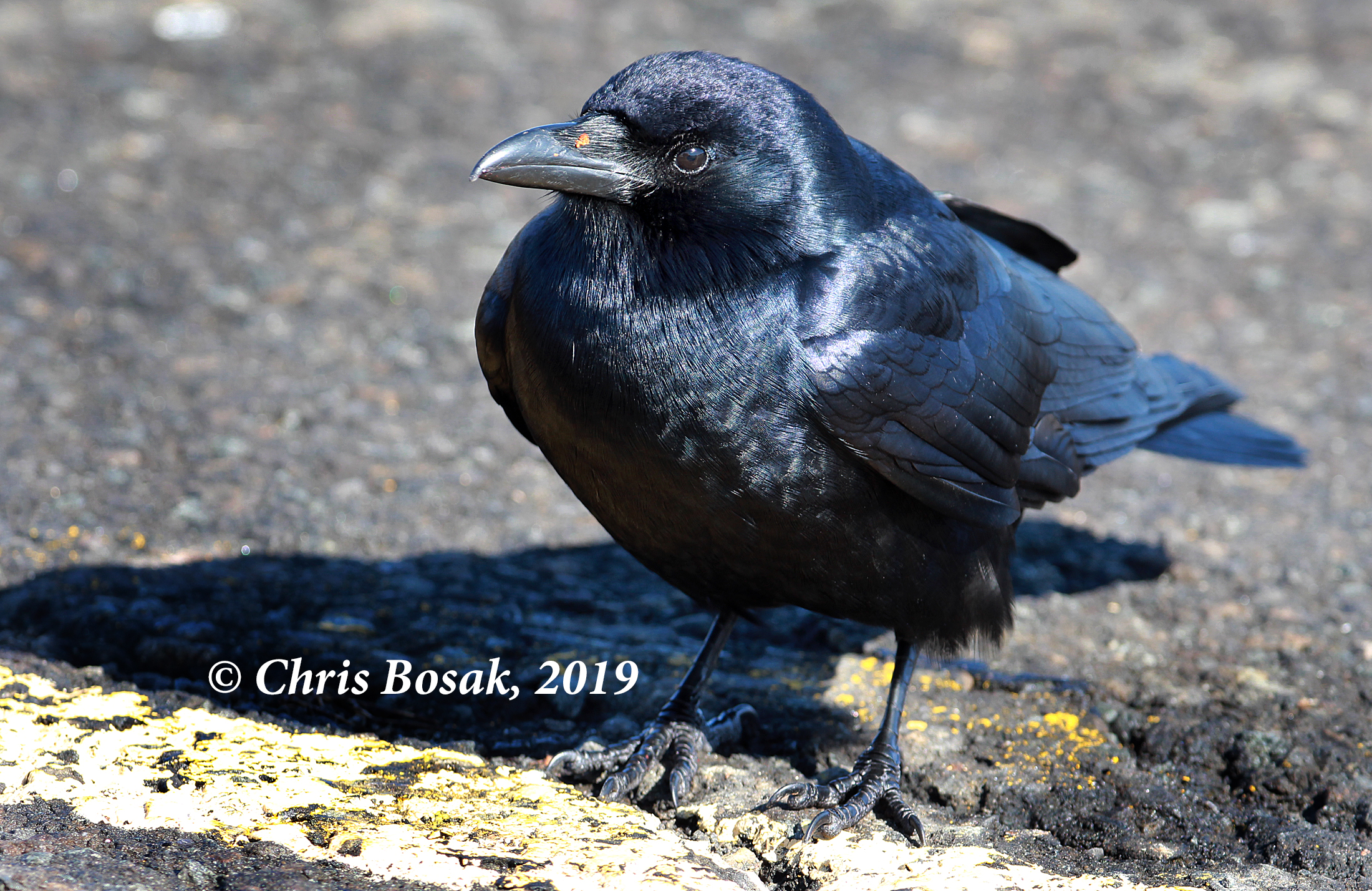
An American crow in Danbury, CT, winter 2019.
It’s like clockwork.
At 6:45 p.m. the crows glide in and land on the upper branches of the mostly dead, huge maple tree in the front yard.
It’s not a massive number of crows like you’d see in the winter at dusk; rather, it’s a small gathering. First two adults land, then two youngsters follow. They sound a few seemingly innocent caws, but their disagreeable reputation as egg-eaters precedes them.
The crows’ arrival puts the other birds in the neighborhood on alarm. Robins sound off from the surrounding trees but remain out of view. Cardinals, also unseen, use their high chip alert calls to keep in contact with each other. Orioles join in but keep their distance.
Blue jays and grackles are more aggressive in their attempts to drive the crows away from the neighborhood. The blue jays squawk and dive-bomb. More jays emerge from the trees and join the effort.
It is hit or miss when it comes to photographing birds. It is mostly miss, but that just makes the hits even more rewarding.
Once in a great while, I have come across very cooperative birds. One of the more memorable times took place on a small lake in New Hampshire where a great blue heron stalked its prey on the shoreline as I silently approached in my canoe. The bird never broke its glance on its prey as my canoe drifted into range.
There have been a few times when a loon, or a loon family, has approached me in my canoe. Talk about a wonderful experience, especially when they sing or call from close range. There is no better wilderness experience than that.
Feeder birds can often make for a similar experience, but there is nothing like finding a cooperative bird in the wild. This particularly goes for birds that you otherwise wouldn’t see in your backyard. These moments come along often when I visit family in Florida, but New England birds are much more challenging.
The warblers are back and delighting, confusing, and frustrating birdwatchers throughout New England.
Warblers are small, usually colorful, passerine (perching) birds that migrate into New England every spring. Many nest here while others continue north to nest in Canada. In the fall, they head to points south such as southern U.S., the Caribbean, Central America or South America. The odd warbler shows up on New England Christmas Bird Counts from time to time, but for the most part, they are gone before the snow starts to fly.
To me, the quintessential warbler is the yellow warbler. It is small, brightly colored, numerous throughout the region and sings its ubiquitous song (“sweet sweet I’m so sweet”) over and over from the brush. It is all yellow with some rusty streaking on its chest and belly.
Warblers come in all colors, however. Many are mostly yellow and many others have flashes of yellow in their plumage. Some are black and white, and some are mostly brownish. A few are mostly blue. It’s no wonder that the spring migration, highlighted by warblers, is the favorite time of year for most birdwatchers.
I’ve missed countless photo opportunities while driving because I did not have my camera with me.
This time I was well-armed.
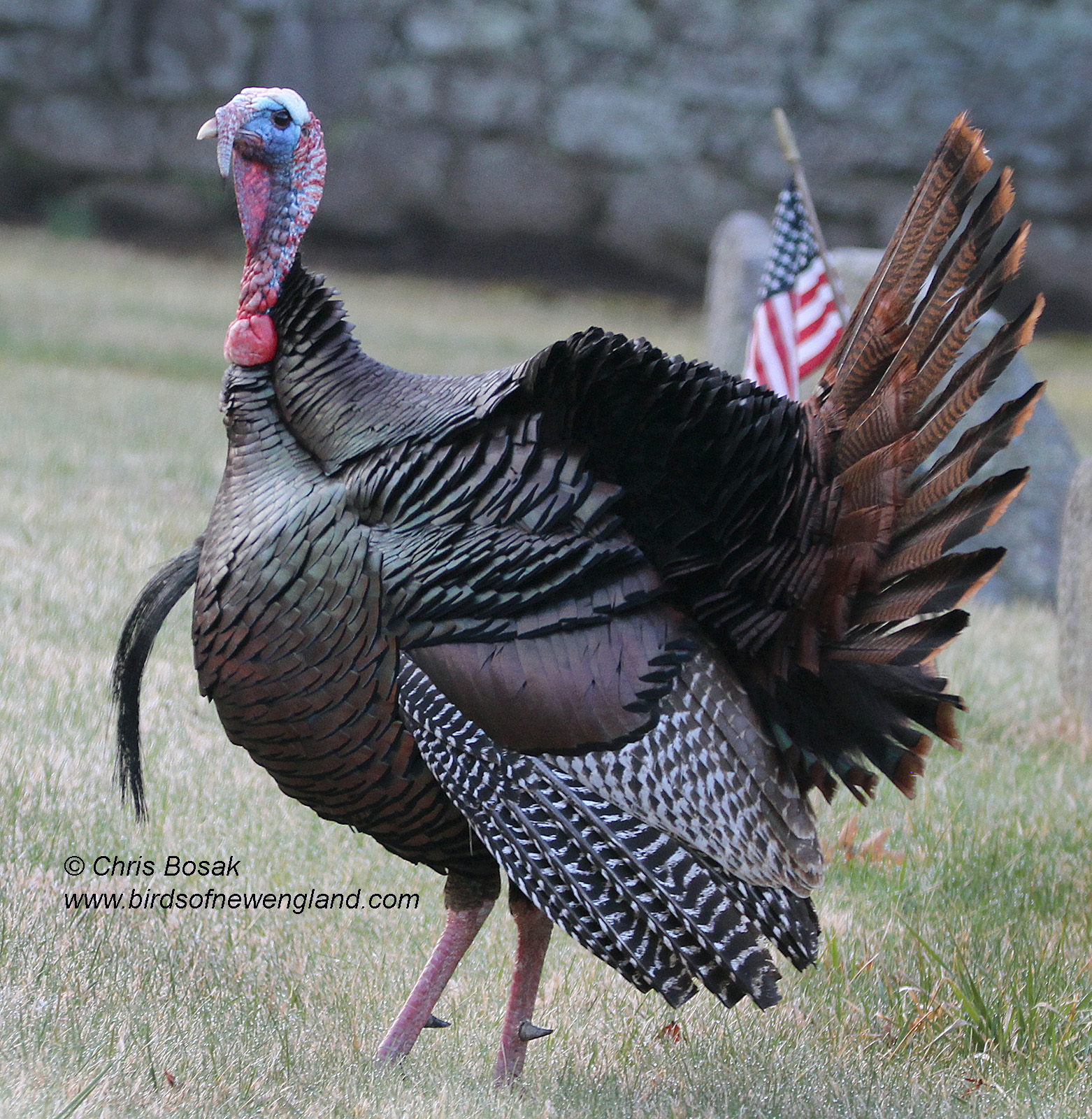
I was driving to work along my usual route when I passed a small, historic cemetery that I have passed hundreds of times before. On this day, I noticed a flock of turkeys among the grave markers as I sped past. I found the nearest safe place to turn around and headed back to the cemetery.
Here’s where my stories usually end with “but they were gone.”
Photo by Chris Bosak
An American robin perches in a tree in New England, June 2020. Merganser Lake.
I think we can officially call it spring now.
The myth that robins are the harbinger of spring has been debunked several times over. I have even mentioned that as being the case in this column several times. But, I’m going to backtrack a bit and say that I still consider the robin to be a harbinger of spring of sorts.
Many robins stay in New England throughout the winter, which is why it is not a true harbinger of spring as you can see them in January or February as well as March or April.