For the Birds: Inside the hawkwatch

Photo by Chris Bosak
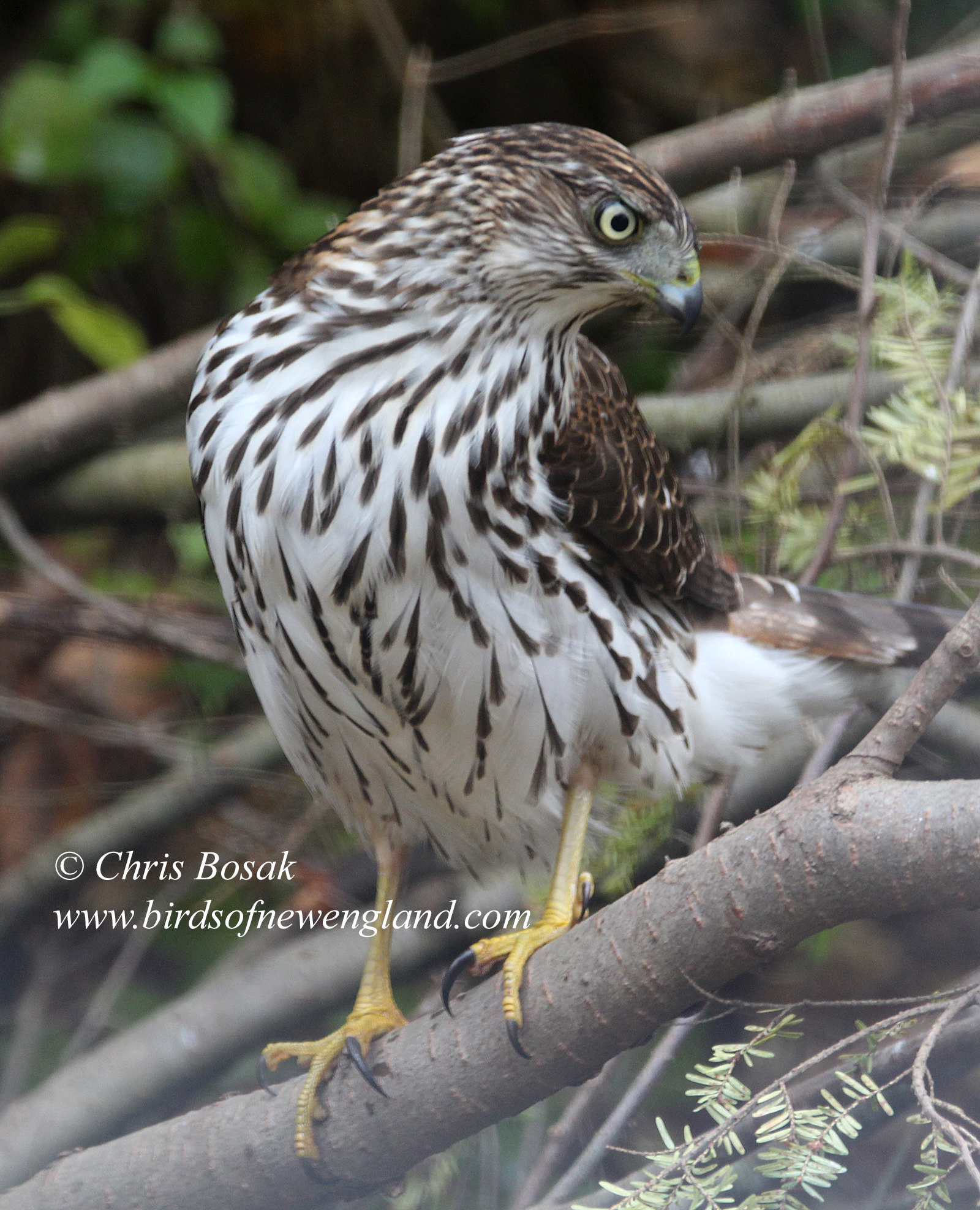
Young Cooper’s hawk in New England.

Last week’s For the Birds column highlighted the results of this year’s fall hawkwatches with a particular focus on Pack Monadnock in Peterborough. The column was heavily focused on data and the number of birds counted.

A number of questions came up in my head as I looked at the results and compiled the data. Not one to let questions go unanswered in my head, I turned to the experts for some explanations.

Specifically, I had an enjoyable chat with Phil and Julie Brown of Hancock, N.H. Phil is the Bird Conservation Director and Land Specialist at the Harris Center for Conservation Education. His wife, Julie, is the Raptor Migration and Program Director of the Hawk Migration Association.

The sheer number of broad-winged hawks was the main thing that jumped out at me as I looked at the data last week. Nearly 6,000 of the 8,500 hawks counted during the 2025 fall migration at Pack Monadnock were broad-winged hawks. To me, it was a bit surprising, as I see red-tailed hawks and red-shouldered hawks all the time, but I rarely see broad-winged hawks.

As a quick reminder, “hawkwatch” in this sense includes eagles, ospreys, falcons and vultures as well.

Julie and Phil explained that broad-winged hawks tend to be more elusive during the breeding season and that they more readily form flocks for migration than other raptors. While most hawks pass over the mountain as one or two birds at a time, broad-winged hawks pass over in huge numbers on certain days.

“They are responsible for a lot of the magic of hawkwatches,” Julie said. “Many people say broad-winged hawks are what got them hooked on hawkwatches.”

While the broad-winged hawk migration is truly a spectacle, with as many as 3,000 or more seen on a single day, it is very time specific. September 14-20 is the sweet spot when nearly all of the broad-wingeds pass through. Phil said many people take the entire week off from work to not miss the right day.

Mark your calendars for the middle of next September and keep your eyes out for a forecast that calls for light or variable winds from the north (or northeast or northwest), particularly following a cold front.

As remarkable as 3,000 birds in a single day is, Julie pointed out that critical hawkwatching sites such as Veracruz, Mexico, can get hundreds of thousands of broad-winged hawks in a single day.

I had a similar question about sharp-shinned and Cooper’s hawks, smallish but fierce hawks that often terrorize birdfeeders. While we tend to see more Cooper’s hawks in our daily lives, sharp-shinned hawks far outnumber Cooper’s hawks on counts. Cooper’s hawks have adapted much better to suburban and urban areas, and many overwinter in New England.

Differentiating between these accipiters often leads to debate, as the species are very similar in appearance. Cooper’s hawks are generally larger, but size is not a reliable determining factor. Even experts debate which bird they are looking at.

Seeing one of these hawks from a distance during a hawkwatch makes for an easier identification, Phil said, as their wing-flapping cadence and other behaviors are reliable differentiators.

Despite the seemingly high numbers of sharp-shinned hawks that are counted on hawkwatches, the Browns said the species is in decline. Phil said sharp-shinned hawks, goshawks, American kestrels and northern harriers do not get the attention they deserve for their decline.

Julie said rodenticides are a major factor in the decline of many hawks, and wildlife rehabilitators are often overwhelmed by the number of poisoned hawks that are brought in. Many people who use rodenticides do not realize the consequences, she said, and education is important in reversing the trend.

“It’s so preventable,” she said.

To end on a positive note (it is the holiday season, after all), the Browns actually met during a hawkwatch on Pack Monadnock in 2006. Julie was a seasonal hawk counter for New Hampshire Audubon, and Phil worked for New Hampshire Audubon at the time. They met on the mountain and got to talking about their love of nature and the boreal forest. Their main goal that day was to see a golden eagle, and sure enough, one of the magnificent birds flew over.

Their wedding bands are adorned with etchings of a golden eagle and the profile of Pack Monadnock.

For the Birds: Breaking down hawkwatch season

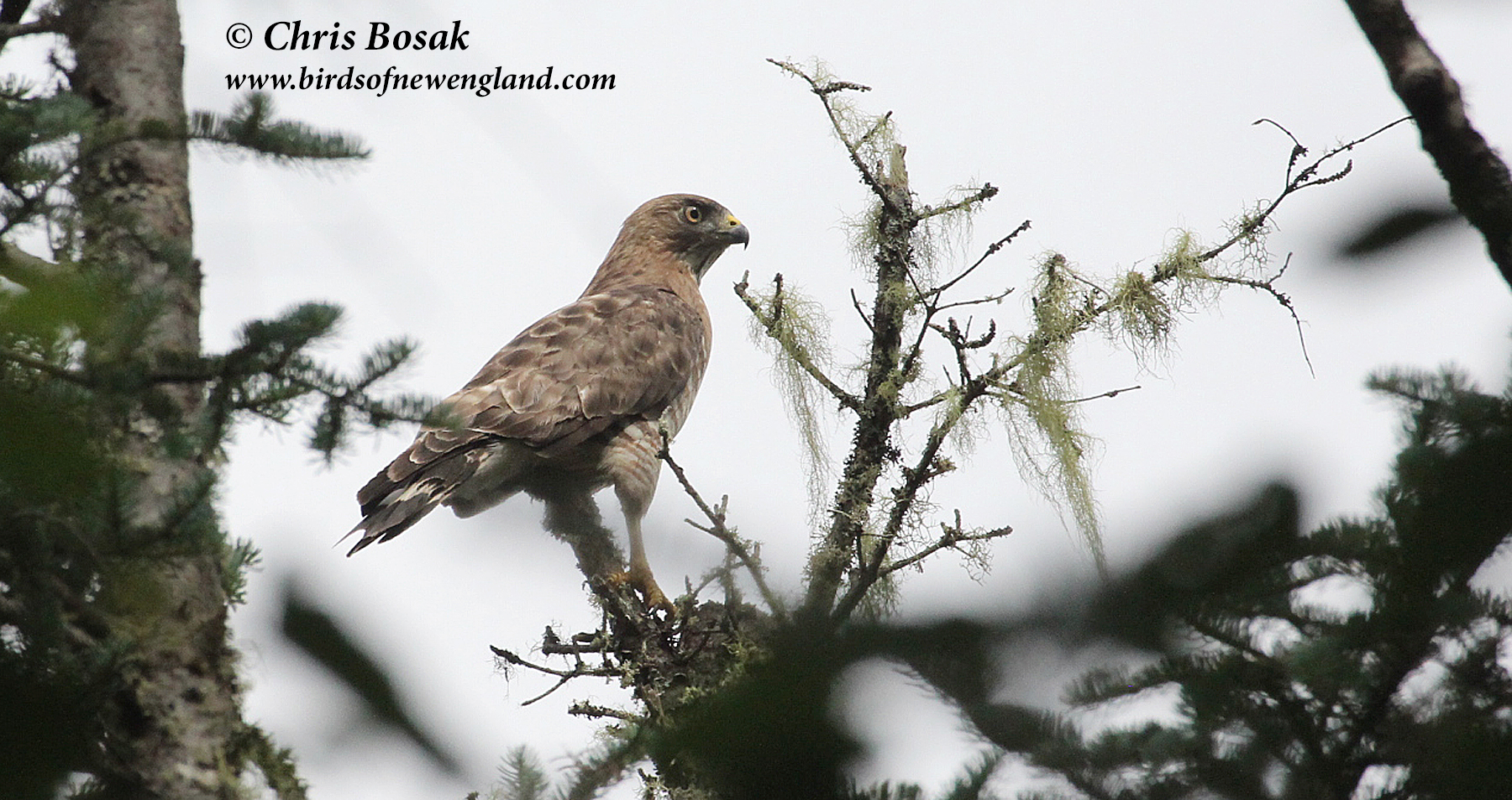
Photo by Chris Bosak A broad-winged hawk perches in a tree in northern New Hampshire, July 2020.

The fall hawkwatching season is winding down. Raptor sightings at the various dedicated locations are slowing down, with only a handful of birds counted each day as November progresses.

It’s a good time, therefore, to check in to see how the various hawkwatching sites fared this year. New England has several popular sites, but Pack Monadnock at Miller State Park in Peterborough is New Hampshire’s most active and popular site. The hawk count is a project of the Harris Center for Conservation Education in Hancock.

As of November 11, and according to hawkcount.org, overall numbers look good in 2025 at Pack Monadnock and outpace the number of hawks counted in 2024. It may be noted, however, that 2025 numbers are below the several years prior to 2024. With the official count season ending there on November 20, Pack Monadnock will end up with about 8,500 hawks counted for the fall.

The term hawk is used somewhat loosely here as the count includes hawks, eagles, ospreys, vultures and falcons. The hawks are counted by experts and volunteers who sit at the peak of Pack Monadnock and watch the birds soar in from the north. I’ve been to several hawkwatch sites and am always amazed at the skills of the official counters. They see and identify most of the birds long before the bird is even in view of most other people. 

Before reading on, can you guess what hawks are counted the most? Hint: One bird stands head and shoulders above the rest in terms of sheer numbers. Another hint: It’s not the red-tailed hawk, which I assume would be many people’s first guess. 

That bird is the broad-winged hawk. Of the roughly 8,500 birds counted at Pack Monadnock this fall, nearly 6,000 (5,821 to be precise) were broad-winged hawks. A distant second is the sharp-shinned hawk with 1,133. 

Simple math (even though I used a calculator) shows that broad-winged and sharp-shinned hawks account for more than 80 percent of the total birds counted. The number drops sharply again for the third-most-counted “hawk,” the turkey vulture, with 222 individuals counted. 

For all you stat geeks out there (like me), the next birds in line are American kestrel (196), Cooper’s hawk (190), osprey (167), bald eagle (159), red-tailed hawk (154) and northern harrier (121). Remember, these are not final numbers, but they will be pretty close.

Although “only” five golden eagles were counted, I’m sure each one elicited some oohs and aahs from the crowd. 

According to hawkcount.org, a page that aggregates hawkwatch sites across the country, a few New Hampshire schools performed mini-hawkwatches this September. Concord School District did a week-long program and counted, you guessed it, mostly broad-winged hawks. Turkey vultures were also counted in fairly high numbers.

Interlakes Elementary School in Meredith did a two-day count and found an impressive 1,350 broad-winged hawks, including 1,257 in a single day. Sharp-shinned hawks and turkey vultures were the next highest counts. 

The aptly named Hawk Mountain Sanctuary in Kempton, Pennsylvania, is perhaps the most well-known hawkwatch site in the East. Similar to Pack Monadnock, broad-winged hawks were the most numerous, accounting for 9,015 of the 13,436 overall birds counted. Sharp-shinned hawks were next with 1,530. 

If you missed this year’s hawk counts, mark your calendars for next year. You don’t want to miss mid-September, which is when the number of broad-winged hawks peaks. More than 3,000 broad-wingeds were counted on September 14 at Pack Monadnock. The conditions must have been right just on that day. October is a good month to see a variety of species, while things start to slow down by November.

The end of hawkwatching season means that winter is right around the corner. Winter may bring out a bah humbug from many, but it is also a great time for birdwatching, just in a different way.

Latest For the Birds column: Hawkwatching primer

Photo by Chris Bosak An Osprey soars over the Norwalk River on Monday, Sept. 1, 2014.

Photo by Chris Bosak
An Osprey soars over the Norwalk River on Monday, Sept. 1, 2014.

Here’s the latest For the Birds column, which runs weekly in The Hour (Norwalk, Conn.), The Keene (NH) Sentinel and several Connecticut weekly newspapers.

A September would not be complete without a bird column on the fall hawk migration. For many, the hawk migration is the highlight of the fall season, despite there being many other birding options this time of year.
It’s hard to blame those people who feel that way. You can’t complain about spending a sunny, crisp fall day on the top of a mountain or other open area looking for hawks coming down from the north. Pick the right day and you may see hundreds of hawks making their way to their winter grounds.
The trick for many people, including myself, is figuring out which hawk is which from such a distance in the sky. I have gotten better over the years but certainly not to the level of the experts at the popular hawkwatching sites throughout New England. The experts, who are trained in this sort of thing, know the identification of the bird long before I can even see it out in the horizon.

The other trick to hawkwatching is picking the right day. Weather plays a big role in the fall hawk migration. Pick a day with a steady southerly wind and you’ll likely see very few hawks. Which hawk wants to battle a stiff headwind to start a thousand-mile (or more) journey.

But, pick a sunny day following a cold Continue reading