For the Birds: How are moose doing these days anyway?

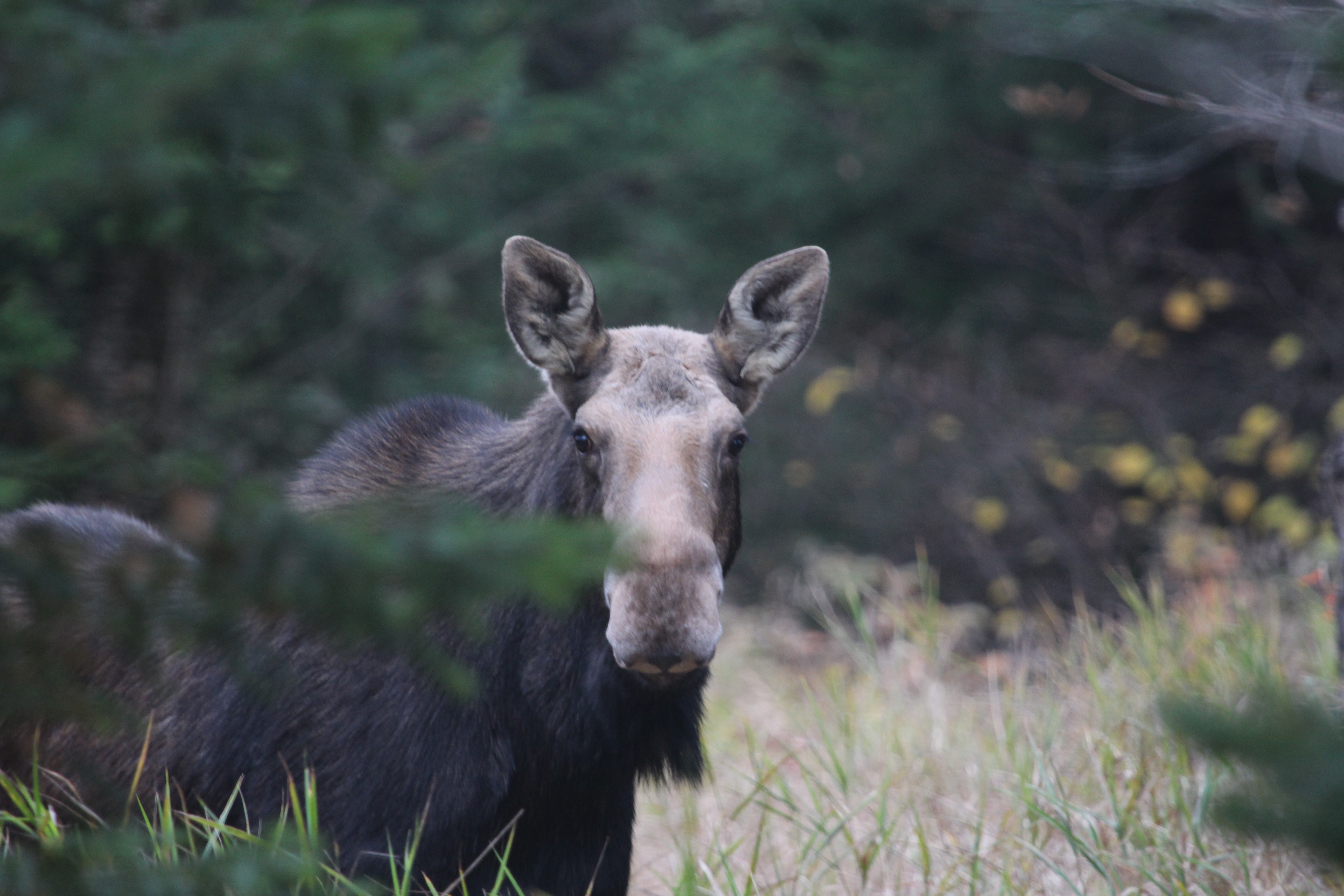
Photo by Chris Bosak – A cow moose in Pittsburg, NH, in the early 2000s.

I was lucky enough to live through New Hampshire’s golden age of moose.

The moose population in the state peaked at somewhere around 7,000 to 8,000 in the mid- to late-1990s. At the time, I worked a four-day week and had Sunday, Monday and Tuesday off each week. Working until midnight on Fridays and Saturdays wasn’t great for my social life, but it was ideal for camping trips. As I headed to northern New Hampshire on Sunday afternoons, most people were packing up and going back home to start the workweek.

I had my choice of campsites at Deer Mountain State Park in Pittsburg, and I had my choice of ponds on which to canoe. Rarely did I see other paddlers on the ponds. But I saw plenty of moose. I won’t exaggerate and say I saw dozens on each trip, but I certainly saw four or five either on the ponds or along the roads each time I went. I can’t recall a trip where I didn’t see at least a few moose.

My most memorable canoe trip came on a Monday after a Fourth of July weekend when I had my favorite pond to myself in the evening and three bull moose lumbered out from different parts of the surrounding woods and settled into the pond with me. That was 30-odd years ago, and I still vividly remember the splashing noise the water made as it cascaded off their velvet-covered antlers when they picked up their heads with a mouth full of aquatic plants.

Those were the good old days.

Then, my life situation changed. I moved farther away and worked normal hours and days. My trips up north decreased dramatically and were relegated to typical weekend days.

More importantly, the moose started to disappear. Slowly at first and then dramatically.

The state’s moose population is now estimated to be about 3,000. A combination of winter ticks, brainworm and changing habitat essentially cut the moose population in half, or more.

The decline started in the early 2000s and received a boatload of press for many years. I wrote my own news article for the Keene Sentinel on the subject in 2019. Lately, it seems to me anyway, the updates have subsided. How are moose doing now? Still decreasing? Perhaps increasing?

It seems like it’s neither, which isn’t necessarily a bad thing.

“The moose population has been relatively stable for the last five years,” Henry Jones, Moose Project Leader for New Hampshire Fish and Game Department, said last week. “It varies locally, with some areas up and some down. Overall, the population has been declining for 20 years.”

Why is that not necessarily bad news? The golden age of moose I mentioned before may have been too much of a good thing. The density of moose in some areas was too high and not sustainable. High moose density allows for winter ticks to thrive. More moose, more ticks. Fewer moose, fewer ticks.

Jones, who received his bachelor’s and master’s degrees from University of New Hampshire, said the goal is to conserve the moose population while still being able to offer recreational opportunities. Last year, the state issued 35 moose hunting permits and there was a 70 percent success rate. This year, the state will again issue 35 permits.

Goal number one for moose in the New Hampshire Big Game Management Plan 2026-2035 calls for population levels that “allow them to be in good physical condition and are realistic for habitat conditions.”

With winter ticks decimating the moose up north, a relatively small population compared to the 1990s is desirable. Why have 7,000 moose if most of them are going to die or become extremely weak due to the ticks slowly and excruciatingly bleeding them dry?

As much as I’d love to head north and see as many moose as I used to, conditions no longer support that. It pains me to say that because I have great memories of seeing so many moose back then, but this is the new reality.

While we may not see a glut of moose again in the state, with the help of biologists at New Hampshire Fish and Game, moose in sustainable numbers will be around for a long time.