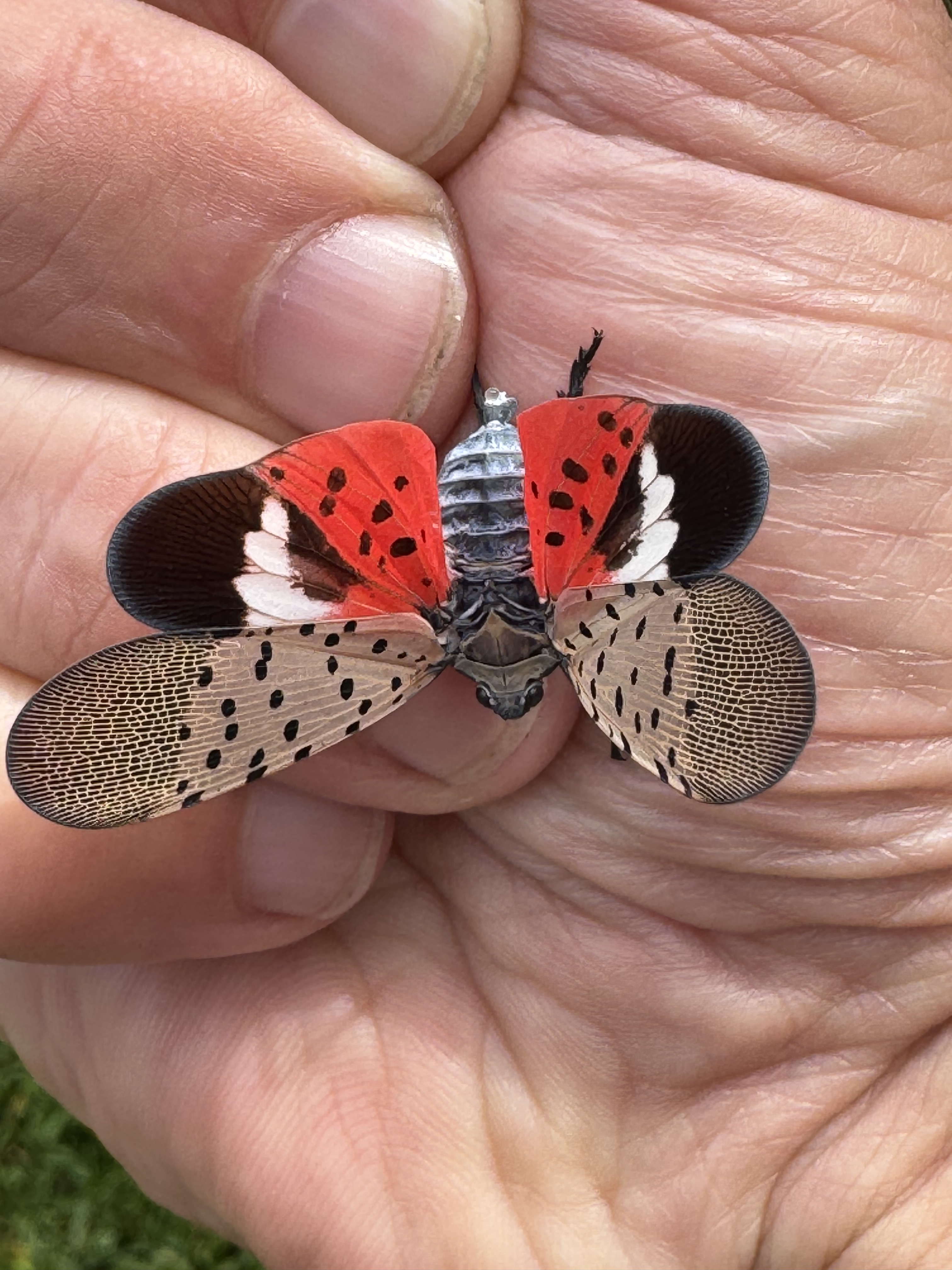
Author Chris Bosak holds a spotted lanternfly in southern New England, summer 2026.
NOTE: This column was originally written for newspapers in New Hampshire, which has not yet been subjected to an invasion of these insects.
Coming to a town near you? Let’s hope not.
So far, the middle and northern parts of New England have largely been spared of the spotted lanternfly. Let’s hope that continues, but I have a feeling those dastardly insects may work their way up into at least the middle of New England.
My reasoning is as follows:
In the summer and fall of 2023, my son played for the St. Frances Academy high school football team in Baltimore, Maryland. I traveled back and forth from Maryland about a dozen times.
One particular beautiful early fall day in downtown Baltimore, I walked with friends to check out some sites and find a good place to eat. Out of nowhere, something bapped me right in the forehead. What the heck was that?
The offender lay at my feet. I can’t remember if it was stunned or dead. Either way, it was a spotted lanternfly. If you are not familiar with spotted lanternflies, they are invasive insects native to Asia. They feed on the sap of a wide variety of plants, causing severe agricultural and ecological damage. They are now pervasive in ….
They are not flies, despite their name, and they are not moths, despite their resemblance. Rather, they are a planthopper-type of insect.
The bap to the forehead knocked some awareness into me, and I suddenly realized those things were all over the place. On the sidewalks, on the buildings, on the trees. Everywhere.
Baltimore was infested with them. I didn’t know much about the species at the time, but I recall that I had at least heard of them and knew they were not desirable. I also recalled that the guidance at the time was to swash them on sight.
Squashing them proved to be more difficult than I would have thought. They are surprisingly quick. My stomping foot often came up empty as the insects utilized their spring-loaded back legs to propel themselves and fly or glide to safety.
Fast forward three years, and the spotted lanternfly is now infesting parts of southern New England, namely Connecticut, Rhode Island, and Massachusetts. I was in southern Connecticut recently and spotted lanternflies were numerous. It didn’t reach the infestation levels I had observed in Baltimore, but even a short walk yielded several sightings. A glance out the window more often than not resulted in at least one sighting.
New Hampshire would be next if the lanternfly maintains its northward movement. In fact, officials in New Hampshire recorded its first sighting last month in Salem. From what I could find and as of this writing, there haven’t been any confirmed sightings in Vermont.
Are the Twin States next? I guess we’ll see in the years to come. Perhaps even next year.
This may be an unpopular opinion, but spotted lanternflies would be pretty cool to have around if they were native and beneficial instead of invasive and destructive. Adult lanternflies are about an inch long (fairly large compared to most insects in New England) with pinkish or gray wings covered in black spots. When in flight, the bright red hindwings (also adorned with black dots) offer a flash of color.
In the life stages leading up to adulthood, lanternflies are black with white spots and then red and black with white spots.
Birds have helped control the invasion somewhat. From what I’ve read, birds such as cardinals, blue jays, catbirds, and woodpeckers have been seen preying upon them. Interestingly, chickens seem to love them. Although spotted lanternflies damage a variety of trees and shrubs, their preferred food source is tree of heaven, another invasive native of Asia. This may make the insects bitter and undesirable to some predators.
Here’s hoping the northward march of the spotted lanternfly stops in southern New England. It will be an interesting story to follow in the years ahead.
If you find a spotted lanternfly, report the sighting at www.nhbugs.org/reporting-form.

