
I’ve written about a lot of different types of birds over the last 30 years. There are some birds I’ve likely written about hundreds of times, and some only a handful of times.
If I searched my “For the Birds” folder for chickadee, robin or woodpecker, I’d get hundreds of hits. If I searched for vireo or flycatcher, I’d get far fewer hits, but still a decent amount.
There’s one bird family found in New England I’m not sure I’ve ever written about or even mentioned within a column. It’s the rail family. Rails are small to medium-sized chicken-like birds of the marshes. The reasons I haven’t written about them before are fairly obvious: rails are not very common, live in a habitat that is difficult for humans to traverse and are extremely secretive.
New England has a few members of the rail family. Virginia rail is the most common and the one most likely to be seen in New Hampshire. Sora is the other most likely candidate in New Hampshire. Clapper rails may be found along the coastal regions of New England.
There are also yellow rails, black rails and king rails found in New England, but they are rarely seen. Virginia rail is the best bet, but even that is a chore.
Rails live among the tall grasses of salt and freshwater marshes. They spend the majority of their time hiding and skulking among the dense, high grasses. Out of sight, out of mind.
But they do have one giveaway: loud calls. If you happen to be in a marsh and hear an odd, loud call, you may have a rail around. Look in that direction and a rail may briefly emerge from the grasses and offer a birdwatcher a fleeting glance.
According to the Cornell Lab of Ornithology, Virginia rail calls are “a long sequence of piglike grunts that tends to trail off at the end.” Not an overly flattering description, but anyway. Cornell continues: “Calls emanate from many a wetland in spring. Males and females perform duetting grunts to defend their territories and to communicate with each other throughout the breeding season.”
New Hampshire Audubon adds of the Virginia rail: “The most common call is a harsh series of grunting noises that descends in pitch. After one bird in a marsh makes this vocalization, others may follow in short order.”
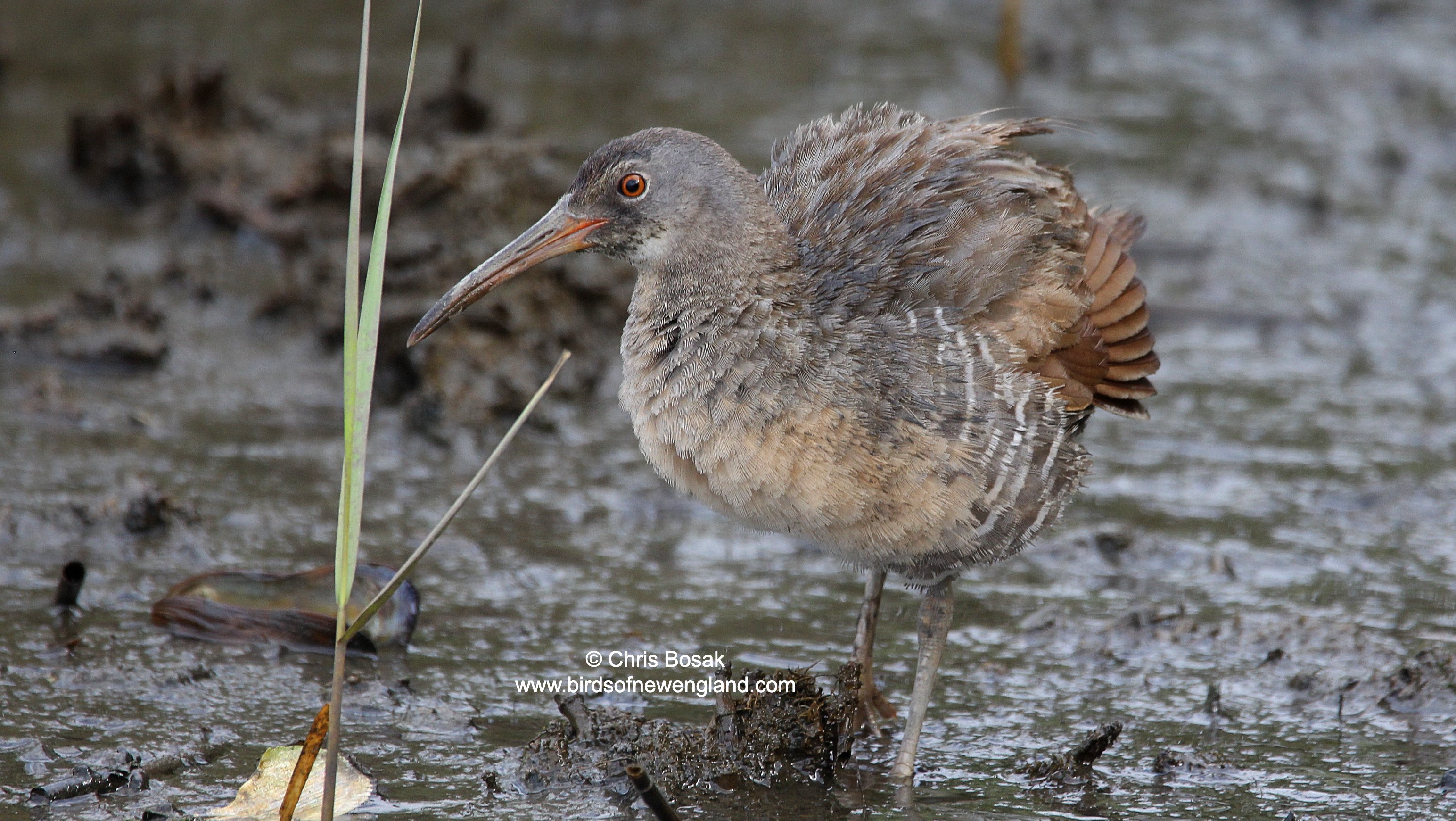
I was lucky enough to find a clapper rail during my recent trip to the Connecticut shoreline along Long Island Sound. After seeing piping plovers, American oystercatchers and least terns on the beach, I took a short drive to a nearby saltwater (really brackish) marsh. It was low tide, and much of the mudflats were exposed. Several clapper rails called back and forth from either side of the river, which at this point was not much more than a trickle.
I could hear one calling very close to me, but I couldn’t find it among the huge clumps of marsh grass. I kept my eyes peeled, and eventually my patience paid off as it walked along the mud from one clump to the next. It was in the open for about 20 or 30 seconds before it disappeared back into the grass. I heard it several times after that but never saw it again.
Rails are most commonly seen in May and June but may be seen during migration periods as well. If you use the bird database eBird, be sure to report your rail sightings there.
By most accounts, little is known about their habits and population numbers in New England. For my part, at least now I can say I have written at least one column about rails.
 Birds of New England.com
Awesome info!! Our next saltwater marsh trip will include a hopeful and patient watch for these unique and interesting birds! Thx for the info!!
LikeLiked by 1 person