Photo by Chris Bosak – An eastern towhee lurks in the brush at Huntington State Park, CT, September 2025.
Fall bird walks can seem like a series of goodbyes to old friends.
I thought of this when I saw an eastern towhee receive an “infrequent” designation on eBird the other day. Ebird, a massive bird database, often flags birds when they are out of their territory or uncommon in an area.
I was a little surprised by the infrequent flag, as I see eastern towhees in that park quite frequently. Of course, it wasn’t because the bird is uncommon in the park, but rather it is getting late in the season for towhees.
Photo by Chris Bosak – A great blue heron stalks the edges of North Pond in Pillsbury State Park in New Hampshire.
A recent camping trip with my son to Pillsbury State Park yielded a slew of quality wildlife sightings.
It started right away as I made my first entry to our remote camping site on the edge of North Pond, one of the smaller ponds at the park. A greater yellowlegs, a relatively large shorebird often seen at freshwater ponds and lakes during migration, worked the shallow water around the rocks looking for morsels.
Three half-mile walks to the car and back later, I headed out for my first canoe ride. It proved to be a bit of a challenge to launch, as the extremely dry weather in New Hampshire had the pond as low as it’s been in years, according to the park ranger.
Photo by Chris Bosak
A ruby-throated hummingbird visits a flower basket in New England, summer 2025.
Other than a few sightings while on walks at local parks, I hadn’t seen a single hummingbird all spring and most of the summer.
It wasn’t for lack of trying. I put out the same feeders and filled them with the same liquid I always do: four parts water, one part sugar. They never came. Not in April or May. Not in June or July.
August was headed toward a shutout as well until one day late in the month, it all changed. And it changed in a big way. Not only did a few hummingbirds show up, but they were around constantly. They visited the feeder one at a time, of course, because god forbid they’d actually share a feeder with four ports.
A reader from Langdon, N.H., sent in this photo of an albino or leucistic hummingbird, summer 2025.
Thank you to the readers from Langdon, N.H., who sent in this photo of an albino or leucistic hummingbird. I’m guessing albino because of the pink eyes and feet, but declaring anything albino invariably brings about debate. Either way, a very cool and rare sighting.
A reader from Langdon, N.H., sent in this photo of an albino or leucistic hummingbird, summer 2025.
Photo by Chris Bosak
A male scarlet tanager in the fall.
It seems like just yesterday we were welcoming back the warblers and other songbirds during spring migration and here we are at fall migration already.
Many of the birds we saw in the spring heading north will look the same on their southward journey. Many others, however, will look different.
Some, like male scarlet tanagers, will bear little resemblance to what they looked like in the spring. When we saw them in May and June, they were the most brightly colored birds in the woods. A sighting always yielded a gasp of excitement as we wondered how a bird in New England could be so brilliant. After the breeding season, however, they molted and are now dull yellow with less shiny black wings. They are still awesome-looking birds but not the striking birds they were in the spring.
In addition to many adult birds molting, the fall migration includes first-year birds that haven’t attained familiar adult plumage yet. They often resemble females or a mix of male and female plumage.
Photo by Chris Bosak
Clapper rail in Milford, Connecticut, summer 2025.
I’ve written about a lot of different types of birds over the last 30 years. There are some birds I’ve likely written about hundreds of times, and some only a handful of times.
If I searched my “For the Birds” folder for chickadee, robin or woodpecker, I’d get hundreds of hits. If I searched for vireo or flycatcher, I’d get far fewer hits, but still a decent amount.
There’s one bird family found in New England I’m not sure I’ve ever written about or even mentioned within a column. It’s the rail family. Rails are small to medium-sized chicken-like birds of the marshes. The reasons I haven’t written about them before are fairly obvious: rails are not very common, live in a habitat that is difficult for humans to traverse and are extremely secretive.
New England has a few members of the rail family. Virginia rail is the most common and the one most likely to be seen in New Hampshire. Sora is the other most likely candidate in New Hampshire. Clapper rails may be found along the coastal regions of New England.
There are also yellow rails, black rails and king rails found in New England, but they are rarely seen. Virginia rail is the best bet, but even that is a chore.
Photo by Chris Bosak
American goldfinches nest later in the season than other New England songbirds.
Answering a few questions from readers:
John from Swanzey asked a few weeks ago when it is safe to prune bushes and hedges so as not to disturb any birds that might be nesting there. It’s a great question and one that is not as easily answered as one may think.
Spring and early summer are obviously not good times, as many of our songbirds use this type of habitat for nesting. Robins, doves, blue jays and catbirds immediately come to mind as they are common backyard birds in New England. Many other birds, such as yellow warblers and American redstarts, use shrubby areas for nesting as well, although they tend to use more wild areas rather than backyard bushes.
But what about mid and late summer? It should be safe then, right? Not necessarily.
Photo by Chris Bosak
American oystercatcher chick, Milford, Connecticut, summer 2025.
The Cooper’s hawk I wrote about last week was a bit of an anomaly for me.
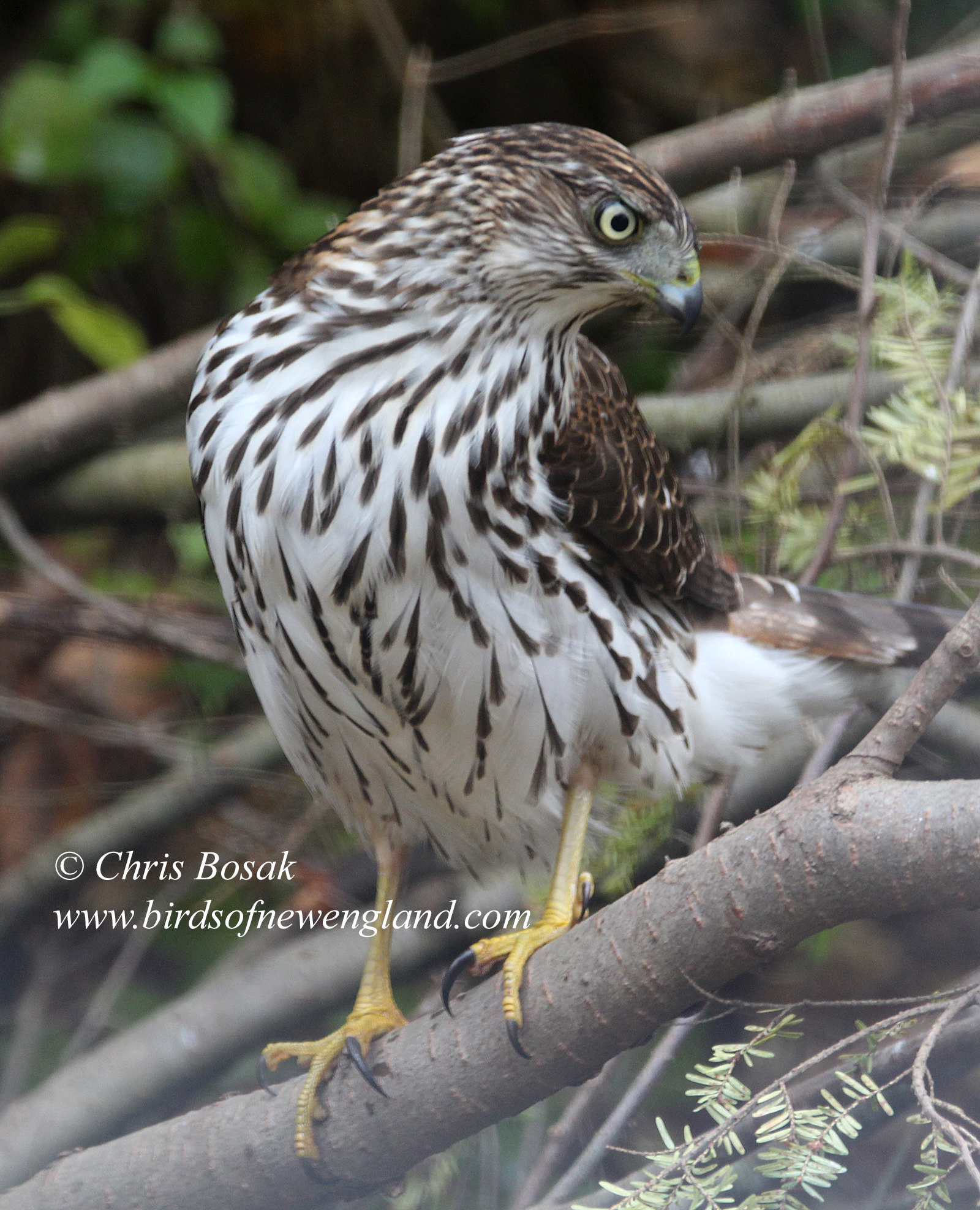
It’s not that I don’t see Cooper’s hawks often, but I typically see immature Cooper’s hawks. The one featured last week was an adult. Looking back through my photo collection, the vast majority of Cooper’s hawks I have photographed were immature birds.
With many birds, differentiating young birds from adults can be tricky as the time period between immature plumage and adult plumage is relatively short. With Cooper’s hawks, it’s easier as they retain their immature plumage into their second year. Bald eagles, similarly, do not obtain their classic white heads and tails until they are four or five years old.
As immature birds, Cooper’s hawks (as well as closely related sharp-shinned hawks) are brown with tan-streaked white chests and bellies. As adults, they are blue-gray with reddish-streaked white chests and bellies. Immature Cooper’s hawks have yellow eyes, and adults have red eyes. Interestingly, ospreys are the opposite with adults having yellow eyes and immatures having orange-red eyes.