For the Birds: As it turns out, birds and birders are smart

Photo by Chris Bosak
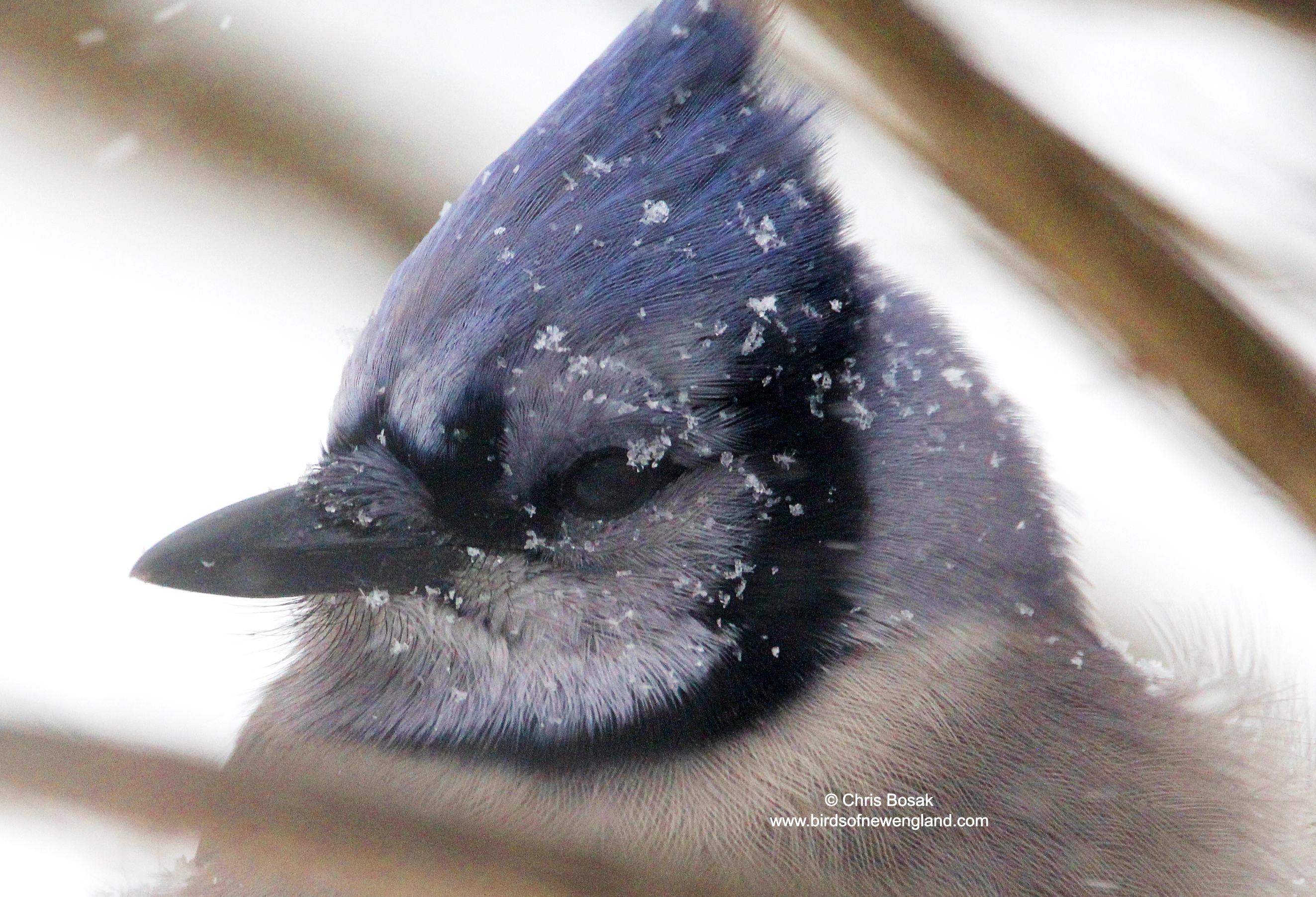
Snow gathers on a blue jay’s face during a snowstorm, January 25, 2026, New England. Blue jays, like all corvids, are highly intelligent.

We’ve all heard the expression “birdbrain” to describe someone lacking intelligence or prone to doing dumb things. The definition that pops up when doing an internet search is “a silly or stupid person.”

Birdbrain, of course, is a misnomer because birds are actually very smart.

While everyone has heard of birdbrain, how about birderbrain? I’d be willing to bet not many people have heard that one before. That would be understandable because I just made up the expression for this column.

The inspiration for the new term comes from an article I read recently. The link to the article came from a sponsored post that popped up on one of my social media accounts. I guess it shouldn’t be surprising that bird and nature content floods my social media feeds.

Anyway, the article is from Science Focus, a publication of the BBC. The article, “Birdwatching could help slow ageing, breakthrough study finds,” summarizes a study published in Journal of Neuroscience by scientists from Baycrest Hospital in Toronto.

The article includes a link to the study itself, but I quickly returned to the summarized BBC version, as the study was a bit over my head. And by a bit, I mean a lot. The title of the study is “The tuned cortex: Convergent expertise-related structural and functional remodeling across the adult lifespan,” if that gives you an idea.

So it was back to the article. Thank goodness for journalists for making studies like this comprehensible.

The study, which compared the brain structures of 29 expert birdwatchers and 29 beginners, found that birders were more perceptive, had a greater memory and could pay attention for longer periods of time.

“And, crucially, honing these skills could literally reorganise the structure of your brain and improve cognition,” the Science Focus article states. “Learning of any kind (such as a new instrument or language) is great for your brain, but the research argues that birding skills are particularly good because of their complexity.”

Remember, it’s a BBC publication, so it spells reorganize and aging (among other things) a little differently.

The study itself found that “Compared to novices, experts showed lower mean diffusivity in frontoparietal (SFG, IPS) and posterior cortical (AG, precuneus, LOC, fusiform) areas, along with a trend for more gradual increases in age-related MD.”

Sorry, let’s let the BBC journalist explain: “Scans revealed that the parts of the brain associated with attention and perception were more compact in the expert birders, and these structural changes made them better at identifying birds. Specifically, the water molecules in these brain regions were able to move more freely, seeming to boost their identification abilities, making them better at detecting less familiar or less local birds.”

I still can’t claim to fully understand the study, scientifically, but it certainly seems like a good thing for your brain to go birdwatching and become good at it through practice and perseverance.

One source in the article who was not associated with the study itself noted that perhaps it wasn’t the birdwatching that strengthened perception, attention and memory, but rather people with “stronger cognitive abilities” are more likely to take up birding and become good at it.

No one has ever accused me of being the smartest person in the room, but heck, I’ll take that explanation as a possibility.

Either way, the next time someone calls me “birderbrain” or even “birdbrain,” I’ll just say “thank you.”

For the Birds: Mixed blackbird flock points to spring ahead

Photo by Chris Bosak
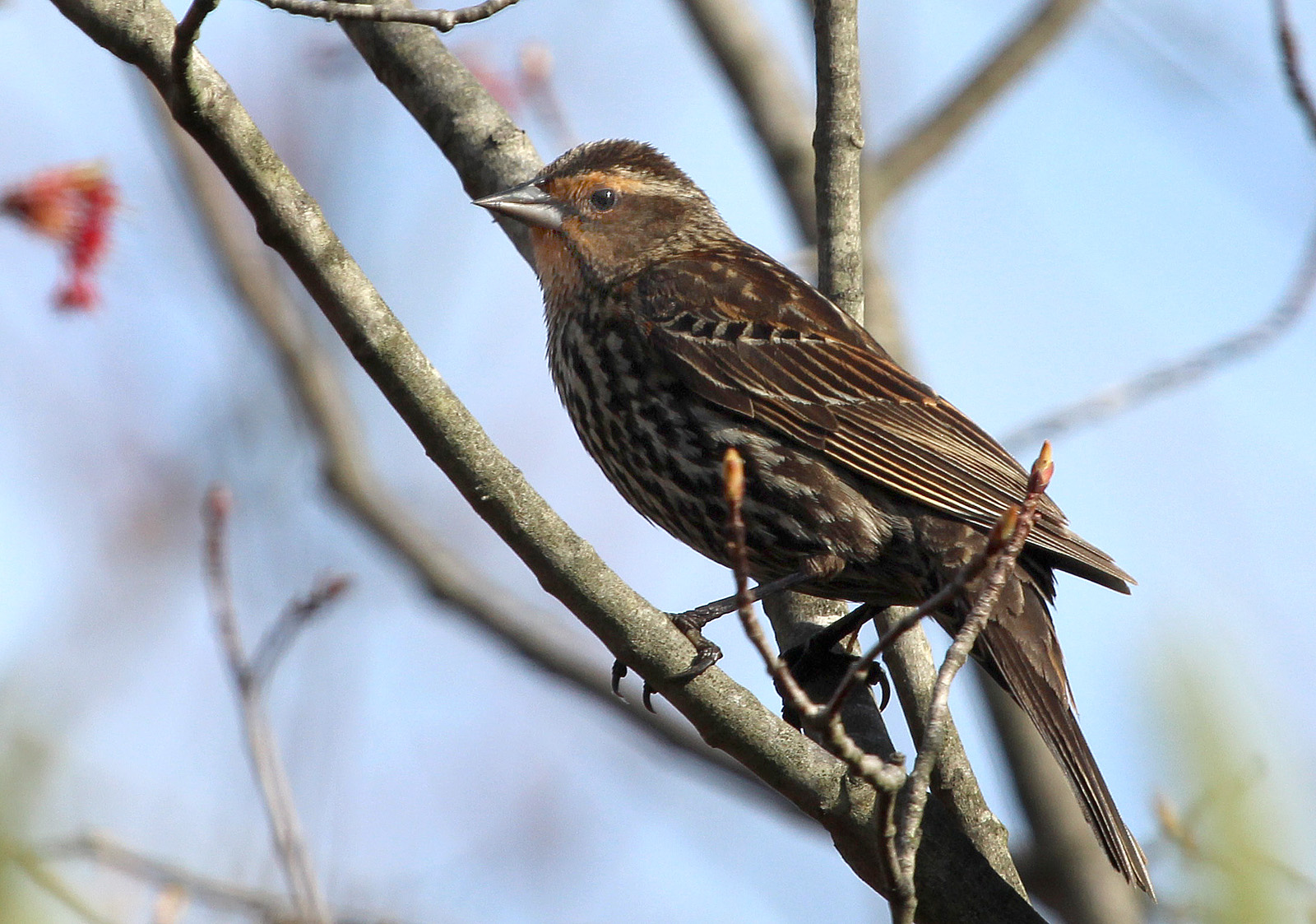
A female red-winged blackbird perches in a tree.

As far as I’m concerned, it’s never too early to talk about signs of spring.

Not that I’m rushing winter. There is plenty to do in winter, and I appreciate all of New England’s seasons for what they offer birdwatchers. But when a sign of spring presents itself, even with several inches of snow still on the ground, it’s hard to ignore.

Unlike plants that may be popping up through the ground but remain unseen due to the snow, birds offer visible and reliable signs of spring. The other day, as soon as I started my walk, I spied several birds flying overhead. In the distance, I heard the familiar and unmistakable songs of red-winged blackbirds.

It turned out to be a classic mixed flock of blackbirds with dozens and dozens of grackles, brown-headed cowbirds and red-winged blackbirds. They join forces, primarily in the winter, for protection (safety in numbers) and to find food sources. I didn’t see any starlings, but they often join those massive flocks.

It was hard to get an estimate of how many birds were in the flock. A few dozen would fly overhead, and then I’d walk up on a tree filled with blackbirds. Then a few more dozen would fly overhead, but I’d see more in another tree down the trail as well.

Red-winged blackbirds are one of the earliest signs of spring as they return from the south to start staking out breeding territory. While some may remain with us throughout the winter, the majority of red-winged blackbirds migrate.

Typically, males arrive a few weeks ahead of the females, but this flock had good numbers of male and female red-winged blackbirds. Female red-winged blackbirds somewhat resemble large, dark, streaked sparrows with a yellow wash around a longer, pointed bill. The flock also included a number of nonbreeding birds.

American robins have typically been known as a sign of spring, but with robins becoming more commonplace throughout the winter, it’s hard to tell if they are returning birds or if they have been with us all winter. Red-winged blackbirds are now a more reliable sign, but their early return can lead to false hope among those wishing for an early spring. (For me, the return of eastern phoebes around mid to late March is the best sign of spring these days.)

As I mentioned earlier, some red-winged blackbirds remain with us all winter as well, but birds in a large flock this time of year are likely migrants. Not many people would describe the red-winged blackbird’s harsh “kong-ka-reee” song as pleasant, but despite not hearing it for several months, I recognized it immediately, and it was, in fact, pleasing to my ears.

Now that at least one sign of spring has been noted, many more will follow, despite the snow still clinging to our landscape. Heck, owls are already nesting. Hawks will start repairing or building their nests. Many more red-winged blackbirds are sure to follow the flock I mentioned previously.

Once the snow melts, and it will eventually, signs of spring will be everywhere. Crocuses will be visible, and daffodils will start poking out of the ground. Trees will start to bud. To me, however, there’s nothing like birds to usher in the change of seasons.

The transition from winter to spring starts slowly with a flock or two of blackbirds and ever so slowly builds over several weeks until one day you’re standing in the woods surrounded by warblers, tanagers, orioles, grosbeaks and many more of our fair-weather feathered friends.

For the Birds: Bird sighting sparks memory of the past

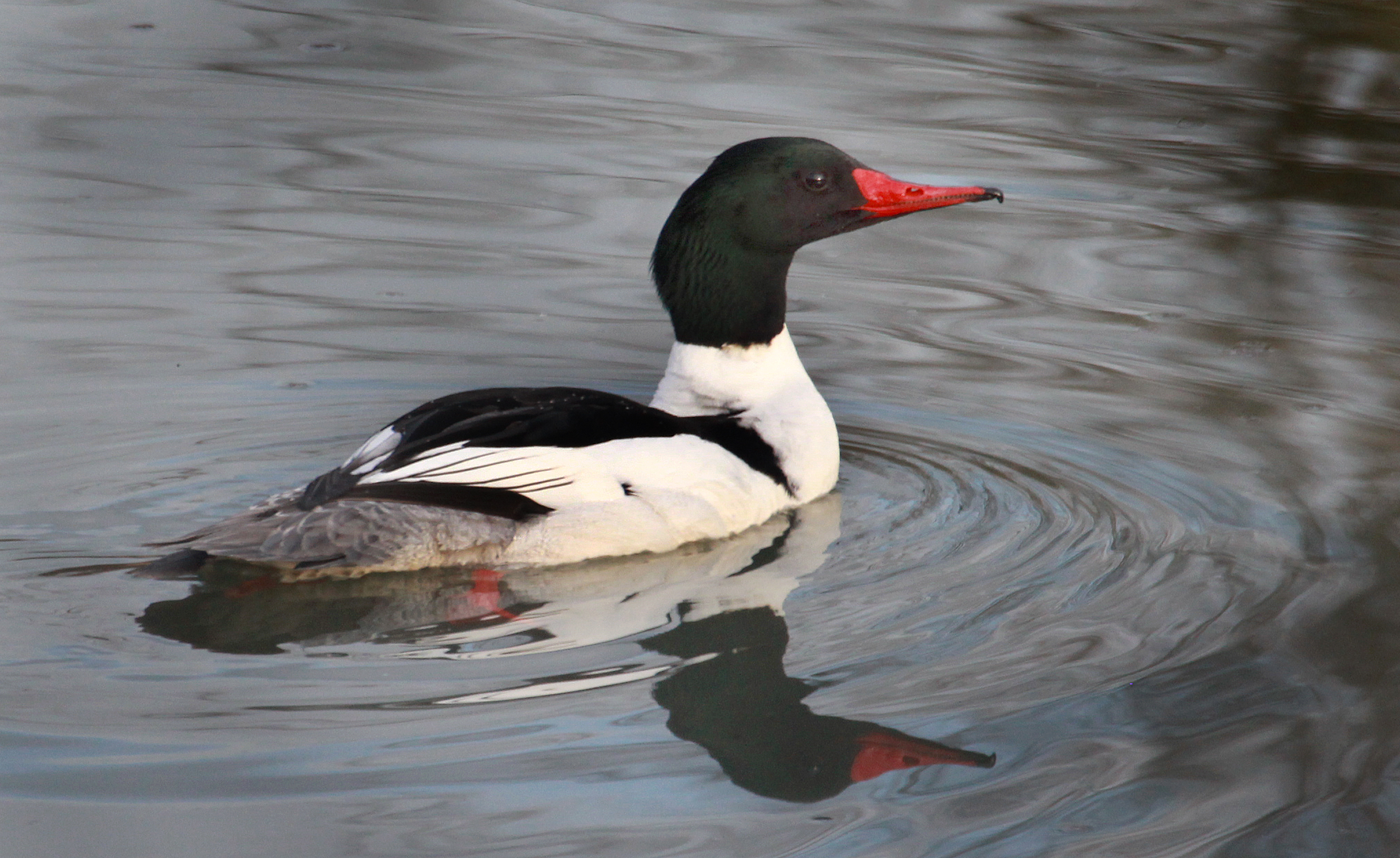
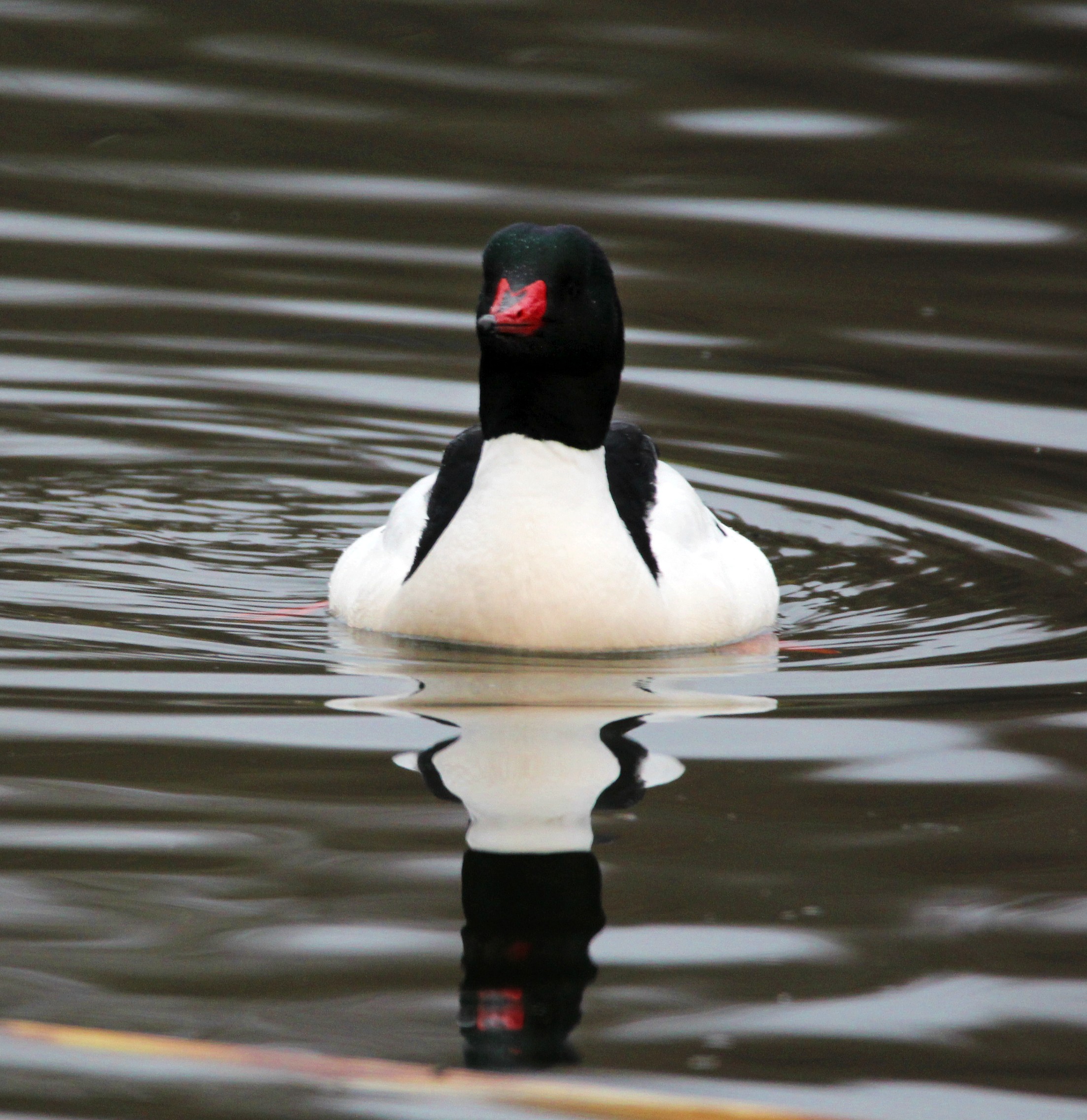
Photo by Chris Bosak A common merganser swims in a pond in Danbury, Conn., March 2019.

When you have done something for so long, sometimes it is hard to remember what it was like at the beginning. The other day, however, I came across a scene that reminded me of one of my early birdwatching experiences.

The recent prolonged cold spell we endured froze or kept frozen most of the water throughout the region. That makes for a great time to check the areas where water does not freeze, such as dams or fast-moving streams. 

I drive past a large dam frequently and always look at the bottom where the water is constantly flowing. I do this especially during the winter to see if any ducks are gathered in the open water. In the right season and under the right conditions, there are usually several common mergansers in the pool created by the flowing water. 

When I drove by the other day, the pool had shrunk due to the encroaching ice, and only a fairly small bit was left unfrozen. That small bit, however, was filled with dozens upon dozens of common mergansers. It was to the point where you could barely see any of the open water because it was filled by the large diving ducks.

As I rounded the corner and drove along the unfrozen stream, only about one hundred yards away from the dam, I spotted an adult bald eagle perched in a tree overlooking the water. Since common mergansers are one of my favorite birds, and bald eagles are too (who doesn’t love bald eagles?), I was quite excited about the sighting and made sure to tell everybody I came across for the next several hours.

A day or so later, it dawned on me that the scene seemed familiar. Then I remembered a canoe ride I had taken on Powder Mill Pond in Greenfield, New Hampshire, many years ago. We are going back almost 30 years here. During that canoe ride, I saw a massive flock of common mergansers as well as a lone adult bald eagle perched in one of the tall evergreens along the shoreline.

Several decades may separate the two sightings, but the feelings and emotions generated by the sightings were the same. It’s easy to see why the first sighting would have caused such excitement. I was new to birdwatching and bird photography, and, while common mergansers are plentiful each winter, bald eagles were a much less common sighting back then. 

Fast forward 30 years, and both mergansers and eagles are still cause for excitement for me. In that span, I have seen countless common mergansers and dozens, if not hundreds, of bald eagles. But the feeling is the same. Pure joy and excitement.

I consider myself lucky to have found a hobby, a challenge and a creative outlet that has enhanced my days and years as much as birdwatching has. Every time I enter the woods or launch a canoe, I have the same hopeful feeling and anticipation of what I might see during the walk or paddle. Occasionally I see almost nothing; usually I see the ordinary, and every once in a while I see the extraordinary.

Regardless of the outcome, I love it all.

For the Birds: Sapsucker make surprise winter visit

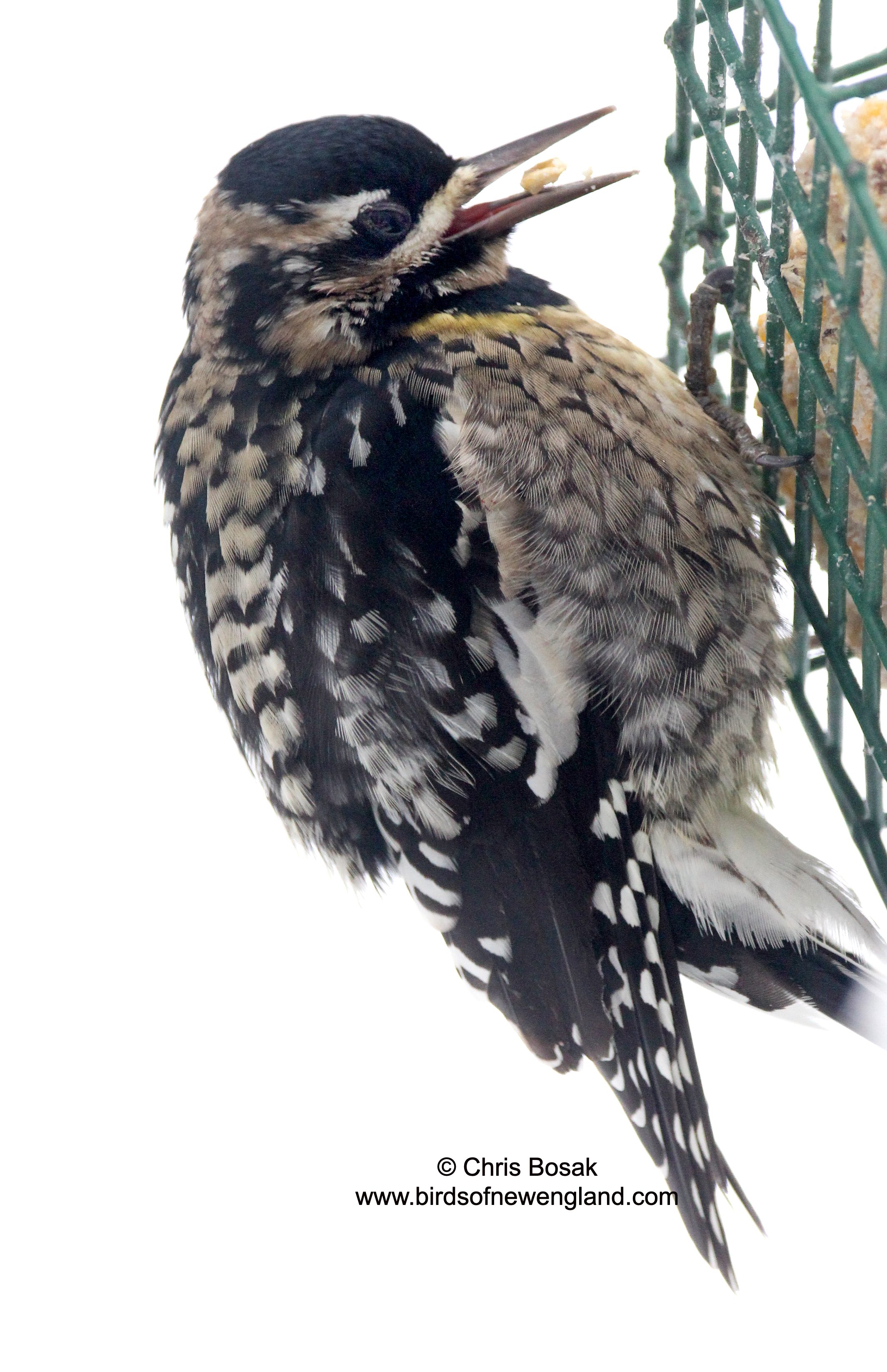
Photo by Chris Bosak – A young yellow-bellied sapsucker visits a suet feeder in New England, January 2026.

At first it looked like a growth on the tall bush near my bird feeding station. I quickly realized it wasn’t a growth at all but rather a yellow-bellied sapsucker hugging a small branch. 

It was a first-year bird, and its dark coloration, lack of red head or throat, and barred plumage made it look like part of the bush. It also caught me by surprise because yellow-bellied sapsuckers are migratory and are not frequent visitors to feeders. It was also perfectly still for several minutes as, from the comfort of my living room, I watched it brave the single-digit temperatures.

It eventually swung a quarter turn around the branch, offering me a view of its profile. Then it darted over to the nearby suet feeder, where it pecked at the frozen cake for several minutes. It returned to the same branch on the bush where I had initially spotted it and remained there for as long as I could watch it. 

The bird was there the next day as well, alternating between its favorite branch and the suet feeder. 

It was the latest uncommon visitor to my feeders this winter, following the likes of a fox sparrow, red-breasted nuthatch and northern flicker. Yes, I’m still waiting for the evening grosbeaks to arrive. 

Yellow-bellied sapsuckers breed throughout New England and up into Canada, but they are perhaps the most migratory of our woodpeckers. They leave in September or October for southern U.S., Central America or the West Indies. I have read that an increasing number are staying in New England for the winter, particularly the southern part of the region. 

Northern flickers are also migratory, but again, some remain here all winter. That is in contrast to our other woodpeckers—downy, hairy, pileated and red-bellied—which are year-round birds here. Black-backed woodpeckers of the north are also non-migratory.

While I was surprised to see the sapsucker the other day, I probably shouldn’t have been. I mentioned nemesis birds in a column a few weeks ago and noted that evening grosbeaks and owls are among mine. I should have mentioned American woodcock as well. Nemesis birds are those that elude you regardless of how hard you try to find them. 

For me, yellow-bellied sapsuckers are the opposite. I hope I don’t jinx myself by writing this, but I see a lot of them. I see them on my walks, in my backyard, and now, at my feeders. This wasn’t the first one I saw this winter either. I spotted one on the Christmas Bird Count and another on a recent walk in the woods.

The only problem with seeing a lot of yellow-bellied sapsuckers is that I have to explain that they are indeed real birds. It’s not just a funny-sounding name that was made up for a scene in The Honeymooners so many years ago. (Check it out on YouTube if you’ve never seen it.)

Birdwatching is full of surprises, whether on a walk in the woods or watching the feeders. The usual suspects are enough to keep me interested, but the surprises add a little oomph to the hobby.

For the Birds: Eerie noises during a night in New England

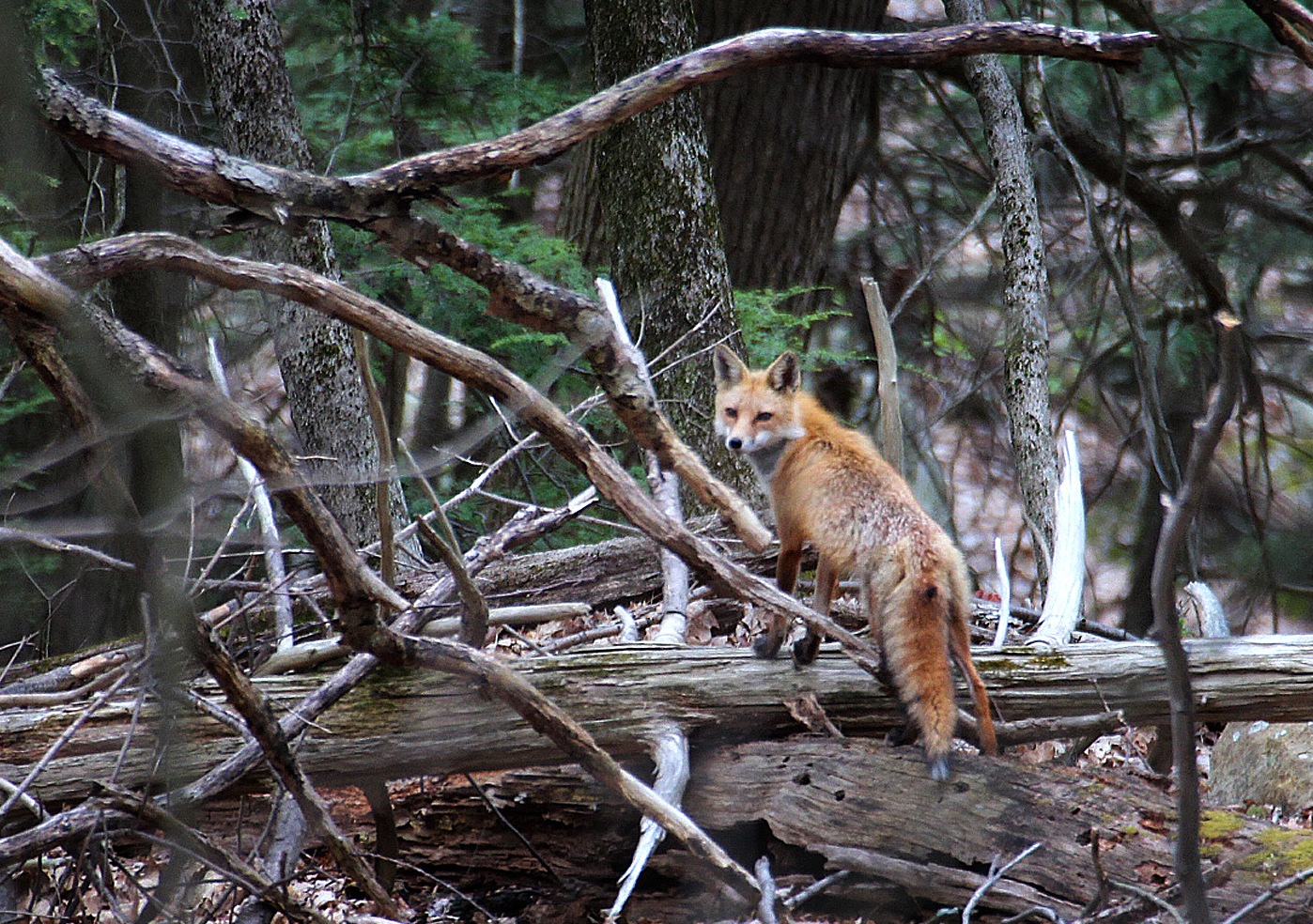
Photo by Chris Bosak – A red fox works its way through the New England woods.

This fox had no consideration for my sleep schedule.

I was sound asleep when the fox decided it was a good time to sit on the shared driveway that separates my house from my neighbor’s house and start barking over and over. I rolled over, tapped the screen on my phone and saw 3:01 displayed. 

The fox was about 15 yards away from where I had been enjoying a good night’s sleep. I pulled back the curtain and there it was, plain as day (even though it was the middle of the night), sitting in the middle of the driveway barking away.

If you’ve ever heard a fox barking, you know it’s not like a dog barking. We’ve all been jarred awake by dogs barking before, but that sound is familiar, and usually the owner is quick to respond and stop the barking. 

A fox’s bark, however, is otherworldly. They are canines, but they do not sound like domesticated dogs. They sound like something you’d hear at a haunted house around Halloween.  

Under other circumstances, I would have enjoyed the visit and, believe it or not, taken pleasure in the sound. But 3:01 in the morning? A fox barking is one of the more unnerving night sounds in New England, especially from 15 yards away when you are in the middle of a deep sleep.

If you have never heard a fox barking, do an internet search and see what you’ve been missing. 

I’ve never personally heard a fisher vocalize at night (or day for that matter), but I understand it makes a fox’s bark sound like child’s play. 

Coyotes calling back and forth at night can also be alarming at first, especially if there are several yipping back and forth to each other. I’ve heard that plenty of times, day and night.

The ultimate “spooky” night sound, of course, is an owl hooting. Great horned owls are not so alarming, as their “who’s awake, me too” call is rather quiet and soothing. 

The barred owl, however, is anything but soothing. Their “who cooks for you, who cooks for you all” call is given at a high volume and sounds nothing like the owls you hear in the movies. I love hearing it, don’t get me wrong, but I can definitely see how some people, especially those hearing it for the first time, would wonder what the heck is making that noise. When there are two barred owls going back and forth, well, that’s double the fun.

I heard a pair of barred owls on a recent walk. Barred owls are primarily active at night, but they can also hunt and vocalize during the day. I never did find the owls, although I didn’t look very hard either. Owls nest early in the year, and I didn’t want to go tromping through the woods and potentially disturb them. Even so, hearing the owls was the birding highlight of the walk. 

The sounds that may be heard at night in New England are fascinating, if not somewhat unnerving at times. Foxes, fishers, coyotes, owls, whippoorwills (if you’re lucky enough), tree frogs, and even a deer snorting can make your ears perk up and wonder what’s going on out there. 

Good luck going back to sleep right away after hearing those sounds.

For the Birds: Looking back on birding highlights of 2025

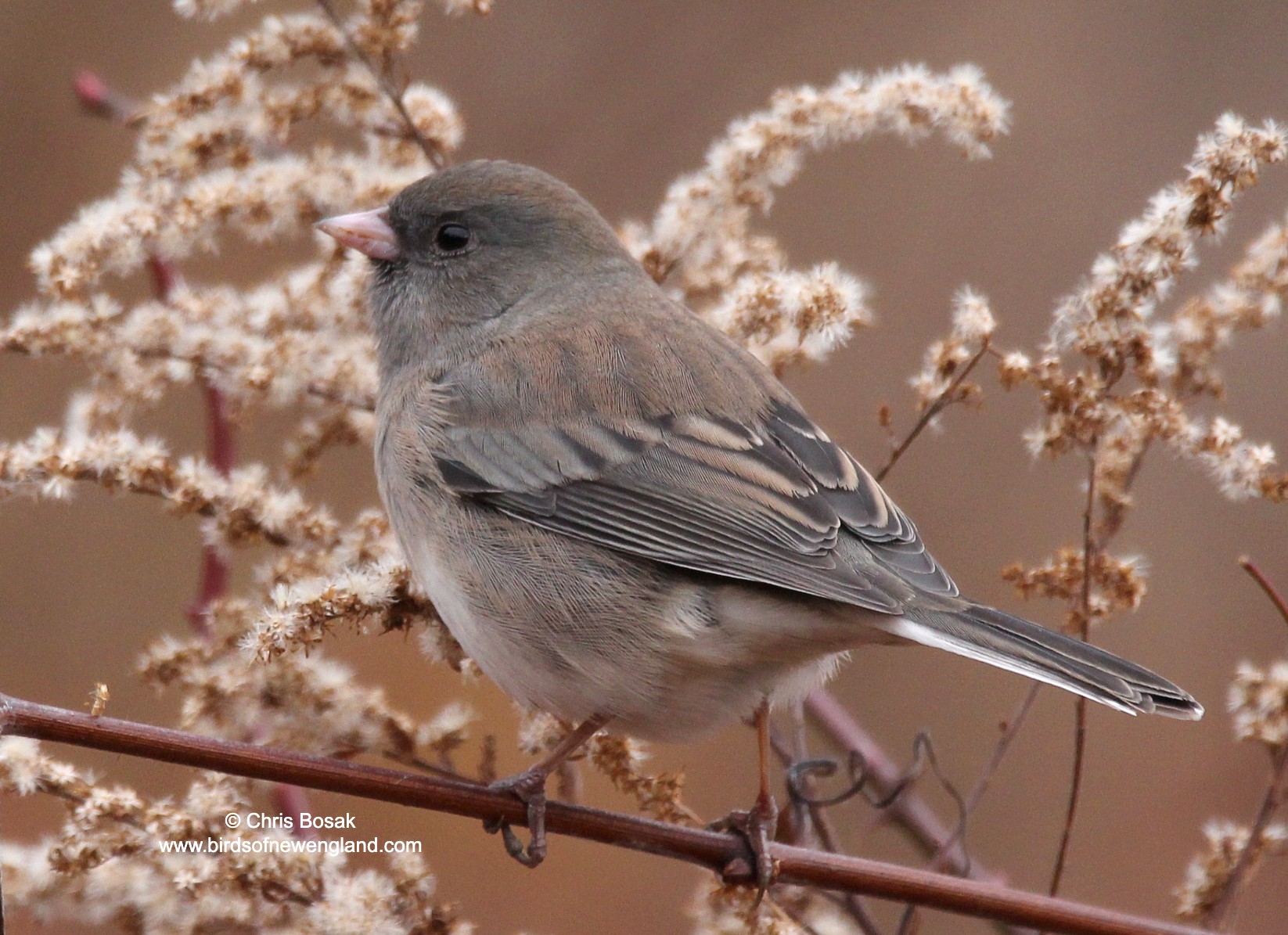
Photo by Chris Bosak – A dark-eyed junco eats goldenrod seeds at Huntington State Park in Redding, Connecticut, November 2025.

It’s time for one of my favorite annual columns, as I take a look at my top 10 birding/wildlife moments from the past year. It’s always fun to look back at a year’s worth of For the Birds columns and pick the moments that continue to resonate with me the most.

Here are my top 10 birding moments of 2025:

10. Early in 2025, when ice still dominated most ponds and rivers, I found a small unfrozen pond with a hooded merganser pair and a small flock of ring-necked ducks. The pond was small enough to afford good photo ops of the birds but large enough that they felt safe on the opposite shore.

9. My eBird totals for 2025 were the highest they have ever been, with 171 species seen during the year, including 134 in New England. They are still modest numbers compared to many serious birders, but I’ve never been a lister and do not put a strong emphasis on finding rarities. For me, the total number is not as important as the combined experience.

8. A few of the species I saw exclusively outside of New England this year came during what has become an annual May birding trip to my old hometown of Erie, Pennsylvania. My brother Paul and I visit Presque Isle State Park and hit our favorite warbler spots for three days straight. We spotted 63 species on our best day.

7. Watching a female Baltimore oriole build a nest was one of the best sightings from that trip to Pennsylvania. It was interesting to see the progress she made on her woven hanging nest over a three-day span.

6. I took a mid-September camping trip to Pillsbury State Park in Washington, N.H., and caught several warbler species on their southward migration. Other highlights included three otters, an immature bald eagle, a solitary sandpiper and a green snake.

5. It had been several years since I visited the shore of Long Island Sound in the summer to see the nesting grounds of piping plovers, American oystercatchers and least terns. I found all three of those species during a late July visit to the Coastal Center at Milford Point in southwest Connecticut.

4. Although it was a very short camping trip, I did manage to get to Pittsburg, N.H., this summer. Loons, bald eagles and warblers were the highlights. I saw the common loon pair on a large lake in the morning with a heavy fog making visibility almost nonexistent.

3. Going back to my Pennsylvania trip in May, I saw and was able to photograph a sandhill crane pair that nested at the park for the first time. I heard the birds first and immediately recognized that it wasn’t a typical bird found in the Northeast. Merlin confirmed it was a sandhill crane, and the search began, which eventually ended in success.

2. I continue to have a fascination with photographing birds eating berries. This was a good year in that regard with robins, cardinals and white-throated sparrows eating border privet berries in January. In October, I came across a huge flock of cedar waxwings eating yellow crabapples. 

1. My top birding highlight of 2025 features a rather common bird, the dark-eyed junco. On a rather dreary early November morning, I stepped into a small field where the goldenrod had faded to varying shades of brown. Dozens of juncos eating seeds from the tops of goldenrod plants literally surrounded me as I stood there taking in the scene. It was proof that bright colors or rare birds are not necessary ingredients for lasting memories or treasured photos. 

Thanks for indulging me on that walk down memory lane. Feel free to send me some of your top birding moments from the year that was.

For the Birds: More winter bird sightings

Photo by Chris Bosak
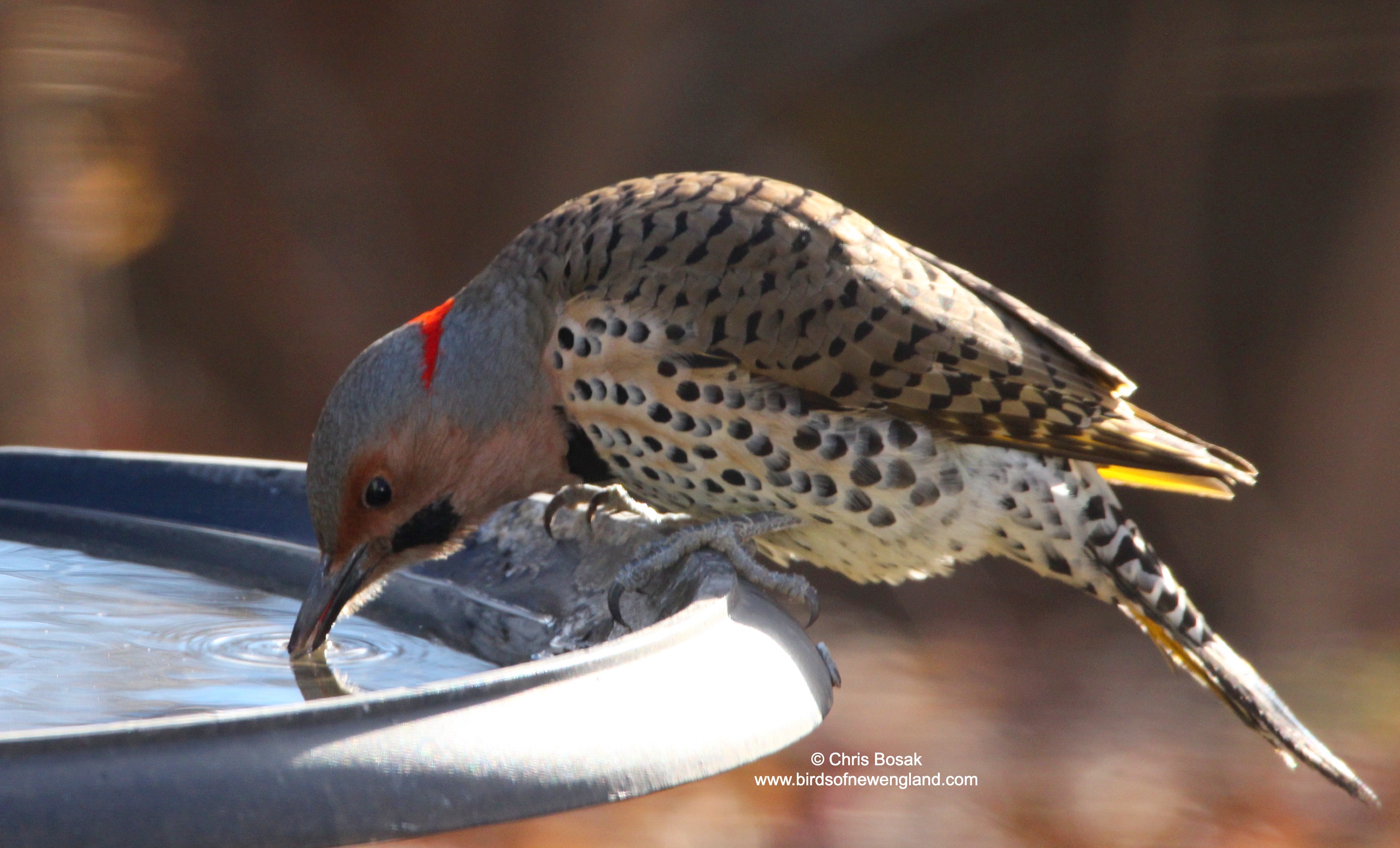
A northern flicker drinks from a birdbath in New England, December 2025.

Last week, I wrote about the evening grosbeak and the various sightings that have occurred throughout New England.

This week, I want to turn the attention to some of the other sightings and questions that have reached my inbox recently. I appreciate hearing from others and what they are seeing at their feeders and in the wild.

Continue reading

For the Birds: Evening grosbeaks on the move

Mike Quinn of Ticonderoga, N.Y. had these evening grosbeaks visit recently (December 2025.)

There is a thing in birding called a “spark bird.”

It is not a species of bird like a bluebird, mockingbird or blackbird, but rather the type of bird that piqued (or sparked) someone’s interest in birding and got them hooked. For many people, it is something big or colorful, like a loon or eagle or Baltimore oriole or great blue heron.

Because I have to be different, my spark bird is actually a moose. Yes, I know a moose is not a bird, but my quest to see a moose in the Vermont woods led me to my love of birdwatching.

Continue reading

For the Birds: Nonprofits to consider for year-end gifts (donations)

Photo by Chris Bosak
A common loon swims at Grout Pond in Vermont, spring 2023.

It’s never too late to celebrate Giving Tuesday.

Giving Tuesday, which occurred this year on December 2, is a day that supports acts of giving, most notably donating money to charities of one’s interest. It follows Black Friday, Small Business Saturday and Cyber Monday. Unlike those other days, Giving Tuesday encourages people to think outwardly in their giving.

While that specific date is when many nonprofit organizations make a push to raise funds for their cause (you probably received many emails that day), the spirit of Giving Tuesday is a year-round concept.

Continue reading

For the Birds: Winter birding surprises

Photo by Chris Bosak
An eastern bluebird braves a New England winter and visit a backyard for mealworms, winter 2020.

The calendar may not show it yet, but in the New England bird world, we’ve officially entered what could be called winter birding season. The vast majority of southbound migrants have left, and the birds we get to enjoy for the next couple of months are either trusty year-round residents or northern visitors who have traveled as far south as they intend to go.

Winter is, of course, the prime time when juncos and white-throated sparrows are found in high numbers. My personal favorite part of winter birdwatching is tracking down different species of ducks. That is, if you can find some open water.

Continue reading