Kicking off a celebration of our common backyard birds

Photo by Chris Bosak A Tufted Titmouse perches on a branch of a fading sunflower before heading to a nearby birdfeeder.

Photo by Chris Bosak
A Tufted Titmouse perches on a branch of a fading sunflower before heading to a nearby birdfeeder.

This photo of a Tufted Titmouse is pulling double duty. It accompanied my latest column in The Hour (Norwalk, Ct) and The Keene Sentinel (Keene, NH), which may be found here.

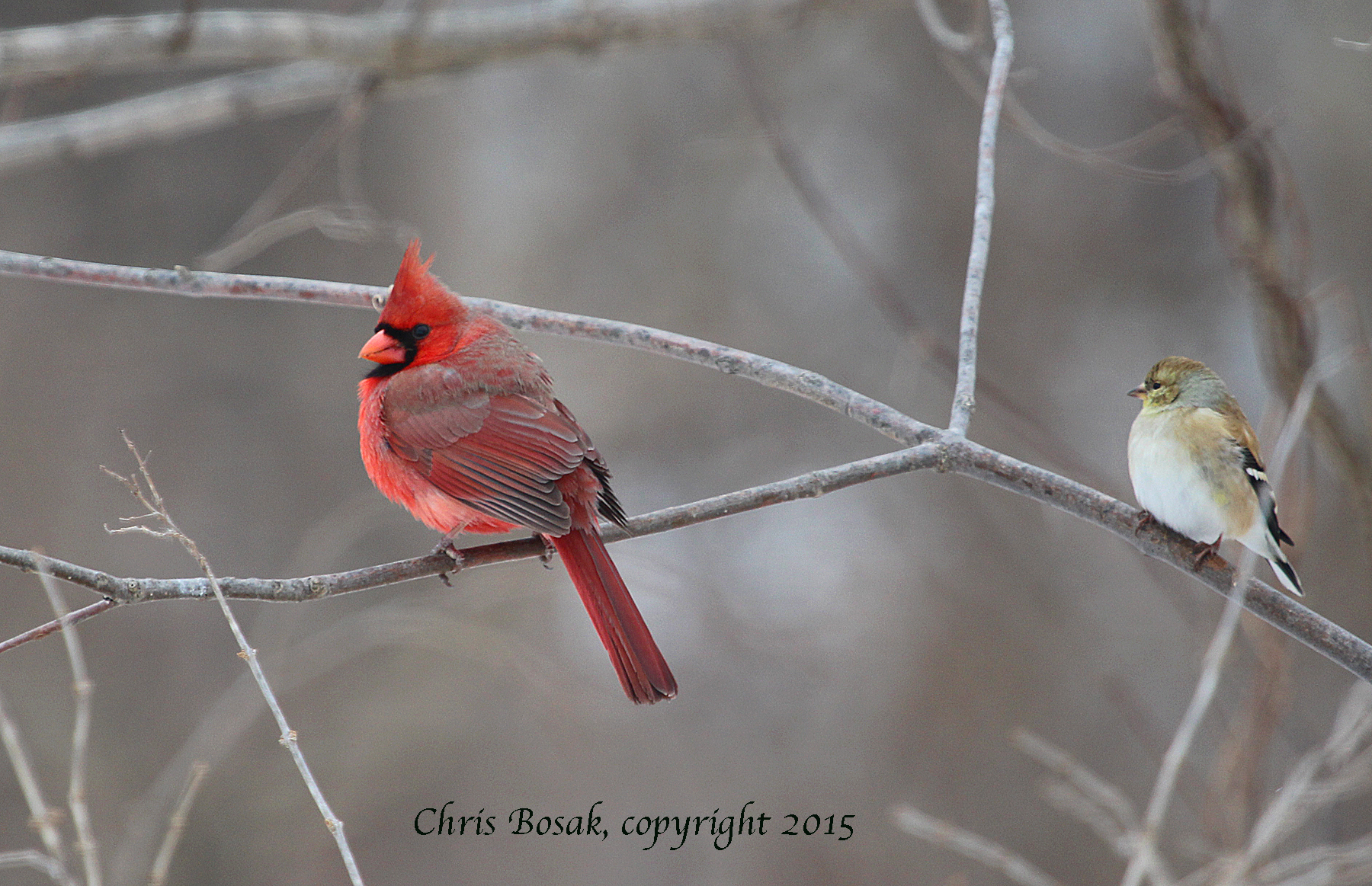
It is also being used on this post to kick off a celebration of our common backyard feeder birds. This is a great time of year for feeding birds as the feeders are active with titmice, chickadees, nuthatches, cardinals and other birds. Under the feeder, birds such as White-throated Sparrows and Dark-eyed Juncos have returned. So to celebrate that, I’ll post a series of photos highlighting some of our more common, but beloved, backyard birds.

Latest For the Birds column: Loons in the fall

Photo by Chris Bosak A Common Loon in transitional plumage swims on a pond in northern New Hampshire in early October 2014.

Photo by Chris Bosak
A Common Loon in transitional plumage swims on a pond in northern New Hampshire in early October 2014.

I recently took my annual trip to northern New England in the hopes of seeing moose and few boreal bird species. The moose were scarce _ I saw a grand total of zero _ and Gray Jays were the only real boreal species of birds I saw. Nonetheless I did see plenty of Common Loons, which makes for a successful trip in my book. My latest For the Birds column addresses loons and their summer and winter plumage (and in-between plumage).
The full column may be seen here. 

Over the next several days I’ll post photos from the trip, which included stops in central Maine and northern New Hampshire.

No seagulls, just gulls

Here’s my latest For the Birds column, which runs weekly in The Hour newspaper (Norwalk, Ct.) and The Keene Sentinel (Keene, N.H.) This one deals with the various gulls (not “seagulls”) that we see in New England.

Want to see For the Birds in your local paper? Contact the editor and make the suggestion.

……

Photo by Chris Bosak A Laughing Gull stands on a piling at a boat dock along the Norwalk River, Sept. 2014.

Photo by Chris Bosak
A Laughing Gull stands on a piling at a boat dock along the Norwalk River, Sept. 2014.

Watching gulls is either one of the easiest things to do or most difficult things to do when it comes to birdwatching.

On one hand, you can go to the beach (or parking lot or dump) and see all the gulls you want. You are 100 percent guaranteed to see them any time of day and any time of year.

On the other hand, gulls can be endlessly challenging for birders, to the point that expert birdwatchers are the only ones who can be certain what they are looking at — and even then maybe not so much.

Like many aspects of birding, it’s as easy or as difficult as you want to make it. You can roll into a parking spot at the beach, pull out a stale loaf of bread and be surrounded by gulls in seconds. (Not that I’m condoning feeding birds bread.) That is certainly birdwatching, whether you care to identify the species of hungry gulls or not.

Or you can find a group of gulls and inspect them to see if any rare species are mixed in among the common species. That sounds easy, but can be extremely difficult, if not next to impossible. It’s not as if the common species are blue and the rare species are yellow. In many cases they look identical with only very subtle differences. It’s like trying to find Waldo but only every other person in the picture wears glasses, blue jeans, and has a red-and-white sweater and hat on.

So is that simply a flock of Herring Gulls and Ring-billed Gulls, or is there a first-year Iceland Gull mixed in there somewhere? Or perhaps is there a hybrid of some sort among the flock.

(Since I used the word “flock” in that previous paragraph twice, now seems to be a good time to address the obvious question. “Flock of Seagulls” is technically not correct since there are no birds that are actually called “seagulls.” They are simply gulls. With that said, good luck getting the song “I Ran” out of your head for the rest of the day. Sorry about that. Whatever you do, don’t go to YouTube and search for that song. The outfits and haircuts are too much. Some things should just stay in the 80s.)

Anyway, New England features several common gulls that may be easily found. The most common gull on a beach depends on exactly where you are in New England. Ring-billed Gulls and Herring Gulls are the predominant gulls in the Norwalk area. Herring Gulls are the large ones while Ring-billed Gulls are smaller and have a black ring around their bills. Greater Black-backed Gulls are also common around here. They are the very large gulls with dark backs. Laughing Gulls, which feature black heads, are also common throughout much of New England, but not seen as often in the Norwalk area as the others I mentioned. Laughing Gulls show up more around here in late summer and early fall.

The less common gulls that show up on occasion — and discernable only by experienced birders in many cases — include Lesser Black-backed Gull, Glaucous Gull, Iceland Gull, and Bonaparte’s Gull. Picking out these species is difficult because they look pretty much the same as the other gulls with white heads, chests and bellies, and darker backs.

Adding to the confusion is that gulls of the same species can look very much different depending on age and time of year. Young gulls are often brown and/or heavily speckled. So even if you’re looking at 100 Herring Gulls many of the birds may look very different.

Yes, digging deep into gull watching is not for the faint of heart or those short on patience. If all gets too much, keep trying and don’t run away from the challenge. After all, when it comes to breaking down a flock of gulls, do you really want to say “I Ran. (So Far Away.)”

There I go again — back to the 80s.

Are birds in our future? State of the Birds 2014 Report

Photo by Chris Bosak A Piping Plover preens at Milford Point in spring of 2014.

Photo by Chris Bosak
A Piping Plover preens at Milford Point in spring of 2014.

The State of the Birds 2014 report was released this week. It is a comprehensive look at how our bird populations are faring and how they might fare in the future. It’s fascinating stuff and a must read for anyone interested in birds and conservation.

Here’s my column on it, with input from Connecticut Audubon officials. 

Visit www.stateofthebirds.org for the full report.

Tricky fall migration

Photo by Chris Bosak A female Common Yellowthroat perches in a tree in West Norwalk late this summer.

Photo by Chris Bosak
A female Common Yellowthroat perches in a tree in West Norwalk late this summer.

Here’s the latest For the Birds column, which runs weekly in The Hour (Norwalk, CT) and The Keene Sentinel (Keene, N.H.)

I’ve mentioned before that the fall migration, for the most part, is less ballyhooed by the birding community.

There are many reasons for this. The spring migration is so eagerly anticipated because it follows winter (usually a harsh one in New England) and birders are itching to see signs of rejuvenation in the natural world. The early flowers do a good job of heightening our spirits, but there’s nothing like the birds’ returning to really get us out of the winter doldrums.

The spring migration is also marked with a wide variety of colorful birds, most notably the warblers and other songbirds that pass through in April and May. The males are in their bright breeding plumage and singing their hearts out. The females are not as brightly colored and not as vocal, but are still a sight for sore eyes in the spring. The birds have a real sense of urgency in the spring migration, too. They need to get to their breeding grounds to get a good nesting spot and get down to th Continue reading

Ruby-throated Hummingbird drinking from berry

Photo by Chris Bosak A female Ruby-throated Hummingbird sips juice from a berry in Norwalk, Conn., summer 2014.

Photo by Chris Bosak
A female Ruby-throated Hummingbird sips juice from a berry in Norwalk, Conn., summer 2014.

Here are some more photos to accompany my most recent column in The Hour (Norwalk, Conn.) and The Keene Sentinel (Keene, N.H.)

Click here for the column.

Click below for more photos

Continue reading

Photo for next For the Birds column

Photo by Chris Bosak A Least Tern flies over its nesting grounds at Milford Point in Milford, CT, in June 2014.

Photo by Chris Bosak
A Least Tern flies over its nesting grounds at Milford Point in Milford, CT, in June 2014.

Here’s a sneak peek at the photo that will accompany my next For the Birds column that will appear in The Hour (Norwalk, CT) tomorrow (Thursday, July 10) and The Keene Sentinel on Monday, July 14. Check those newspapers’ respective websites to see the column soon.

If you live in New England and your local newspaper does not carry “For the Birds,” give the editor a call and suggest that they pick it up. They can contact me via this website. Thanks!

Find a baby deer? Leave it alone, it’s just fine

Here’s a column I wrote about a year ago that ran in The Hour (Norwalk, Ct.) and The Keene Sentinel (Keene, N.H). It is about finding baby deer that are “abandoned” — but not really abandoned, of course. Since it is that time of year again when people may stumble across baby animals, I figured I’d put this column out there again.

Photo by Chris Bosak A fawn hides in the woods, June 2013.

Photo by Chris Bosak
A fawn hides in the woods, June 2013.

What do old tennis balls, my boys’ penchant for baseball, and a nearby school have to do with this nature column?

Hang in there, you’ll find out soon enough.

First, let’s back up to winter. During snowless winter days I like to wander around the woods surrounding tennis courts and collect as many old tennis balls as I can. My boys used to love to join me in this endeavor. Now they kind of just tolerate the venture.

So why would I spend time and put up with the invariable scratches that come with such an outing? To have plenty of fodder for batting practice in the backyard. I live next to a school and the property is divided by a chain link fence about eight feet high. It makes for the perfect home run derby fence. I don’t have the bank account to fix all the broken windows that using a real baseball would cause, so we use old tennis balls.

The boys are getting bigger and stronger so lots of tennis balls go flying over the fence. Sometimes four or five pitches in a row are lost in the small p Continue reading

An interview with David Allen Sibley

Example of Sibley guide's second edition.

Example of Sibley guide’s second edition.

David Allen Sibley, the renowned birdwatcher and field guide author/artist, was kind enough to grant me and The Hour an interview about his recently released second edition of The Sibley Guide to Birds. I picked him up at the train station, drove to The Hour offices in Norwalk, and did the interview. I was hoping for some time to do some birdwatching, but alas, time was tight and it just didn’t happen. Not really anyway (read the column ((link attached)) for more details.)He sat down with The Hour photographer Erik Trautmann and me and I fired a bunch of random birding questions at him. We started, of course, with the field guides but then, as my interviews normally do, we headed off in all kinds of directions.It was a great time and I’m glad David took the time to do the interview in our office. Click here for the column and accompanying video of a portion of the interview. I will add to this website more audio of the interview in the coming days.

Thanks for visiting http://www.BirdsofNewEngland.com


For the Birds column: Greenberg to speak about Passenger Pigeon book at Yale

Contributed image Cover of Joel Greenberg's "A Feathered River Across the Sky."

Contributed image
Cover of Joel Greenberg’s “A Feathered River Across the Sky.”

Here’s an excerpt from my latest For the Birds column, which will be in print in The Hour tomorrow. Full story is available online now, click on link below.

….

Joel Greenberg says the story of the Passenger Pigeon is unique in three ways: the species’ sheer abundance; its vast flocks; and its rapid descent to extinction.

To expand on that a bit: The Passenger Pigeon likely numbered in the billions in the mid 1800s. Its flocks were so monumentally large that naturalist John James Audubon wrote that a single flock darkened the sun for three days. Finally, the species went from billions of individual birds to zero in matter of about 40 years.

Greenberg is the author of “A Feathered River Across the Sky: The Passenger Pigeon’s Flight to Extinction,” which was published in January by Bloomsbury USA. He is also working on an accompanying documentary entitled “From Billions to None.”

Species in peril today are protected by various laws and, for the most part, have the human race rooting for them to survive. That was not the case with the Passenger Pigeon.

“Hunters, instead of saying ‘let’s lay off a bit,’ took the other attitude,” Greenberg said. “They said ‘this bird is disappearing so I’m going to kill as many as I can before they are gone.’ There were a handful of individuals expressing concern, but not many.”

But, Greenberg points out, …

Click here for the rest of the column.