Warbler Week: Black-and-white warbler

Photo by Chris Bosak
A black-and-white warbler seen in Ridgefield, Conn., May 2019.

The black-and-white warbler is another common warbler in New England. Black-and-white warblers are one of the few warblers often seen on tree trunks. According to the Cornell Lab of Ornithology, they have an extra hind claw that helps them cling to trunks. They are also often heard and not spotted, especially when the leaves are fully out in our New England woods. Listen for the high-pitched squeaky wheel song. Some song descriptions are of little help, but this warbler sounds exactly like a squeaky wheel. The black-and-white warbler is not a colorful warbler (obviously) but it’s a striking bird regardless with its striped plumage.

Warbler Week: Common yellowthroat

Photo by Chris Bosak
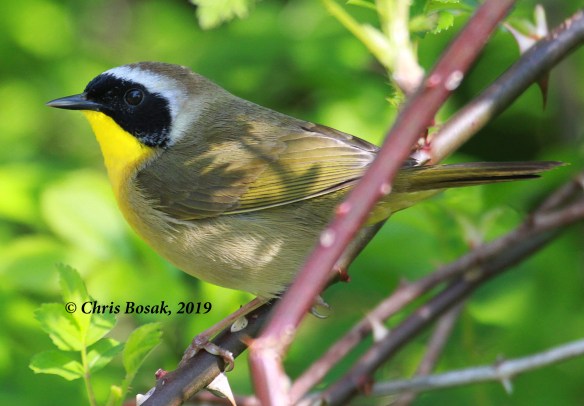
A common yellowthroat perches on a branch in Ridgefield, Conn., May 2019.

Aside from the yellow warbler, the common yellowthroat is perhaps New England’s most common and widespread warbler. The male is a handsome bird with a thin white “forehead,” thick black face mask and bright yellow throat and underparts. The rest of the body is olive and tan. Females are mostly olive and tan with a yellow throat. The loud “witchety-witchety-witchety” song often accompanies birders on spring and early summer walks. Yellowthroats prefer shrubby habitat and are usually found low in this habitat.

Photo by Chris Bosak
Female common yellowthroat

Warbler Week: Ovenbird

Photo by Chris Bosak
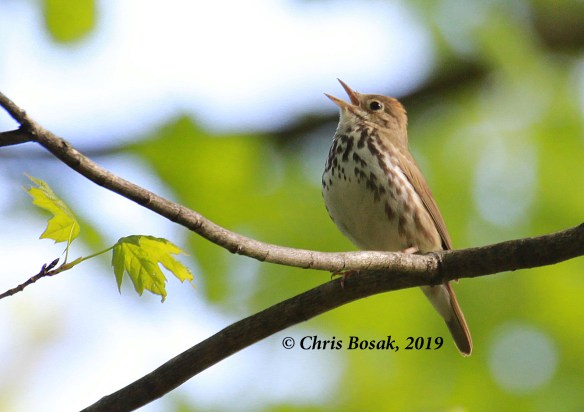
An ovenbird sings from a perch in Ridgefield, Conn., May 2019.

The ovenbird’s “teacher, teacher, teacher” song is often the dominant sound in the New England woods during spring and summer. It is a loud and piercing song, but it is often difficult to find the source. The ovenbird is small (it is a warbler after all) and well-camouflaged bird. It resembles a thrush with its overall brownish plumage and spotted chest but it also has an orange crown flanked by two dark streaks. The ovenbird, which is named for the shape of its ground nest, is often found walking along the forest floor. It will sing from the ground or from a perch in the woods making it that much more difficult to find.

Photo by Chris Bosak
An ovenbird sings from a perch in Ridgefield, Conn., May 2019.

Warbler Week: American redstart

Photo by Chris Bosak
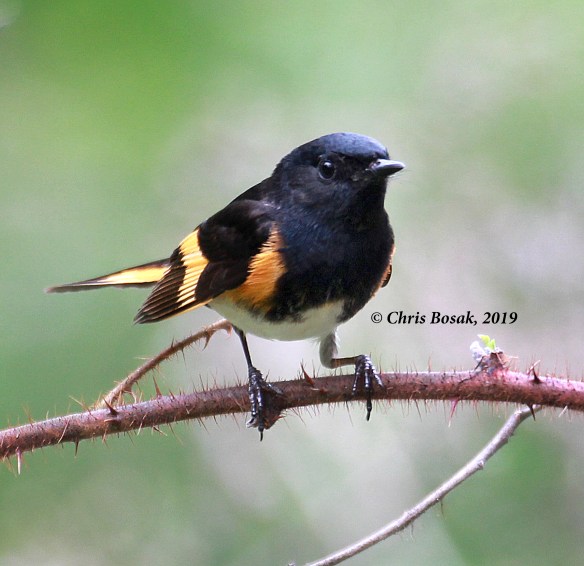
An American redstart perches in a tree in Ridgefield, Conn., May 2019.

The American redstart is a dynamic-looking little bird with black and orange plumage. While the Baltimore oriole is predominately orange with black and white, the redstart is mostly black with orange markings on its sides, wings and outer tail edges. The redstart, of course, is also much smaller than an oriole. Redstarts are common throughout New England in brushy areas near woods. You’ll probably hear its high-pitched, rather non-musical song before seeing the handsome bird. Females and young redstarts are similarly patterned to males, but gray and yellow instead of black and orange.

Here’s the female …

Photo by Chris Bosak
An American redstart perches in a tree in Ridgefield, Conn., May 2019.

Warbler Week: Chestnut-sided warbler

Photo by Chris Bosak
A chestnut-sided warbler in Hardwick, Mass., May 2019.

I found this guy flitting among the low branches in the woods near my son Andrew’s school lacrosse field last weekend. I had an hour to kill before the game started and, of course, took a little walk in the woods. Towhees and ovenbirds provided the musical backdrop when this guy appeared right in front of me. The chestnut-sided warbler has always been one of my favorites ever since I saw my first one more than 20 years ago in Keene, N.H.

Chestnut-sided warblers breed throughout New England and nearby Canada. They winter in mixed flocks in Central America.

Photo by Chris Bosak
A chestnut-sided warbler in Hardwick, Mass., May 2019.

Kicking off Warbler Week

Photo by Chris Bosak A yellow warbler perches on a branch in Brookfield Conn., May 2019.

Last week may have been a better week to feature some of our more common warblers, but plenty of these beautiful little birds will be passing through or settling into New England this week as well. Each day this week I’ll feature a warbler or two with short text descriptions and, of course, photos. I’ll kick off Birds of New England’s Warbler Week here with a bonus post highlighting two of the warblers I’ve already posted about this spring.

Photo by Chris Bosak
A yellow warbler sings from a perch in Brookfield Conn., May 2019.

The yellow warblers are one of the most commonly seen warblers in New England. They start arriving in early May and nest throughout the region. They are most likely to be seen in brushy areas near woods. Their “sweet sweet sweet I’m so sweet” song is a common song heard throughout spring and summer.

Yellow warblers make a strong case for capitalizing bird names, which is something I go back and forth on. Whenever I capitalize names, however, it is usually the style of the publication for which I am writing to not capitalize and the capitalization is changed anyway. But consider this: Many warblers have yellow featured prominently in their plumage so there are many bird species that may be considered on some level to be yellow warblers. But there is only one Yellow Warbler and the capitalization makes it clear that that’s the bird I’m talking about.

Yellow warblers are all yellow with brown/rusty streaks on its chest and sides.

Photo by Chris Bosak
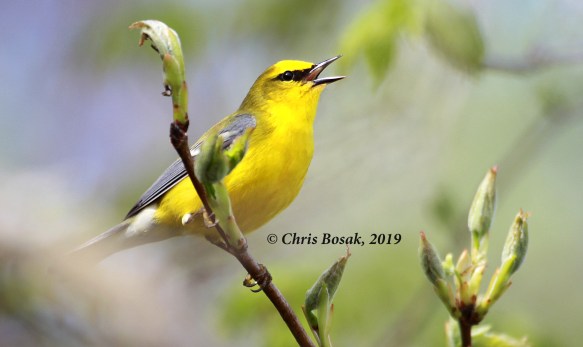
A blue-winged warbler sings from a perch in Brookfield, CT, May 2019.

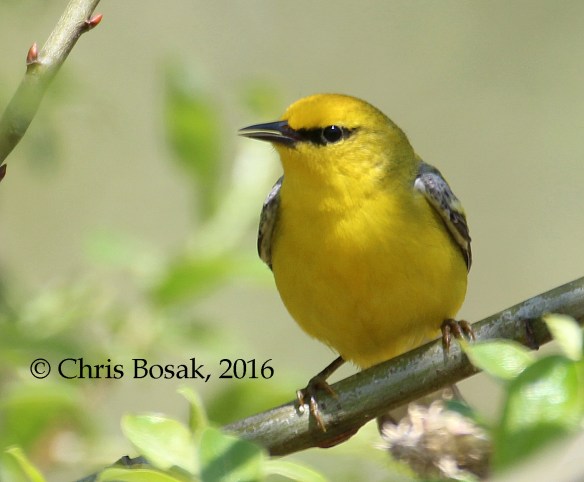
Blue-winged warblers are also common and widespread throughout New England. Their insect-like song “buzzzz-beee” is another common sound during a spring walk. They also favor shrubby areas near woods. In my estimation, they are one of the more distinctive looking warblers with bright yellow plumage and thick black eye streak.

Here’s a shot from 2016.

Photo by Chris Bosak A Blue-winged Warbler seen at Fairchild Wildflower Sanctuary in Greenwich, Conn., May 2016.

Blue-winged warbler: Bonus photo from my last bird walk

Photo by Chris Bosak
A blue-winged warbler sings from a perch in Brookfield, CT, May 2019.

To me anyway, the blue-winged warbler is one of the more strikingly plumaged birds we see in New England. The overall bright yellow plumage is an obvious eye-catcher, but the black eyestripe adds an unmistakable element of coolness to the bird’s appearance. The blue-winged warbler is common in New England and breeds throughout the region. Listen for its insect-like song as you walk along the edge of woods.

Blue-winged warblers have expanded their range northward since the 1800s, which is good and bad news. Why? This is from the Cornell Lab of Ornithology: “In the late 1800s, Blue-winged Warbler populations expanded northward as agricultural fields were abandoned and forest clearcuts started regrowing. This northward expansion increased the frequency of contact with Golden-winged Warblers, a Partners in Flight Red Watch List species, as well as hybridization between the two species. Hybridization and competition between Golden-winged and Blue-winged Warblers is partially responsible for declining populations of Golden-winged Warblers.”

Nature has a delicate balance.

More towhees and a warbler

Photo by Chris Bosak A yellow warbler perches on a branch in Ridgefield, Conn., April 2019.

A recent walk in block 91A (my area of the Connecticut Bird Atlas) yielded even more eastern towhees than my walk last week. At one point I saw a female eastern towhee carrying a lump of straw in her bill. Good sign!

Later in my walk, after seeing a beautiful coyote cross the trail and disappear into the woods, I saw my first yellow warbler of the year. Yellow warblers are one of the more ubiquitous warblers in New England as they both migrate through and stay to breed Continue reading

Warbler watch is on

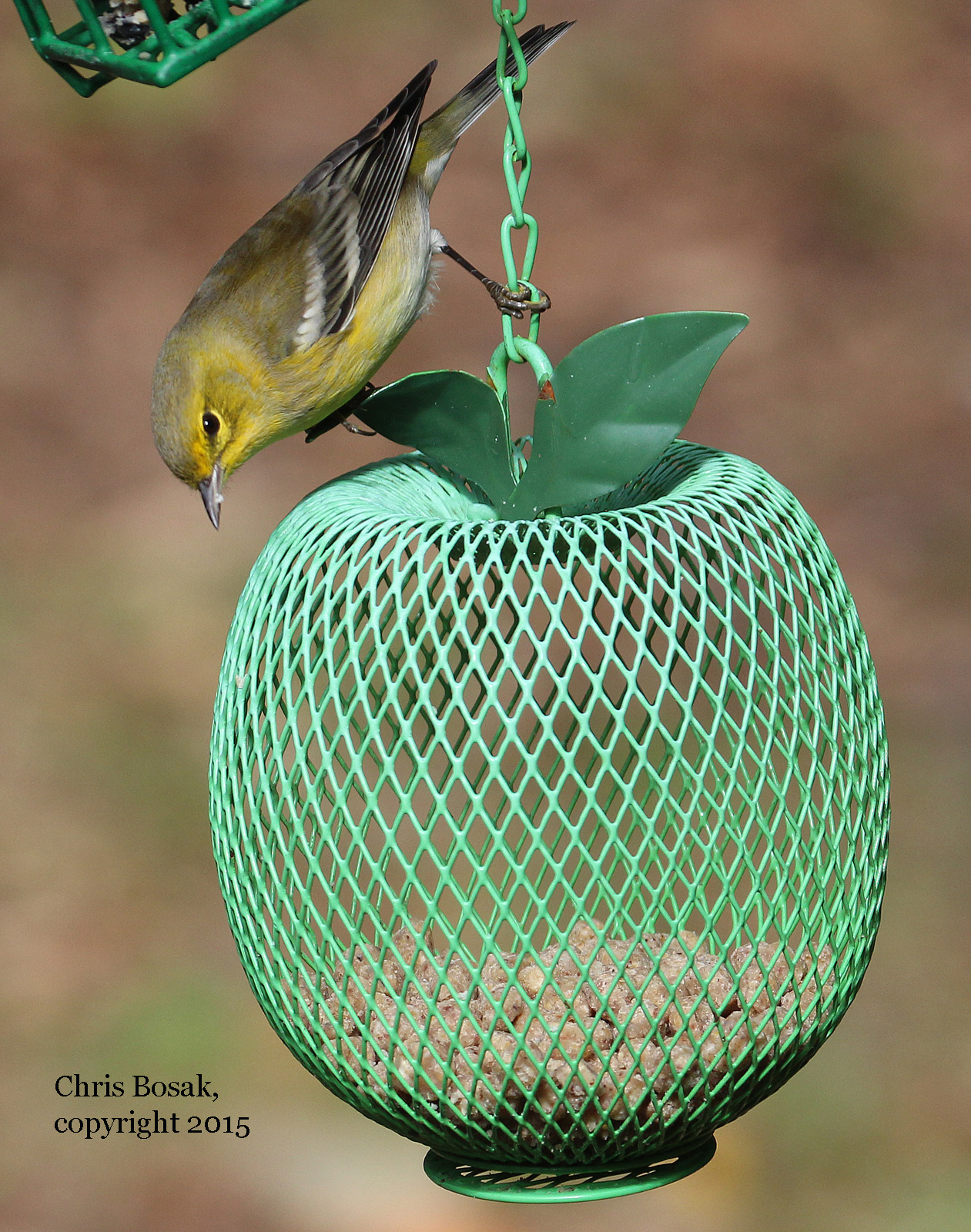
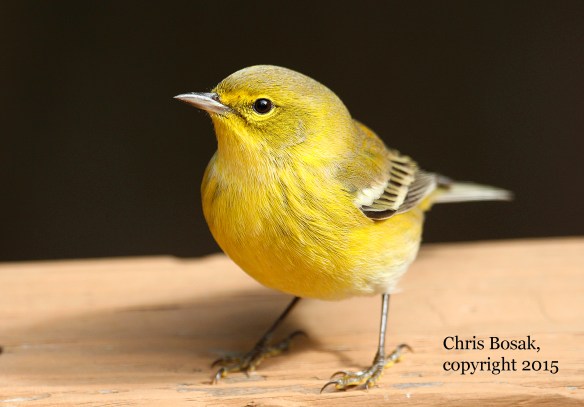
Photo by Chris Bosak A Pine Warbler sits on a deck railing in New England this fall.

The early warblers started arriving in New England a week or two ago. Pine warblers and palm warblers are typically the first two species to make their way back this far north and, sure enough, both are back now. This post includes photos of both species so you know what you’re looking for. (Above is the pine warbler; below is the palm warbler.)

The spring warbler season is the highlight of the year for many birdwatchers. It will pick up gradually over the next week or so and then erupt from late April through the middle of May. At the height of the warbler migration, a New England birdwatcher can see between 20 and 30 warbler species in a single day. (It would take some effort, of course, but it’s very possible.)

I’ll post frequently about warblers over the next few weeks and, hopefully, have plenty of fresh warbler photos to share. In the meantime, practice up with this link from AllAboutBirds.org — it includes various warblers and their songs.

Photo by Chris Bosak Palm Warbler

For the Birds: Waiting for warblers

Here is the latest For the Birds column, which runs weekly in several New England newspapers.

Photo by Chris Bosak A Pine Warbler sits on a deck railing in New England this fall.

Photo by Chris Bosak
Pine Warbler at feeder in Danbury, Conn., fall 2015.

Finally, I thought, a warbler singing in the backyard.

It’s been a long winter and the pine warbler I usually hear by the end of the first week of April never materialized. The first week of April turned into the second week and still no warblers to be seen or heard — at least on my end.

One cool, but bright morning last week, I stepped out onto the deck to fill the feeders and heard a high-pitched, soft and somewhat melodic tune coming from a giant oak. Surely a warbler, I thought, but I wasn’t sure which one.

I grabbed the binoculars, which always hang at the ready just inside the door. Now to find the little bugger. The leaves haven’t popped yet, so this shouldn’t be too tough, I told myself. It was more difficult than I thought, of course, but I finally zeroed in on a little bird high up on the trunk.

As you can probably tell from the build-up, it wasn’t a warbler at all. It was a brown creeper — a small, brown bird seen on tree trunks throughout New England, mostly in the fall, winter and spring. Usually the birds are silent as they look for insects by starting at the bottom of a tree trunk and working their way up.

In fact, I think this may have been the first time I consciously heard the song of a brown creeper. The website AllAboutBirds.org describes the song, sung only by males, as such: “His song is a jumble of high, thin notes that lasts up to 1.5 seconds. It’s sometimes likened to singing the phrase, ‘beautiful trees.’”

You’d think after all these years of birdwatching, I would know all the songs of warblers and be able to distinguish between warblers and non-warblers. There are many types of warblers, however, and I know a lot of the songs, but not all of them. Plus, this song was very warbler-like, as I mentioned. Also — my final excuse, I promise — it’s been 11 months since we’ve heard warblers singing and my birding-by-ear is rusty. It’s only average to begin with, so this guy definitely fooled me.

Not that I’m complaining that it was a brown creeper. I find them extraordinarily interesting birds, despite their small size and rather non-descript appearance. I like how they work up the trunk of a tree and then fly down to the base of a nearby tree to start again.

I’m still waiting on that first warbler, but I’m confident they will arrive soon. As usual, the sightings will start as a trickle — pine warbler here, palm warbler there — and then become a fantastically overwhelming phenomenon of tiny, colorful birds in the trees.

Get your ears ready.

Note: Since this column was originally written, I’ve seen palm and pine warblers. Rejoice!