Birds to brighten your day: May 10 (Part II)

Photo by Chris Bosak
An ovenbird perches on snowy branches at Bennett’s Farm State Park in Connecticut during a rare May snowfall in 2020.

Usually I post my latest bird column on Sunday and leave it at that. But yesterday (yes May 9) many in New England woke up to a snow-covered ground and then got another dose of the white stuff later in the day. I couldn’t pass up the opportunity to get up early and head into the woods to try to get photos of warblers and other spring migrants that we typically don’t associate with snow. There was just a covering of snow and the morning sun was melting it quickly so I had to hurry. I ended up with a few shots of an ovenbird and a blue-winged warbler on snowy branches. Strange times, indeed. (I’ll post the ovenbird a bit later today.)

Happy Mothers Day to all the moms out there!

(Here’s even more repeat text for context:  I’m running out of COVID-19 lockdown themes so from now until things get back to some semblance of normalcy, I will simply post my best photo from the previous day. You could say it fits because of its uncertainty and challenge. I’ll call the series “A Day on Merganser Lake,” even though that’s not the real name of the lake I live near in southwestern Connecticut, it’s just a nod to my favorite duck family.)

Photo by Chris Bosak
An ovenbird perches on snowy branches at Bennett’s Farm State Park in Connecticut during a rare May snowfall in 2020.
Birds to brighten your day: May 10

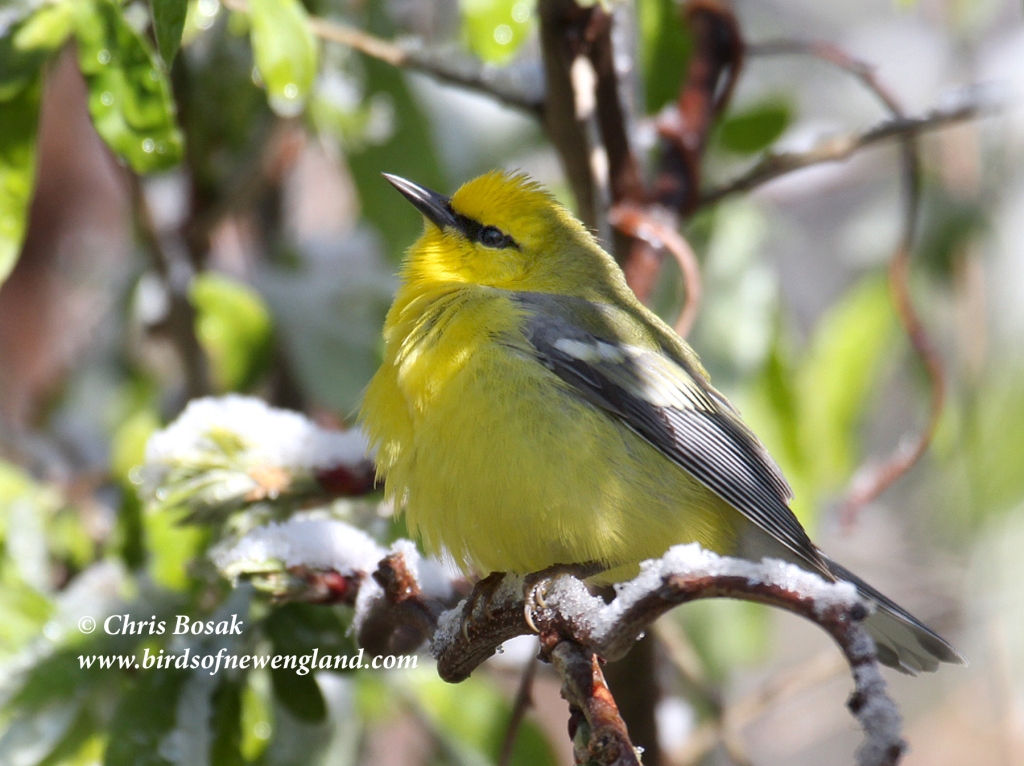
Photo by Chris Bosak A blue-winged warbler perches on snowy branches at Bennett’s Farm State Park in Connecticut during a rare May snowfall in 2020.

Usually I post my latest bird column on Sunday and leave it at that. But yesterday (yes May 9) many in New England woke up to a snow-covered ground and then got another dose of the white stuff later in the day. I couldn’t pass up the opportunity to get up early and head into the woods to try to get photos of warblers and other spring migrants that we typically don’t associate with snow. There was just a covering of snow and the morning sun was melting it quickly so I had to hurry. I ended up with a few shots of an ovenbird and a blue-winged warbler on snowy branches. Strange times, indeed. (I’ll post the ovenbird a bit later today.)

Happy Mothers Day to all the moms out there!

(Repeat text for context:  I’m running out of COVID-19 lockdown themes so from now until things get back to some semblance of normalcy, I will simply post my best photo from the previous day. You could say it fits because of its uncertainty and challenge. I’ll call the series “A Day on Merganser Lake,” even though that’s not the real name of the lake I live near in southwestern Connecticut, it’s just a nod to my favorite duck family.)

Photo by Chris Bosak A blue-winged warbler perches on snowy branches at Bennett’s Farm State Park in Connecticut during a rare May snowfall in 2020.
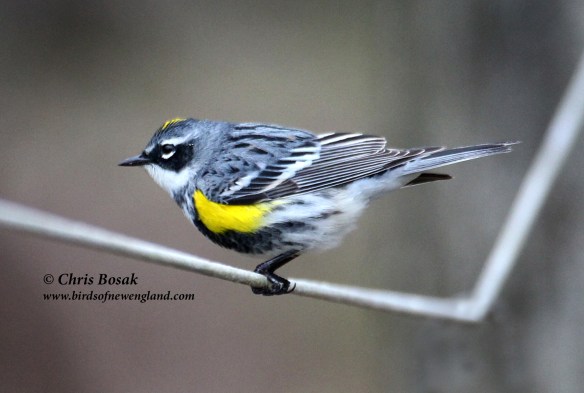
Photo by Chris Bosak
A blue-winged warbler perches on snowy branches at Bennett’s Farm State Park in Connecticut during a rare May snowfall in 2020.

For the Birds: Patience is key, even though it’s hard

Photo by Chris Bosak A yellow-rumped warbler perches on a clothesline in Danbury, CT, April 2020. (Merganser Lake)

I doubt Tom Petty had birdwatching in mind when he wrote the lyrics “the waiting is the hardest part,” but it sure is appropriate for birders in the spring.


Signs of spring start as early as January or February when a few hardy flowers poke out of the ground. Owls also start their breeding season about this time but that is done in secret and largely unbeknownst to humans. March brings the first spring peeper calls, more flowers, red-winged blackbirds, American woodcock and, finally, eastern phoebes, at the end of the month. March also brings the official start to spring, of course.


April starts off fairly slowly until the first pine warblers arrive. Then it’s warbler season! The problem is, pine warblers are three weeks to a month ahead of most of the other warblers and other colorful migratory songbirds. Palm warblers and yellow-rumped warblers are the exceptions as they closely follow the pines.

Those three weeks to a month can seem like an eternity. We’ve endured winter and have slowly gotten small teases of spring. Bring it on already! We jump Continue reading

Birds to brighten your day: May 4

Photo by Chris Bosak
A palm warbler rests on a wire fence in a backyard in New England, April 2020. Merganser Lake.

A Day on Merganser Lake XIV

I spent most of the weekend working in the garden and putting a fence around a new plot I had dug a few weeks earlier. Having never put in a fence before, I was fairly happy with the results. Apparently, a palm warbler agreed as it perched on the fence less than an hour after I had completed the task. Gotta love warbler season.

(Repeat text for context:  I’m running out of COVID-19 lockdown themes so from now until things get back to some semblance of normalcy, I will simply post my best photo from the previous day. You could say it fits because of its uncertainty and challenge. I’ll call the series “A Day on Merganser Lake,” even though that’s not the real name of the lake I live near in southwestern Connecticut, it’s just a nod to my favorite duck family.)

Birds to brighten your day: April 30

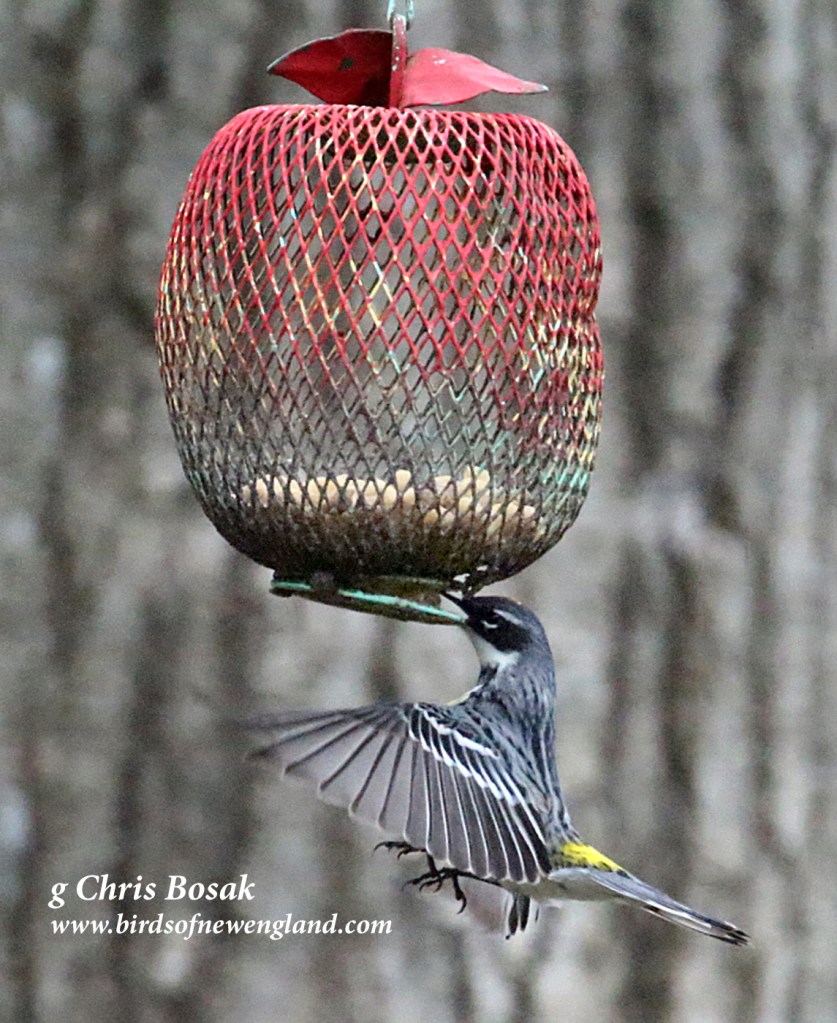
Photo by Chris Bosak A yellow-rumped warbler hovers to get a treat from a feeder in Danbury, CT, April 2020. (Merganser Lake)

A Day on Merganser Lake XXI

The pine warblers swoop in and land on this apple-shaped feeder like it’s no problem. The yellow-rumped warblers, however, have difficulty and sometimes hover underneath it instead of landing on it. So I jacked up my ISO to freeze the action (at the cost of image quality) and got this shot of the yellow-rumped grabbing a suet nugget. The image at the bottom shows why it’s called a yellow-rumped warbler.

(Repeat text for context:  I’m running out of COVID-19 lockdown themes so from now until things get back to some semblance of normalcy, I will simply post my best photo from the previous day. You could say it fits because of its uncertainty and challenge. I’ll call the series “A Day on Merganser Lake,” even though that’s not the real name of the lake I live near in southwestern Connecticut, it’s just a nod to my favorite duck family.)

Photo by Chris Bosak A yellow-rumped warbler hovers to get a treat from a feeder in Danbury, CT, April 2020. (Merganser Lake)

Birds to brighten your day: April 27

Photo by Chris Bosak
A yellow-rumped warbler perches on a clothesline in Danbury, CT, April 2020. (Merganser Lake)

A Day on Merganser Lake XVIII

Here’s a solo shot of the yellow-rumped warbler. Warblers aren’t known as feeder birds, but I’ve had three yellow-rumpeds and at least two pine warblers all over my suet feeders the last few days. Warblers are small, often colorful birds that winter in parts south and migrate north each spring. Some nest in New England and some pass through New England on their way farther north.

(Repeat text for context:  I’m running out of COVID-19 lockdown themes so from now until things get back to some semblance of normalcy, I will simply post my best photo from the previous day. You could say it fits because of its uncertainty and challenge. I’ll call the series “A Day on Merganser Lake,” even though that’s not the real name of the lake I live near in southwestern Connecticut, it’s just a nod to my favorite duck family.)

Birds to brighten your day: April 23

Photo by Chris Bosak A palm warbler looks for food on the ground in a yard in Danbury, Connecticut, April 2020. Merganser Lake.

A Day on Merganser Lake XIV

I’ve been seeing palm warblers around my yard for about a week now. They are fairly brave as they sometimes approach closely in their search for food. They remain tricky photo subjects, however, because, like most warblers, they are constantly in motion. I got a decent shot of this bird as it hopped along a rocky area of my side yard yesterday.

Palm warblers are usually the second warbler to arrive in New England in the spring, following the pine warbler. Palm warblers are tail-pumpers so if you see a small, yellow bird with a rusty cap sitting on a branch pumping its tail, it’s a palm warbler.

(Repeat text for context:  I’m running out of COVID-19 lockdown themes so from now until things get back to some semblance of normalcy, I will simply post my best photo from the previous day. You could say it fits because of its uncertainty and challenge. I’ll call the series “A Day on Merganser Lake,” even though that’s not the real name of the lake I live near in southwestern Connecticut, it’s just a nod to my favorite duck family.)

For the Birds: Warbler season already

Photo by Chris Bosak
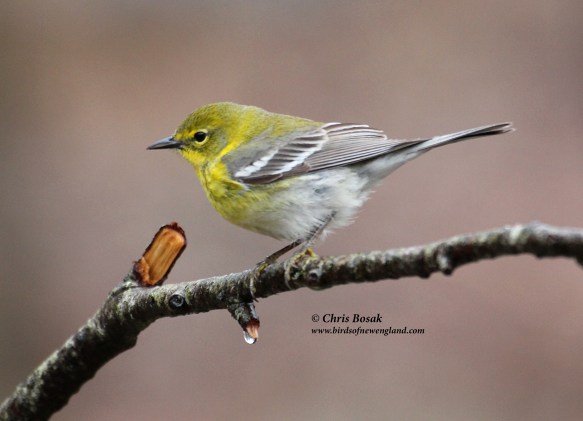
A pine warbler visits a backyard in New England, April 2020, Merganser Lake.

Another quick, one-day break from the A Day on Merganser Lake photo series to bring you the latest For the Birds column …

Could it be warbler season already?

It sure is and I’m just as surprised as the next person. Not that the first week of April is unusual for the early warblers to arrive; it’s right on time.

Still, I was surprised when I looked up and saw a pine warbler perched at the top of my bird-feeder pole system the other day. I wasn’t ready for it. In a normal year, I’d be counting down the days until the first warblers arrived. But this is no normal year. I think we can all agree on that.

Like many others, I’m sure, I’ve been consumed with COVID-19, or coronavirus. It’s on the news 24/7. Grocery stores have one-way aisles, most people are wearing masks and the cashiers are wearing face shields. My work (thankfully I am still working) is busier than ever due to the virus and the days start earlier and end later than ever.

No sports. No concerts. No parties. Heck, no talking to your Continue reading

Birds to brighten your day: April 10

Photo by Chris Bosak
A pine warbler visits a backyard in New England, April 2020, Merganser Lake.

A Day on Merganser Lake III

Back-to-back pine warblers in the early stages of my “best photo from yesterday” series. As long as the pine warblers (there are at least four of them) keep visiting my suet and mealworm feeders, it’s going to be tough to not consider them my best photo. We’ll see what tomorrow brings, though.

Thanks for checking out BirdsofNewEngland.com as we get through this crisis together.

(Repeat text:  I’m running out of COVID-19 lockdown themes so from now until things get back to some semblance of normalcy, I will simply post my best photo from the previous day. You could say it fits because of its uncertainty and challenge. I’ll call the series “A Day on Merganser Lake,” even though that’s not the real name of the lake I live near in southwestern Connecticut, it’s just a nod to my favorite duck family.)

Back to back For the Birds columns

Here are the last two For the Birds columns, mostly focused on what readers have been seeing this spring.

Photo by Chris Bosak A male indigo bunting eats seeds from a platform feeder in Danbury, Conn., in May 2018.

If the past season was the Winter of the barred owl, this is the spring of the indigo bunting.

I’ve heard from numerous readers and friends throughout New England and even Canada about this bright blue bird visiting their backyards. The cause for excitement is obvious as it is one of our more colorful birds, flashing a brilliant blue plumage. The brilliance of the blue plumage is dependent upon the light.

It is also nice to hear that so many of these birds are around and delighting backyard birders in large numbers. Rose-breasted grosbeaks are another popular bird this spring. I’ve had limited luck with indigo buntings this spring, but for me, it’s been a banner year for rose-breasted grosbeaks. I’ve seen as many as three males in a tree overhanging my feeders. A female visits the feeders often as well.

It’s also been a good spring for warblers and nearly every walk last week yielded yellow warblers, common yellowthroats, black-and-white warblers, chestnut-sided warblers, American redstarts and yellow-rumped warblers.

I’m not the only birdwatcher enjoying a productive spring. Here’s what Continue reading