Here’s a recent column I wrote for The Hour newspaper in Norwalk, Conn. Most of the Osprey have returned to New England by now and Connecticut Audubon is once again holding its Osprey Nation program whereby citizens monitor the nests of “fish hawks.” There are now dozens of Osprey nests along Continue reading
Must be spring, the phoebes are back

Photo by Chris Bosak
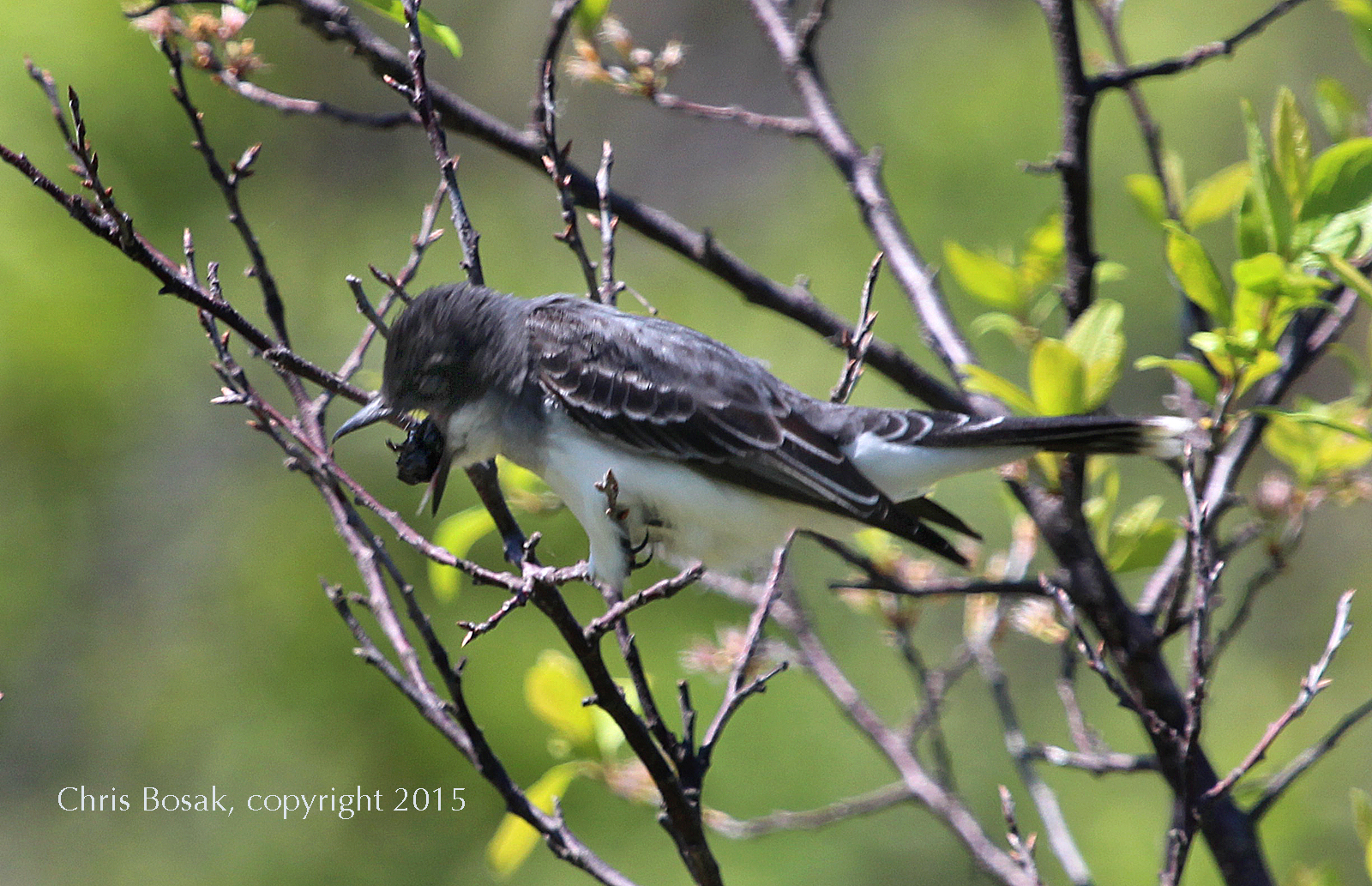
An Eastern Phoebe perches on a branch in Selleck’s Woods in Darien, Conn., in late March 2015.
A very quiet walk in a patch of woods the other day suddenly turned interesting when a lone Eastern Phoebe made an appearance. Overall, the phoebe is somewhat drab, but its habit of bobbing its tail constantly gives its identity away immediately.
I’ve always liked phoebes despite their nondescript appearance and quiet voice. Perhaps it’s because they migrate so early and offer some hope that winter is finally in the rearview mirror.
I’ve been seeing them almost daily now, so it’s nice to know spring is here. Phoebes, just like chickadees and several birds, are named after the song they sing.
Killdeer doing what Killdeer do to keep the species going
The day after photographing a Killdeer walking along the snow-covered ground of Spring Grove Cemetery in Darien, Conn., I returned to the same spot to see what other birds might be around.
I watched a few Wood Ducks and Ring-necked Ducks in the small pond, but they stayed out of photographic range. It was good to see them anyway, of course.
Then I spotted a Killdeer somewhat near the pond’s edge. What the heck, I thought, may as well take some photographs. I grabbed a few shots and almost started to drive away until I noticed another Killdeer not far away. I almost drove away again as the new Killdeer was not adding any new photographic opportunities. I was happy to see it, don’t get me wrong, but I was ready to move on with me day.
I put the camera back on front seat and reached for the gear shift when I heard a long and consistent “piping.” What are they up to, I thought. Instinctually I got the camera ready again and, sure enough, the male climbed on top of the female and did what comes naturally in the natural world. The continuation of the species … it’s a beautiful thing.
Killdeer handles the cold and snow

Photo by Chris Bosak
A Killdeer stands in the snow at a cemetery in southern New England in late March 2015.
One of the drawbacks to being an early northward migrant is that they are subject to the whims of the early spring New England weather. Will it be hot, cold, just right? Raining, snowing? The birds that show up in March are subjected to it all. But they’ve been doing it for generations, so for the most part, they can handle whatever is thrown at them.
Killdeer are one of these early migrants. They mate and nest earlier than most birds, too. So a little snow is no big deal for these “shorebirds.” The snow does make for nice photos, though.
Now that’s a lot of robins!

Photo by Chris Bosak
A flock of American Robins searches through the light snow near a cemetery in southern Connecticut, March 2015.
Early every spring, the robins return in force. Yes, of course many robins remain in New England all winter, but early spring marks the return of many robins that bolted for warmer temps down south.
Nowhere is that more apparent to me than a cemetery and adjacent field at town hall in Darien, CT. I drive past here nearly every day and suddenly one day in late March the fields are filled with American Robins. That day was a few days ago and the robins remain. Soon they will disperse and get down to the serious business of nesting and raising families.
That first robin of the year may not be an accurate harbinger of spring because many are with us all winter, but when the fields are full of robins … now that’s a sign of spring.
(The above photo is admittedly not the greatest, but it gives an idea of how many there are. About 50 are shown in this photo, but the field extends widely to the left and right. In all, there were about 400.)
Yes, there are eagles out there

Photo by Chris Bosak
A Bald Eagle preches in a tree on Chimon Island off the coast of Norwalk, Conn., March 2015.
I tagged along with U.S. Fish & Wildlife Service officials and staff this week to confirm an active Bald Eagles’ nest on Chimon Island off the coast of Norwalk, Conn. The nest is visible from the coast with binoculars or a spotting scope, so we were all fairly certain of

Hour photo/Chris Bosak
Rick Potvin, manager of the Stewart B. McKinney NWR, holds a sign before it was posted on Chimon Island on Wednesday. The U.S. Fish & Wildlife officials were on the island to mark off areas to protect a bald eagle nest.
what we’d see anyway, but the confirmation has officially been made. The U.S. Fish & Wildlife staff posted more signage on the island and placed additional barriers to protect the eagles, which are safeguarded by state and federal laws.
Chimon Island is part of the Stewart B. McKinney National Wildlife Refuge.
The laws, of course, do not protect the eagles against annoyed
Ospreys, so a battle may be pending. The eagles have taken over a nest that has been used by an Osprey pair for the last four years. The osprey haven’t returned from South America yet, so it could get interested when they do.
The photos aren’t great, I know, but they are indeed the eagles off the coast of Norwalk.
Here are links to some stories I wrote for The Hour newspaper regarding the eagles.
Bald Eagles may be nesting on Norwalk Island
For the Birds: Have the eagles landed?
U.S. Fish and Wildlife Service confirms eagle nest on Chimon Island
Greater White-fronted Goose chilling with Canada Geese

Photo by Chris Bosak
A Greater White-fronted Goose is seen with a flock of Canada Geese at Cove Island Park in Stamford, Conn., March 2015.
Here’s a shot of a Greater White-fronted Goose within a flock of Canada Geese. The photo was taken Sunday, March 22, 2015, at Cove Island Park in Stamford, Conn.
It’s a reminder to look closely at flocks of Canada Geese for the stray bird. Individual Snow Geese are often found among flock of Canada Geese, too. So, when is a flock of Canada Geese not a flock of Canada Geese? When there’s something else in there, too. Look carefully.
The Greater White-fronted Goose is common in the West and Midwest, but seen only occasionally in the East.
I was alerted to this bird by the Connecticut birding list, so thanks to those who listed this bird.
Here’s a close up:
House Finches and eye disease

Photo by Chris Bosak
A House Finch with an eye disease visits a feeder station in Stamford, Conn., March 2015
It had been a while since I saw a House Finch with Mycoplasma gallisepticum, an eye disease that inflicts many House Finches in the eastern U.S.
The other day, however, I was watching a feeder station in Stamford, Conn., when a lone male House Finches showed up. With my new-found appreciation for House Finches (click here for more on that) I was happy to see the bird. Then the bird adjusted itself on a branch near the feeder and I noticed it had the disease. Poor thing.
Based on Project FeederWatch observations that alerted ornithologists to the problem, the Cornell Lab of Ornithology started the House Finch Disease Survey in 1994. Much was discovered about the disease, but obviously it has not gone away. The project has since been defunded, but Project FeederWatch participants can still report House Finches with this disease. It’s may seem like a small way to help, but it’s something. Every little bit helps when it comes to bird study.
For a lot more information on House Finches and the eye disease, click here.
Junco season winding down
We love to see our first Dark-eyed Juncos of the late fall. They remind us that our winter birds have arrived and will be with us for the next several months.
Well, those months are passing by quickly and soon the junco sightings will become scarce again. So here’s a shot I took of a junco the other day. Will it be one of the last— at least until next fall?
Did you know …
• Juncos are members of the sparrow family
• There are several types of juncos in the U.S., including Slate-colored; Oregon; Pink-sided; White-winged; Gray-headed; and Red-backed. Only the Slate-colored is found in New England.
A new eagles’ nest in town?
Here’s a story I did for today’s (Tuesday, March 17) The Hour newspaper in Norwalk, Conn. Norwalk is along the southwestern coast of Connecticut and, while on the surface does not seem an ideal place for eagles to nest, the coast and islands off the mainland offer perfect habitat. It is already home to more than a dozen Osprey nests. Now, hopefully the eagles will be successful there, too. Thanks to Larry Flynn for the above photo and keeping me abreast of this news.
Here’s the story:
NORWALK – The Norwalk Islands may play a part in the remarkable comeback of the Bald Eagle.
Over the last several weeks, a Bald Eagle pair has been exhibiting nesting behavior high atop a dead tree on Chimon Island, which is one of the Norwalk Islands and part of the U.S. Fish & Wildlife Service’s Stewart B. McKinney National Wildlife Refuge. The Bald Eagle has been making a strong comeback after being nearly eliminated from the contiguous United States.
“It’s pretty exciting,” Milan Bull, director of Connecticut Audubon, said. “Who would have thought this would happen several years ago? I think we’ll start seeing eagle nests in a lot of areas.”
Officials from Stewart B. McKinney National Wildlife Refuge will visit the