A few more Hermit Thrush photos; and a link to column

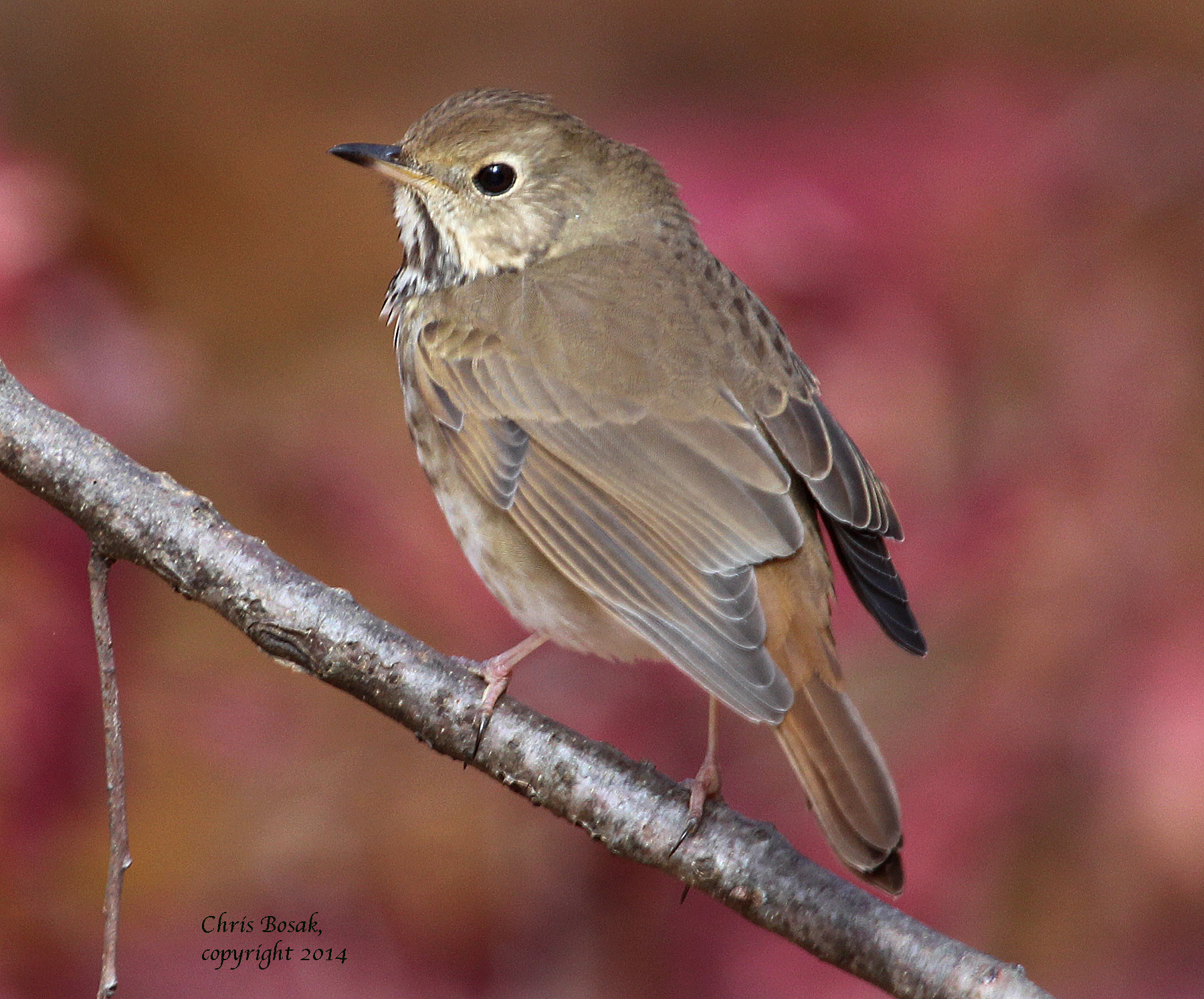
Photo by Chris Bosak A Hermit Thrush perches on a branch at Selleck's/Dunlap Woods this fall.

Photo by Chris Bosak
A Hermit Thrush perches on a branch at Selleck’s/Dunlap Woods this fall.

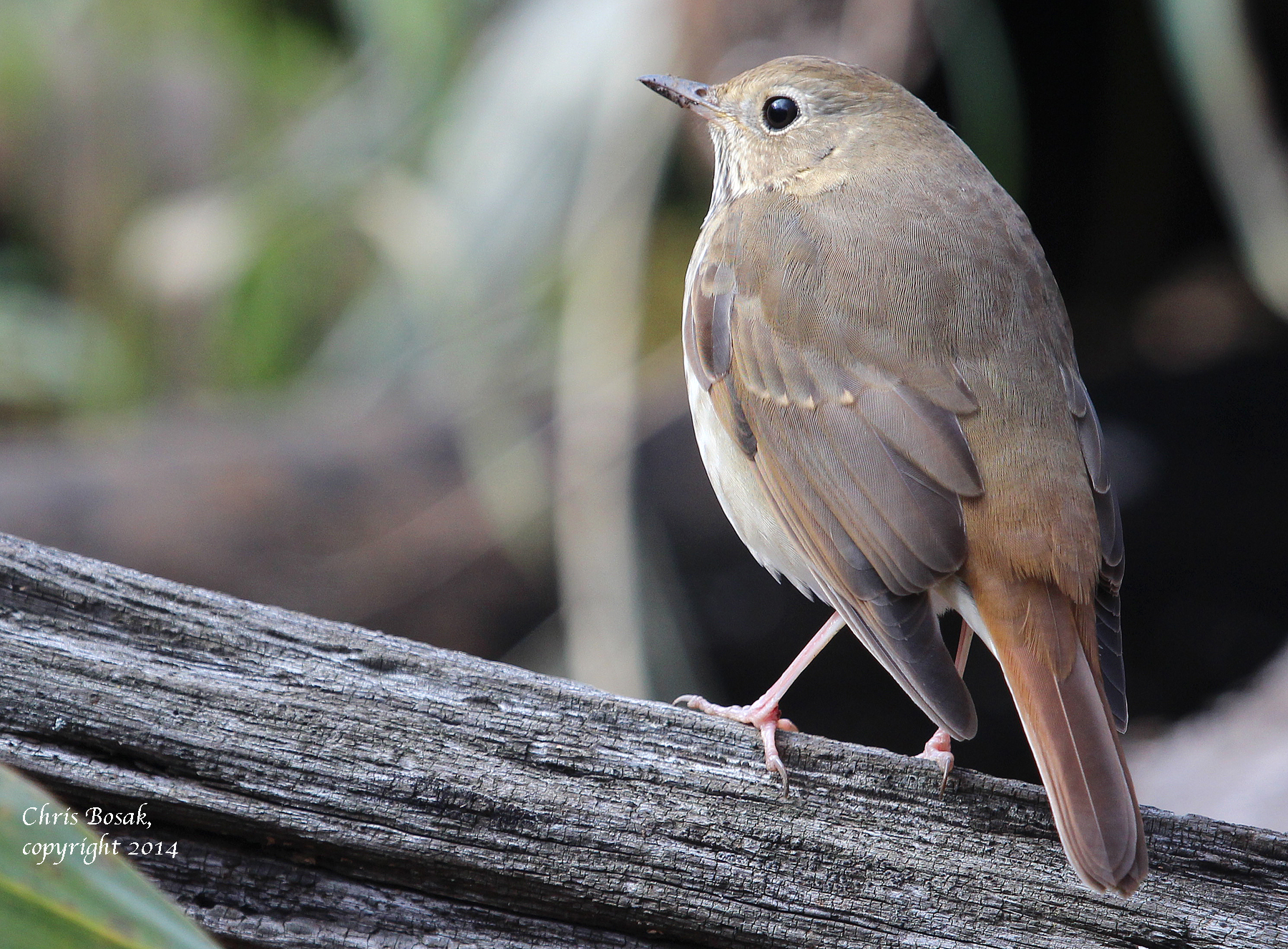
Here are a few more photos of Hermit Thrushes, a species profiled in my last post a few days ago. Also below is a link to my latest For the Birds column, which appears weekly in The Hour (Norwalk, CT) and The Keene Sentinel (Keene, N.H.)

Here’s the link.

Photo by Chris Bosak A Hermit Thrush rests on a log at Selleck's/Dunlap Woods this fall.

Photo by Chris Bosak
A Hermit Thrush rests on a log at Selleck’s/Dunlap Woods this fall.

Hermit thrushes abound on latest bird walk

Photo by Chris Bosak A Hermit Thrush perches on a branch at Selleck's/Dunlap Woods .

Photo by Chris Bosak
A Hermit Thrush perches on a branch at Selleck’s/Dunlap Woods .

I can’t speak for how well the Hermit Thrush population is doing in general, but the last bird walk I took yielded a lot of these handsome birds. I was walking through Selleck’s/Dunlap Woods in Darien (Conn.) with my buddy Larry Flynn and the thrushes were by far the most commonly seen bird. At one point we had five or six Hermit Thrushes in one bush. I’ve seen plenty of Hermit Thrushes in my day, but never that many in the same bush.

As we walked along the trails, Hermit Thrushes popped up here and there, and pretty much everywhere. The birds, however, were silent — other than their little feet rustling among the fallen leaves. They didn’t sing their famous flute-like song because it’s the fall migration. During the breeding season (spring and summer) it’s a treat to hear their song echo throughout the woods.

I mentioned before than I can’t speak for how the population is doing overall. Well, that was a white lie because I can, at least by crediting another source. Hermit Thrushes, thankfully, are doing well as a species. In fact their numbers have been rising since 1966, according to the North American Breeding Bird Survey.

Hermit Thrushes are probably the most commonly seen thrush in New England, but there are several types of thrushes — and they can be very difficult to tell apart. The Wood Thrush and Veery look somewhat different than the Hermit Thrush and are fairly easy to differentiate. However, species such as Bicknell’s Thrush, Swainson’s Thrush and Gray-checked Thrush pose a tougher ID challenge and it takes a trained eye to pick out those species.

Larry and I are pretty certain that what we were seeing were all Hermit Thrushes. The next walk, however, may yield nary a Hermit Thrush. That’s the joy of migration — and birding in general.

Feel free to leave a comment …
In full-hearted agreement

Screen shot 2014-11-10 at 2.28.37 PM

The most recent newsletter of the Cove Island Wildlife Sanctuary — a great spot not too far from my house — is not written by Dave Winston as it usually it, but rather a tribute to Dave and the hard work he does for the Sanctuary. Dave, along with many others, was instrumental in creating the Sanctuary in the first place and continues to maintain and nurture the grounds. I agree that a tribute was in order (not that anyone needed my approval), so here’s the link to the newsletter. Good job and thanks Dave.

Here’s the link.

We need more Titmice

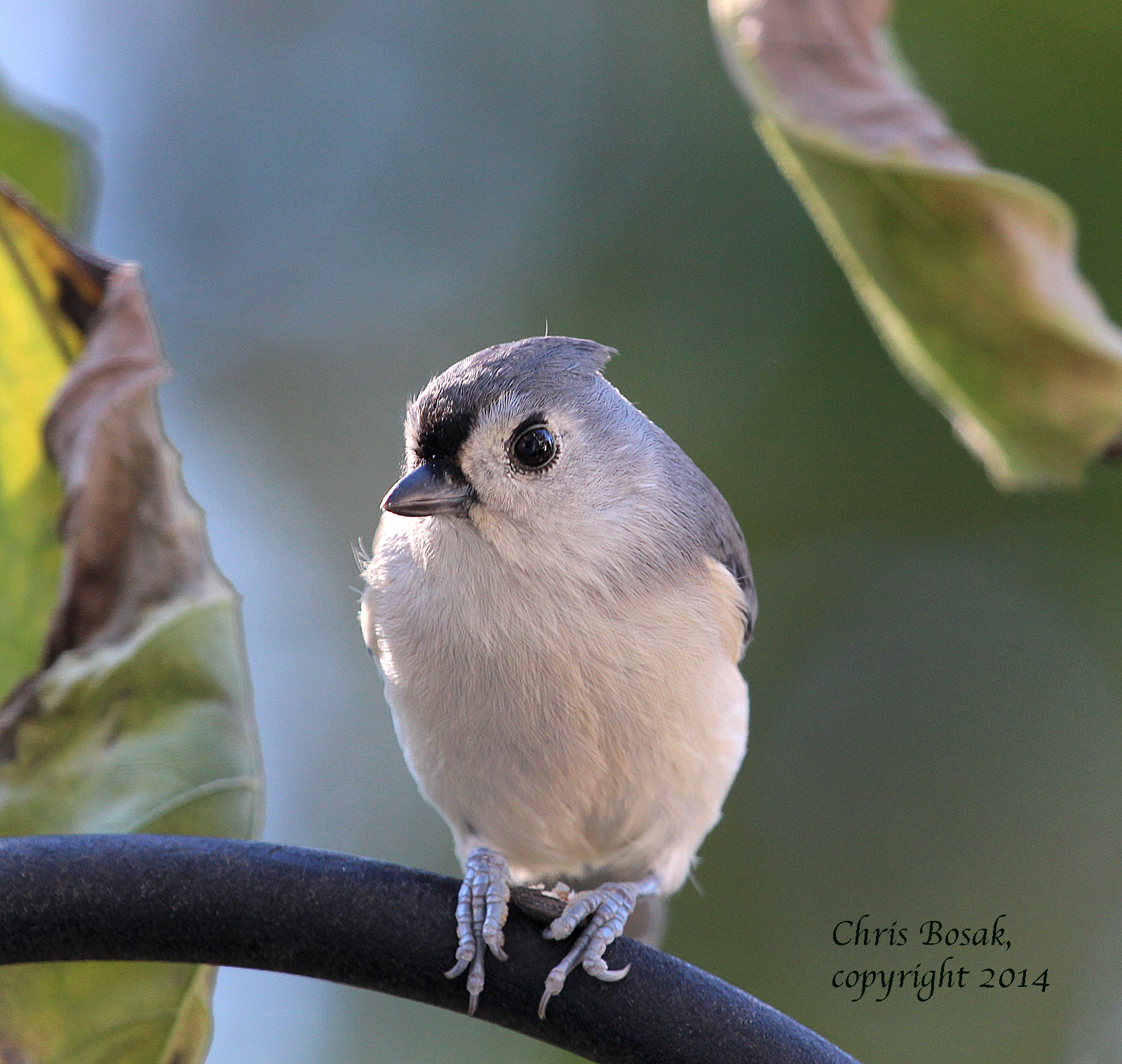
Photo by Chris Bosak A Tufted Titmouse perches on a pole near a birdfeeding station, Oct. 2014.

Photo by Chris Bosak
A Tufted Titmouse perches on a pole near a birdfeeding station, Oct. 2014.

Last week I posted a photo of Tufted Titmouse that I saw outside my window at my birdfeeding station. It kicked off a short series of photos I posted of common backyard feeder birds.

But, of course, I had more than just one photo of Tufted Titmice. So here are a few more photos of this small and lovable blue-gray bird. So far this fall Tufted Titmice have been the most numerous and reliable birds at my feeder. I can’t complain about that.

More photos below:

Continue reading

Nice young buck

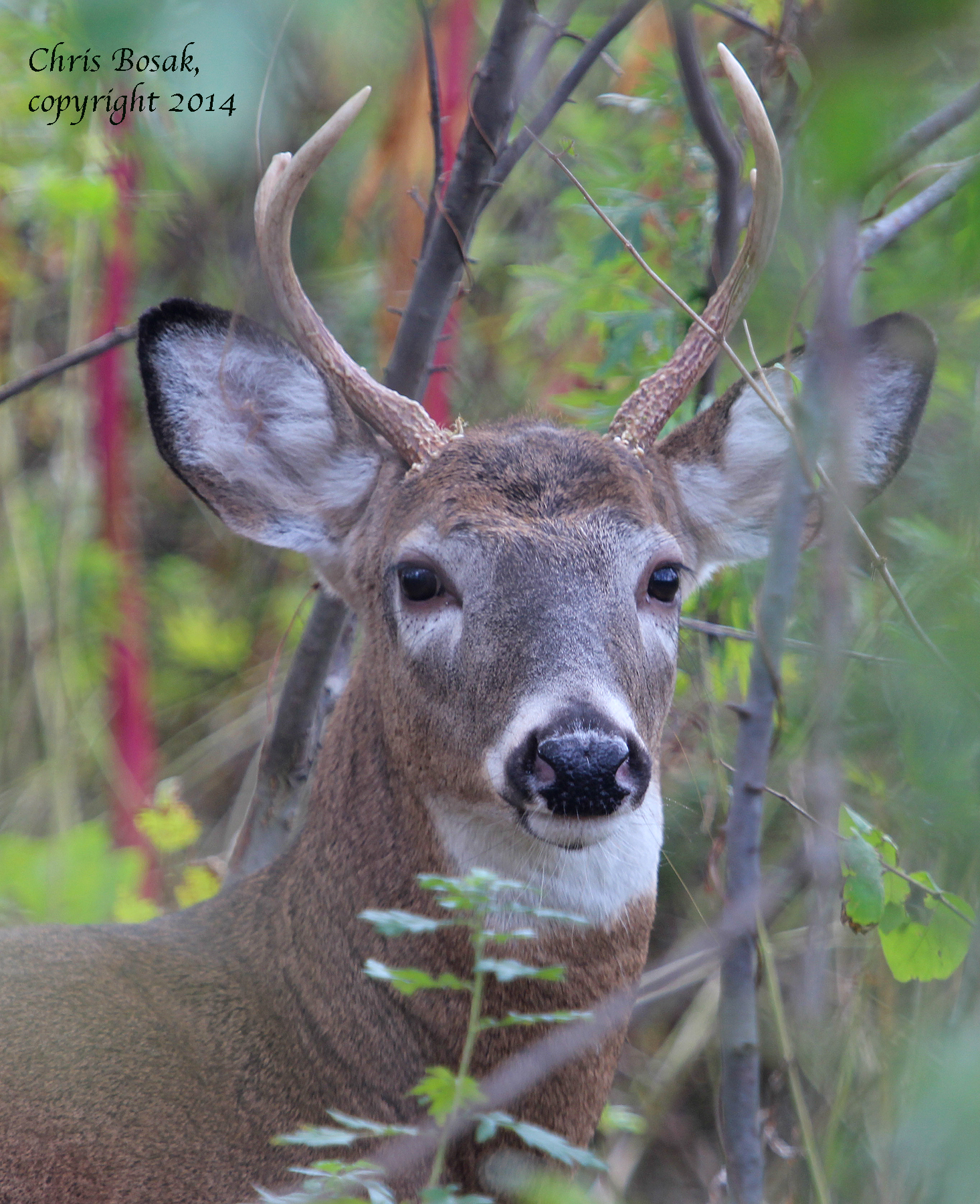
Photo by Chris Bosak A young White-tailed Deer in Stamford, Oct. 2014.

Photo by Chris Bosak
A young White-tailed Deer in Stamford, Oct. 2014.

I was looking for birds, of course, but this young buck (literally) was just off the trail and seemingly unfazed by my presence, so I grabbed a few shots of him. You never know what you’ll see out there. I found this guy at Cove Island Wildlife Sanctuary.

Feel free to share your bird and other wildlife sightings and/or photos. Send them to bozclark@earthlink.net

Hey, a hawk’s gotta eat, too

Photo by Chris Bosak A Red-tailed Hawk eats a Gray Squirrel in a cemetery in Darien, Oct. 2014.

Photo by Chris Bosak
A Red-tailed Hawk eats a Gray Squirrel in a cemetery in Darien, Oct. 2014.

A local cemetery is often fruitful when it comes to finding birds. This day was no exception as literally hundreds of juncos and other small sparrows scattered as I drove slowly along the narrow roads.

I almost missed the highlight of the short birding trip, though. I glanced to my right just in time to see a Red-tailed Hawk on the ground a few dozen yards away. I hit the brakes and backed up just a touch. A Red-tailed Hawk on the ground usually means it is eating. Such was the case as this raptor was picking apart a freshly-killed Gray Squirrel. I watched for a bit, snapped a few photos and left the hawk to its meal. They aren’t called birds of prey for nothing.

More photos below:

Continue reading

Northern Cardinal looking right at you

Photo by Chris Bosak Northern Cardinal at backyard feeder, Oct. 2014.

Photo by Chris Bosak
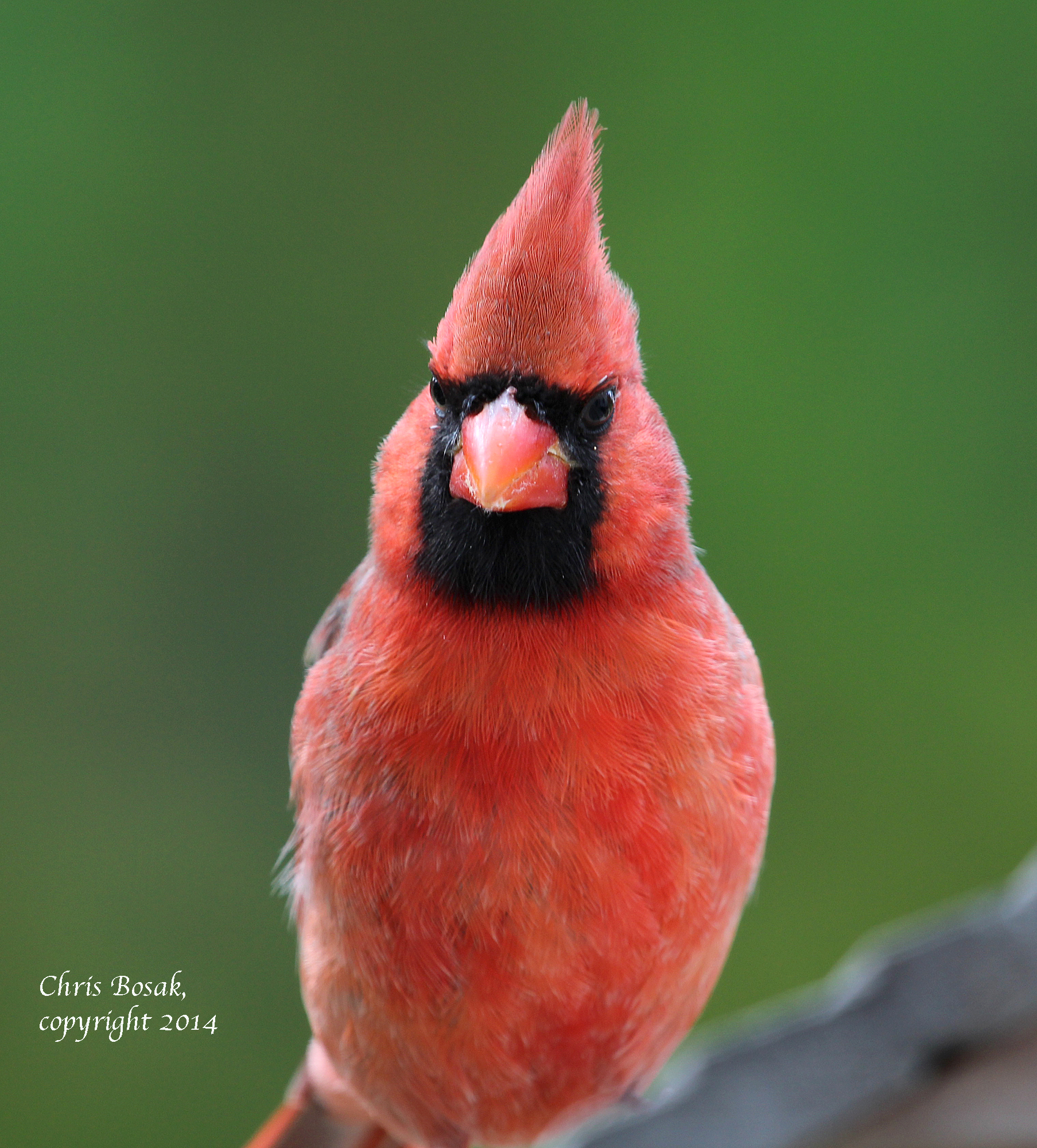
Northern Cardinal at backyard feeder, Oct. 2014.

Getting back to my common backyard bird series … the Northern Cardinal is common, but certainly not plain. The cardinal is a favorite bird of many people — and it’s hard to argue.

My favorite thing about the Northern Cardinal is that it is a year-round bird for us here in New England. It doesn’t fly south when the days shorten or temperatures drop, like most colorful birds we see here. It breeds here and remains here, giving us a flashy bird to look for all 12 months.

Purple Finch: A welcomed visitor to the feeder

Photo by Chris Bosak A male Purple Finch eats sunflower seeds from a feeder in New England, Oct. 2014.

Photo by Chris Bosak
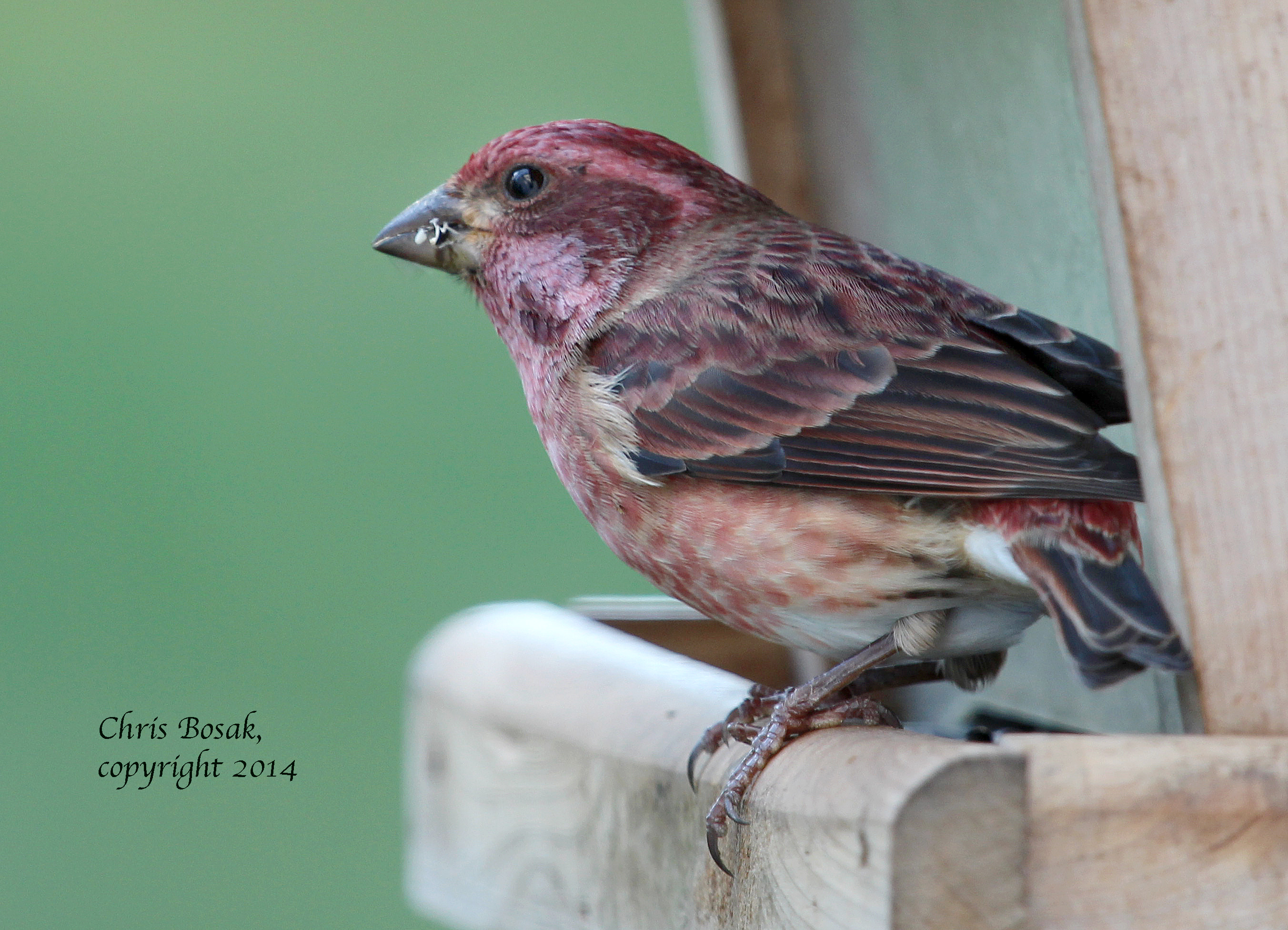
A male Purple Finch eats sunflower seeds from a feeder in New England, Oct. 2014.

The Purple Finch doesn’t exactly fit in with my series of “Common Backyard Birds,” but this handsome fellow visited my feeder over the weekend so I’m including it anyway.(No, that’s not your cursor on its bill, that’s a sunflower seed shell.)  It doesn’t fit in with the series because, sadly, the Purple Finch is not really a common backyard sighting in New England. The introduced House Finches certainly are, but the native Purple Finches visit less frequently.

Purple Finches and House Finches can be tricky to differentiate, but that’s mostly because we don’t see enough Purple Finches to get used to their looks. Some particularly colorful House Finches can resemble Purple Finches and throw off the ID. But, as someone once told me long ago, “When you see a Purple Finch, you’ll know it.”

I can differentiate the finches because the Purple Finch is larger and bulkier. Its “purple” (really reddish pink) is also more widespread on its plumage. The females are even more tricky, but again, are bulkier than their House Finch counterparts.

So an October sighting of a Purple Finch was most welcomed. Hopefully it’s a sign of things to come this fall and winter.

Did you know: The Purple Finch is the state bird of New Hampshire.

Love this White-breasted Nuthatch photo

Photo by Chris Bosak White-breasted Nuthatch at backyard feeder, Oct. 2014.

Photo by Chris Bosak
White-breasted Nuthatch at backyard feeder, Oct. 2014.

Sometimes when photographing birds (or anything for that matter) you never really know what you’ll get. You should always be mindful of the background, but sometimes it’s tough to determine exactly how the photo will look until you take it. Honestly I got kind of lucky with this shot with the jet black background, which really makes the White-breasted Nuthatch standout. I’m not even sure what in the background was so black. Oh well, I’ll take it.

This is the third in a series of photographs celebrating our common backyard feeder birds.

Who doesn’t love chickadees?

Photo by Chris Bosak Black-capped Chickadee at backyard feeder, Oct. 2014.

Photo by Chris Bosak
Black-capped Chickadee at backyard feeder, Oct. 2014.

I highlight the Black-capped Chickadee as the second in a series of photos of our common backyard birds here in New England. This series of photos will focus on the birds we commonly see at our feeders. Can you ever see enough chickadee photos?