Photo by Chris Bosak A Canada jay perches in a tree in Pittsburg, N.H., November 2018.
While on my unsuccessful moose search in northern Maine recently, I came across a bird found only in points north of middle New England.
I knew what it was and launched the field guide app on my phone to gather a little information on the species.
To my surprise, nothing showed up when I searched for the bird.
“How could that be?“ I asked myself. “I know what bird it is and I know what it’s called. Why would it not show up on a search in a field guide to North American birds?”
Then it hit me. I was searching the wrong name. The gray jay is no longer called the gray jay. It is back to being the Canada jay. It had formerly been known as the Canada jay, got switched to gray Jay, and in 2018, got changed back to Canada jay. I had known this before, and even mentioned it in a previous bird column, but had totally forgotten while I was in the field at that moment.
My destination was the northern part of Maine. I’m talking way north. Get to Baxter State Park and keep going for several more hours.
I drove pretty much through the night to get there. I took a few half-hour breaks to sleep and then continued on my way. I have been to northern New Hampshire dozens of times, and I have been to the middle of Maine many times. I’ve always wanted to see what Aroostook County was all about so I took the opportunity to head up there and finally see for myself.
I settled at the border town of Fort Kent where only the St. John River separates the U.S. from Canada.
Wildlife, of course, was the driving force behind the decision to drive up there. The boreal forest, to me anyway, is a magical place filled with so many interesting creatures. Moose are my favorite creatures, but things like lynx, loons, eagles, grouse, boreal chickadees, Canada jays, and other specialty species unique through the habitat are also a draw.
I pulled into the tire shop for my appointment the other day, handed over the keys and asked how long it would take. The nice gentleman said it would be at least an hour, but that I was welcome to sit in the waiting area and help myself to coffee.
It was an ideal late summer/early fall day and the fall migration was well underway, so I decided to take a walk instead.
I gave the guy my cell phone number, asked him to give me a call when the truck was ready, and set out to find the nearest place where I might find some birds.
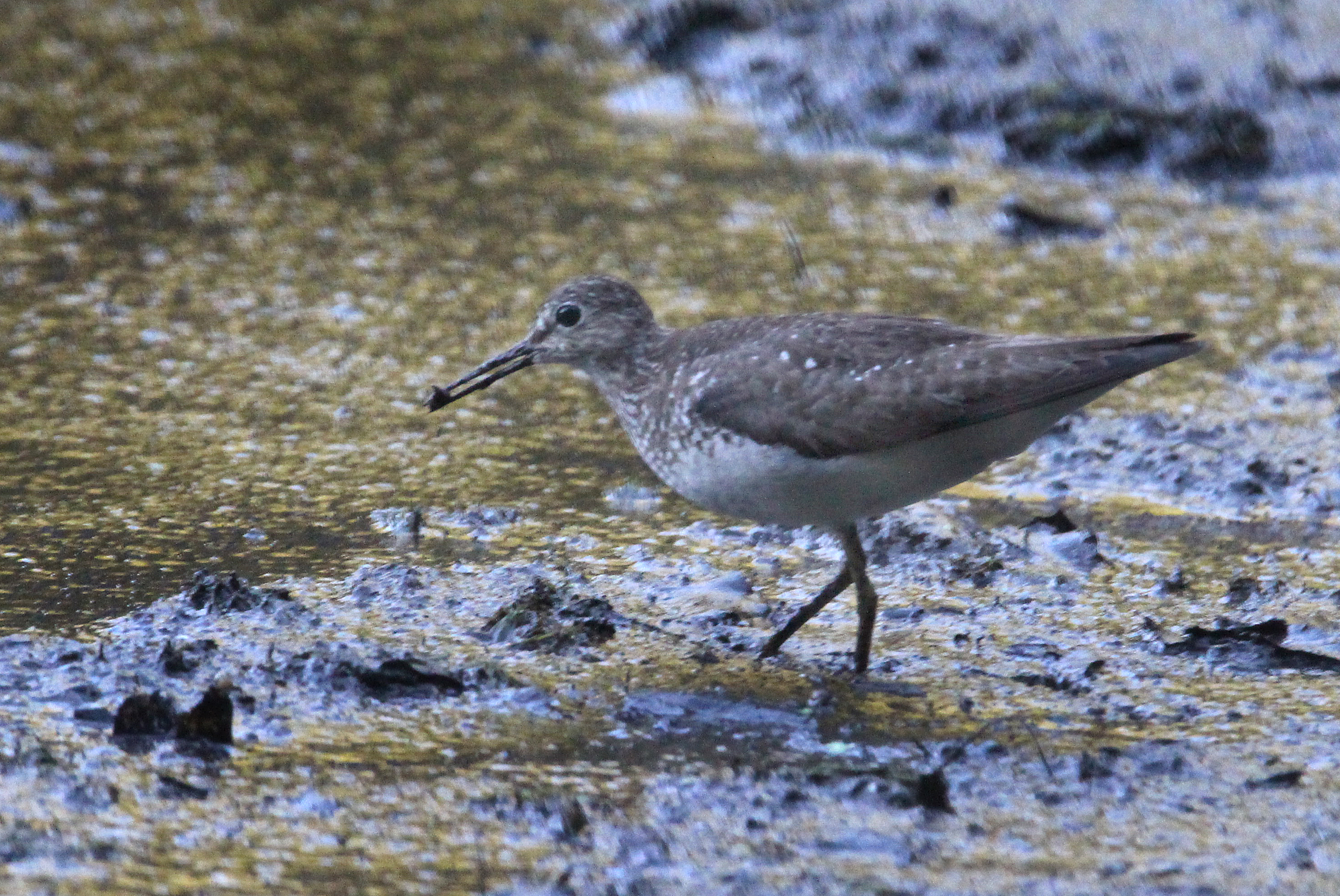
Photo by Chris Bosak – A solitary sandpiper on the edge of a pond in New England, August 2022.
When hearing the word shorebirds, most people likely think of sanderlings and other small sandpiper-like birds running back and forth among the waves at the ocean.
Shorebirds, however, are not limited to small “peeps,” nor are they limited to the ocean. While it is true that the ocean and other coastal regions, such as Long Island Sound, are the best places to find shorebirds, inland lakes and ponds have shorebirds too.
I have seen lesser yellowlegs at many inland lakes in New Hampshire, all the way from the northern tip in Pittsburg to southern lakes such as Edward McDowell Lake in Peterborough. Yellowlegs may be seen on the edges of inland lakes during migration periods, such as now.
Sometimes, or more accurately, rarely, a big surprise happens. You look out at your feeder and a bird you hadn’t seen in years is perched enjoying a meal. Or you are taking a winter stroll on a New England beach and notice a snowy owl resting in the distance.
The other day, I was treated to a few surprises on a much smaller magnitude. They came at a small park with a tiny pond in suburbia that typically has your normal birds. Crows and sparrows are the main birds with a few mallards in the pond.
On this particular day, however, things were a little different.
I normally drive right past the park without stopping or even casting a glance toward the pond, but something big and white caught my eye as being out of the ordinary. It was a great egret standing near the edge of the water. It wasn’t right at the edge where you would typically see an egret but rather 10 to 15 feet into the grass away from the pond. A sizable flock of Canada geese roamed around the grass near the egret.
Hummingbirds are always a good conversation starter, especially in that time of year after the bird breeding season, but before fall migration begins. My last few columns on hummingbirds elicited a few responses from readers I’d like to share.
Similar to my “problem,” Mary Ellen from Keene has a territorial female hummingbird that keeps all other would-be visitors away. The feistiness of New England hummingbirds, however, pales in comparison to the rufous hummingbirds she observed at her daughter’s property in Colorado at 9,200 feet of elevation.
“This one bird kept all other hummers from feeding. I put up another feeder thinking that would solve the problem but instead of one territorial rufous, we ended up with two!” she wrote.
Mary Ellen did some research and discovered the migration route of the rufous hummingbird takes them over the Rocky Mountains when alpine flowers are in bloom. Sure enough, she wrote, the aggressive rufous hummingbirds left after two weeks and the other hummingbirds were free to enjoy the feeders again.
Mary Ellen also marveled at how far these tiny birds can fly during migration. Ruby-throated hummingbirds are the only hummingbird species that is regularly found east of the Mississippi River. They get to their territory, including New England, by flying nonstop over the Gulf of Mexico, a 500-mile journey that takes about 20 hours. Some hummingbirds, if they are lucky enough to find one, will stop and rest on a boat or oil rig.
Deb from Royalston, Massachusetts, said her six to 12 hummingbirds visit mostly at dawn and dusk.
Zaden commented on my website that: “In Japanese, they call them hachi-dori, ‘bee birds.” I love that word.”
Eunice wrote on my website: “I have three feeders and 30 healthy hummers here in N.H. but hundreds of flowers for them to enjoy. Yes, my visitors hop from one feeder to another, but they all get to feed. Many are babies. It was a good year for them.”
Don and Heidi Nowers from Westminster, Vermont, thought the rose of Sharon bush and nearby feeder would be enough to keep all of the hummingbirds content. Not so. “It appears that after the dominant hummer chases the little guys off, a couple of bees move onto the feeder. When Ruby comes back, it’s game on.” They wrote that the bees and bird chase each other and play a game of cat and mouse. They did once observe a bee and hummingbird sharing the feeder, proving there is enough to go around.
My house in the woods had a lot of rose of Sharon bushes growing wildly and the hummingbirds loved it. There are lists upon lists of the types of flowers hummingbirds are attracted to. I’ve found that hummingbirds will visit just about any bloom to see if it is a potential food source. Sure, they may prefer red, tubular blooms, but they’ll come to just about any flower, I have found.
Deborah from Fitzwilliam had similar thoughts about sharing the wealth when she purchased a second hummingbird feeder. Alas, instead of the birds sharing, Deborah is “still entertained by hummer wars.” Deborah also noted “that the hummingbirds’ warning of flying in an arch while it chirps is similar to a bumblebee’s warning?” I hadn’t noticed that before but will pay attention next time I see bumblebees acting territorially.
Thank you to all who wrote in and shared your stories. Let’s keep the conversation about nature going.
Photo by Brian Thoele – Brian Thoele of Norwalk, Conn., got this shot of a downy woodpecker on a hummingbird feeder.
Hummingbird feeders, as the name suggests, are meant to attract hummingbirds.
It’s right in the name “hummingbird feeder.”
But, as we all know, it attracts a lot more than hummingbirds. The most common invaders include yellowjackets, hornets, bees, and ants. However, hummingbird feeders also attract larger critters such as bats, squirrels, raccoons, and even bears.
The list doesn’t stop there as a few emails I received this week point out. Other birds enjoy a visit to a hummingbird feeder as well.
Downy woodpeckers are probably the most common other birds that visit hummingbird feeders. Michele from the Monadnock Region wrote in to share that two woodpeckers had dislodged five of the six yellow plastic inserts that go into the feeding ports. The plastic inserts are supposed to keep birds like woodpeckers away, but these woodpeckers found a way around it. Michele did her best to find the inserts and put them back, but the woodpeckers just popped them out again.
Photo by Chris Bosak
A Ruby-throated Hummingbird perches on a feeder in Danbury, CT, summer 2015.
I’ve seen plenty of hummingbird feeders in New England with a dozen or more of the tiny birds zipping around the ports.
I stayed at a small motel in Errol several years ago and was amazed at the hummingbird feeder near the office. The birds were constantly at the feeder, from sunup to sundown, and there were a lot of them. The birds were not necessarily cooperative with each other, but at least they were tolerant.
That has never been the case with hummingbirds that visit my yard. All of my hummingbirds are jerks. I’m joking, of course. They are just territorial. Very territorial.
Such is the case this year again. I saw a female hummingbird off and on throughout this spring and early summer. Over the last two weeks, however, I’ve seen her every day and several times each day.
I’ve also seen a male a few times, but his visits to the feeder are short-lived. As soon as he settles onto the perch and dives his bill into the port, the female appears out of nowhere and buzzes right by his head. The male takes off for cover, followed by the female making sure he knows that the feeder is off limits.
Photo by Chris Bosak
A Scarlet Tanager perches in a tree in Danbury, Conn., July 2016.
This has been the first spring/summer since I can remember in which I have not seen a scarlet tanager. I was hot on the trail of a few in the spring, but I never did spot the birds.
Granted, my birding this year has been hampered by foot ailments, but I have still spent enough time out there that I feel I should have seen one or two of these beauties.
The scarlet tanager is one of the most sought-after species in New England in the spring. Their electric red bodies with contrasting black wings make it one of our most unique and beautiful birds. The problem with tanagers is that they mostly hang around the tops of tall trees. Even a bird as bright as a teenager can remain hidden in a full canopy of oak or maple leaves.






 Birds of New England.com