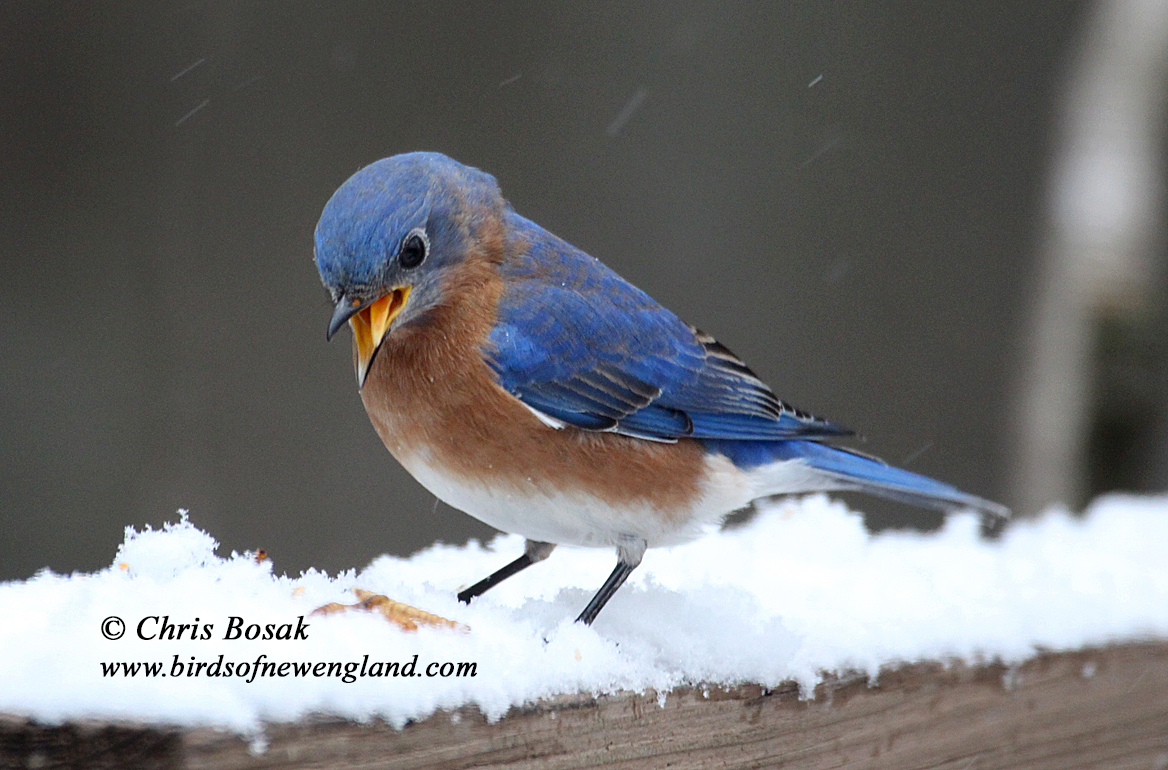
Photo by Chris Bosak An eastern bluebird braves a New England winter and visit a backyard for mealworms, winter 2020.
We don’t usually think of eastern bluebirds as a winter bird in New England, but many bluebirds tough out our cold months. Visits from or sightings of bluebirds brighten the short winter days, for sure. Here’s a collection of photos of bluebirds in the snow.
Photo by Chris Bosak Eastern bluebirds brave a New England winter and visit a backyard for mealworms, winter 2020.
Photo by Chris Bosak
A dark-eyed junco visits a backyard in New England, January 2021.
The junco sat perfectly still in the bush as snow collected on his back. The snow came down hard and the wind whipped it around.
It was the wind that kept the junco motionless in the bush. When the wind offered a rare break, the junco darted to the nearby bird feeder to grab a few sunflower seeds.
He would fly back to his spot in the bush, having shaken off the snow that had collected on him. It didn’t take long for new snow to accumulate on his dark gray feathers.
Snowy days are among the best times to watch the feeders. It is interesting to see how little the elements affect the birds. Tiny birds such as chickadees can withstand extremely cold and windy conditions. They have a variety of mechanisms to protect them from the harsh elements. I have written about those in previous columns and may revisit that topic in the future.
But for now, I’m going to focus on this past storm that hit New England and recall the many birds that visited. The junco I mentioned before was one of more than a dozen juncos that were around that day. Other sparrows included white-throated, song and house. Many people don’t think of juncos as being a sparrow because of their different coloration, but they are indeed members of the sparrow family.
Both nuthatches came and went throughout the day. It is such a thrill to see the red-breasted nuthatches daily this winter. Not that I don’t appreciate the white-breasted nuthatches, but they are much more common and year-round birds where I am. The red-breasted nuthatch shows up only in random years.
Of course, chickadees and titmice were regular visitors. A pair of Carolina wrens entertained me as well. I always like watching their antics in the yard, especially when they make their unique chatter calls outside the window.
It was a heck of a snowstorm — the worst in several years where I am anyway. Will there be more opportunities this winter to watch the birds at the feeder in the snow? That remains to be seen, but I wouldn’t be surprised in the least. In fact, I would be very surprised if we didn’t have more snowfalls. This is New England, after all, and winter is a way of life here.
Photo by Chris Bosak
An eastern bluebird perches on a branch in New England, February 2020.Photo by Chris Bosak A Northern Mockingbird seen Sunday at Taylor Farm in Norwalk during the annual Christmas Bird Count.
Here’s a quiz for which there is no prize other than that good feeling you’ll get from knowing you got it right (if you can guess the answer.)
The question is: Why am I posting photos of these particular birds today? Leave a comment or send me an email with your guess. Have a Super day.
Photo by Chris Bosak
A fox sparrow perches on the snow in Danbury, Conn., Nov. 16, 2018.
It’s time to help the birds again.
As usual, New Hampshire Audubon’s Backyard Winter Bird Survey and the Great Backyard Bird Count take place on the weekend so you can kill two birds with … oh wait, bad expression. You can help two birds (really all of them) with one walk in the woods. New Hampshire Audubon’s Backyard Winter Bird Survey takes place Saturday, Feb. 13, and Sunday, Feb. 14. Your job is to count birds on those days and submit your results (species and number of individual birds) to the organization to help biologists better understand what is going on with our winter birds. These annual snapshots of data give biologists a broader picture of bird populations and behavior. It helps ornithologists better understand and perhaps find patterns in the winter irruptions of finches and other northern birds. Irruptions are when food scarcity up north drives birds down to New Hampshire and farther south.
This fall and winter have been particularly strong for red-breasted nuthatches. I have two of them visiting every day, and many readers have emailed me to say these cute little birds are visiting them as well. Real data on these birds will be critical to get when submitted by participants of the survey.
Other irruptive species include pine siskin, common redpoll, purple finch, evening grosbeak, pine grosbeak, red-winged crossbill, white-winged crossbill and snowy owl. Are these birds visiting your backyard or favorite place to walk in the woods? Let the New Hampshire Audubon biologists know. Count the common birds as well, of course. That data is just as valuable to have.
The survey is open to everyone, regardless of skill level. Spend an hour or 30 hours counting the birds that weekend and submit your results online at the New Hampshire Audubon website. You may also receive a hard copy of the reporting form and instructions by emailing your name and address to bwbs@nhaudubon.org or calling 224-9909.
While you’re out there (or in there if you’re watching backyard feeders) counting birds, you may as well submit your results to the Great Backyard Bird Count, too. The GBBC started in 1998 as a relatively small initiative to get a snapshot of winter bird populations across the country. It has mushroomed into a global phenomenon with more than 160,000 checklists turned in online worldwide last year. According to GBBC officials, it created the “largest instantaneous snapshot of global bird populations ever recorded.”
The GBBC runs from Friday, Feb. 12, to Monday, Feb. 15. Again, all skill levels are welcome, participation is free and no set time commitment is required. Visit www.birdcount.org for more information and instructions on how to submit results.
What will show up on New Hampshire checklists? It’s hard to say. It’s been a strange winter with a sage thrasher being seen regularly in Hinsdale, boreal chickadees being found on Mount Monadnock far from their northern range, a red-headed woodpecker frequenting Keene and evening grosbeaks showing up everywhere in the Granite State. Have your say and participate in the NH Audubon Winter Bird Survey and GBBC.
I heard from some readers this week who will have some interesting sightings to submit if the birds stick around for a few more weeks. Mimi from Troy reported seeing double-digit numbers of blue jays, chickadees and juncos, as well as several white-breasted nuthatches, red-breasted nuthatches, cardinals, mourning doves, hairy woodpeckers, downy woodpeckers, evening grosbeaks and three eastern bluebirds. The bluebirds have been eating mealworms and suet.
Brian from Keene sent some great photos not related to the winter surveys, but as a follow up to last week’s column about the importance of saving native insects. I had mentioned that fish feed on insects and birds such as herons feed on the fish, hence the important, but sometimes indirect, role insects play in helping birds. Brian sent some photos he took a few years ago of a great blue heron eating grasshoppers. It reminded me of when I watched a green heron eating dragonflies near a pond several years ago. Mark your calendars for next weekend, and let me know what you find out there.
Photo by Chris Bosak
A Carolina wren visits to a New England backyard, January 2021.
Death, taxes and bird photos from http://www.birdsofnewengland.com every time it snows. Yes, New England is getting another snow storm and here are some new bird photos to prove it.
Feel free to send me yours at birdsofnewengland@gmail.com. I’ll post them on this site.
Photo by Chris Bosak
A Carolina wren visits to a New England backyard, January 2021.Photo by Chris Bosak
A Carolina wren visits to a New England backyard, January 2021.
We swat them, stomp them, spray them, do anything we can to keep them away from us. We are annoyed by them, vilify them, wish them away, and created a multi-billion dollar industry to get rid of them. But we can’t live without them.
No, I’m not talking about the Kardashians. I’m talking about insects.
A summary of several recent independent studies has revealed that insects are dying a “death by a thousand cuts,” according to the world’s top insect experts and that the earth is losing 1 to 2 percent of its insects each year. The news isn’t entirely surprising, but it’s always good to be reminded of the fragile state of our environment from time to time.
According to the studies — and the summarizing article led by University of Connecticut entomologist David Wagner — climate change, insecticides, changes in agriculture and light pollution are major contributors to the marked decline of our insects. Some scientists refer to it as the “insect apocalypse,” and in some respects, that sounds about right.
Why am I writing about insects in a column about birds? Because Continue reading →
Photo by Chris Bosak A northern mockingbird drinks from a birdbath in New England, January 2021.
We all know it’s important to offer water as well as food for our feathered friends. It can be discouraging, however, to watch a birdbath day after day and not see any birds using it. They typically aren’t as busy as birdfeeders with a constant stream of birds using it. Factor in the sub-zero temperatures Continue reading →
Photo by Chris Bosak A cedar waxwing looks for berries in a park in New England, January 2021.
With the tendinitis in my foot acting up again, I wasn’t sure how long of a walk I would be able to bear. I had to give it a shot, however, as a few inches of light, fluffy snow had fallen overnight and made the landscape irresistible for anyone with a camera.
As luck would have it, I didn’t have to go very far to get some nice bird photos. I started down a path bordered by thick brush on both sides when I saw a swarm of birds land in a nearby leafless tree. My initial thought was that they were starlings as this flock rivaled in number the large groups of starlings you often see. Something didn’t look quite right, however. They weren’t acting like starlings and they weren’t the right shape.
How cool would it be if they were cedar waxwings? I asked myself. About 10 seconds later Continue reading →
Photo by Chris Bosak A boreal chickadee in Pittsburg, NH, summer 2010.
It was a year of firsts and high numbers for many Christmas Bird Counts across the Granite State.
Significant firsts included boreal chickadees on the Peterborough-Hancock Count, a red-headed woodpecker and long-tailed duck in Keene, and a gray catbird in Laconia. Not to mention the sage thrasher found in Hinsdale during the Brattleboro count.
Keene, part of the original Christmas Bird Count in 1900, boasted a record 62 species of birds found. That topped the previous record of 61, which had been recorded four times. A patch of open water on Spofford Lake helped that total as six waterfowl (including the long-tailed duck) and a common loon were spotted there. The long-tailed duck, formerly called oldsquaw, is more often associated with salt or brackish water.
The Christmas Bird Count is the nation’s longest-running community science bird project. It was originally proposed by Frank Chapman, who encouraged people to count birds instead of kill them during the traditional Side Hunt. In 1900, the first CBC took place and included 27 birdwatchers in 25 different areas. There are now hundreds of areas covered throughout North America and thousands of volunteers doing the counting. There are more than 20 Continue reading →