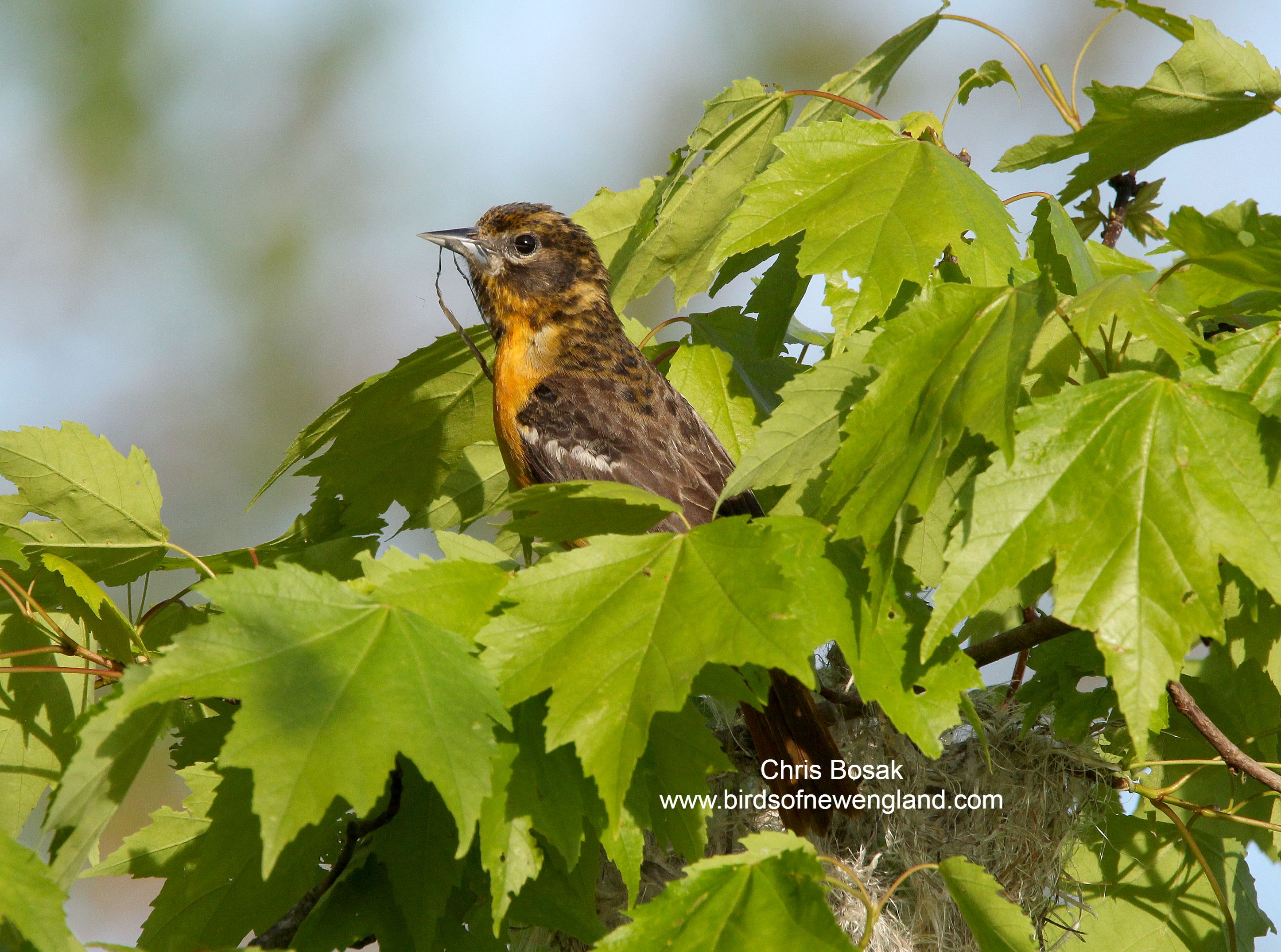
Photo by Chris Bosak A female Baltimore oriole brings material back to her nesting site this spring.
On my way to visit my family in Pennsylvania, I decided to stop at the Bashakill Wildlife Management Area in Sullivan County, New York, to see what birds might be in and around the giant marsh.
I used to canoe there frequently when I lived closer to that spot, but I hadn’t been there in many years. I didn’t have my canoe with me this time, but luckily there is a trail that follows the edge of the water and offers many expansive views.
As a bonus, the trail is wooded, so you get the shallow water on one side and the woods on the other. The Bashakill has a navigable channel winding through the middle, but the surrounding area is shallow water with thick aquatic vegetation where wood ducks and other birds find refuge.
Photo by Chris Bosak
A bald eagle at Bashakill NWMA, summer 2019.
Savanna and I decided to venture outside the friendly confines of New England and take a short drive to the Bashakill Wildlife Management Area. It’s a beautiful area teeming with wildlife, great scenery and surprises around every bend as you paddle along the narrow serpentine river. It is a New York state Bird Conservation Area and located between the Shawangunk (“Gunks”) and Catskills mountains.
I discovered this gem of a place when I worked for a short time in Middletown, N.Y. about 20 years ago. I’ve returned now and then ever since, but it had been quite some time since my last visit. So one day last weekend we strapped the canoe on the car the night before, rose before dawn and headed west.
Other than my usual access road being closed due to construction, everything was as I remembered it. The water channel was a bit more narrow than usual, but that’s because it was August and it hadn’t rained in quite some time.
Wood ducks, as usual, were the dominant species. There must be thousands there and we must have seen a few hundred of them. Red-winged blackbirds and a lone kingfisher were other usual sightings. At one point we saw a bush in the distance in the swamp that was literally bursting with swallows. The swallow migration has begun and this bush looked like a Christmas tree covered with live ornaments.
But the most memorable sightings were of the resident adult bald eagles. We saw the male first and then the female. As with most birds of prey, female bald eagles are larger than males. A man we met in the parking lot later — who identified himself as the “local eagle guy ” — who said there were two young eagles that year, too, but they like to stay hidden in the woods away from the open swamp. It was good to hear that the adults continue to have breeding success there.
Bald eagles are making a strong comeback throughout the U.S. and New England and nearby N.Y. are no exception. Just like the tremendous comeback of the osprey over the last few decades, it’s nice to witness another iconic species on the rebound. Now, let’s just keep it that way.
Photo by Chris Bosak A bald eagle at Bashakill NWMA, summer 2019.