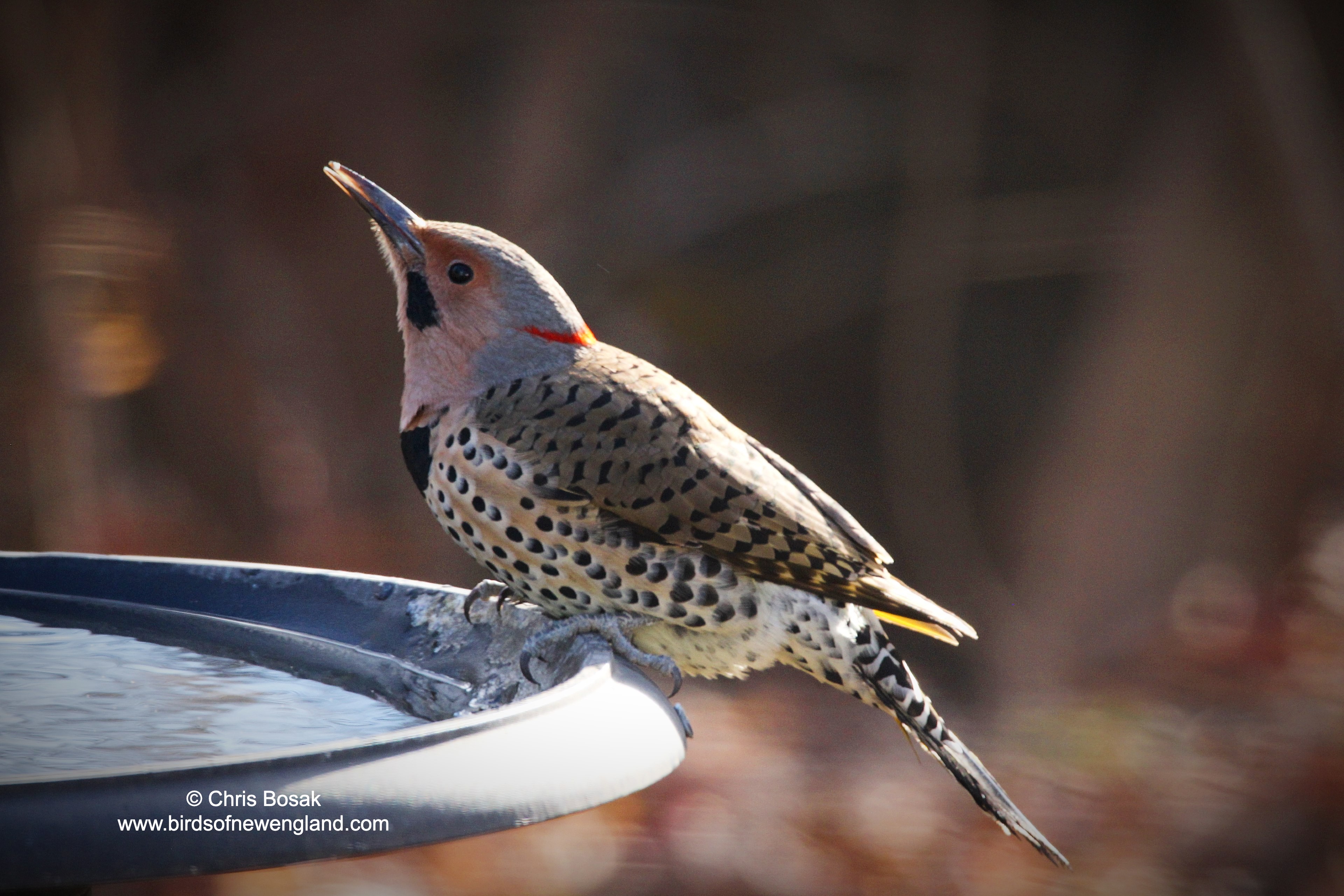
Photo by Chris Bosak A northern flicker sips from a birdbath in New England, fall 2025.
I looked out and saw that the water in the birdbath was a solid block of ice. I poured in enough warm water that the ice broke free, so I tossed the frozen block onto the ground and filled the bath with warm water. Within 10 minutes, a northern flicker arrived and took a few sips. What a design on this bird.
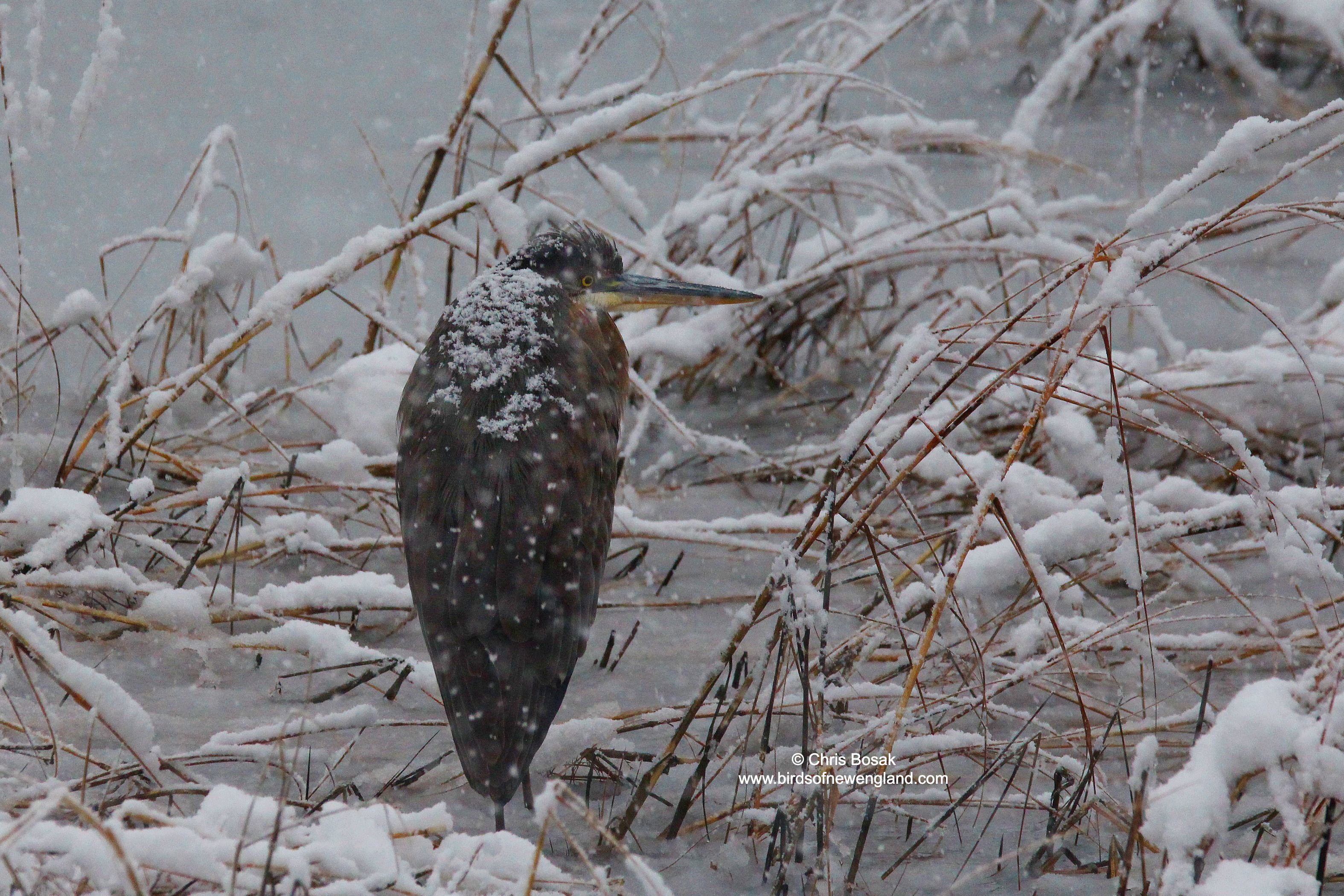
Great blue heron in snow, Christmas Bird Count 2025, Stamford, CT.
It was that type of day for the Christmas Bird Count today (Sunday, Dec. 14, 2025). Frank and I did the Cove area of Stamford (Connecticut) and nearby Darien.
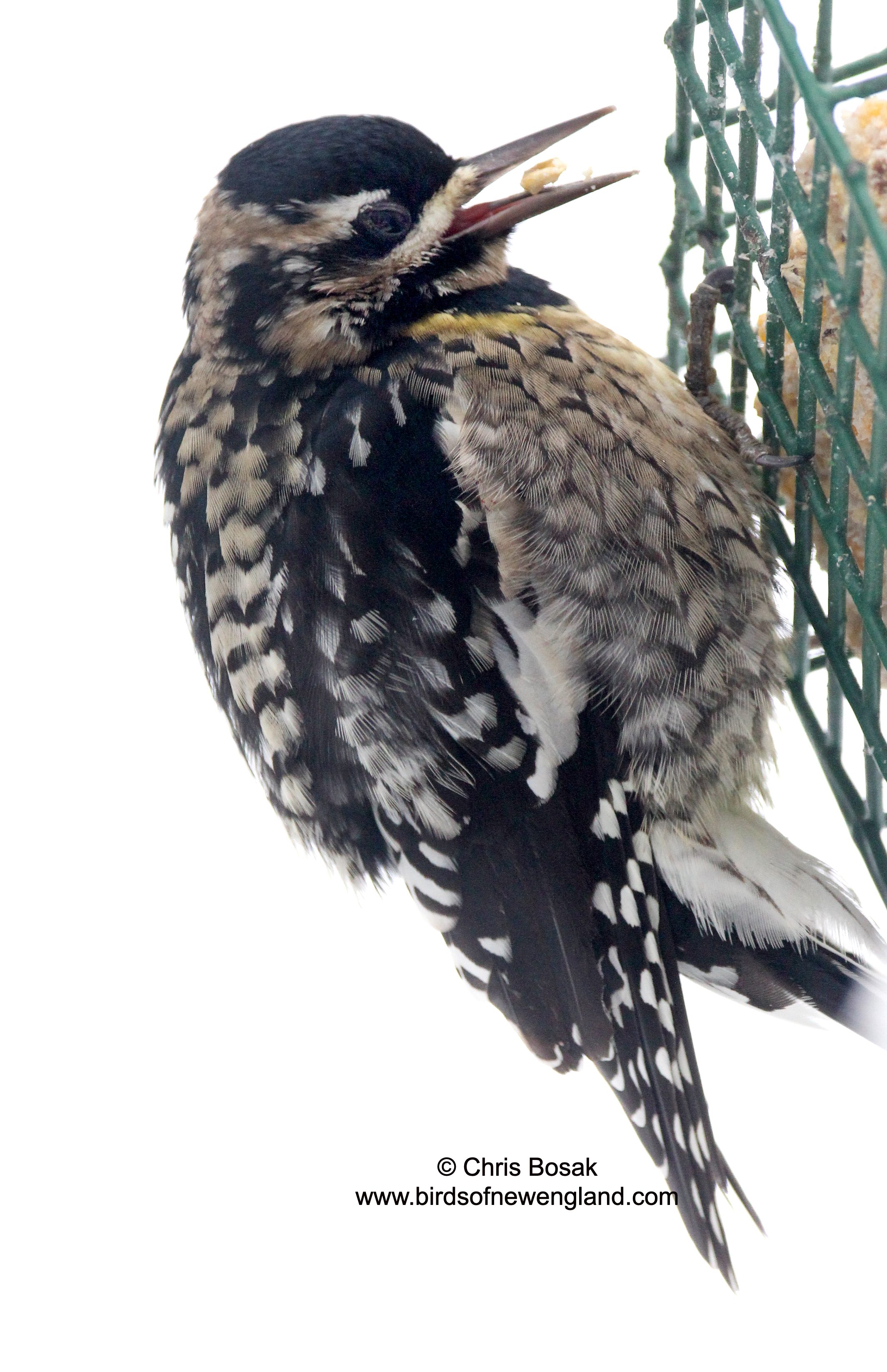
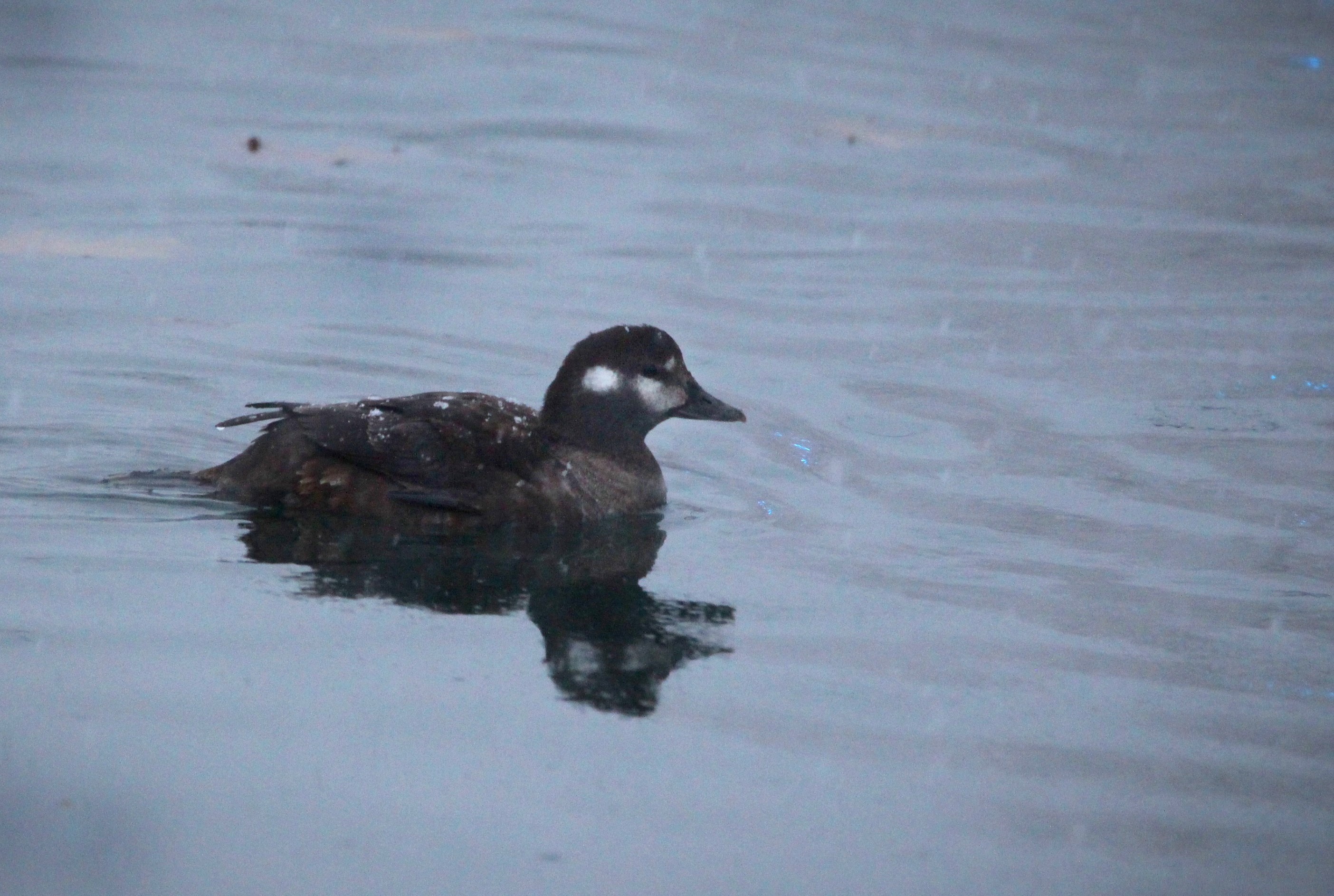
The heavy snow in the morning kept many of the land birds hidden, but many of the water birds were still around, braving the elements. A few highlight species were: harlequin duck (one female), greater white-fronted goose, killdeer, yellow-bellied sapsucker, and snow bunting.
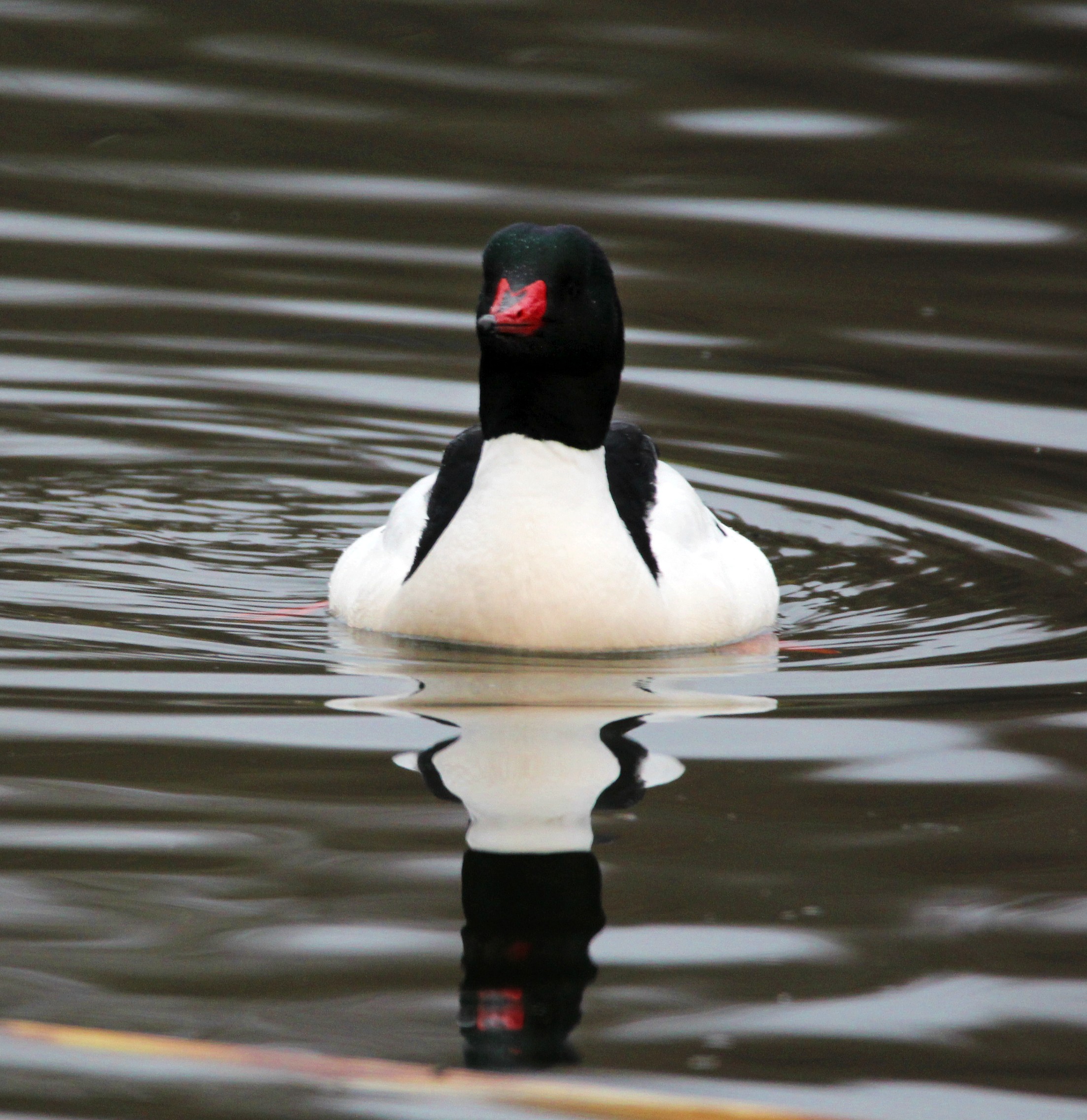
Photo by Chris Bosak Hooded mergansers in the snow, Christmas Bird Count 2025, Stamford, Connecticut.Female harlequin duck, Christmas Bird Count 2025, Stamford, Connecticut.Three greater white-fronted geese with one Canada goose, Christmas Bird Count 2025, Darien, Connecticut.
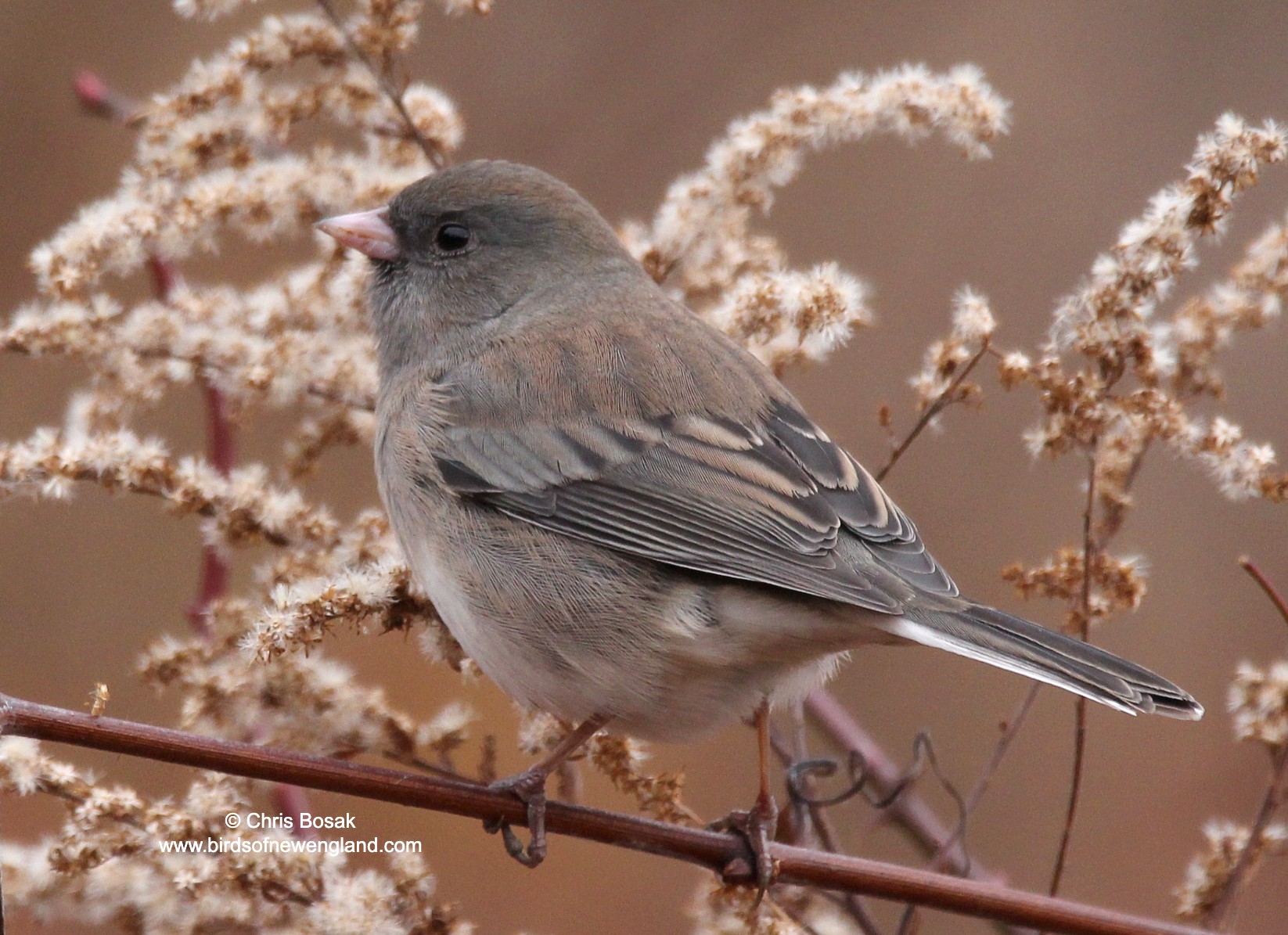
Photo by Chris Bosak – A dark-eyed junco eats goldenrod seeds at Huntington State Park in Redding, Connecticut, November 2025.
Here are a few more photos of my experience with juncos in the goldenrod field recently. See the last “For the Birds” column for the whole story. On a side note, now you know what goldenrod looks like after the yellow flowers die off.
Thanks for your support of Birds of New England.com.
Photo by Chris Bosak – A dark-eyed junco eats goldenrod seeds at Huntington State Park in Redding, Connecticut, November 2025.Photo by Chris Bosak – A dark-eyed junco eats goldenrod seeds at Huntington State Park in Redding, Connecticut, November 2025.Photo by Chris Bosak – A dark-eyed junco eats goldenrod seeds at Huntington State Park in Redding, Connecticut, November 2025.
Photo by Chris Bosak – A dark-eyed junco eats goldenrod seeds at Huntington State Park in Redding, Connecticut, November 2025.
Have you seen any videos of kayakers being surrounded by whales?
I’ve seen a few such videos. I’m not sure where they were filmed, but I’m reasonably sure they are real and not AI-generated. Of course, it’s getting harder to tell these days.
While being surrounded by whales would be a moment you’d never forget, I’m not sure I’d want to experience it. I didn’t get into bird- and wildlife-watching for extreme, brush-with-destiny experiences.
I did, however, have a similar experience last week. Granted, this was far less risky and would never go viral on social media, but for me, it was a moment I won’t soon forget.
I came to the part of the trail where it exits the woods and cuts through the middle of a smallish meadow, about the size of a football field. Like most meadows, it looks vastly different depending on the season. In the spring, it is lush green and the flowers, weeds and grasses seem to grow by the hour. In the summer and early fall, colorful blooms take over the scene, and the growth is so thick that the trail becomes impassable. I tried plowing through the trail once in the summer and was covered with ticks by the time I reached the other side. I’m not doing that again.
In the fall, after the goldenrod has faded but before winter applies its death grip, the field is a pleasing palette of subtle brown and yellow notes. Fall foliage from the woods and brushy areas around the perimeter of the meadow paints the background with vibrant shades of red, orange and yellow.
Such was the scene the other day when I entered the meadow. I immediately noticed a ton of bird activity among the browned grasses and weeds. A lone palm warbler flew off into the brush, and a small group of white-throated sparrows followed suit. But the juncos remained.
I got about 15 steps into the meadow and stopped. I looked around and realized I was surrounded by juncos. The little black or dark gray and white birds went about their business of eating goldenrod seeds while I took in the scenery. It was difficult to get an accurate count because many of the birds preferred to do their seed hunting toward the middle of the plant instead of the top. I would guess there were at least 30 juncos total in all directions from where I stood, some as close as 10 feet away.
Again, not quite like being surrounded in a kayak by whales, but I’ll take it any day.
On top of everything else, it was a perfect late fall morning. It was about 50 degrees, enough to need a sweatshirt but nothing more, and light cloud cover kept the harsh sun at bay. As I get older, I am much more appreciative of moments like this. I was outdoors, the temperature was ideal (for me anyway), and dozens of birds surrounded me.
In this day of virulent political division, social media dumpster fires, and animosity toward fellow man by so many, it’s nice to get lost in moments like these. Leave it to New England nature to provide the perfect escape.
Ruby-crowned kinglet, fall 2025, Huntington State Park, CT.
Two species dominated my latest bird walk.
Perhaps not surprisingly, the white-throated sparrow was the most dominant species. I lost track of how many I had seen early in the walk as dozens of these beautiful native sparrows were around every bend.
The second-most dominant species may be a bit more surprising. While large groups of white-throated sparrows lingered around every corner, singular ruby-crowned kinglets kept me occupied on the straightaways.
They were constant companions during the walk. Little flashes of movement in the bushes or low branches of trees gave away their whereabouts. Not that they were trying to stay concealed, as they can be surprisingly tame for wild birds.
Tame or not, close looks or not, ruby-crowned kinglets are notoriously difficult to photograph, as they are in constant motion, and predicting their next move is a crapshoot. If you see one that sits still for a full second, you’d better be prepared with the camera and not blow the opportunity. (I’ve blown innumerable opportunities, by the way.)
Then comes the real challenge: Getting a photo of one with their namesake crown exposed. Not only do you have to get a kinglet to sit still long enough for a photo, but the bird must be in an excited state. Ruby-crowned kinglets show their colorful crown only when they are unsettled. Otherwise, these birds are mostly olive colored with yellow and black wings and tails, and an eye ring that doesn’t quite make it all the way around the eye.
All the kinglet photos I managed to capture on this particular walk were without the crown exposed. (Although the photo at the top shows just a hint of the red crown.) In fact, in my entire photo collection going back many years, I have very few photos of kinglets with their crowns showing.
Golden-crowned kinglets, a sleeker and slightly more decorated cousin of ruby-crowned kinglets, are the same way. They are difficult to photograph because of their hyperactivity and display their crowns only when agitated. To me anyway, golden-crowned kinglets are even more difficult to photograph because I see far fewer of them than ruby-crowned kinglets.
Kinglets do not typically visit birdfeeders, but they may still be found in yards. Check flowerbeds with dead and dying flowers, as kinglets are often found close to the ground. They are most likely looking for insects and spiders to eat, but they do supplement their diet with seeds and berries. Flowers that linger deep into fall, such as sedum, are good candidates to attract ruby-crowned kinglets. For golden-crowned kinglets, check evergreen trees, particularly those thick with branches and needles.
Kinglets are New England’s smallest birds, apart from hummingbirds. What they lack in size, kinglets make up for in character. (Hummingbirds fit that bill as well.) They are high-energy, exceptionally fun to watch and numerous during certain times of the year. Kinglets may occasionally be found during the winter in New England, but most of them make a relatively short migration to southern U.S. or Mexico.
As a late migrant, the tiny kinglet adds a little pizzazz to a late fall walk.
Ruby-crowned kinglet, fall 2025, Huntington State Park, CT.
Photo by Chris Bosak Pitcher plant at pond in northern New Hampshire.
Launching the canoe from the campsite proved to be much more difficult than I imagined. The dry summer left the pond extremely shallow, and the shoreline had receded to the point where I had to carry the canoe through several yards of muck to reach the water.
A solitary sandpiper watched the action from the opposite shoreline. Its interest faded quickly, and it went back to looking for food in the shallows.
Once on the water, I dodged a few rocks ─ some exposed and some lurking just beneath the surface ─ and eventually was able to float freely. The feeling of freedom shortly came to an end as the canoe stopped abruptly. Thick vegetation put the brakes on the effortless ride and required heavy paddling to move forward.
The pond is relatively small, so I was determined to canoe around the entire shoreline and end up back at the campsite. For the moment anyway, I put out of my mind the effort it was going to take to get the canoe back out of the water.
The thick vegetation made the going tough, but I managed to round the first bend. A young bald eagle flew overhead and landed near the top of a distant evergreen. A vast swamp and towering mountains in the background came into view. No birds, mammals or reptiles to be seen, however.
But there was an interesting sighting that drew me in. As I slogged my way toward the target, I had no fear of it flying away like a heron, plopping in the water like a turtle, running away like a deer or silently sauntering into the woods like a moose. It was a plant. It wasn’t going anywhere.
I don’t normally get excited about seeing plants, although I understand why many people do. It was a purple pitcher plant, or more accurately, several purple pitcher plants. I hadn’t seen pitcher plants in many years, mostly because I haven’t been in my canoe as much as I’d like.
Pitcher plants are named after the container that holds liquid, not the baseball player that stands on the mound. The pitcher-shaped leaves attract and trap insects. They are one of New England’s few carnivorous plants.
According to Massachusetts Audubon’s website, “Its vase-shaped leaves are 4-10 inches long. Peer inside one of these leaves and you’ll see a bacteria-laden soup. Insects fall into this fluid and are digested; they can’t escape because the walls are lined with downward-pointing hairs.”
I don’t typically find plants interesting, but it’s hard not to be fascinated by carnivorous plants. For those of a certain age, like me, we can remember the advertisements for Venus flytraps in the backs of comic books. The plants, of course, were depicted as menacing creatures daring any insect to come close. I guess that’s where my fascination started.
Pitcher plants do not look menacing, but they do stand out among the shorelines of ponds, fens and bogs with their rich maroon or purple color. They live in wet, acidic places where the soil is poor in nutrients. The insects they “eat” supplement their diet.
Purple pitcher plants are hardy enough to handle cold winters and can be found throughout New England, from Connecticut through Maine. They grow low to the ground in clusters. While not as flashy a wildlife sighting as a rare bird or regal mammal, pitcher plants have a beauty, mystery and intrigue that makes their story fascinating.
Sometimes the allure comes from unexpected sources, but New England nature never disappoints.
Photo by Chris Bosak
A male scarlet tanager in the fall.
It seems like just yesterday we were welcoming back the warblers and other songbirds during spring migration and here we are at fall migration already.
Many of the birds we saw in the spring heading north will look the same on their southward journey. Many others, however, will look different.
Some, like male scarlet tanagers, will bear little resemblance to what they looked like in the spring. When we saw them in May and June, they were the most brightly colored birds in the woods. A sighting always yielded a gasp of excitement as we wondered how a bird in New England could be so brilliant. After the breeding season, however, they molted and are now dull yellow with less shiny black wings. They are still awesome-looking birds but not the striking birds they were in the spring.
In addition to many adult birds molting, the fall migration includes first-year birds that haven’t attained familiar adult plumage yet. They often resemble females or a mix of male and female plumage.
Photo by Chris Bosak
Clapper rail in Milford, Connecticut, summer 2025.
I’ve written about a lot of different types of birds over the last 30 years. There are some birds I’ve likely written about hundreds of times, and some only a handful of times.
If I searched my “For the Birds” folder for chickadee, robin or woodpecker, I’d get hundreds of hits. If I searched for vireo or flycatcher, I’d get far fewer hits, but still a decent amount.
There’s one bird family found in New England I’m not sure I’ve ever written about or even mentioned within a column. It’s the rail family. Rails are small to medium-sized chicken-like birds of the marshes. The reasons I haven’t written about them before are fairly obvious: rails are not very common, live in a habitat that is difficult for humans to traverse and are extremely secretive.
New England has a few members of the rail family. Virginia rail is the most common and the one most likely to be seen in New Hampshire. Sora is the other most likely candidate in New Hampshire. Clapper rails may be found along the coastal regions of New England.
There are also yellow rails, black rails and king rails found in New England, but they are rarely seen. Virginia rail is the best bet, but even that is a chore.
Photo by Chris Bosak
American oystercatcher, Milford, Connecticut, summer 2025.
Following up on yesterday’s post, here are a few more American oystercatcher photos. I find both of these photos rather humorous. The top photo looks like an unhappy customer storming away from the counter. The bottom photo looks like an oystercatcher giving someone the evil eye.