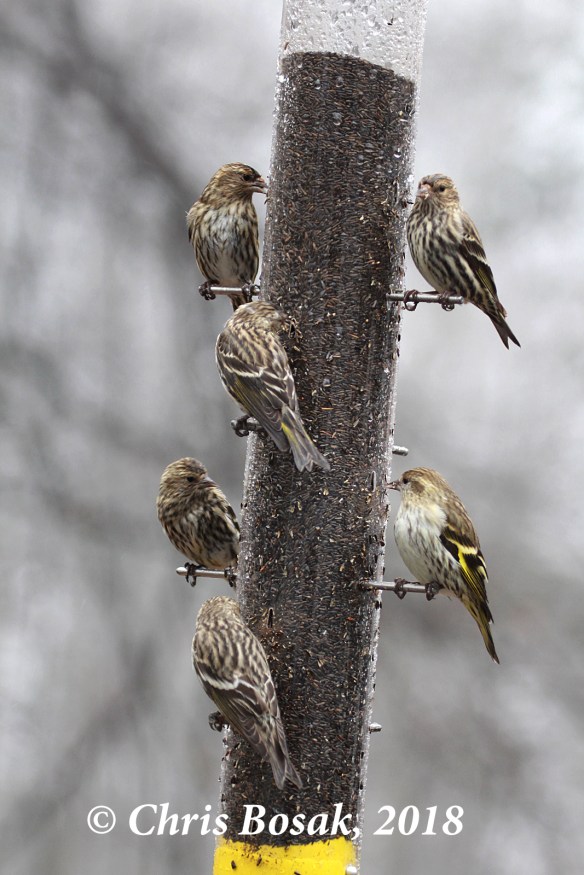
Photo by Chris Bosak Pine siskins visit a feeder in Danbury, Connecticut, fall 2018.
A wise man once said: “The nature of a winter finch irruption, however, could mean a sizable flock of pine siskins can show up and empty out my Nyjer seed feeder at any moment.”
Just kidding. That was me writing two weeks ago about the hot start to the winter finch season. The wise man part is up for debate.
At the time of that writing, a female purple finch had been my only out-of-the-ordinary sighting at my feeding station. A week later a few fox sparrows showed up. I know fox sparrows are not finches, but they can fit loosely into the category of winter finches because of their sporadic visits to New England backyards.
Then last week, true to the sentence at the top of this column, the pine siskins showed up. It started out with two siskins sharing the tube feeder with a group of goldfinches. The next day, I counted three siskins. The third day, about 20 siskins showed up and occupied every perch on the tube feeder and a nearby hopper feeder. The spillover Continue reading →
Photo by Chris Bosak A purple finch eats seeds at a feeder in New England, Nov. 2018.
There has been a lot of talk lately about winter finches. There usually is this time of year.
I have read accounts of people seeing big flocks of pine siskins. Siskins are probably the most common winter finch that irrupts into the middle and southern parts of New England sporadically in winter.
Winter finch is not an official term with a clear-cut number of species that nicely fits the category. Rather, it is a general term used for members of the finch family that breed up north and typically spend their winters up north, but irregularly move south during the winter as food sources dictate.
The species most commonly associated with a winter finch irruption include pine siskin, common redpoll and purple finch. Larger finches, such as pine grosbeak and evening grosbeak, are also species seen at backyard feeders throughout New England during the winter.
But birds do not even have to be finches to fall into the loose category of “winter finch.” Often, the red-breasted nuthatch is lumped into the category due to its great abundance at feeders some winters and being a no-show during other winters.
So far this winter I have seen a lone female purple finch at my backyard feeding station. That has been the extent of my winter finch season so far. The nature of a winter finch irruption, however, could mean a sizable flock of pine siskins can show up and empty out my Nyjer seed feeder at any moment.
I did see a few red-breasted nuthatches on a recent trip to northern New Hampshire, but that is part of their breeding and winter grounds, and would not fall into the category of a winter-finch sighting.
Admittedly, it took a minute or two to identify the female purple finch that has been visiting my yard. It was clearly something different, so I knew I had to lock down an ID as soon as possible.
Female purple finches are streaky brown in plumage. It didn’t have the look or feel of a sparrow, so I eliminated those possibilities immediately. It looked a lot like a house finch, but was more heavily streaked and slightly larger and plumper overall. The thick bill further eliminated any sparrow possibilities and after very briefly considering the female rose-breasted grosbeak, I was able to nail down the ID as a female purple finch.
In the past when I have seen purple finches, it has usually been a pair so getting an ID was easier because I had the more colorful male to observe.
For whatever reason, regardless of how great a winter finch season it is throughout New England, my yard typically does not drive in a lot of these birds. While I’ve read about several backyards being ambushed by pine siskins already this season, I haven’t seen a pine siskin in about 10 years. That species typically irrupts every three or four years.
If nothing else shows up at my feeders all winter, I still have my regular feeder birds and my female purple finch. And I’m good with that.
Here is the latest For the Birds column, which runs in several New England newspapers.
…
Photo by Chris Bosak A ruby-throated hummingbird perches on a stick being used as a garden stake in New England, summer 2018.
One of the nice things about living in the woods is that you are never at a loss for garden stakes.
Does that tomato plant need support? Take a little walk in the backyard, find a thin but sturdy stick on the ground, and you’ve got yourself a garden stake. Sure, it’s not apt to be perfectly straight, and it might not sport a perfectly pointed end for jabbing into the soil, but that’s nothing a whittle or two with a jackknife can’t fix.
A bonus to using these natural garden stakes, I’ve noticed, is that if they are placed near a birdfeeder, they make for good perches, too. This is especially true if the sticks have smaller branches at the top.
My property is predominantly shaded, but there is a sunny enough area on the deck and a small portion of the yard near the deck. I do a lot of container planting on the deck, so these garden stake/bird perches are high off the ground.Continue reading →
Here is the latest For the Birds column, which runs in several New England newspapers.
…
Photo by Chris Bosak An American Robin perches on a gravestone at at a cemetery in Darien, Conn., April 2014.
A raccoon knocked over something in the backyard around three in the morning. The crash woke me from a dead sleep, so I got up to investigate. A quick look in the pitch-dark with a cheap flashlight did not yield the cause of the crash. The potted plants looked to be intact and the birdfeeders seemed to be in their place.
I went back to the screened-in porch to continue my night’s sleep, but sweet dreams eluded me. I used to be the world’s best sleeper; able to sleep anytime, anywhere. As I’ve gotten older, however, it’s gotten less easy.
So, I stared into the dark woods, listened to the night sounds and hoped to doze off again. When the robins started singing I gave up. I checked the time: 4:45. Still dark. I got to thinking as I sat there waiting for the sun to rise about why birds would sing before dawn in the summer. I can understand in the spring, as the male birds want to attract females, so why not get an early jump on the competition.
But in the summer, why sing so early? Why sing at all, really?
The breeding season, for the most part, is over, so impressing females shouldn’t be at the top of their list. That is the beauty of thinking, of course. You come up with theories, right or wrong, about your questions. Robins are the most-hearty singers in the morning in the summer, at least at my place. Robins are early nesters, getting started before a lot of our songbirds. They also have several broods each year — two or three in New England.
So, it made sense to me that a robin would be singing that early because he may still be in the breeding season.
In my weary ruminations, I thought of another reason. Birds sing for two main purposes: to attract females and to protect their territory. The breeding season might be over, but the task of raising young is still at hand. A bird waking up that early to sing is calling out to other birds that they are alive and well to stay the heck away.
Now for the beauty of the Internet: You can discover what others think on the subject. There are other theories on why birds sing so early — atmospheric condition is one theory — but I will leave the scientific research to those more capable.
I did find some interesting tidbits on singing. Bird pairs recognize each other’s “voice.” It is mostly the males that sing, of course, but all birds call to each other. The songs and calls may all sound the same to us, but birds can recognize individuals by the nature of the sounds.
Some females do sing. I’ve heard female cardinals singing on plenty of occasions. I’ve read that female grosbeaks and orioles also sing.
Sleeping outside (the screened-in porch is close enough to outside) opens your eyes and ears to the dark side of nature. I mean dark in a literal sense, of course.
Also, when sleep escapes you, it gives you time to ponder.
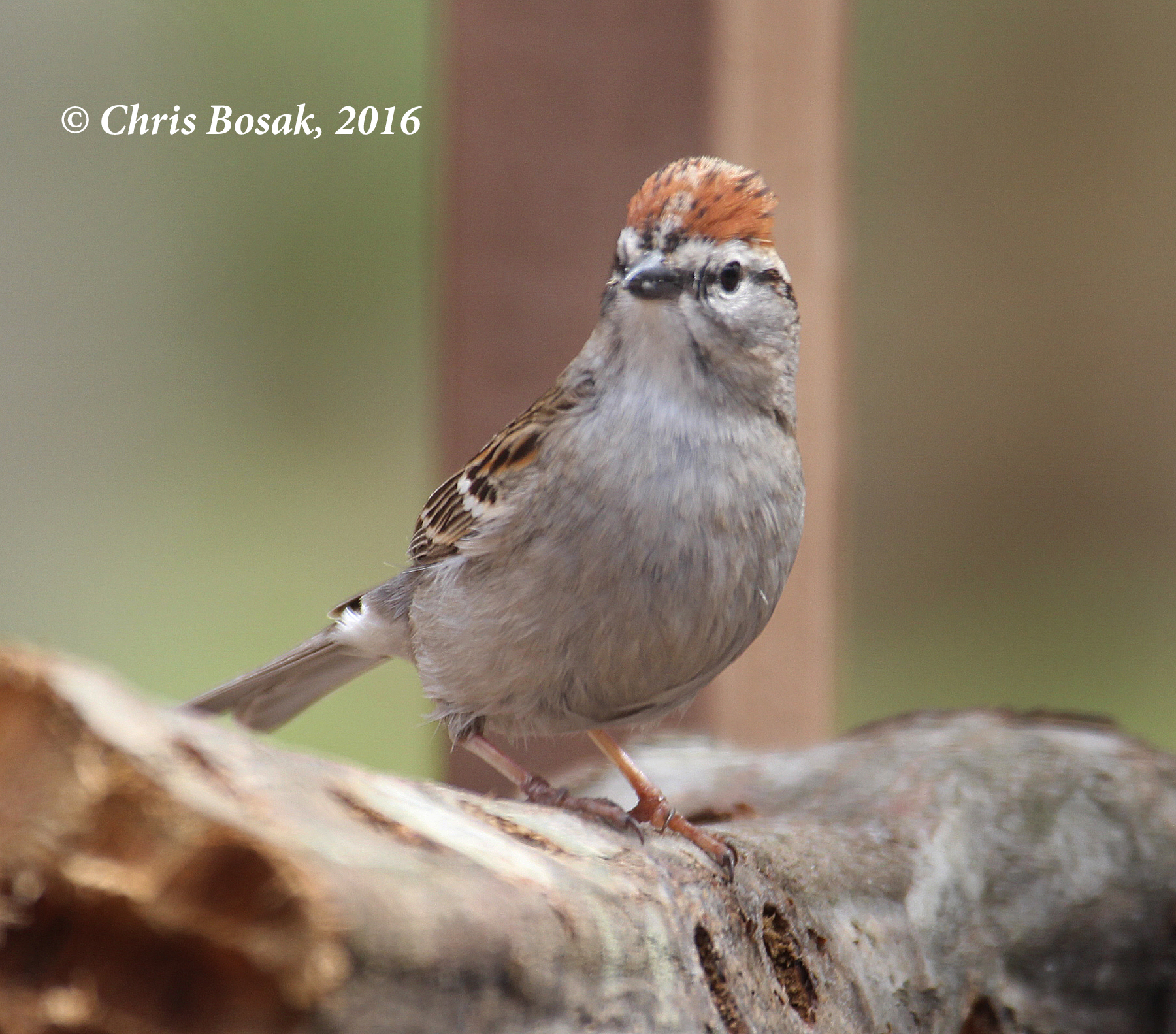
Photo by Chris Bosak A Chipping Sparrow raises its crest while standing on a log in Danbury, Conn., summer2016.
I wasn’t about to let this one slip away.
I’ve said that to myself plenty of times over the years and most of the time it does, indeed, slip away. But not this time.
Persistence is often necessary when trying to nail down a bird’s identity. The problem is this: The bird doesn’t know this and often (usually?) flies away before you can study it long enough to get that ID.
This latest bird was driving me crazy. It sang loud and clear from the depths of the woods. The song appeared to be an endless series of robin-like phrases sung over and over. Despite the constant notes, I couldn’t find the bird in the treetops.
My first thoughts were that the bird was either a Baltimore oriole, rose-breasted grosbeak or scarlet tanager. I was thinking big in terms of color apparently. I looked in the tree tops, but saw nothing.
Eventually, I eliminated those birds from consideration because the song was too constant. The aforementioned birds take at least a little break between repeating their respective songs.
My next thought was a gray catbird as the song had a bit of a squeakiness to it. It wasn’t the right habitat for catbirds, however, as the scene was heavily wooded.
I recorded the song in case the bird decided to fly away, leaving me frustrated without a positive ID. I’ve tried that before, however, and it rarely seems to work. Just like birds Continue reading →
Here is the latest For the Birds column, which runs in several New England newspapers.
…
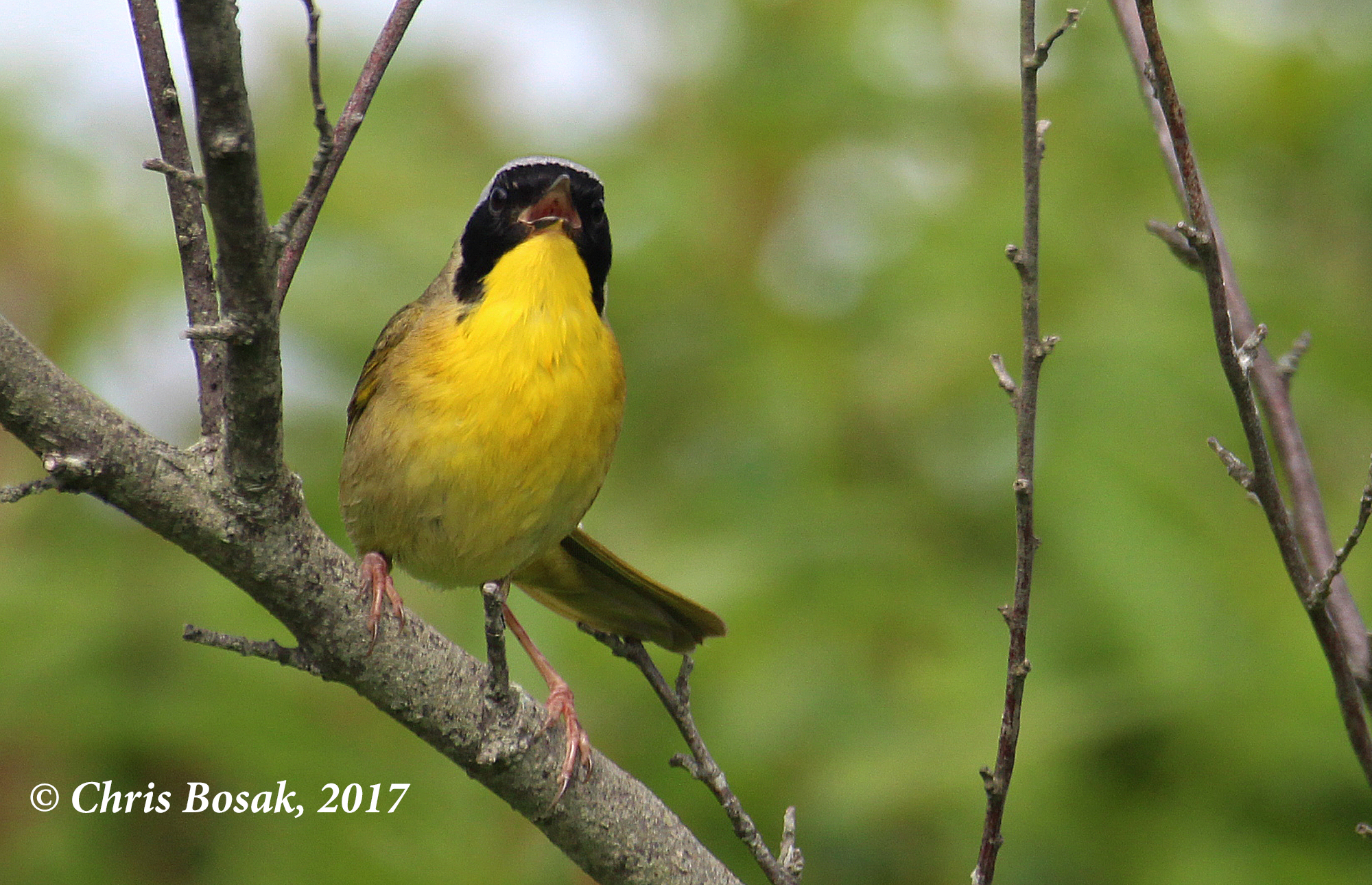
Photo by Chris Bosak Rare bird alerts are a good way to find out when spring migrants, like this yellowthroat, are arriving.
What do we do now with spring migration winding down and birds busy with the task of continuing their species?
We still look for birds, of course, but where to find them? Resident birds make themselves scarce as they hide away in holes and on nests. We don’t want to disturb the birds at this time of year anyway.
It’s a good time to check out the rare-bird alerts to see what others are finding throughout the region. I’ve never been a big “chaser,” but it’s always fun to see what birds are around. You never know, maybe one of the rarities is in your town or in a neighboring town.
The best place to look is birding.aba.org, which is run by the American Birding Association. It is a combination of birding news and rare-bird alerts. Not all of the sightings listed are rare, but may be unusual for location or time of year. Sometimes, contributors just have a bird question for the community.
The “landing page” of the website gives users the option to click on any state. It’s fun to click on random states to see what’s showing where. If you’re traveling, you can always check to see if any unusual birds are hanging around your destination.
Some of the recent sightings in New Hampshire include nighthawks, chukar, king eider, mourning warbler and snowy owl. Yes, you read that last one correct. A snowy owl is still around the New Hampshire coast.
New Hampshire Audubon also maintains a great rare-bird alert system. Visit www.nhaudubon.organd click on “Get Outside,” then “birding.” It is updated frequently and lists rare and unusual sightings from around the state. There is also eBird, which is revolutionizing birding and bird tracking, but I’ll save that one for another day as it warrants its own story.
The lists will not let you know how the common species are doing, or where they are being seen. Cardinal and chickadee sightings are not appropriate for the rare-bird alert lists, but you can always send them to me if you feel the impulse to share. I’m always interested in knowing what people are seeing — rare and common species welcomed.
The ABA site is also good fodder for bird discussions. Many birders use the site to have questions about birds answered. A birder posted last week about a bird song she had heard and wondered if anyone could figure out what it was.
While I’ve never been a lister or chaser, it’s always good to check in occasionally with the rare-bird alerts. You’d hate to find out too late that a once-in-a-lifetime bird was right under your nose.
Photo by Chris Bosak A scarlet tanager perches in an oak tree in Danbury, Conn., spring 2018.
Here is the latest For the Birds column, which runs in several New England newspapers.
…
The colors just keep on coming this spring.
I’ve been lucky enough to see two indigo buntings, three rose-breasted grosbeaks (although two were males fighting each other), a scarlet tanager, at least three Baltimore orioles, a pair of ruby-throated hummingbirds and a handful of warblers in my yard so far this spring. It’s been a welcomed color bonanza after a long winter.
Now that Memorial Day has passed and we are unofficially in summer, let’s look at what some readers have seen.
Carol from the Monadnock Region sent a photo of an oddly colored hairy woodpecker. Instead of the traditional white and black, this one was black and yellowish brown. A reader from Connecticut sent me a similar photo a few years ago.
My guess is that it is a normal hairy woodpecker with a pigment abnormality. Pigment abnormalities show up in birds every so often, such as orange house finches or white robins. Leucism and albinoism are extreme forms of pigment abnormalities, but more subtle color variations occur.
Don watched as an eagle eyed a pair of common mergansers on Granite Lake. He wondered if the eagle would try to take one of the ducks, but a loud noise distracted the eagle and it flew off. Eagles, which often scavenge for food, can take birds as big as common mergansers.
Norma from Spofford had an indigo bunting visit her feeders this spring. She has been in Spofford for nearly 40 years and has seen buntings only a handful of times.
It’s also been a colorful spring for Lenny of Greenfield, who has seen orioles, rose-breasted grosbeaks and cardinals. A special treat was seeing the oriole and grosbeak at the feeder at the same time.
Dean in Marlborough reported visits from pileated woodpeckers, indigo buntings, cardinals and eastern bluebirds. Another colorful yard in the Monadnock Region.
Lida from Harrisville had a male and female oriole come to her table to feast on oranges. Another reader suggested using grape jelly to attract orioles.
I tried to attract orioles with both oranges and grape jelly this spring, to no avail.
Eric in Surry noticed the usual changing of the guard for ground-feeders as the juncos left and chipping sparrows arrived, with about a two-week overlap. He has also noticed a few warbler species, including a pine warbler carrying nesting material. The material was hair he leaves out for the birds after brushing his dog. He has also seen chickadees, phoebes and nuthatches grab some of the hair.
He had another interesting bird sighting this spring; shortly after filling in small holes in his yard, a Cooper’s hawk swooped in to grab a chipmunk. Eric has also seen a blue-gray gnatcatcher and heard an eastern whip-poor-will. It’s been years since I’ve heard a whip-poor-will so I’m glad someone is still hearing them.
Spring migration is winding down, but not over. Soon, it will give way to nesting season. Let me know what you are seeing out there in this exciting time of the year for birdwatching.
Here is the latest For the Birds column, which runs weekly in several New England newspapers.
…
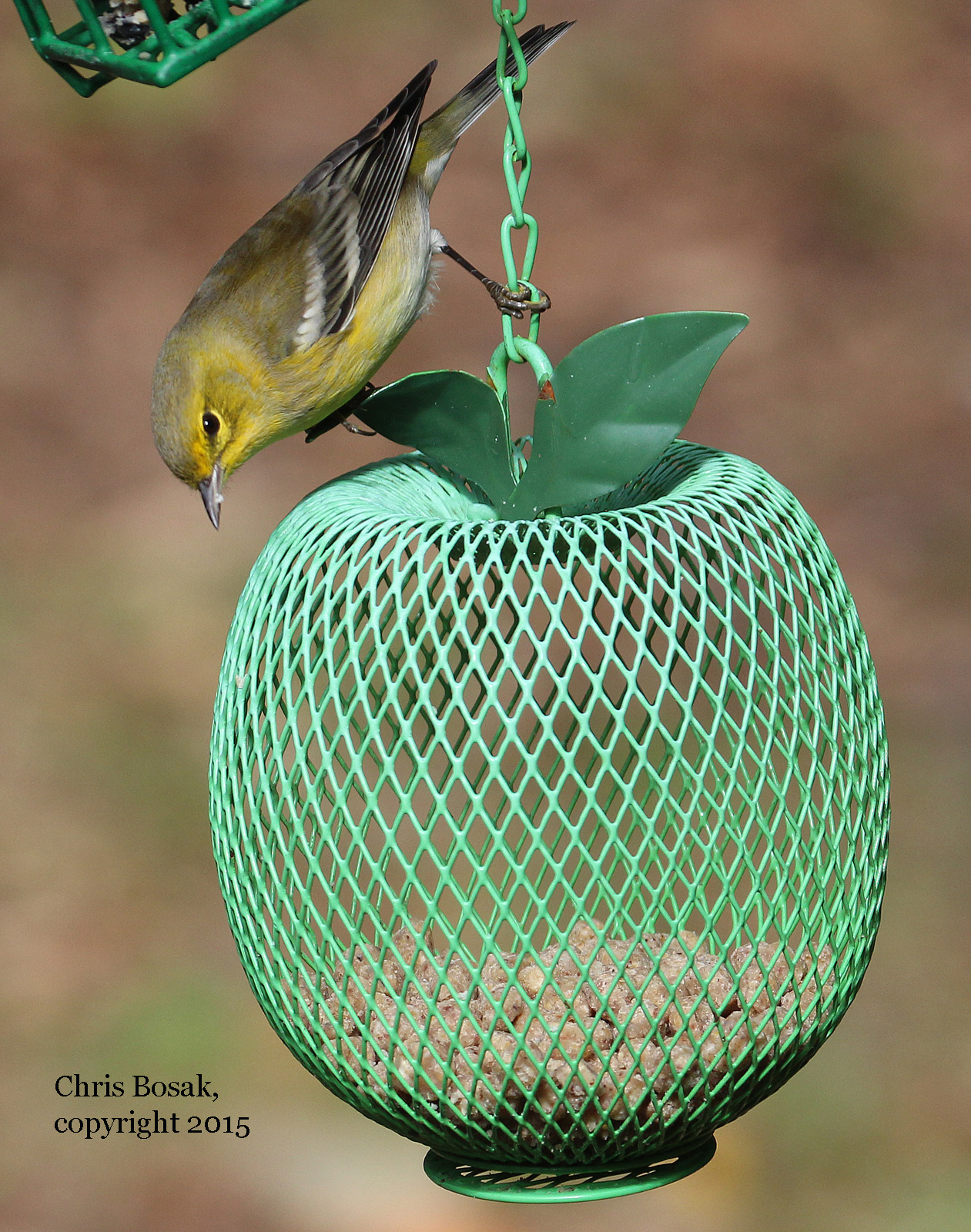
Photo by Chris Bosak Pine Warbler at feeder in Danbury, Conn., fall 2015.
Finally, I thought, a warbler singing in the backyard.
It’s been a long winter and the pine warbler I usually hear by the end of the first week of April never materialized. The first week of April turned into the second week and still no warblers to be seen or heard — at least on my end.
One cool, but bright morning last week, I stepped out onto the deck to fill the feeders and heard a high-pitched, soft and somewhat melodic tune coming from a giant oak. Surely a warbler, I thought, but I wasn’t sure which one.
I grabbed the binoculars, which always hang at the ready just inside the door. Now to find the little bugger. The leaves haven’t popped yet, so this shouldn’t be too tough, I told myself. It was more difficult than I thought, of course, but I finally zeroed in on a little bird high up on the trunk.
As you can probably tell from the build-up, it wasn’t a warbler at all. It was a brown creeper — a small, brown bird seen on tree trunks throughout New England, mostly in the fall, winter and spring. Usually the birds are silent as they look for insects by starting at the bottom of a tree trunk and working their way up.
In fact, I think this may have been the first time I consciously heard the song of a brown creeper. The website AllAboutBirds.org describes the song, sung only by males, as such: “His song is a jumble of high, thin notes that lasts up to 1.5 seconds. It’s sometimes likened to singing the phrase, ‘beautiful trees.’”
You’d think after all these years of birdwatching, I would know all the songs of warblers and be able to distinguish between warblers and non-warblers. There are many types of warblers, however, and I know a lot of the songs, but not all of them. Plus, this song was very warbler-like, as I mentioned. Also — my final excuse, I promise — it’s been 11 months since we’ve heard warblers singing and my birding-by-ear is rusty. It’s only average to begin with, so this guy definitely fooled me.
Not that I’m complaining that it was a brown creeper. I find them extraordinarily interesting birds, despite their small size and rather non-descript appearance. I like how they work up the trunk of a tree and then fly down to the base of a nearby tree to start again.
I’m still waiting on that first warbler, but I’m confident they will arrive soon. As usual, the sightings will start as a trickle — pine warbler here, palm warbler there — and then become a fantastically overwhelming phenomenon of tiny, colorful birds in the trees.
Get your ears ready.
Note: Since this column was originally written, I’ve seen palm and pine warblers. Rejoice!
Here is the latest For the Birds column, which runs in several New England newspapers.
Photo by Chris Bosak Vultures would be a good addition to Fortnite.
Fortnite is the hottest game going.
The survival video game has swept the nation — and world — and eaten up countless hours of kids’ and adults’ time.
But, since it is such a huge phenomenon (with well over 3 million players), I have to somehow relate it to birds, of course. I did something similar in the summer of 2016, when the Pokémon Go craze was at its peak. That was a fun column to write and may be found here.
Here’s a quick description of Fortnite for those who may be unfamiliar. It is a video game that can be played on a computer, PlayStation, Xbox, and now even a mobile device. The most popular way to play is the person-to-person mode — you can play solo or as a duo or squad (four-person team) — and the point is always to be the last one standing.
Other players may be eliminated by a variety of weapons that are picked up in towns and cities on an island where the game takes place. Players can Continue reading →
Here is the latest For the Birds column, which runs in several New England newspapers.
…
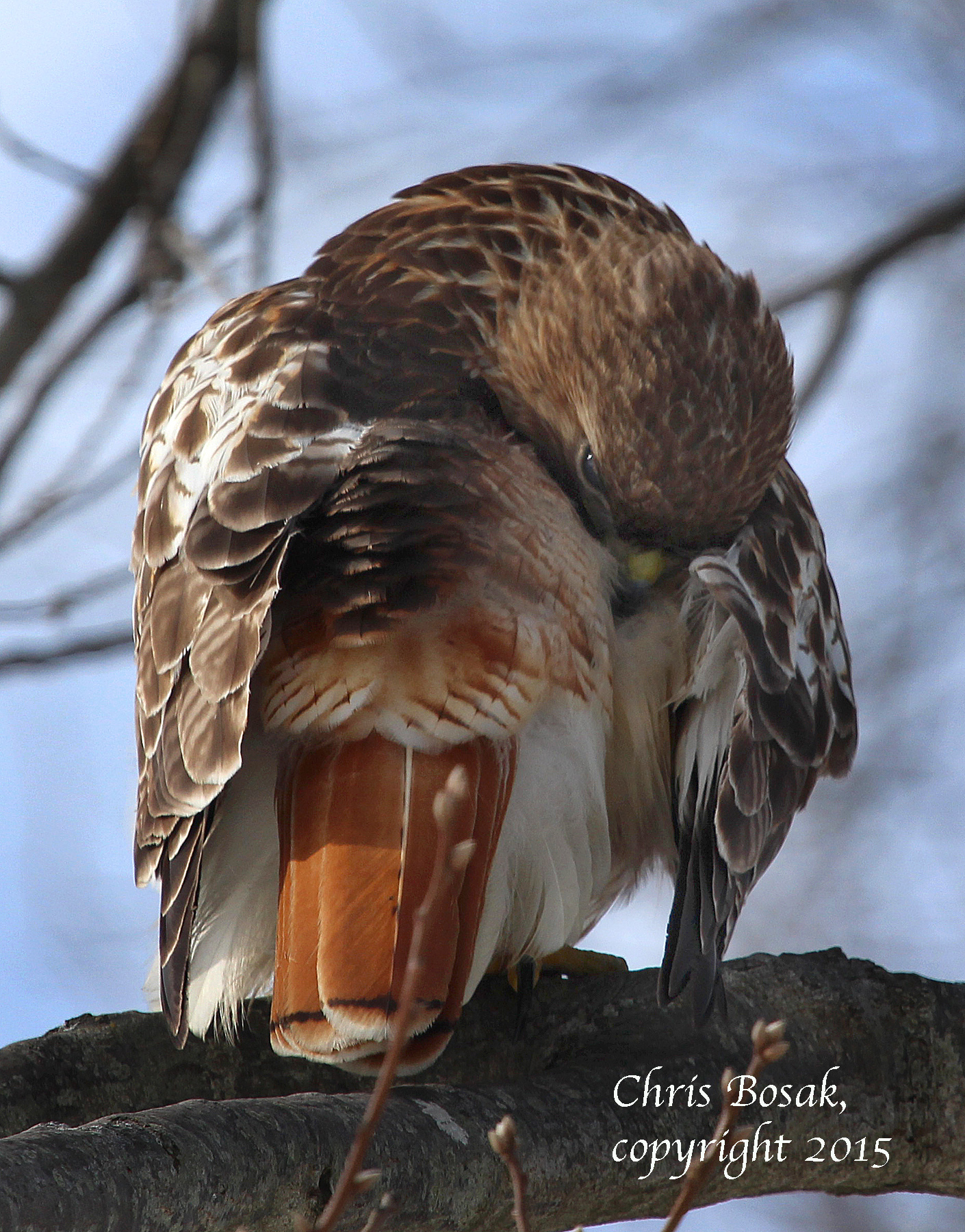
Photo by Chris Bosak A Red-tailed hawk preens at Weed Beach in Darien, Conn., January 2015.
I thought my cat was bad. The incessant licking to keep himself clean. He’s got to be the cleanest cat ever.
Then I watched a northern mockingbird preening itself. It went on for as long as I could watch and who knows how much longer after I walked away.
Feather maintenance is an important part of life for birds and it takes up a great amount of their time. Feathers play a role in a bird’s ability to fly, attract a mate, hide from predators and protect itself from the weather. Birds are the only living creatures with Continue reading →