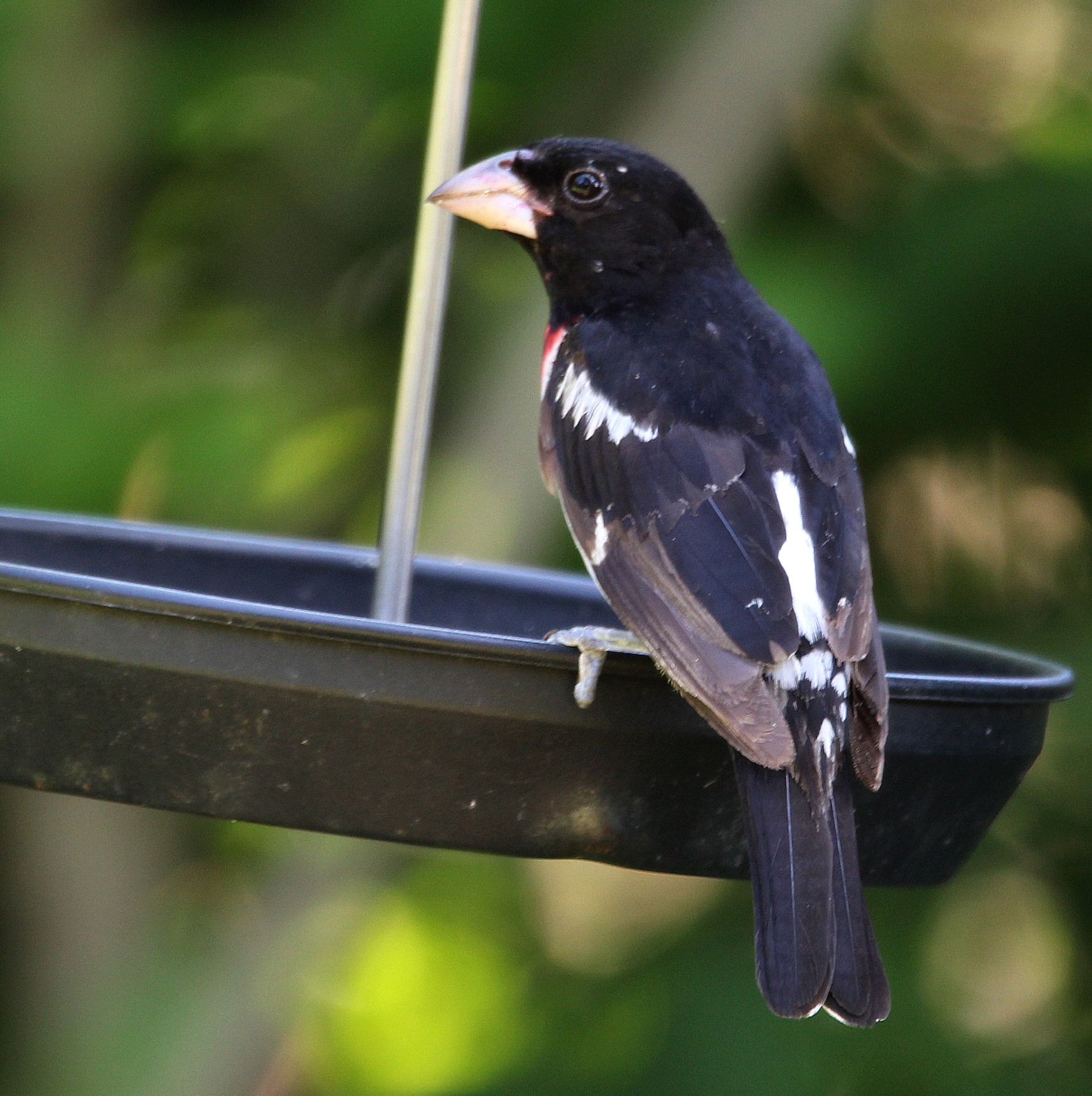
Photo by Chris Bosak – A young male rose-breasted grosbeak visits a feeder in New England, summer 2025. Note the brown feathers on the wings.
I was heading to my car at work when four or five relatively large birds emerged on the ground from around the corner of a building. I didn’t immediately recognize them, as their sudden appearance surprised me and my mind was elsewhere.
I took a few more steps and quickly realized what they were: baby turkeys. By that time, I had progressed enough that the mother turkey was now visible and only a few yards away. Will she attack like a mute swan or Canada goose might? Never get between a mother and her babies, the saying goes. I wasn’t actually between them, but I was certainly close enough to some of the babies that I could be considered a threat.
Sandhill crane, Presque Isle, Erie, Pa., May 2025.
What is rare and causes excitement in one area is often commonplace and taken for granted in other areas.
For instance, a roseate spoonbill caused quite a stir in southern New England a few years ago. People came from all over the region to see it. If you visit the right places in Florida, however, roseate spoonbills, while I’m sure still appreciated, are no big deal to the locals.
Conversely, there are birds common to New England that sometimes stray into other regions where they are not common and are a thrill for the people in that region.
Last week, while visiting my brother in Erie, Pennsylvania, I had one of those out-of-place bird experiences. We were walking along a trail looking for warblers and other migrating songbirds when I heard in the distance a very loud song from a bird that I did not recognize. Even though I didn’t know what the song was right away, I knew it was something special as I was certain I had never heard it before. The call was extremely distinctive, loud and carried a long way.
My brother had his Merlin app activated and sandhill crane came up. I had no idea that there were sandhill cranes at Presque Isle State Park as we have visited there frequently and had never seen, heard or even heard mention of the large birds being there before.
Photo by Chris Bosak
A cedar waxwing eats border privet berries in New England, February 2025.
Blue jays give and blue jays take away.
During a walk in the woods the other day, I heard a bunch of blue jays squawking up a storm. It was too loud and frantic to be simple alarm calls for a potential threat. This threat had to be real. The calls and squawks reached a fever pitch as more and more blue jays appeared onto the scene from all directions.
I knew it had to be a hawk or owl that had the jays all riled up. I just had to find it.
After a minute or two of peering into the thick hemlock branches, I noticed a large bird being harassed. The blue jays may have been smaller, but it was at least 15 to 1 in their favor. From my angle, the larger bird was still well hidden. I took a few steps to change my perspective, and my suspicions were confirmed that it was a barred owl.
Photo by Chris Bosak
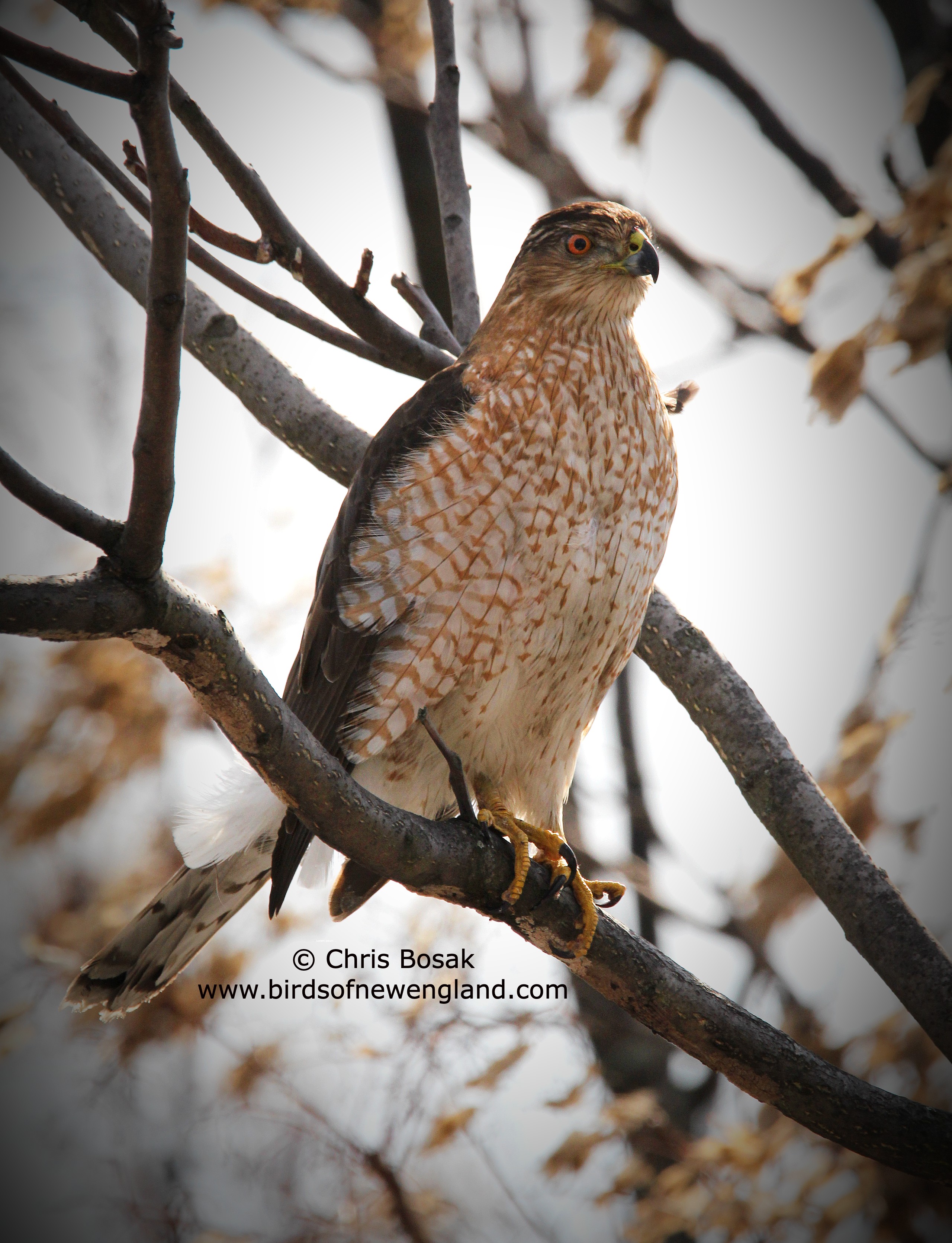
Adult Cooper’s hawk seen in Norwalk, Connecticut, January 2025.
I was walking along a short but windy trail in southern New England the other day in search of overwintering warblers. This short path is known for harboring these tiny songbirds during the winter, as it is adjacent to a water treatment center that features open water on even the coldest days.
I came around one of the many bends and jumped back as I flushed a large bird that was on the ground next to the trail. With my heart racing from the surprise, my immediate reaction was that it was a ruffed grouse. It flushed with the familiar exuberance and noise of a grouse, so my mind immediately went there. Ruffed grouse, however, do not live in that area of New England any longer, and the habitat wasn’t right for the popular game bird.
The weather icons on my iPhone showed rain starting at 8 a.m. I figured that would give me about an hour of dry weather to look for some early spring migrating birds.
No such luck. The rain started even before sunrise so my hour of dry weather wasn’t going to happen. Instead of rolling over and going back to sleep (a very tempting option) or mindlessly scrolling through social media, I decided to head out into the rain anyway. OK, I did take a few minutes to do Wordle quickly before heading out.
The walk started in a light rain, and a lot of birds were out singing. Immediately, I heard robins, cardinals, blue jays, song sparrows and a field sparrow in the distance. Field sparrows have a very distinctive song that sounds like a ping-pong ball bouncing on a table with the time between bounces getting progressively shorter, just like a real ball would do.
As soon as I committed to a trail leading me farther into the woods, the rain picked up. It never turned into a downpour, but it was a good, steady rain. Thankfully, the temperature was a very manageable 55 degrees, so I just got wet instead of wet and cold. I like birdwatching in all types of weather, but a cold rain is probably the worst. Heavy wind is not much fun either, but I would take it over a cold rain.
Birdwatching is extremely easy. Birdwatching is extremely difficult.
Both of those sentences are true. Everything in between is true as well. I’ve written this before, but one of the many great things about birdwatching is that it is as easy or difficult as you want to make it.
If you are happy identifying a few backyard birds that visit the feeder, fine. If you want to learn a few of the common birds you see on your walks through the woods, fine. And so on it goes until you get to those people who have reached expert status. You know, the people who pick out a first-year Iceland gull among a flock of 200 herring and ring-billed gulls.
Even though I’ve written a birdwatching column for more years than I can count on my fingers and toes, I’m not that expert. I’m not picking out a rare gull because I noticed the trailing edge of its wing is slightly different from the bird next to it. But I still love birdwatching and strive to get a little better each year.
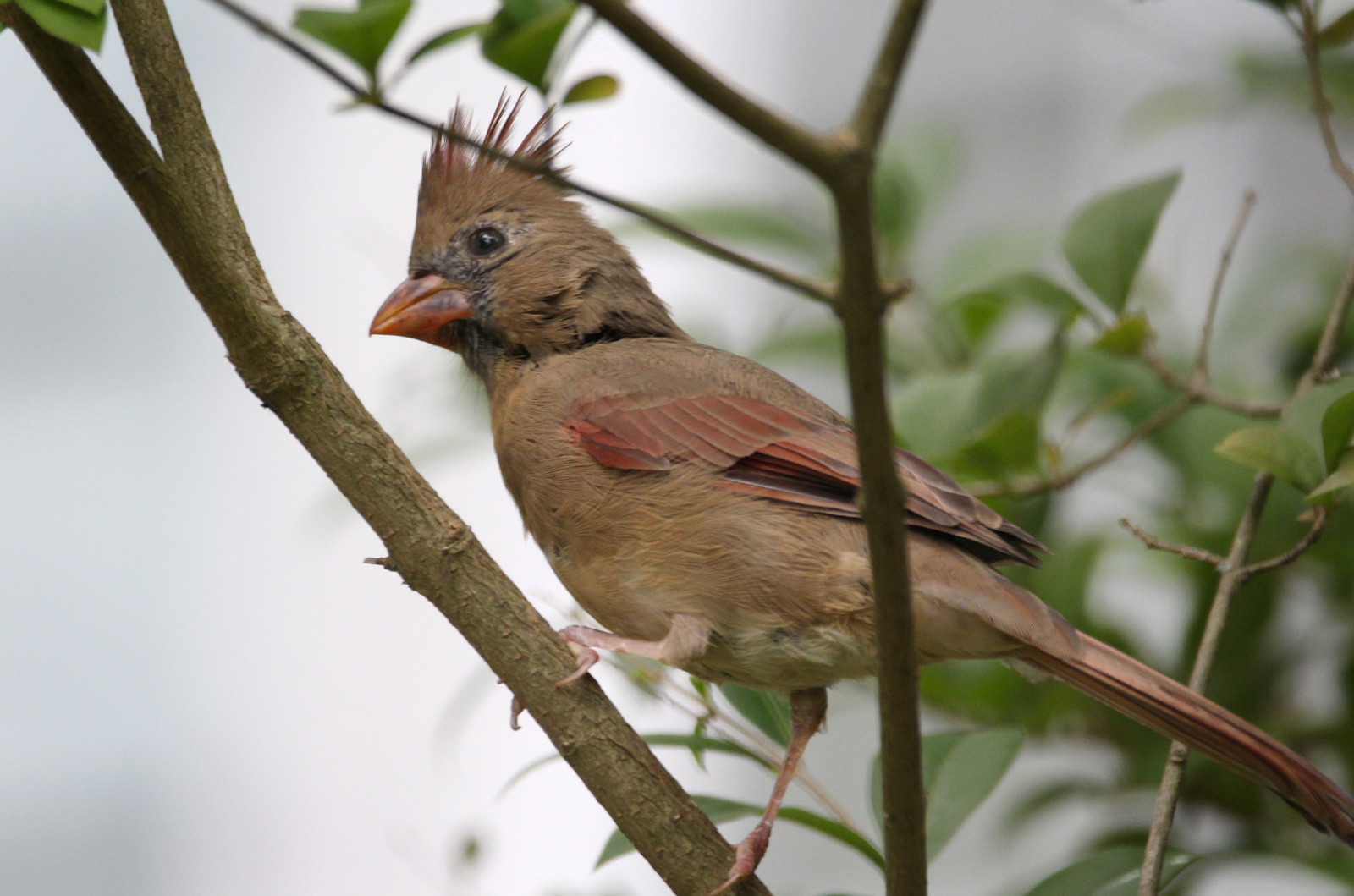
Photo by Chris Bosak – An immature cardinal perches in a bush next to a feeder.
…
My intermittent foot problems have kept me grounded for the most part over the last few weeks, so I have relied heavily on my backyard birds to keep me entertained.
Thankfully, it is a great time of year to watch birds in the backyard. Just as fall migration brings many birds to our parks and open spaces, they also bring plenty of birds to the backyard.
In addition to the common feeder birds, I have seen a few surprises either at the feeder or among the bushes near the feeder. One day I was sitting outside working when a ruby-crowned kinglet flew right past my face and landed in a bush about five feet away from me. Like most kinglets, it did not sit still for very long and hopped around the branches before disappearing in a matter of seconds. It was a nice little visit anyway.
Photo by Chris Bosak
A Scarlet Tanager perches in a tree in Danbury, Conn., July 2016.
This has been the first spring/summer since I can remember in which I have not seen a scarlet tanager. I was hot on the trail of a few in the spring, but I never did spot the birds.
Granted, my birding this year has been hampered by foot ailments, but I have still spent enough time out there that I feel I should have seen one or two of these beauties.
The scarlet tanager is one of the most sought-after species in New England in the spring. Their electric red bodies with contrasting black wings make it one of our most unique and beautiful birds. The problem with tanagers is that they mostly hang around the tops of tall trees. Even a bird as bright as a teenager can remain hidden in a full canopy of oak or maple leaves.
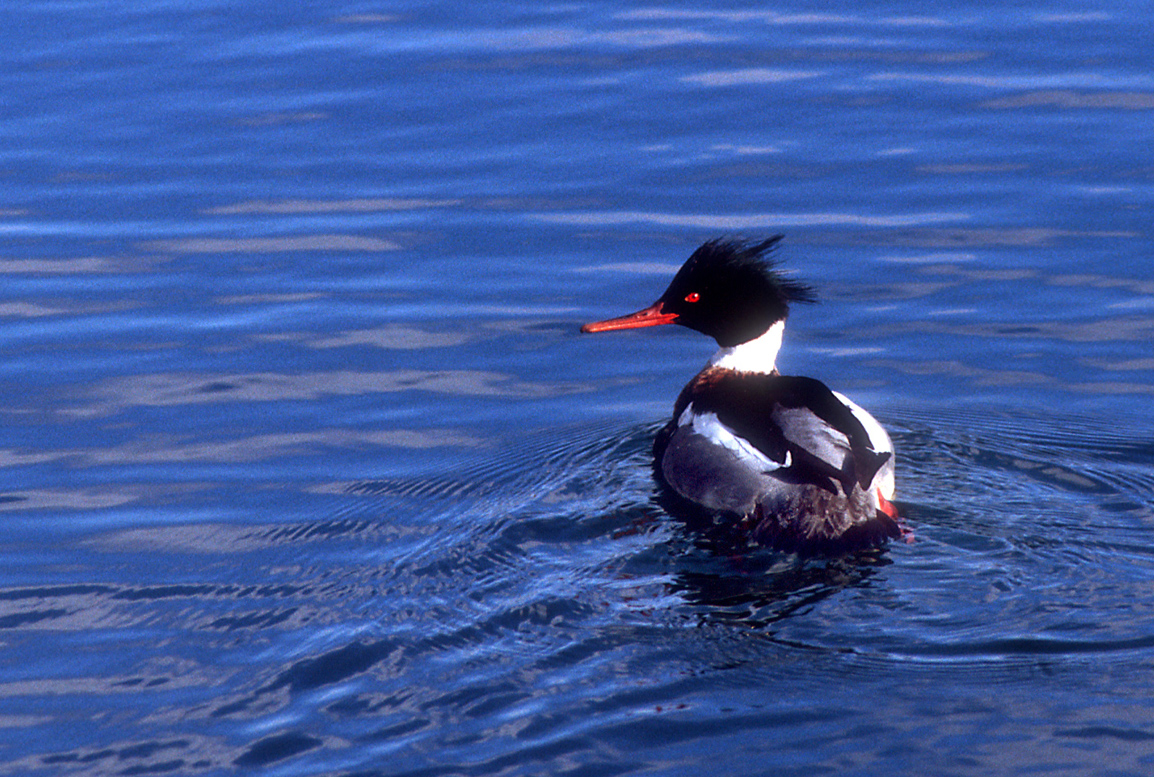
Photo by Chris Bosak Red-breasted mergansers may be seen throughout winter on the ocean or Long Island Sound.
There are always two ways to look at something.
I don’t remember what it was advertising, but I recall an old television commercial wherein one guy says: “Camping? I hate camping. There’s nobody around.”
The next guy on camera, within the same friend group of the first guy but unaware of what he said, says: “Camping? I love camping. There’s nobody around.”
I guess it all depends on your personal preferences and motives.
Photo by Chris Bosak
A bobcat rests in a field in New England, March 2021. (Huntington State Park)
It’s time for my favorite column of the year; a look back at my top 10 birding highlights from the previous year.
For all its faults, 2021 was a pretty good year for birdwatching. One thing that is not on this list for the first time in nearly 20 years is the Christmas Bird Count. I look forward to the all-day event for months leading up to it, but I had to bail on my birding partner Frank this year. An as-of-yet undiagnosed foot ailment that comes and goes was acting up, so I had to sit out this year’s CBC. Bummer.
But the year did include several highlights. Here are the top 10:
10. Crossbills. A sizable flock of red crossbills entertained New England birdwatchers at a Connecticut beach in March. They flew from spruce to spruce and the birder paparazzi followed their every move. Crossbills are unique in that their upper and lower bills cross rather than meet uniformly. The adaptation helps them get at seeds in spruce cones. Read story here.
9. Loons. If I see loons in any given year, it will make this list. I was camping with Katie at Woodford State Park in Vermont and I was hopeful but not optimistic that we’d see loons. Sure enough, despite the campground being fully booked, a pair of loons swam at the far end of the lake.
8. Feeder birds. My new home is not the birding paradise that my old place in the woods was, but a fair number of birds visit. I get most of the usual suspects, but the highlight was a small number of red-breasted nuthatches that came regularly last winter. Read story here.
7. Fall warblers. Birding in the fall can be tricky with the songbirds passing through in their non-breeding plumage. Warblers can be particularly tricky. But this fall, I had a few walks whereby palm warblers and yellow-rumped warblers (two that are relatively easy to recognize in the fall) were very numerous. It was like a little flashback to spring ahead of the long winter. Read story here.
6. Clapper rail. Katie and I walked along a marsh in the spring and heard the unmistakable call of a clapper rail. We looked at an opening in the marsh and the unusual bird ran across the mudflat and disappeared into the tall marsh grasses.
5. No owl, but buntings. I walked the length of a Connecticut beach where a snowy owl had been being seen reliably for quite some time. I came up empty on the owl, but did enjoy the snow buntings and larks that were there. Read story here.
4. Cooperative indigo bunting. Indigo buntings are a thrill to see regardless of the circumstances. One August afternoon, I came across a brilliant male indigo bunting singing from an obvious perch close to the trail. Bird photography should always be so simple. Read story here.
3. Road eagle. Anyone who drives to work knows the daily commute can get rather monotonous. One morning, as I passed a swollen part of a creek where wood ducks occasionally swim, I noticed a large bird perched on a snag over the water. It was an immature bald eagle either resting or looking for prey in or around the water. A break from the norm, for sure. Read story here.
2. Continuing For the Birds. I have written my For the Birds column for well over 20 years now. I enjoy writing it as much, if not more, than people enjoy reading it. I love hearing from long-time readers as well as new readers. A lot has changed in the world over the past 20-plus years, but New England’s passion for nature has only gotten stronger.
1. Bobcat! Without question, this was the nature highlight of the year. I spotted the bobcat from afar in a field and walked in its direction. It kept walking and going about its day. When it stopped and sat in the field, I stopped and grabbed a few shots with the camera. Then I slowly walked backward away from the impressive animal. Read story here.
I can’t wait to see what 2022 brings. In many ways, it’s off to a poor start, but let’s remain positive and create some great nature highlights. Drop me a line and let me know your highlights.





 Birds of New England.com