Photo by Chris Bosak
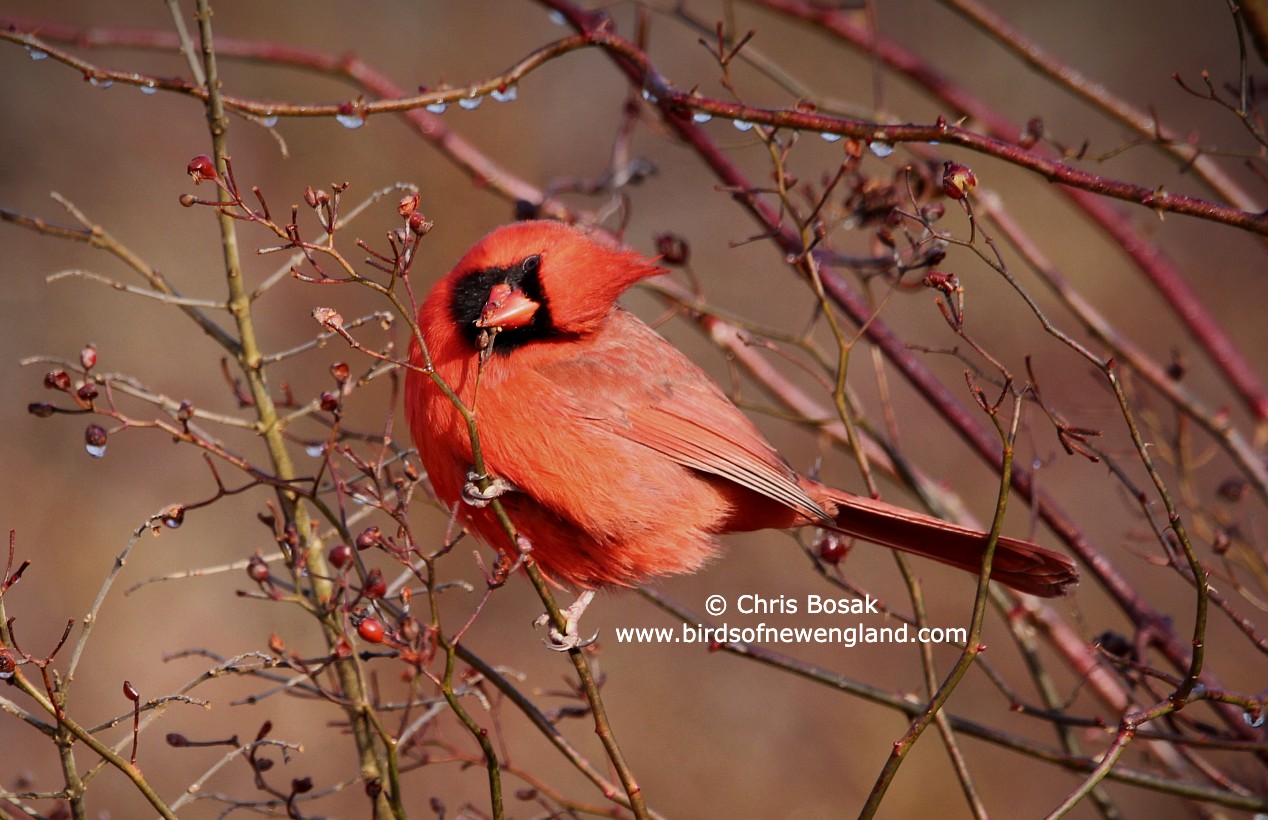
A cardinal eats berries in New England, January 2025.
I’ve seen a ton of robins this winter. On several occasions, I’ve seen them in big numbers attacking bushes and trees and stripping them of fruit.
I’ll always remember the first time I saw this spectacle. It was more than 20 years ago, and I was a relatively new birder. I walked into the woods and the trees were alive with bird life. Birds were darting from tree to tree all around me.
I was finally able to focus on a few and discovered that they were all robins. I was surprised because, at the time, I still thought of robins as spring and summer birds in New England. They are the harbinger of spring, aren’t they?
Photo by Chris Bosak – A hermit thrush in New England, January 2024.
For the past two weeks, I’ve written about surprise winter bird sightings such as the catbirds, hermit thrushes, yellow-bellied sapsuckers and purple finches I’ve seen on my recent walks.
It could be shaping up to be an interesting Great Backyard Bird Count this year with all these birds that typically migrate out of New England still hanging around. Who knows what other surprises will show up on the checklists of birders throughout the region, and the world for that matter?
The 27th annual Great Backyard Bird Count takes place from Friday, Feb. 16 through Monday, Feb. 19. Birders of all skill levels may participate in the Count. Simply count birds – alone or with a group – for at least 15 minutes and enter the birds able to be identified and the location at the GBBC website www.birdcount.org. While the results must be submitted online, the birding itself can take place anywhere: a park, backyard, conservation area.
Photo by Chris Bosak
A fox sparrow perches on the snow in Danbury, Conn., Nov. 16, 2018.
It’s time to help the birds again.
As usual, New Hampshire Audubon’s Backyard Winter Bird Survey and the Great Backyard Bird Count take place on the weekend so you can kill two birds with … oh wait, bad expression. You can help two birds (really all of them) with one walk in the woods. New Hampshire Audubon’s Backyard Winter Bird Survey takes place Saturday, Feb. 13, and Sunday, Feb. 14. Your job is to count birds on those days and submit your results (species and number of individual birds) to the organization to help biologists better understand what is going on with our winter birds. These annual snapshots of data give biologists a broader picture of bird populations and behavior. It helps ornithologists better understand and perhaps find patterns in the winter irruptions of finches and other northern birds. Irruptions are when food scarcity up north drives birds down to New Hampshire and farther south.
This fall and winter have been particularly strong for red-breasted nuthatches. I have two of them visiting every day, and many readers have emailed me to say these cute little birds are visiting them as well. Real data on these birds will be critical to get when submitted by participants of the survey.
Other irruptive species include pine siskin, common redpoll, purple finch, evening grosbeak, pine grosbeak, red-winged crossbill, white-winged crossbill and snowy owl. Are these birds visiting your backyard or favorite place to walk in the woods? Let the New Hampshire Audubon biologists know. Count the common birds as well, of course. That data is just as valuable to have.
The survey is open to everyone, regardless of skill level. Spend an hour or 30 hours counting the birds that weekend and submit your results online at the New Hampshire Audubon website. You may also receive a hard copy of the reporting form and instructions by emailing your name and address to bwbs@nhaudubon.org or calling 224-9909.
While you’re out there (or in there if you’re watching backyard feeders) counting birds, you may as well submit your results to the Great Backyard Bird Count, too. The GBBC started in 1998 as a relatively small initiative to get a snapshot of winter bird populations across the country. It has mushroomed into a global phenomenon with more than 160,000 checklists turned in online worldwide last year. According to GBBC officials, it created the “largest instantaneous snapshot of global bird populations ever recorded.”
The GBBC runs from Friday, Feb. 12, to Monday, Feb. 15. Again, all skill levels are welcome, participation is free and no set time commitment is required. Visit www.birdcount.org for more information and instructions on how to submit results.
What will show up on New Hampshire checklists? It’s hard to say. It’s been a strange winter with a sage thrasher being seen regularly in Hinsdale, boreal chickadees being found on Mount Monadnock far from their northern range, a red-headed woodpecker frequenting Keene and evening grosbeaks showing up everywhere in the Granite State. Have your say and participate in the NH Audubon Winter Bird Survey and GBBC.
I heard from some readers this week who will have some interesting sightings to submit if the birds stick around for a few more weeks. Mimi from Troy reported seeing double-digit numbers of blue jays, chickadees and juncos, as well as several white-breasted nuthatches, red-breasted nuthatches, cardinals, mourning doves, hairy woodpeckers, downy woodpeckers, evening grosbeaks and three eastern bluebirds. The bluebirds have been eating mealworms and suet.
Brian from Keene sent some great photos not related to the winter surveys, but as a follow up to last week’s column about the importance of saving native insects. I had mentioned that fish feed on insects and birds such as herons feed on the fish, hence the important, but sometimes indirect, role insects play in helping birds. Brian sent some photos he took a few years ago of a great blue heron eating grasshoppers. It reminded me of when I watched a green heron eating dragonflies near a pond several years ago. Mark your calendars for next weekend, and let me know what you find out there.
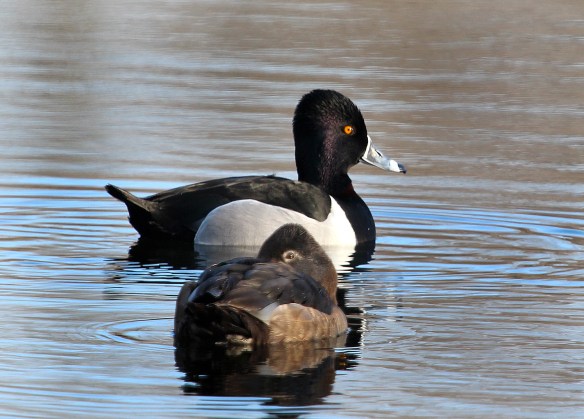
Photo by Chris Bosak A pair of Ring-necked Ducks rest at a pond in Darien, March 2014.
Here is the latest For the Birds column.
I decided to stick to the woods behind my house for the Great Backyard Bird Count. I could have gone off to some nearby birding hot spot to try to log more birds, but I decided to stay put and “bird my patch.”
The action was fairly slow but not terribly so. I didn’t find any out-of-the-ordinary species, but I did get a lot of the common ones. I got my chickadees, titmice, white-breasted nuthatches, downy woodpeckers, red-bellied woodpeckers and American goldfinches. A small flock of pine siskins came to the backyard just as I was wrapping things up. I was glad it arrived for the count as this bird has been a regular visitor all winter.
The highlight of the count for me was checking out the beaver pond at the end of the trail that begins behind my house. The pond was mostly frozen, probably about 85 percent so, but the open water that did exist on the far edge held a lone male hooded merganser and nine ring-necked ducks.
Did I say nine? I meant to say 12. No, make that 13. When getting a precise number of birds is important, such as when doing a bird census like the Great Backyard Bird Count, it is important to check and double check the diving ducks.
When I first looked at the ring-necked ducks, I counted nine. I moved along the edge of the pond to change my angle and suddenly I counted 12. I watched for another minute and another duck popped up its head to make 13. I watched carefully for another couple minutes and the number stayed at 13.
Ring-necked ducks are one of the more common diving ducks we see in New England during the winter. Diving ducks are the ones that, true to the description, dive underwater for their prey such as fish and crustaceans. The other types of ducks are dabblers and they simply tip up and stick their heads in the water in their search for food.
Most of our very common ducks are dabblers. Mallards, black ducks, wood ducks and teal are all dabblers. The divers include species such as the mergansers, bufflehead, goldeneye, and, as mentioned, ring-necked ducks.
Dabblers are sometimes difficult to count because there can be so many of them they tend to crowd each other out. But at least you can always see them. They don’t “disappear” underwater.
When you approach a pond and see a flock of divers, you never know whether you are looking at all of them or not. Not that it would have made a whole lot of difference in the grand scheme of things if I had submitted 12 ring-necked ducks, or even my original count of nine, for that matter. But, of course, I was trying to be as accurate as possible so I’m glad I was able to submit the correct number.
All in all, it was a fun count with a decent number of species. How did you do? Feel free to send me an email and let me know.
For more information and international results of the Great Backyard Bird Count, click here.
Photo by Chris Bosak A white-breasted nuthatch sits on a bird-shaped birdfeeder during the winter of 2016-17 in Danbury, Conn.
As promised, here are the results of my Great Backyard Bird Count experience this morning. It wasn’t overly successful in terms of finding birds, but it wasn’t too bad either. At any rate, all checklists are valuable, so my 2019 GBBC list is in. Not that participants are limited to one checklist, and I may just do another one tomorrow as the Count runs through Monday.
My species list included: black-capped chickadee, tufted titmouse, white-breasted nuthatch, downy woodpecker, red-bellied woodpecker, dark-eyed junco, pine siskin, American goldfinch, hooded merganser, and ring-necked duck. The waterfowl, of course, I spotted at the pond at the end of the trail behind my house. The pond is 85 percent frozen, but open just enough to hold a small flock of ring-necks.
Since my species list wasn’t so great, here are photos of each bird I saw today. (Note: The photos were not taken today, but these are “file photos.”) Continue reading →
A Red-breasted Nuthatch perches near a bird feeding station in Danbury, Conn., Oct. 2016.
There is still time to participate in the Great Backyard Bird Count. In fact, in recent years the Count has been extended through Monday — so no excuses. It’s a beautiful day in New England (at least where I am) and I’m eager to head out right after making this post. I’ll let you know what I find later today or tomorrow. As always, feel free to send me your highlights.
Remember, if you see a ton of birds or only a few (or none), it’s all good data. Don’t fail to submit results just because you think it was an “unsuccessful” bird walk. Click here for my recent column on that matter.
Many people are concerned that they are not seeing chickadees at their feeder this winter. This is your chance to contribute to data that may help scientists determine if, indeed, there is a problem.
All the information about the GBBC and how to submit your results may be found by clicking here.
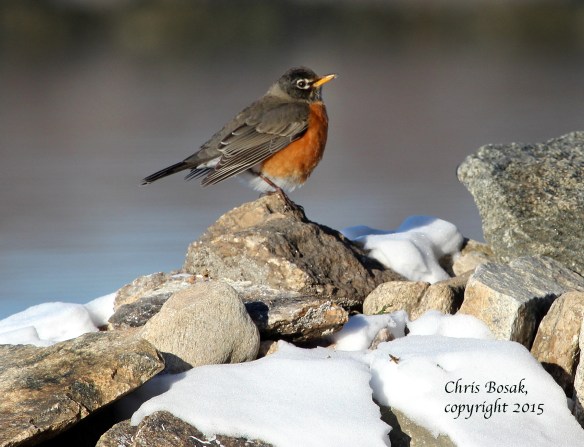
Photo by Chris Bosak An American Robin perches on a rock at Weed Beach in Darien, Conn., in Jan. 2015. Flocks of robins often show up during winter bird counts
I am guilty. I admit it.
Even though I have preached in this column before about the importance of participating in citizen science studies and turning in results, whether those results are good or bad, I often do not submit my “bad walks.”
Take eBird, for example.
Even though it would valuable to report all of my walks to this online bird database, I often submit only results for the walks that yield unique or plentiful species. I saw only two chickadees and a turkey vulture flyover, I say to myself. How is that data going to be valuable?
In reality, that data is just as valuable as the results I turn in when the birding is good. Scientists who track this data need to know what’s going on out there at all times, not just when a lot of birds are around.
Is there a problem brewing with a certain species? Biologists will never know Continue reading →
Photo by Chris Bosak A Tufted Titmouse and White-breasted Nuthatch share a feeder during a snowstorm in Danbury, Conn., Jan. 23, 2016.
Here’s the latest For the Birds column, which runs weekly in The Hour (Norwalk, Conn.) and Keene (NH) Sentinel:
…
One of my favorite times to watch birds is when the snow is falling. Not a driving snow with icy temperatures and high winds, but an otherwise rather pleasant day with frozen crystals falling from the sky and covering everything with a fresh coat of white.
I do not shy away from taking walks to look for birds when the snow is actively falling, in fact I thoroughly enjoy walks at such times. But I also enjoy very much watching the activity at the feeders during snow falls.
As long as the snow is not falling at too fast a rate, the birds will continue coming to feeders. Indeed, during light and moderate snow falls the birds may be seen at higher-than-usual …
New York, NY, Ithaca, NY, and Port Rowan, ON–Participants from more than 100 countries submitted a record 147, 265 bird checklists for the annual Great Backyard Bird Count and broke the previous count record for the number of species identified. The 5,090 species reported represents nearly half the possible bird species in the world. The four-day count was held February 13-16, the 18th year for the event which is a joint project of the Cornell Lab of Ornithology and the National Audubon Society with partner Bird Studies Canada.
The information gathered by tens of thousands of volunteers helps track the health of bird populations at a scale made possible by using the eBird online checklist program. A sampling of species found by intrepid counters include Ibisbill in India, Bornean Bistlehead in Malaysia, and Continue reading →
Photo by Chris Bosak A female Bufflehead swims in Darien.
I hit Weed Beach this morning for the Great Backyard Bird Count. The woods were fairly quiet, but the water offered some good birds. Some of the highlights were about a dozen Black-capped Chickadees, some American Robins, a Northern Mockingbirds, several Red-breasted Mergansers, a few Gadwall, dozens of American Black Ducks, dozens of Bufflehead and a couple Common Goldeneye.
So what was on your list? Feel free to comment below.