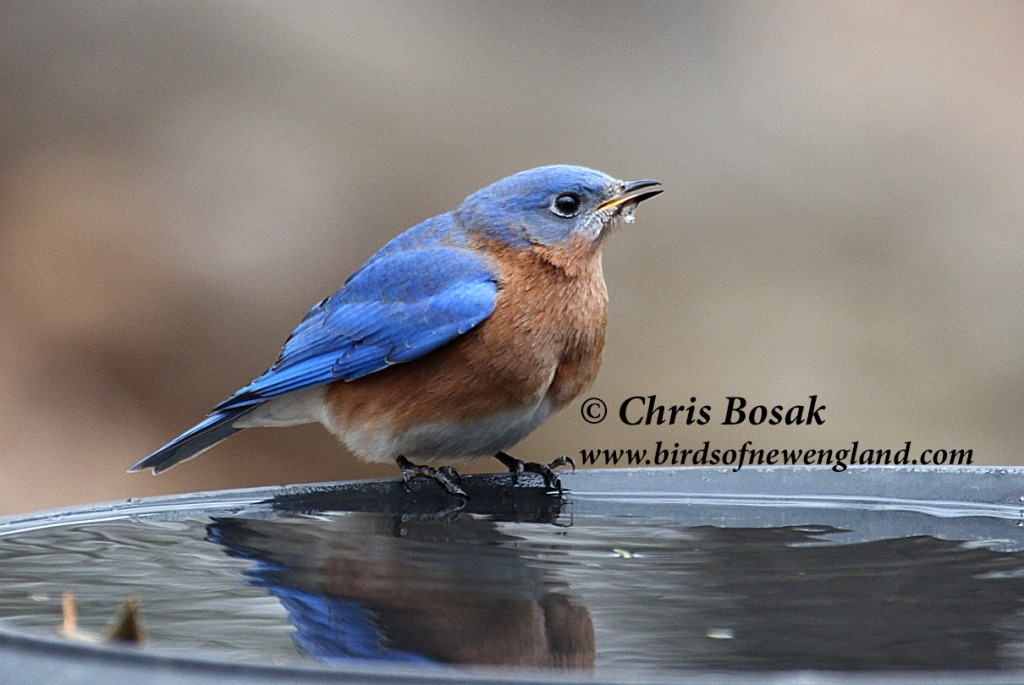
There will be more on this coming next week when the next For the Birds column is posted here, but here’s a teaser photo to get you through a weekend of isolation. Moral of the story in short: offer water to the birds too.

There will be more on this coming next week when the next For the Birds column is posted here, but here’s a teaser photo to get you through a weekend of isolation. Moral of the story in short: offer water to the birds too.

A few weeks ago, I wrote about coming across a sumac patch being invaded by black-capped chickadees. I included only one photo with that post, which is not like me at all. So, here are some more photos from that day.
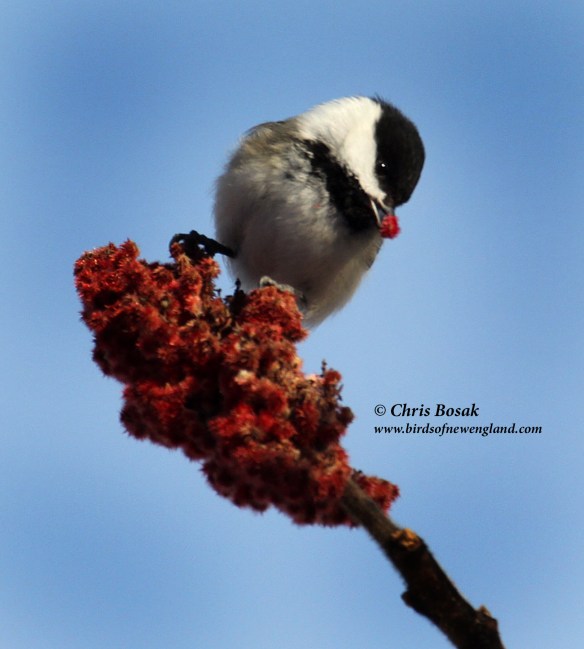

Here is the latest For the Birds column, which runs weekly in several New England newspaper.
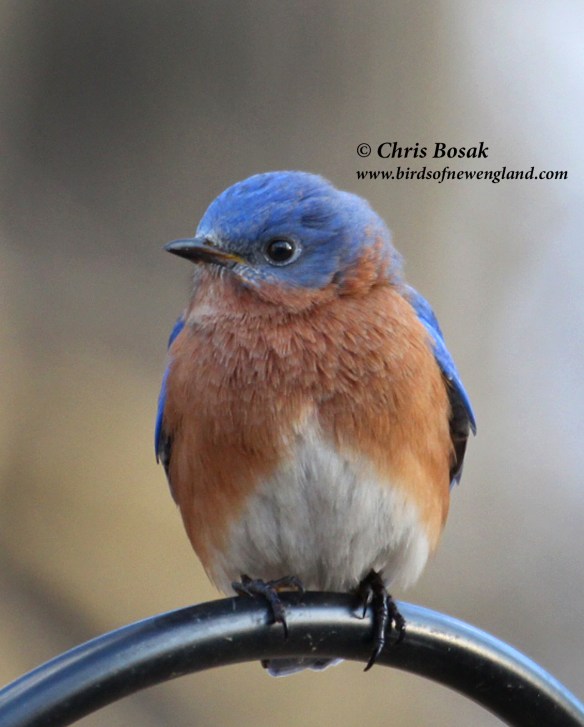
Sorry, but I have to go back to writing about bluebirds. After several weeks of writing about bluebirds that other people had in their yards, I finally got some of my own.
I would imagine no apology is necessary, however, as who doesn’t like to hear, read and talk about bluebirds?
I walked into my sunroom and saw through the window just a flash of a bird out of the corner of my eye. The bird had been perched on one of the arms of the feeder pole system and disappeared into woods behind my house.
That was a bluebird, I know it, I told myself, even though I got only the shortest of looks in my peripheral Continue reading

For a cold February day, it’s been a pretty good day at the feeder. In all, 14 species showed up already and it’s not even noon. The pileated woodpecker was in the side yard, not at the feeders. I took the photo through a dirty, hence the poor quality. Here’s some photographic evidence of the busy day: Continue reading

The temperature when we started our walk was a whole 1 degree Fahrenheit. That number, however, was slowly climbing and there wasn’t a hint of wind to speak of. The sun was shining brightly, and the sky was as blue as you can imagine. In other words, a perfect day to spend several hours outside.
I was visiting my brother in upstate New York near the Vermont border, and two other brothers from out of town were there as well. Paul and I took a relatively short and absolutely birdless walk before returning to Gregg’s house. We both commented on how the single-digit temperatures were having little effect on us because it was a deadly calm day. So why go back inside just because the walk is over?
Gregg lives near an expansive field bordered by woods so Paul opened the hatch to his car and broke out a bag of flying discs. One of his hobbies is disc golf and he’s always Continue reading

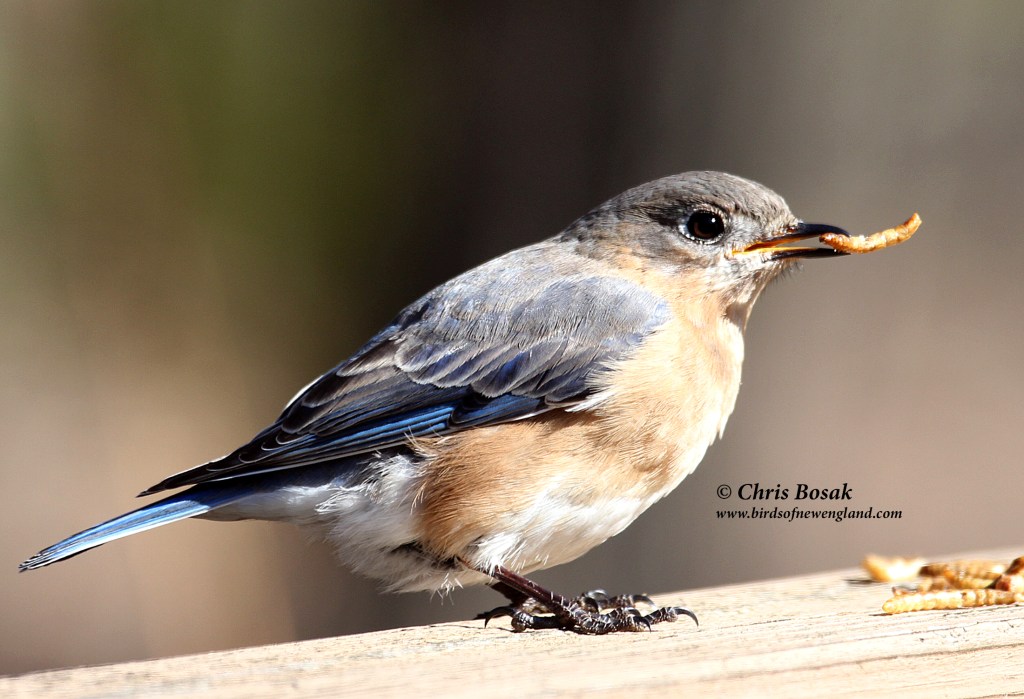
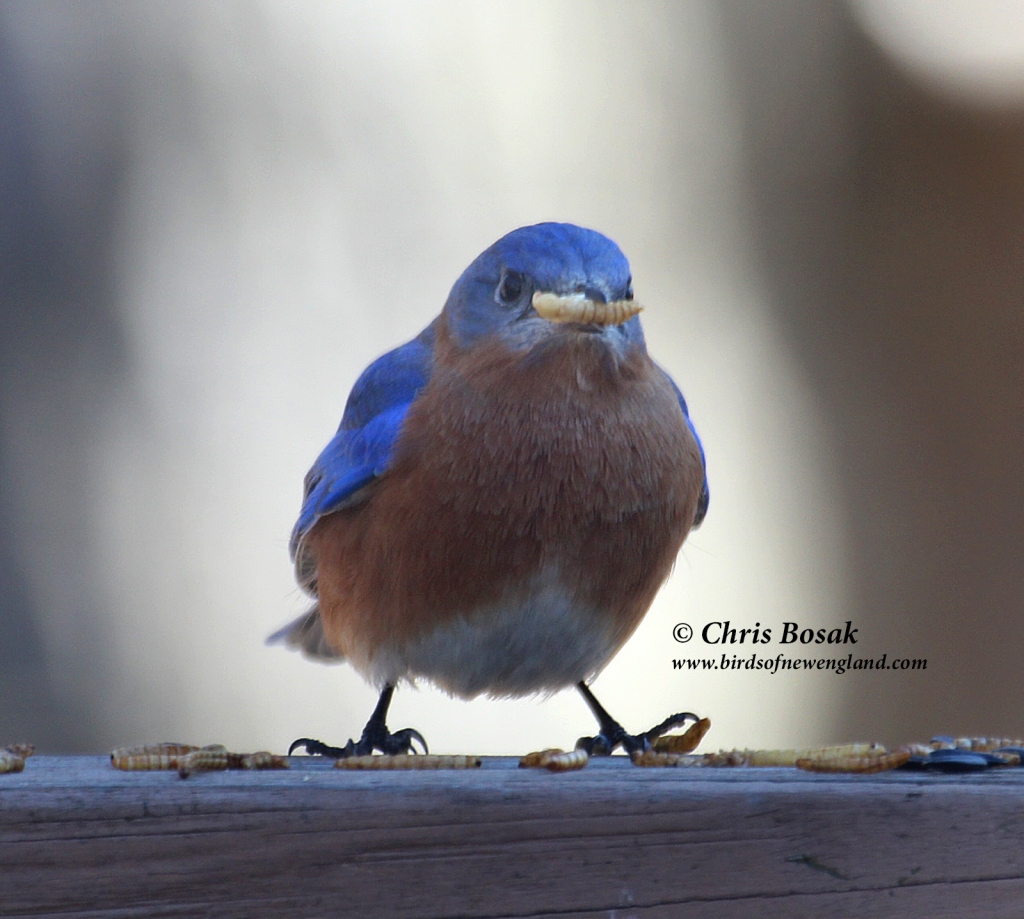
After several weeks of writing about eastern bluebirds that other people have seen, I finally got a few of my own this weekend. I caught a glimpse of one flying away from my feeding station that includes suet, sunflower seeds and Nyjer seed. My guess is that the bird flew away disappointed as mealworms are their favorite food (at least in terms of backyard feeding.) So, of course, I rushed out there with a handful of mealworms and spread them out on the deck railing. Within half an hour a male and female bluebird were enjoying the dried morsels.
More on this to come! In the meantime, here are a few more shots. Also, feel free to look back on some past posts on this site to see how this has become the Winter of the Bluebird in New England.
Here is the latest For the Birds column, which runs in several New England newspapers. Thanks for checking it out …

The word typical often has a negative connotation.
It is usually used to describe something boring or mundane. “Just a typical day at the office.” Or worse, as a word of exasperation to draw attention to a recurring negative behavior: “He said what? Oh, that’s so typical of him.”
But I’m going to use typical in a positive way here. After all, Thanksgiving is a fresh memory, the holiday season is upon us, and 311 is my favorite band. The band encourages “positivity” and closes its concerts with “Stay positive. Love your life.” So I will do that here with the word typical.
The other day, all the “typical” birds showed up at my feeder. And that’s a good thing.
My typicals include black-capped chickadees, tufted titmice, white-breasted nuthatches, downy woodpeckers, red-bellied woodpeckers and blue jays. You can throw juncos in there, too, during the winter — and late fall as they have already arrived.
Other birds visit from time to time, but those are the birds that are always here. Many people have written to me lately about a lack of chickadees at their feeders. It’s definitely a trend to keep an eye on, but thankfully, I still have plenty of chickadees visiting my feeders. I still haven’t solved the mystery as to why so many people are experiencing a scarcity of chickadees, but I can tell you that I see them often.
I’m not trying to be boastful about my feeders or the fact that I see a lot of chickadees. There are some obvious bird species that I hardly ever see in my backyard.
Cardinals, for whatever reason, are rare sightings at my feeders. I see them all the time in the bushes along the sides of the road when I am driving through the neighborhood, but they avoid my yard like the plague.
Although I get more than my share of juncos in the winter, I rarely see white-throated sparrows — a usual accompaniment of juncos. At my previous houses, white-throated sparrows were a common winter occurrence and easily outnumbered all other winter birds. Here, I barely see them. I’ve seen more fox sparrows here than white-throated sparrows and that’s just plain odd.
I do see a ton of chipping sparrows in the spring and summer, but not enough to add them to my typical list. I am lucky enough to get good numbers of rose-breasted grosbeaks each spring, but their length of stay is too short to make the list. I do enjoy that short window each year, though.
Ruby-throated hummingbirds miss the cut by the barb of a feather. I see them daily from late April until the end of September, but I couldn’t bring myself to include a bird that is not a year-round New Englander. The hummingbirds are off sunning themselves and gorging on insects in Costa Rica or thereabouts, not like the chickadees, titmice and nuthatches that visit me daily regardless of the temperature.
I don’t just give out the title of “typical” to anything, you know.

The word typical can have a negative connotation. It is usually used to describe something boring or mundane. Or worse, as a word of exasperation to draw attention to a recurring negative behavior: “Oh, that’s so typical of him.”
But I’m going to use typical in a positive way here. Yesterday, all the typical birds showed up at my feeder. And that’s a good thing. My ‘typicals’ include chickadees, titmice, white-breasted nuthatches, downy woodpeckers, red-bellied woodpeckers, and blue jays. You can throw juncos in there, too, in the winter. Other birds come from time to time, but those are the birds that are always there. Many people write to me about a lack of chickadees at their feeders lately. It’s definitely a trend to keep an eye on, but thankfully, I still have plenty of chickadees visiting my feeders.
Not that I’m boasting about my feeders. There are some obvious bird species that I hardly ever see. Cardinals, for whatever reason, are Continue reading

My friend Ellen was excited to show me her new Canan f2.8 lens with a range of 70 to 200mm. She asked if I wanted to borrow it for a week and I said yes (of course). With 200mm as the maximum zoom, its capability as a wildlife photography lens is limited, but still very useful for some circumstances. Many of the days were overcast and that made the 2.8 aperture very handy. It is also a high-quality lens so even subjects that are a bit distant will still be sharp.
I experimented with the lens mostly in the backyard where I know I have a steady supply of subjects near the birdfeeders. White-breasted nuthatches turned out to be the best subjects as they perched in a tree close to the feeders before coming to get a seed. Here are some of the results. Continue reading

I heard a loud banging from my side yard the other day. I assumed a neighbor was doing some work involving a hammer as noises echo and carry far in the small lake community in which I live.
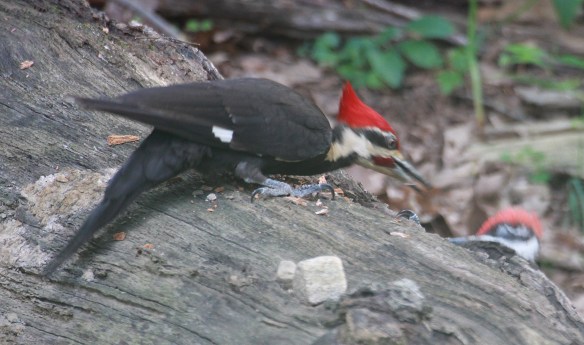
Like any good, nosy neighbor, I stepped onto the deck to see what was going on. The noise was coming from the edge of the woods and it wasn’t a neighbor with a hammer at all, it was four pileated woodpeckers looking for a meal. The main noisemaker was the adult male who was banging away on a tree trunk that had fallen to the ground many, many years ago. He was perched on top of the trunk and a young male was a few feet away on the ground watching his dad go to work. An adult female and another youngster (I couldn’t tell the gender) were working on the trunks of nearby standing trees.
Twice, the adult male found an insect or worm and stretched its neck toward the youngster to offer the morsel. The youngster, of course, accepted. The daddy pileated woodpecker worked its way along the fallen trunk and eventually flew to the nearby trunk where the mother was busy looking for meals. The young male took his father’s place atop the fallen trunk and started pounding some holes of his own. I couldn’t tell if he was successful or not, but he certainly learned a thing or two by watching his parents at work.
Male and female pileated woodpeckers have red heads. Only males have the red “mustache” extending from the bill.
Here’s one of the adult feeding the youngster. I was a fair distance away and didn’t want to get closer and risk breaking up the family group, hence the poor quality of the photo.
 Birds of New England.com