Bluebirds are back at Mather Meadows

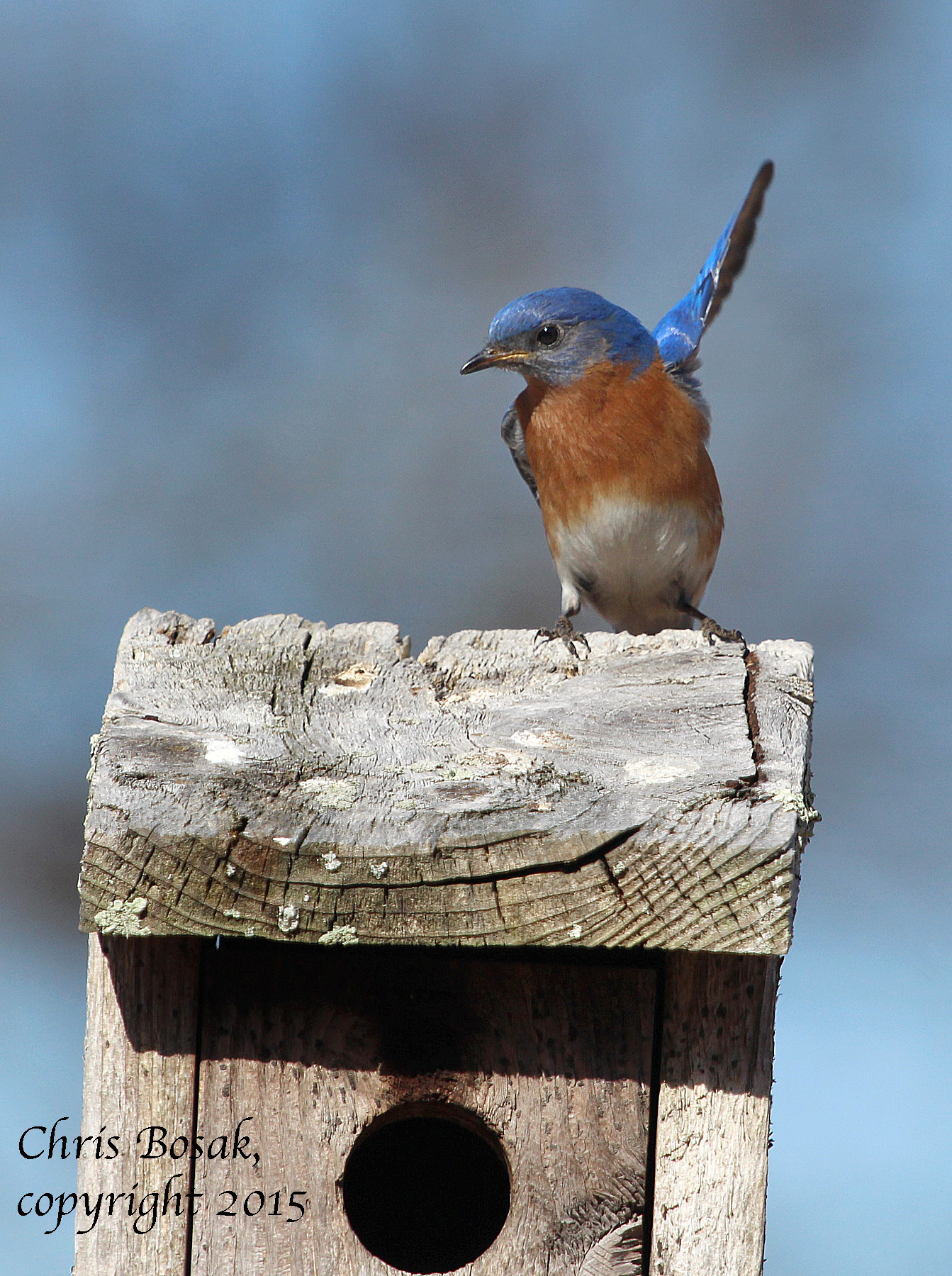
Photo by Chris Bosak An Eastern Bluebird stretches a wing as it rests on a birdhouse at Mather Meadows in Darien, Conn., April 2015.

Photo by Chris Bosak
An Eastern Bluebird stretches a wing as it rests on a birdhouse at Mather Meadows in Darien, Conn., April 2015.

Last spring I had a post on this site featuring a pair of Eastern Bluebirds at Mather Meadow, a property of the Darien Land Trust. This weekend I paid a visit to the property again and, sure enough, the bluebirds are back. I checked quickly and noted four blue eggs in the house. It’s so good to see them nesting there year after year. It wouldn’t have been possible without the hard work and determination of so many people at the Darien Land Trust. If the property (which is largely critical meadow property)  Continue reading

Bluebirds — the bird of winter 2014-15?

Elena from Winchester, N.H., got this shot of Eastern Bluebirds at her warm-water birdbath during the cold snap of Feb. 2015.

Elena from Winchester, N.H., got this shot of Eastern Bluebirds at her warm-water birdbath during the cold snap of Feb. 2015.

Here’s my For the Birds column from last week. Since I wrote it I have received a few more emails from readers who have seen bluebirds this winter. In fact, one reader wrote to say he saw seven Eastern Bluebirds pile into a single birdhouse to stay warm. (Note, the above photo was taken by a reader from New Hampshire).

….

It seems that every winter has its bird. Last year, of course, it was the Snowy Owl. A few years ago it was the Common Redpoll and, before that, the Pine Siskin.

Every year it seems a certain species of bird “irrupts” into New England and sets the birding world abuzz. An irruption is when birds come to a region in large numbers, presumably because their food source is scarce on their typical wintering grounds. The term usually refers to northern birds, especially finches, coming south for the winter.

I can remember a winter when the Dark-eyed Junco was bird of winter. We see them every winter in New England, but during this particula Continue reading

Clearing out my 2014 photos, take 9: Black-capped Chickadee

Photo by Chris Bosak A Black-capped Chickadee clears out a cavity in a tree for a nesting site at Selleck's/Dunlap Woods in Darien in spring 2014.

Photo by Chris Bosak
A Black-capped Chickadee clears out a cavity in a tree for a nesting site at Selleck’s/Dunlap Woods in Darien in spring 2014.

Here’s my next photo in the series of 2014 photos that I never got around to looking at and posting.

Admittedly not a great shot technically, but interesting to see a Black-capped Chickadee exiting a potential nesting hole with a bill full of dead wood shavings. A pair of chickadees worked their tails off getting this cavity ready for the nesting season. I’m not sure if they actually saw this whole project through or not. I kind of hope not because the tree was dead and pretty flimsy. I’m not sure it was strong enough to withstand some of the storms we get here in New England. I’m sure the birds know what they are doing. At any rate, chickadees first excavate a cavity and then build a small nest of materials such as moss to soften the bottom of the home.

Purple Martins banded at Sherwood Island

Photo by Chris Bosak A volunteer from Department of Energy and Environmental Protection holds a young Purple Martin while she identifies the age during a Purple Martin banding event held Thursday, July 10, 2014, at Sherwood Island State Park in Westport, Conn.,

Photo by Chris Bosak
A volunteer from Department of Energy and Environmental Protection holds a young Purple Martin while she identifies the age during a Purple Martin banding event held Thursday, July 10, 2014, at Sherwood Island State Park in Westport, Conn.,

Sometimes fun news assignments come across our offices at The Hour newspaper. If it has to do with birds it usually ends up being forwarded to my email address by everyone else who receives it. Not that I mind, of course.

Photo by Chris Bosak A volunteer from Department of Energy and Environmental Protection holds a young Purple Martin while she identifies the age during a Purple Martin banding event held Thursday, July 10, 2014, at Sherwood Island State Park in Westport, Conn.,

Photo by Chris Bosak
A volunteer from Department of Energy and Environmental Protection holds a young Purple Martin while she identifies the age during a Purple Martin banding event held Thursday, July 10, 2014, at Sherwood Island State Park in Westport, Conn.,

Such was the case this week when the Friends of Sherwood Island (a state park in Westport, Conn.) sent a release announcing a Purple Martin banding project. I attended the event, of course, and marveled as staff and volunteers from state Department of Energy and Environmental Protection and Friends of Sherwood Island took young martins from their nest, fitted them with bands, weighed and measured them, recorded data and returned them to the nests.  As all this was going on, the adult martins fearlessly and undaunted continued to hunt for insects to bring back to the colony.

I even got to return five baby Purple Martins to their gourd. It was the first time I’ve ever held a Purple Martin. Very cool.

For the complete story and photos from The Hour photographer Erik Trautmann, click here.

Guarding their gourd

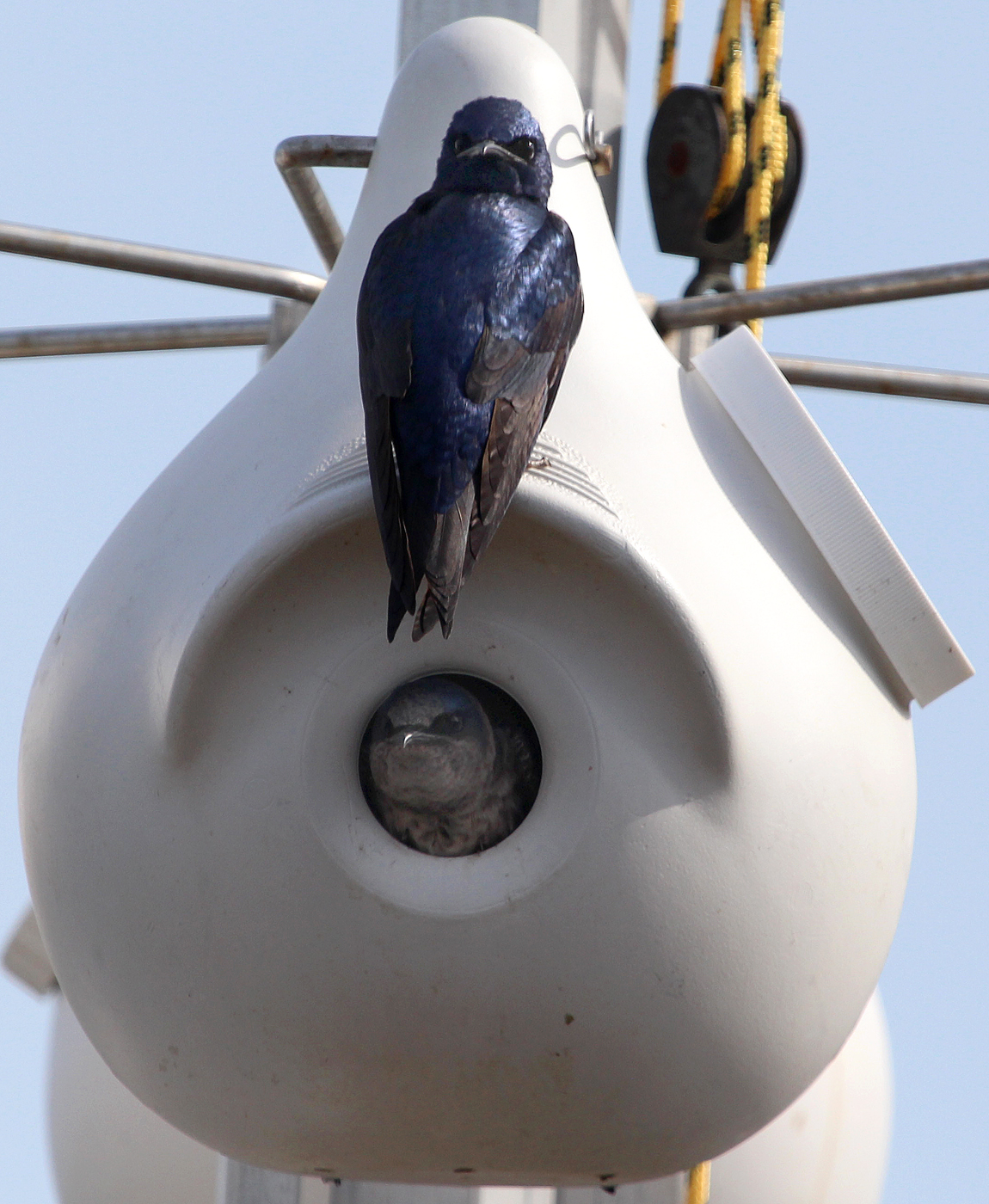
Photo by Chris Bosak Purple Martins stand guard on their gourd homes in Milford, Conn., May 2014.

Photo by Chris Bosak
Purple Martins stand guard on their gourd homes in Milford, Conn., May 2014.

Here’s a shot I took of a Purple Martin pair a few weeks ago keeping watch at their gourd as part of the colony at Milford Point. Purple Martin colonies are excellent for insect control in people’s yards, but the conditions need to be just right to attract them.

On the East Coast, Purple Martins are completely dependent upon human-offered housing.

Check out this website for more information on attracting them.

PurpleMartin.org

Help protect shorebirds on the beaches this Memorial Day Weekend

Photo by Chris Bosak An American Oystercatcher walks along the beach at Coastal Center at Milford Point this spring.

Photo by Chris Bosak
An American Oystercatcher walks along the beach at Coastal Center at Milford Point this spring.

Photo by Chris Bosak Piping Plover at Coastal Center at Milford Point, April, 2014.

Photo by Chris Bosak
Piping Plover at Coastal Center at Milford Point, April, 2014.

I’ve been volunteering to monitor shorebirds at a Connecticut beach this spring. This involves looking for Piping Plovers, American Oystercatchers and other birds that rely on coastal areas to raise their families. I’ve found several nests of plovers and oystercatchers and it’s a thrill to know they are using our beaches to raise the next generation of shorebirds. The areas are roped off and nests are further protected by fencing.

Until now, traffic has been fairly light on the beaches. A few beach walkers, some with dogs on leashes, are all I’ve come across. (Of course I monitor the birds on Monday mornings, so beach traffic is expected to be light.) But with the Memorial Day weekend upon us, beach traffic will increase tremendously — just at a time when the birds are most vulnerable with eggs and babies to take care of.

Photo by Chris Bosak Piping Plover egg. Plovers typically lay four eggs in their nest, which is nothing more than a small depression in the ground.

Photo by Chris Bosak
Piping Plover egg. Plovers typically lay four eggs in their nest, which is nothing more than a small depression in the ground.

When you visit beaches this weekend and throughout the summer, please keep in mind that shorebirds may be nesting nearby and to give them a wide berth. The most vulnerable areas along our beaches are roped off, so mind the barriers and keep dogs on leashes (if dogs are even allowed at your favorite beach.) The crowded beaches are not likely to have nesting shorebirds, but be mindful when visiting the less traveled coastal areas.

Thank you and have a great weekend.

Here’s more information from the American Bird Conservancy on protecting shorebirds.


The robins have hatched! Most of them anyway

Right outside my front door is this American Robin nest. I’ve been checking it for the last couple weeks.
Finally this afternoon, there are little babies, with one more to go.
Here’s an iPhone photo of the youngins.

20140521-184651-67611064.jpg

Love those bluebirds (plenty of photos)

Photo by Chris Bosak Eastern Bluebird at Mather Meadows, a property of the Darien (Conn.) Land Trust.

Photo by Chris Bosak
Eastern Bluebird at Mather Meadows, a property of the Darien (Conn.) Land Trust.

Eastern Bluebirds are nesting again at Mather Meadows, a property of the Darien (Conn.) Land Trust. Here are some photos I took during a quick visit on Tuesday morning. (More photos below — click on “continue reading.”)

Eastern Bluebirds have made a strong comeback following a decline due to several factors, including competition for nesting sites with introduced species such as House Sparrows and European Starlings. The comeback has been bolstered in large part to humans offering nesting sites to bluebirds, a.k.a bluebird houses. The houses are built to specific dimensions, including the entry/exit hole sized to keep out sparrows and starlings. Bluebirds still face competition for those homes from Tree Sparrows, but the competition is not as fierce.

Continue reading

Purple Martins arrive in New England

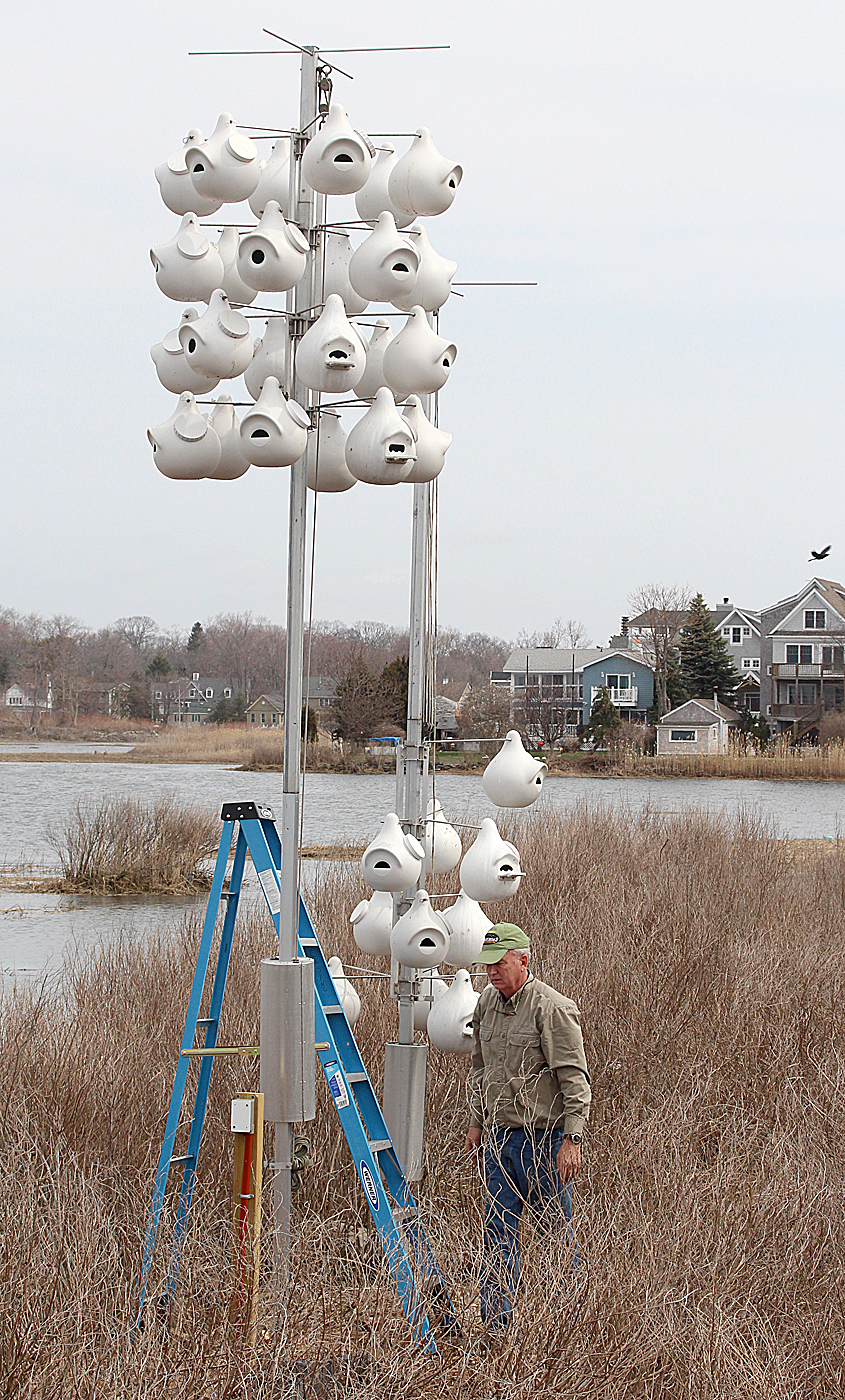
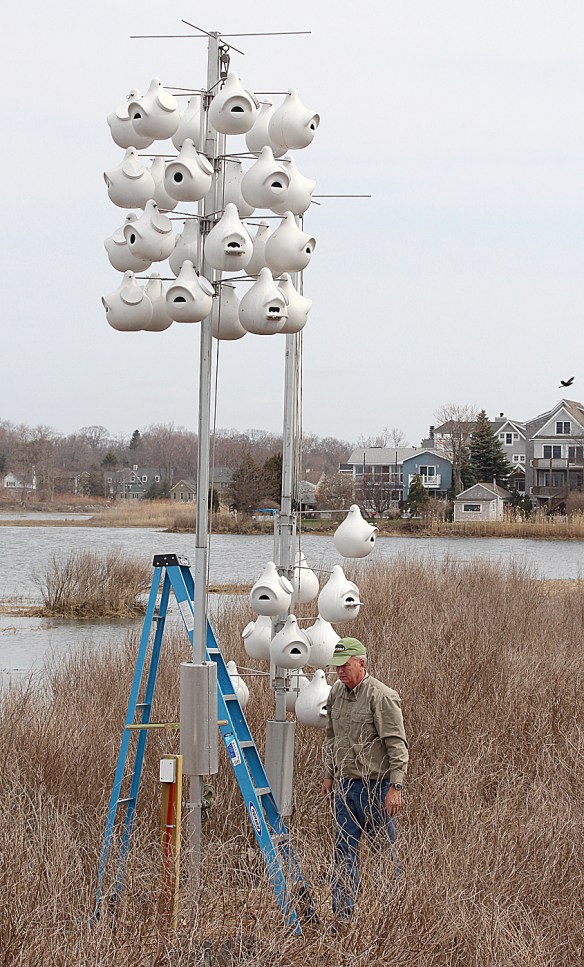
Contributed photo Milan Bull, Senior Director of Science and Conservation at Connecticut Audubon, sets up the Purple Martin gourds at the Coastal Center at Milford Point on Monday, April 14, 2014.

Contributed photo
Milan Bull, Senior Director of Science and Conservation at Connecticut Audubon, sets up the Purple Martin gourds at the Coastal Center at Milford Point on Monday, April 14, 2014.

It’s Purple Martin season in New England! Last week I ran into David Winston and Patrick Duggan putting up the Purple Martin gourds at Cove Island Park in Stamford. On Monday, after finishing my volunteer Piping Plover monitoring duties at the Coastal Center at Milford Point (CT), I ran into Milan Bull of Connecticut Audubon putting up the gourds there.

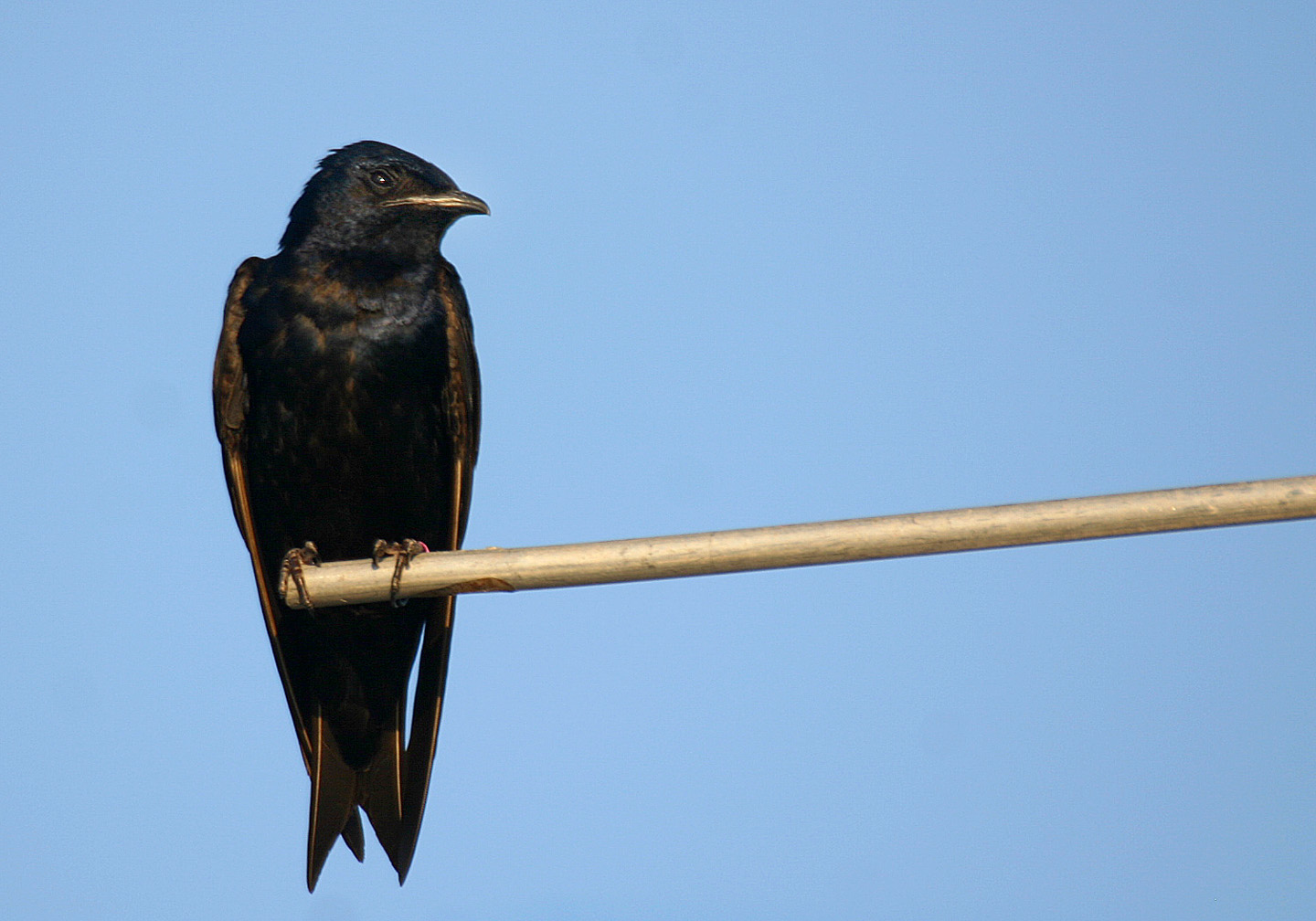
Purple Martin at Cove Island in Stamford.

Purple Martin at Cove Island in Stamford.

The Purple Martins had already arrived and many perched on the poles as Milan worked underneath to get the gourds ready. I even got my hands dirty and helped him out a bit (of course, he was nearly done by the time I got there.)

Purple Martins will return to the same site year after year, so if you were successful in getting Purple Martins last year, get your gourds or houses up soon. If you were not successful last year, or are trying for the first time this year, you can get the houses up now, or wait a few weeks. Younger birds seeking to start a new colony will arrive throughout the next several weeks, or even months. Just keep an eye on the gourds or houses for House Sparrows. Remove the nests if House Sparrows take up residence.

I’m far from an expert in attracting Purple Martins, so for more detailed information about Purple Martins, I’ll refer you to this site: http://www.purplemartin.org/

Thanks for visiting http://www.birdsofnewengland.com

Time to clean the bird houses

Darien Land Trust member Denis "Den" Frelinghuysen removes a Tree Swallow nest from a bird house at Mather Meadows as Darien Land Trust Executive Director Shirley Nichols looks on in this Nov. 23, 2013, photo.

Darien Land Trust member Denis “Den” Frelinghuysen removes a Tree Swallow nest from a bird house at Mather Meadows as Darien Land Trust Executive Director Shirley Nichols looks on in this Nov. 23, 2013, photo.

If you haven’t already, this is a good time to clean the bird houses. Birds will still use the houses for winter shelter without the nests. Old nests hold a variety of parasites and could be harmful to the birds in the spring. Cleaning the boxes will also give you the opportunity check if any unwanted visitors have used the house, such as wasps.

In the above photo, Darien Land Trust member Denis Frelinghuysen removes a Tree Swallow nest from a box at the Mather Meadows property in the northern part of Darien. Land Trust Executive Director Shirley Nichols looks on.