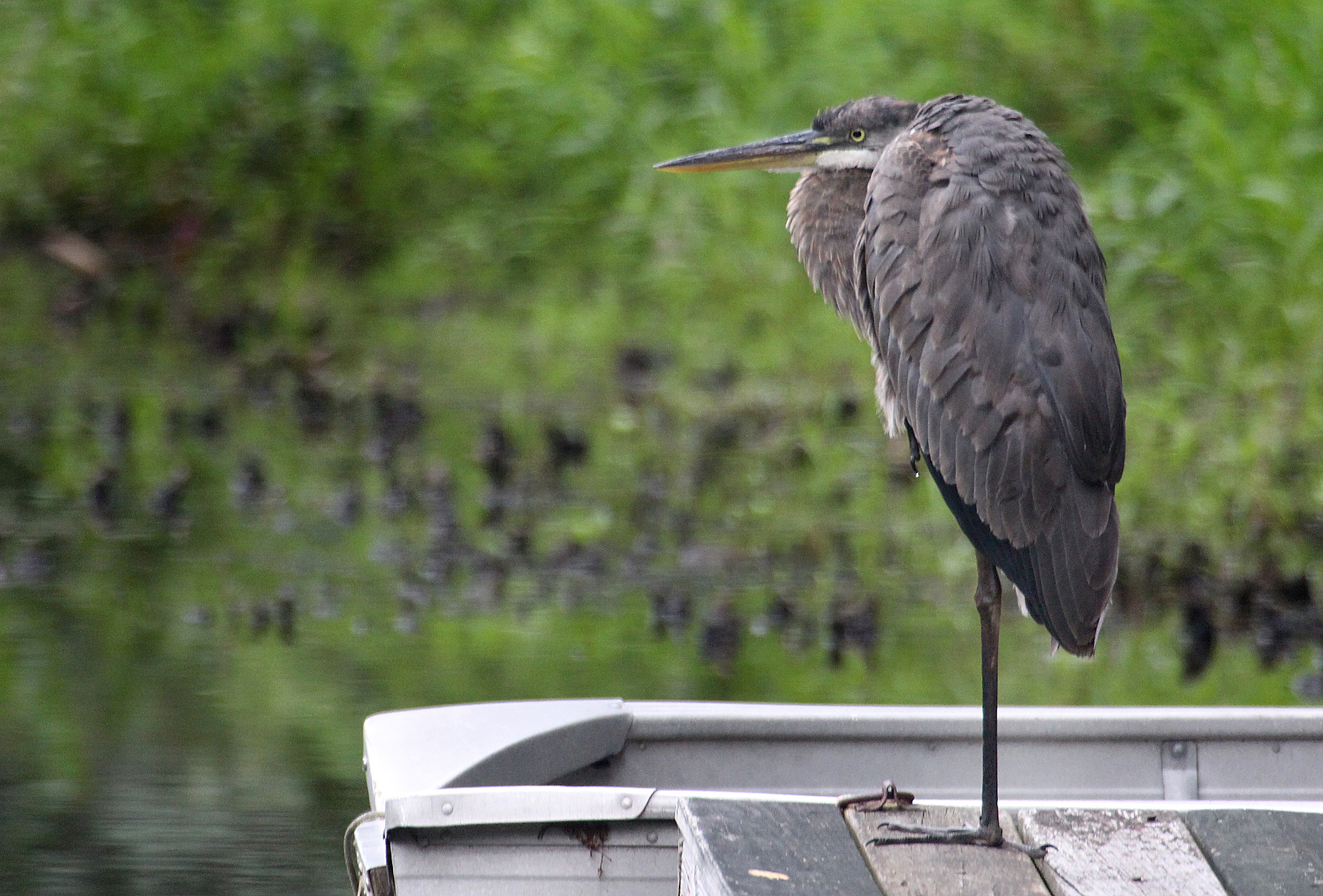
Photo by Chris Bosak A great blue heron stands on a dock.
Even when nothing out of the ordinary is seen, walks in nature are still valuable and memorable.
While my recent walks haven’t been full of extraordinary sightings, many moments stick out in my mind as enduring.
Here are a few:
A friend and I were taking a walk in a large conservation area dominated by wide swaths of fields. Thank goodness for those areas because birds such as bobolinks need that habitat to nest. While bobolinks were indeed plentiful, another sighting remained with me from that walk.
We were about to round a corner of the path that cuts through the field when we noticed something on the trail ahead. It was large and dark, and I thought at first it was a mammal such as a groundhog. Then I thought it was a turkey. Finally, my eyes and mind started to work together, and I realized it was a turkey vulture.
I could tell from its movements that it was eating something. Why else would a turkey vulture be sitting on the edge of a trail in the middle of a field? I peered through the binoculars and noticed the vulture was eating a dead snake. I tried to determine what type of snake it was, but I couldn’t get a clear enough view. It’s highly unlikely that the vulture killed the snake, but rather a hawk, kestrel or some other large predator.
As a supplemental sighting to that one, a second turkey vulture was perched behind us in a snag. It had gone unnoticed until we walked past it. Our heads turned when it flew off its perch and left the dead branch bouncing up and down like that old drinking bird toy. We heard its wings as it flapped past us. A resident red-winged blackbird did not take kindly to the circumstance and chased after the vulture rather aggressively. The vulture rose quickly, which seemed to satisfy the blackbird.
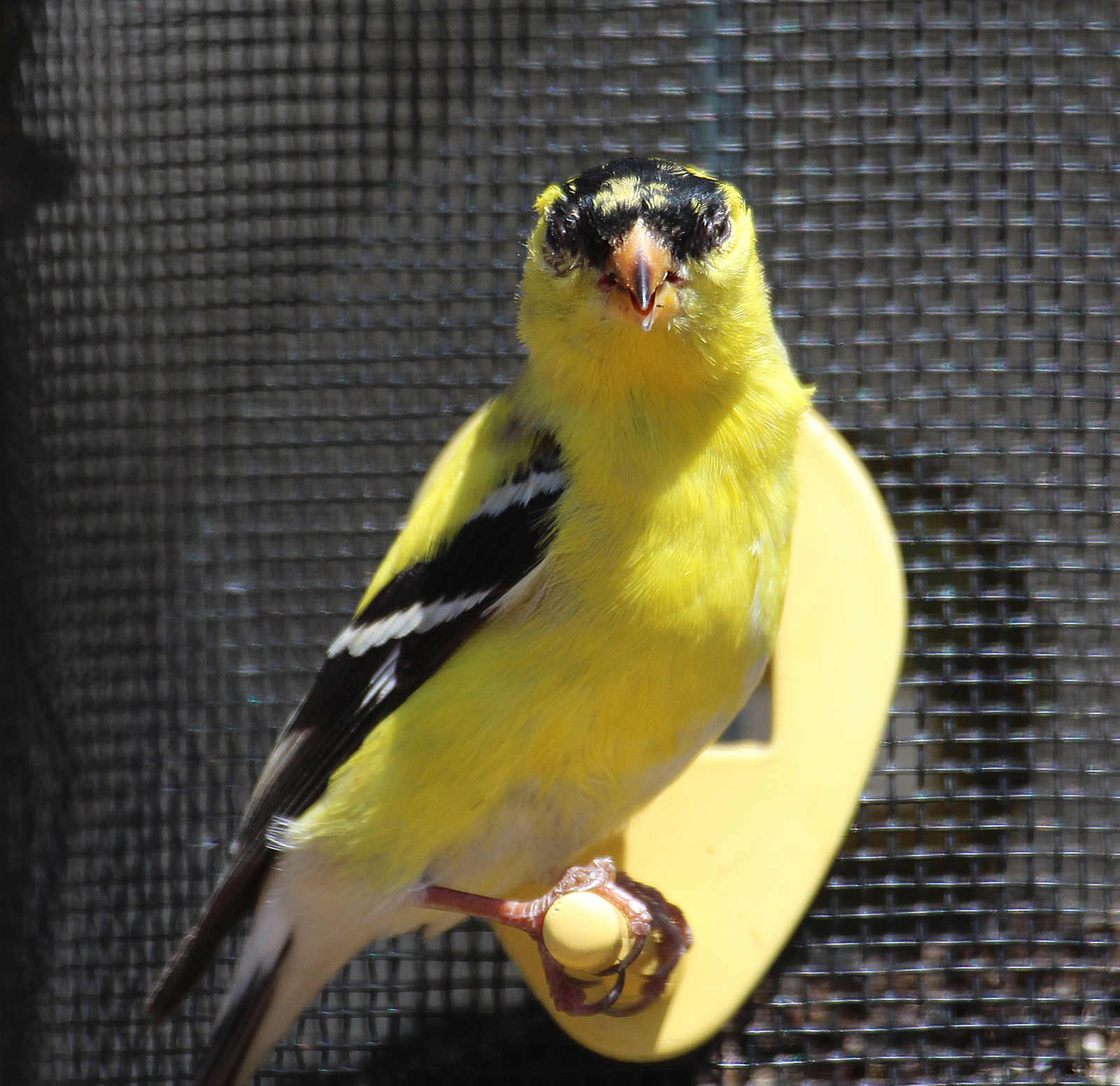
Photo by Chris Bosak An American Goldfinch with Avian Conjunctivitis visits a birdfeeder in Danbury, Conn., April 2016. A different disease is killing birds in the U.S. this summer.
Something is killing birds in unusually large numbers.
An as-of-yet undetermined disease has taken a heavy toll on birds such as robins, blue jays and grackles in about a dozen Mid-Atlantic and Midwest states. The die-off started in May and, while it hasn’t reached New England yet (as far as we know), officials at conservation organizations are encouraging people to take precautions to protect birds. Among the precautions: Stop feeding birds (or at least wash all feeders with a 10 percent bleach solution) and discontinue the use of birdbaths temporarily.
Disorientation, imbalance, lethargy and encrusted or cloudy eyes are among the symptoms of the birds afflicted with the disease. Young birds appear to have been disproportionately impacted. Researchers have confirmed that this differs from the avian conjunctivitis that has plagued house finches and goldfinches for many years. They have also ruled out many other potential causes, such as bacteria, viruses and parasites that commonly afflict birds.
It’s important to know what is not causing the die-off, of course, but finding out what is causing the event is even more significant. Determining that is still a work in progress.
One theory, which has been applauded by some and discounted by others, is that the die-off is related to the 17-year Brood X periodical cicada emergence. The geography of the die-off and emergence appears to align, and the theory suggests that the cicadas, which have been underground for 17 years, have soaked up pesticides, herbicides and whatever other nasty stuff we’ve been using to control insects and grow our grass and crops. It seems to make sense, but as I’ve mentioned, many researchers do not think the link is plausible.
Photo by Chris Bosak
An immature Peregrine Falcon sits on prey at Veterans Park in Norwalk, CT, Dec. 2013.
Early and mid-summer can be a tricky time for birdwatchers. I know, I know. I say that about a lot of times of the year.
This is a tricky time in that many young birds are fledging, and they don’t always resemble an adult bird yet. When a young bird is found in the field, it is often difficult to determine what exactly it is.
Some young birds are fairly obvious. A young robin may not look exactly like an adult robin, but it is clearly a robin nonetheless. Many birds fall under that category. But there are other birds, such as young warblers and even some ducks and hawks, that do not yet resemble their parents and therefore require some study to figure out what they are.
It is always rewarding to see young birds at your feeder or birdbath. I’ve seen many cardinals over the years teaching their youngsters how to eat from feeders. Last summer, I had the pleasure of watching a bluebird family visit daily for an extended period eating mealworms I had left on the deck railing.
Photo by Chris Bosak
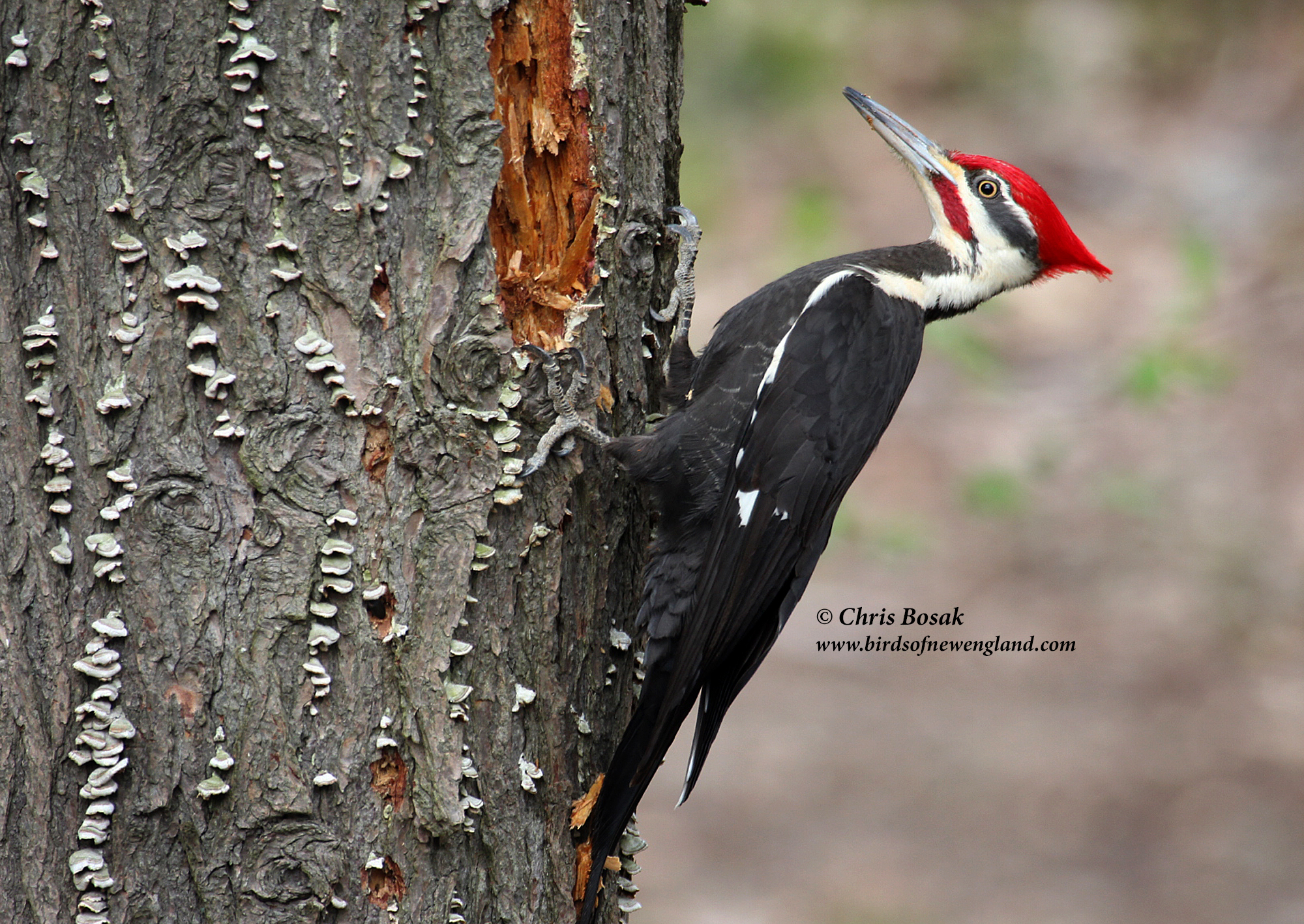
A pileated woodpecker works over a tree in New England, May 2020. Merganser Lake.
Every tree tells a story, even the dead ones. In fact, the dead ones may have the most interesting stories to tell.
A recent walk through the woods had me thinking about the trees. These particular woods were a mixture of evergreen and deciduous trees — predominantly deciduous but a few evergreens sprinkled in as well.
A large ash tree was snapped about 12 feet from the ground. The otherwise healthy-looking trunk stood tall and straight, while the rest of the tree bent down into the forest at a 45-degree angle.
I’m pretty sure I know what happened to the tree. A severe wind storm, with spotty tornado touch downs, blew through the area last summer and reduced many trees to tall trunks. It’s funny how storms impact trees differently. Some storms uproot most of the trees they damage. Other storms snap them like twigs. Still other storms, it seems, hardly damage the trees at all.
Photo by CHRIS BOSAK
Young Barn Swallows look for food from their mother, which is returning to the nest with food.
A new study of global bird populations, based mainly on citizen science databases such as eBird, estimates there are around 50 billion wild birds in the world.
Four species, according to the study, have a population of more than one billion birds. On the other hand, about one-tenth of the bird species in the world have fewer than 5,000 individuals.
A team of researchers at the University of New South Wales conducted the study, which was published in the “Proceedings of the National Academy of Sciences.” The researchers adjusted the citizen science numbers by modeling and consulting birding experts in specific regions.
So what are the four members of the billion bird club? Two of them are rather obvious: house sparrow and European starling. House sparrows, according to the study, are the world’s most populous bird with 1.6 billion individuals. The other two species were less obvious, to me anyway: ring-billed gull and barn swallow. I see a lot of ring-billed gulls pretty much everywhere I go in New England (inland and shore), but I didn’t realize they had such a global presence as well.
Barn swallow was the one that really surprised me. Not to be a bird snob, but house sparrows, starlings and ring-billed gulls are not what I would consider to be desirable birds. In the case of house sparrow and starling, they are non-native birds that have thrived in North America at the expense of native birds. Barn swallows, in my estimation, are desirable birds and I enjoy seeing them in the field. It was good news to me that this study put the barn swallow in the billion bird club.
Past studies have estimated the global bird population to be anywhere from 200 to 400 billion individual birds. That’s a wide range and not even close to the 50 billion birds estimated by this recent study.
I also found that past studies have estimated the global barn swallow population to be somewhere between 100 million and 200 million. BirdNote, the popular radio program and website, included in an episode that the “worldwide population of barn swallows is estimated to be 190 million.” The bird conservation consortium Partners in Flight estimates a breeding population of 120 million barn swallows.
So what is it? One billion (or more), 190 million (or less), or somewhere in between? It depends on the study, obviously. Either way, it’s good to see that the barn swallow population is thriving. Or is it?
A 2014 article published by phys.org claims that the barn swallow “has seen a 95 percent drop in numbers across North American in the last 40 years.” The article opens by defining the word “extinction,” and hints that swallows may be heading in that direction.
One billion individuals or teetering on extinction? That’s a huge difference, but both extremes are reported by seemingly credible sources. I’m sure each research team will vehemently defend their own numbers — at least I hope they would.
A 2019 study of birds in the Western Hemisphere by Cornell Lab of Ornithology, American Bird Conservancy, Smithsonian Conservation Biology Institute and other organizations, garnered a lot of attention and press, and was hailed as a wake-up call to protect birds before they disappear. The study found that one in four birds had disappeared over the last 50 years. This study estimated the barn swallow population in the Western Hemisphere to be around 46 million birds.
The wide-ranging numbers underscore how difficult it is to get an accurate count of global bird populations. Personally, I like to go with the lower estimates. I think there’s no doubt that birds and other wildlife are in decline to some degree. Why not take steps to change that? If we are wrong and the population is thriving, well, then we’d just have more of a good thing.
Photo by Chris Bosak
A red-winged blackbird sings from the top of a tree at Happy Landings in Brookfield, Conn., spring 2017.
It was about an hour before sunrise and it was decision time: try to go back to sleep for a few hours or get up and watch the sunrise in the woods somewhere.
Nine times out of ten, going back to sleep wins out and I wake up with the sun fairly high in the sky. This time was different. A few robins were already awake and singing, and I felt as if trying to sleep would be fruitless. I got up, made a cup of coffee and drove to the nearest park.
It was a good call. Nothing too out of the ordinary happened, but being in the woods when the natural world wakes up is always something memorable. In my younger years (not that long ago, mind you), I would do this quite frequently. Lately, not so much.
The sky was already brightening by the time I hit the trail. It was light enough that I didn’t need a flashlight to see where I was going, but it was dark enough that taking a photograph would yield a blurry, indiscernible image. Not that there was much to see anyway.
But there was plenty to hear. Robins, perhaps cousins of those that had awakened me about half an hour earlier, were the dominant sound. “Cheerily, cheerily, cheer up, cheer up,” over and over from all directions in the pre-dawn woods.
Plenty of other birds (and frogs and insects) joined the chorus, but the robins dominated. Most noticeable, and delightful, were the sounds that weren’t being heard: no airplanes overhead, no trucks downshifting from the highway miles away, no leaf blowers, no lawn mowers, no chainsaws. Just nature. It was cool and calm. Later it would be hot and hectic. But not just yet.
The robins had plenty of company in the morning chorus. I heard the Space Invaders-like song of the veery as well as wood thrushes, mourning doves, titmice, red-bellied woodpeckers, song sparrows, eastern wood pewees, red-winged blackbirds and many other bird songs I could not identify. Bullfrogs added a deep and interesting texture to the chorus.
I walked down a narrow path lined with ferns on either side. The lush ferns stretched far into the woods in all directions. I walked past a pond on my right. Fog rose from the water and man-made wood duck boxes were placed strategically around the edges. Grackles, ever ubiquitous, flew among the cattails.
My face and legs broke through hundreds of spider webs and mosquitoes feasted on the back of my neck. A great blue heron uttered its croaking sound as it flew from a nearby marsh and landed in a tall snag towering over the steaming pond. A friend of mine once said the great blue heron’s “song” reminded him of a dying goat. It’s not that far off.
I noticed a snapping turtle between the trail and the water. Years ago, I would have thought it was a rock, but my older, wiser self knew immediately it was a snapper. I pulled out my phone, took a few steps closer, bent low and grabbed a few photos. It was a willing subject.
Eventually, the natural sounds waned and the unnatural ones took over. The distant humming of the highway reminded me that I, too, had responsibilities to tend to. I reluctantly retreated back to the car and returned home. It was still before 7 o’clock in the morning when I got back. I felt as if I had experienced an entire day already. I never did miss those couple hours of sleep.
Photo by Chris Bosak
A snapping turtle at a pond’s edge in New England, spring 2021.
Photo by Chris Bosak
An eastern towhee seen in Ridgefield, CT, summer 2019.
June may not have the buildup and excitement of May, but it is still an interesting time in the birding and natural world.
By the time June comes around, the swarms of migrating birds have dissipated, having either gone farther north or settled into their breeding territories. June also follows May, which I would argue is the most exciting month for birding in New England. I wouldn’t say June is a letdown, but it lacks the anticipation that May has going for it. May, after all, follows months and months of cold, gray weather. May’s songbird migration is like a reward for enduring winter and early spring.
Early June does have the odd migrant still working its way north, which is nice to see. For the most part, however, the migration is over.
June is a time to recognize, appreciate and take pride in the birds that are breeding in the area. There’s something special in knowing that birds are raising young nearby. The other day, I took a walk and saw or heard eastern towhees (pictured above), yellow warblers, blue-winged warblers, common yellowthroats, indigo buntings, rose-breasted grosbeaks, bobolinks, catbirds, veeries and hermit thrushes. Those are nice sightings regardless of the circumstances, but it was particularly rewarding knowing they are breeding locally. I hope they all have a successful breeding season.
The birds, for the most part, were still fairly vocal. I heard all of the aforementioned birds singing. Finding them proved to be a touch more difficult than in May. In May, birds are still searching for or defending territory and are easy to spot. In June, more birds are hunkered down for fear of giving away their nesting site. The colorful males often jump out to grab attention while the more subtly plumaged females remain on the nest camouflaged from predators.
June also means more insects, which is good and bad. It was nice to see a few butterflies flitting among the early-blooming flowers in the meadow, but the deer flies attacking the back of my neck were not something I was quite ready for. Oh well, it’s all part of living in New England.
As the insects gain steam, the birding action will slow down over the next couple of weeks as they hang low raising young. Morning and evening are always the best times to look for birds, but this will become even truer in July and August as the heat and humidity will keep the birds in the shade during the day. Steamy August afternoons are my favorite times to wander through New England meadows looking for butterflies, dragonflies and whatever other creatures lurk in the tall grasses and flowers.
In the meantime, enjoy June and what it offers birdwatchers. There’s still plenty of action out there.
Photo by Chris Bosak
A red-eyed vireo is stuck in a bird-banding net in New England, spring 2021.
I have said many times that one of the great things about birdwatching is that there is always something to learn at all levels.
A beginner, of course, has a lot to learn as the world of birds is vast. An intermediate-level birdwatcher has a lot of knowledge, but there is still plenty more to learn, such as hybrid species and plumage phases. Even experts have a lot to learn as it is impossible to know everything about every bird in the world, and there are species and discoveries yet to be made.
Over the last few weeks, I have been writing a lot about warblers and other spring songbird migrants such as tanagers and grosbeaks. In my opinion, those types of birds straddle the line between beginner and intermediate-level birdwatching. There are a lot of nuances in that statement, however. Identifying warblers by sound is clearly a more intermediate or even advanced intermediate skill. But identifying a rose-breasted grosbeak at a feeder is more of a beginner skill.
There are many other types of spring migrants passing through or settling now in New England that fall clearly into the intermediate, or even expert, category. Vireos and flycatchers, I believe, are two types of birds that can be tricky to learn and therefore require a higher level of skill to identify. Both types of birds tend to favor the tops of trees and are difficult to get a good look at. Often, the sun is either hiding behind clouds or in your face, which makes identifying a bird even more difficult as the colors are not showing well through the binoculars.
A few of the vireos can be relatively easy to identify if you get a good, close look. The blue-headed vireo, with its obvious white spectacles, is one example. The red-eyed vireo is another example, but it is pretty rare that you get a good enough look to determine eye color. Similarly, great-crested flycatchers, with their relatively large bodies and boisterous songs and calls, can be another fairly easy identification.
But most vireos and flycatchers are largely brown or gray with subtle markings, making identification difficult for even intermediate birdwatchers. That is when learning their song and calls becomes important. But that, of course, is a more advanced skill, particularly when one is already trying to learn the song of warblers and other more common birds, such as Baltimore oriole and rose-breasted grosbeak.
In my opinion, vireos and flycatchers are often overlooked, or even ignored, by many birdwatchers. I myself am guilty of this as I rarely write about them in my column. The other day, however, I was struck by the beauty of a red-eyed vireo. I had a rare, extremely close look at the bird. I was walking through a small conservation area where bird banding was taking place, and the vireo was tangled in one of the mesh nets. I took a quick photo with my iPhone and rushed to alert one of the banders of the catch.
That sighting got me thinking about the other vireos and other birds such as flycatchers that are flitting among the treetops with little fanfare.
Several years ago, I brought my boys to a bird-banding area, and one of the banders allowed us to participate in the release of the birds. After all the pertinent information about the bird was collected, Andrew got to release a gray catbird, and Will, who was about 5 years old at the time, released a yellow-bellied flycatcher.
The vireo sighting the other day made me recall the release of the yellow-bellied flycatcher. Rarely on a bird walk are those birds found, and rarely are they discussed when the topic of New England bird comes up. But they are out there and count just as much as the warblers and other ballyhooed birds of New England.
Birdwatching can be a fairly easy hobby. If you are content to know a few common backyard birds such as robins, mourning doves, blue jays and cardinals, that is pretty easy to pick up. If that is your end goal in birding, that’s perfectly fine. If you desire to learn more and take the hobby to another level, that can be done, too, as birdwatching can be as difficult as you want to make it. I look at birds like vireos and flycatchers as birds that definitely take a birder to another level.
Photo by Chris Bosak
An American Redstart sings from a perch in Selleck’s and Dunlap Woods in Darien, Conn., May 2015.
Any walk through deciduous woods when the leaves are out drives home the importance of knowing what birds sound like. It can be a lesson in futility to try to find a tiny warbler at the top of a giant oak tree covered in leaves. The exercise can lead to frustration and a condition known as “warbler neck.”
My birding-by-ear skills are average at best, and I was reminded of this during a recent walk through the woods under a thick canopy. I heard several warblers and other birds, and, while I saw only a few, I was able to recognize the songs of several others. There were many birds, however, I could not find through my binoculars nor recognize by their songs or calls. As I mentioned before, it can be frustrating, but I have reached an age where I can let go of the frustration quickly and not dwell on the bird that got away. In years past, I would often hold onto the frustration long after the walk, which, after all, is supposed to be enjoyable.
Birds don’t always look exactly like they do in a field guide, whether the images are photos or illustrations. There are different plumages depending on time of year, age, sex and other factors. There is also slight variation among individuals of a species. Not every male robin looks exactly the same.
That said, birds don’t always sound exactly like they are supposed to either. A bird’s song is only one of the sounds they make and even their songs can vary greatly. Cardinals, for instance, have distinctive high-pitched call notes. They also have a distinctive song, but there are several versions of the song. The cardinal in your forsythia may have a song that is greatly different from the cardinal across the street. All of the songs are loud, clear and beautiful, but very different. Don’t get stuck thinking that the cardinal song you hear every day is the only one cardinals have. Many other birds are the same way as well.
My advice if you are just starting to learn bird sounds is to learn the common and obvious ones really well. Study what the robin sounds like. Their typical song is often translated to “cheerily, cheer up, cheer up, cheerily, cheer up.” But there is much variation in the song, and they have several calls as well, such as the “tut, tut, tut,” call.
Robins are very common in New England, so if you learn the sounds of the robin, you can save yourself much frustration on your walks by not getting hung up on a bird you will likely come across several times.
Get to know the various calls and songs of blue jays, cardinals, nuthatches, chickadees and titmice. You will hear those often throughout the year, and you can eliminate other birds in the spring when you hear those sounds during a song-filled spring morning.
Warblers and other migrants are a different story. We do not hear them year-round, but rather for only a few weeks out of the year. That is a short window to try to learn those songs in the field. Birding Internet sites and phone apps are filled with recordings of bird songs and calls. I would encourage you to learn a few warbler songs each year so as to not try to pack too much information in your head and end up not remembering anything. Learn the yellow warbler and common yellowthroat, for instance, as those are commonly heard in the spring and summer throughout New England.
Warblers are difficult to learn because there are so many of them and many of their songs are similar to each other’s. But, as I said, learn a few a year and within a couple of years you will be picking out many of the songs you hear in the woods in April and May. And if you just can’t pick it up, don’t fret or stress. Study a little more, and get it next time.
Photo by Chris Bosak
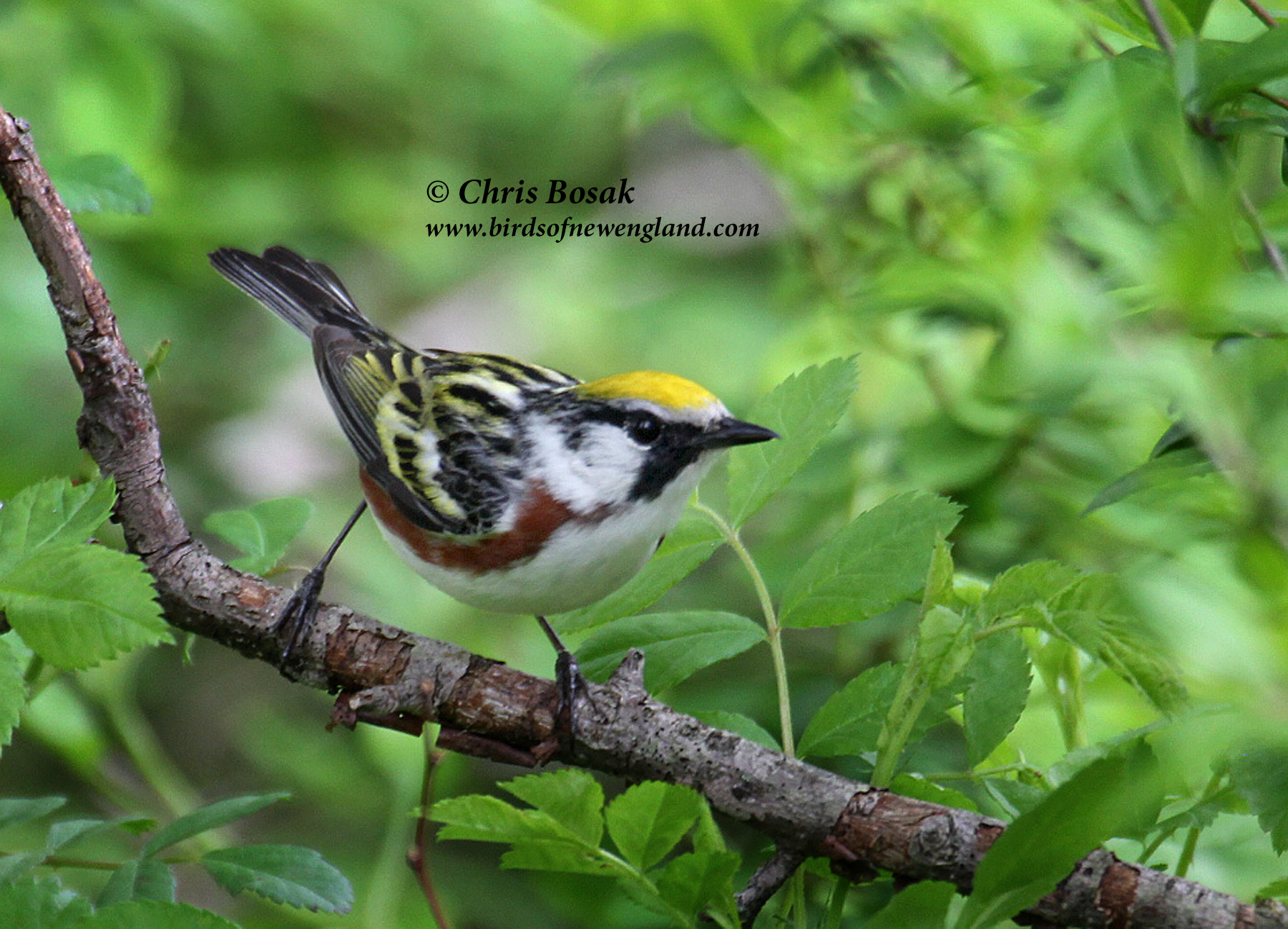
A chestnut-sided warbler lurks in the brush in New England, May 2020. Merganser Lake.
Welcome to May, arguably the best month of the year for birdwatching.
So many exciting things happen in the bird world in May that it’s hard to know where to begin. The breeding season is in full swing and our year-round birds as well as newly arrived migrant birds are either looking for nesting sites or already raising young. Suddenly our feeders are visited by colorful newcomers such as rose-breasted grosbeaks, Baltimore orioles or indigo buntings. Waders are back in full force stalking our ponds and rivers.
When it comes to May, however, talk of the birding world has to begin with warblers, those small and often colorful Neotropical migrants that add life to our neck of the woods every spring. Some of these warblers will simply stop by for a few days before heading farther north to their breeding grounds. Many, however, will find a suitable place to raise young and will be with us until the fall.