Two species dominated my latest bird walk.
Perhaps not surprisingly, the white-throated sparrow was the most dominant species. I lost track of how many I had seen early in the walk as dozens of these beautiful native sparrows were around every bend.
The second-most dominant species may be a bit more surprising. While large groups of white-throated sparrows lingered around every corner, singular ruby-crowned kinglets kept me occupied on the straightaways.
They were constant companions during the walk. Little flashes of movement in the bushes or low branches of trees gave away their whereabouts. Not that they were trying to stay concealed, as they can be surprisingly tame for wild birds.
Tame or not, close looks or not, ruby-crowned kinglets are notoriously difficult to photograph, as they are in constant motion, and predicting their next move is a crapshoot. If you see one that sits still for a full second, you’d better be prepared with the camera and not blow the opportunity. (I’ve blown innumerable opportunities, by the way.)
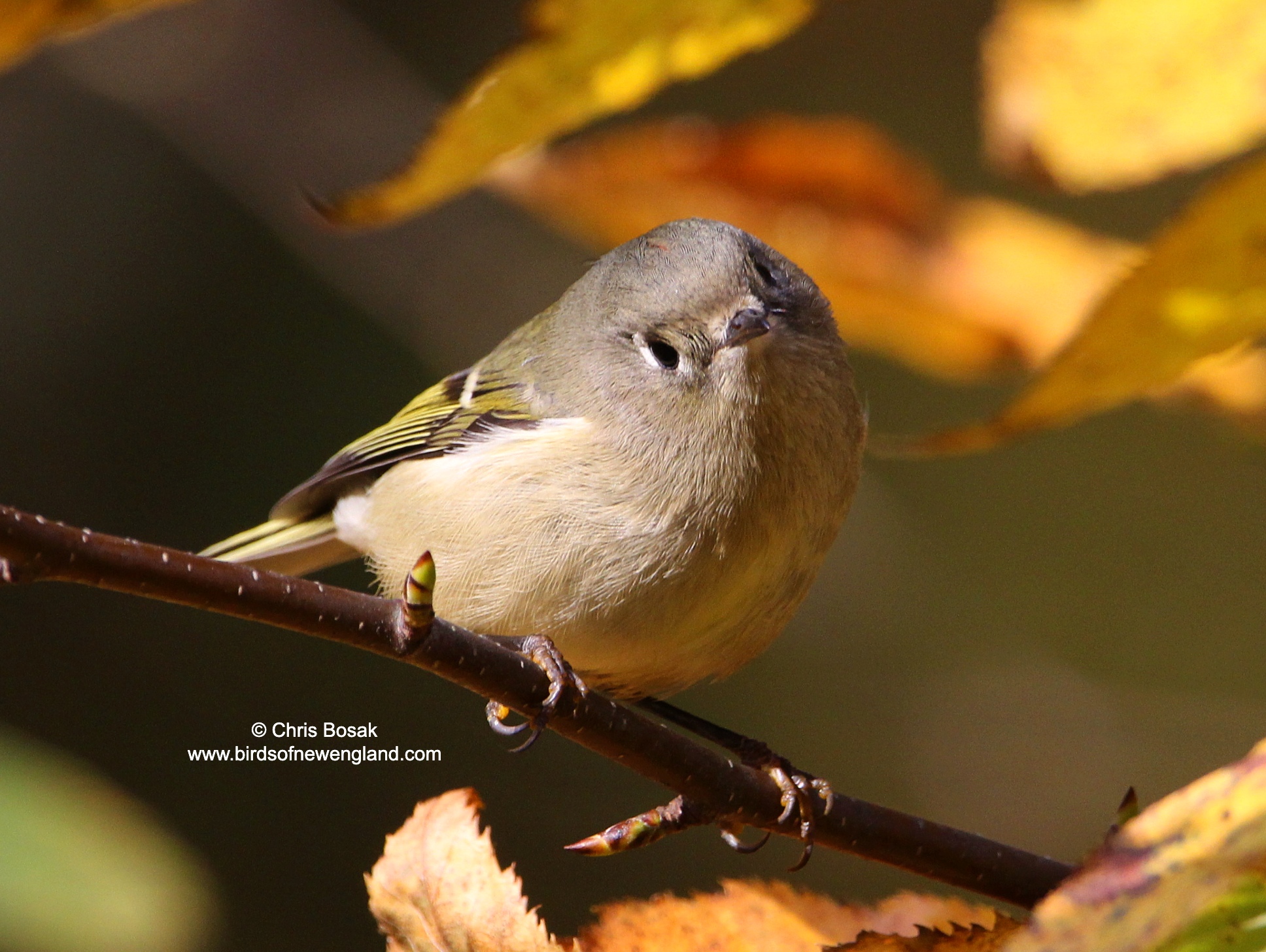
Then comes the real challenge: Getting a photo of one with their namesake crown exposed. Not only do you have to get a kinglet to sit still long enough for a photo, but the bird must be in an excited state. Ruby-crowned kinglets show their colorful crown only when they are unsettled. Otherwise, these birds are mostly olive colored with yellow and black wings and tails, and an eye ring that doesn’t quite make it all the way around the eye.
All the kinglet photos I managed to capture on this particular walk were without the crown exposed. (Although the photo at the top shows just a hint of the red crown.) In fact, in my entire photo collection going back many years, I have very few photos of kinglets with their crowns showing.
Golden-crowned kinglets, a sleeker and slightly more decorated cousin of ruby-crowned kinglets, are the same way. They are difficult to photograph because of their hyperactivity and display their crowns only when agitated. To me anyway, golden-crowned kinglets are even more difficult to photograph because I see far fewer of them than ruby-crowned kinglets.
Kinglets do not typically visit birdfeeders, but they may still be found in yards. Check flowerbeds with dead and dying flowers, as kinglets are often found close to the ground. They are most likely looking for insects and spiders to eat, but they do supplement their diet with seeds and berries. Flowers that linger deep into fall, such as sedum, are good candidates to attract ruby-crowned kinglets. For golden-crowned kinglets, check evergreen trees, particularly those thick with branches and needles.
Kinglets are New England’s smallest birds, apart from hummingbirds. What they lack in size, kinglets make up for in character. (Hummingbirds fit that bill as well.) They are high-energy, exceptionally fun to watch and numerous during certain times of the year. Kinglets may occasionally be found during the winter in New England, but most of them make a relatively short migration to southern U.S. or Mexico.
As a late migrant, the tiny kinglet adds a little pizzazz to a late fall walk.