White-eyed vireo: New England first-timer for me

I saw a white-eyed vireo in Florida when I visited my brother in February. I thought it was an interesting bird and was happy to see it.

Well, yesterday morning I saw one in New England for the first time. Southern New England (Connecticut, Rhode Island and southern Massachusetts) is the northernmost range of the bird. It’s a cool-looking bird, but its song is what makes it stand out. I was instantly drawn to the thicket from where the song was coming. You can hear the song here.

Another good spring sighting!

Here’s a photo of the one I saw in Florida (plus a few others.)

Hummingbird scratching video

Well, if he’s going to sit right outside my window on a rainy day then I’m going to make a YouTube video of him. First hummingbird I’ve seen this year (May 4, 2022, in Bethel, Conn.)

A few birds from a late-April morning walk: field sparrow, eastern towhee, bald eagle

Photo by Chris Bosak – Field sparrow, April 2022.

Not as many migrants as I expected, but a good walk nonetheless at Huntington State Park in Redding, Conn. I heard only one warbler (black-and-white), but I have heard and seen dozens of eastern towhees over the last two days. It’s (arguably) the best time of year to be out there. No excuses! (I’m talking to myself too). The bald eagle flyover was a bit of a surprise, hence the lousy photo.

Photo by Chris Bosak – Eastern towhee, April 2022
Photo by Chris Bosak – Bald eagle, April 2022
Photo by Chris Bosak – field sparrow, April 2022.

For the Birds: Just a little more patience

Photo by Chris Bosak – A yellow-rumped warbler perches on a branch in New England, spring 2022.

It was a classic early spring walk.

Expectations were high to see a lot of migrants, but those expectations did not match the calendar. Mid-April can be a tough time for birdwatchers. We know the migrants are coming any day, and we have waited so long that the anticipation gets the better of our waning patience. It’s like the feeling children get on December 22 and 23. The decorations and tree have been up for weeks already, but it’s still not time to celebrate.

This is not to say it wasn’t a fruitful walk. I saw a handful of migrants including my first warblers of the season. But instead of dozens of species and 100s of individual birds, as we will get in a few weeks, it was more like a few species and about a dozen individuals.

It was a good warm-up to the upcoming peak of spring migration. Let’s put it that way.

Continue reading

For the Birds: Patience is key to spring migration

Photo by Chris Bosak An Eastern Phoebe perches on a branch in Selleck's Woods in Darien, Conn., in late March 2015.
Photo by Chris Bosak A red-winged blackbird sings from the top of a tree at Happy Landings in Brookfield, Conn., spring 2017.

Late March and early April can be a tough time for birdwatchers as we are in the slow build up to spring migration.

The spring migration actually starts sometime in February when the first male red-winged blackbirds arrive. It’s a nice sight (and sound) when they return to our swamps, but it’s pretty much just a tease as we know winter will continue, and it will be several weeks until other birds start to show up.

American woodcocks and eastern phoebes return to New England around the middle of March. A few weeks later, ospreys arrive. The build up can be excruciatingly

Continue reading

Palm warblers out in force

Photo by Chris Bosak A palm warbler stands on a stone wall in New England, October 2021.

Three species dominated the count total on my morning bird walk today. White-throated sparrows were plentiful and it was great to hear their song again. Yellow-rumped warblers were plentiful, as they often are this time of year. Palm warblers were numerous as well and a flock of five kept me company near a stone wall at Huntington State Park. The fall warbler migration is bittersweet. It’s great to see them, of course, but the crisp air reminds me they will be gone soon and a long winter looms. At least winter is good for birdwatching too.

Photo by Chris Bosak A palm warbler stands on a stone wall in New England, October 2021.

A few more yellowthroat photos

Photo by Chris Bosak A common yellowthroat perches on a branch in New England, July 2021.

Common yellowthroats are one of most familiar warblers we see in New England. While we are seeing many warblers pass through this time of year on their way south, yellowthroats remain one of the more common sightings. The male (pictured above) is easy to recognize with his black mask, but the female is a little more tricky, particularly in the fall when warblers are notoriously difficult to ID. Here are a few more shots to distinguish the female yellowthroat from other warblers passing through. Click here for a recent For the Birds column on yellowthroats.

Continue reading

For the Birds: Welcome to May!

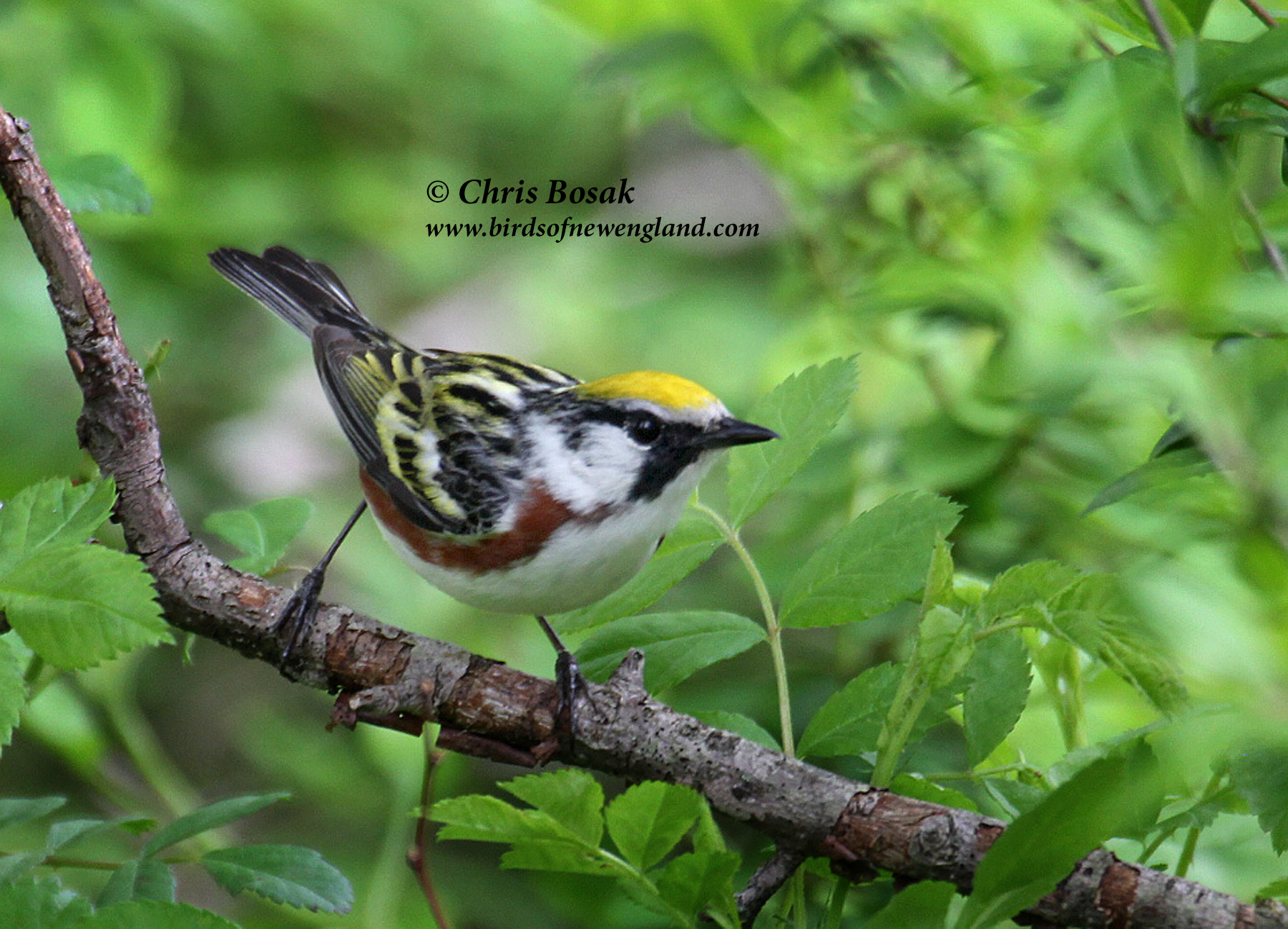
Photo by Chris Bosak A chestnut-sided warbler lurks in the brush in New England, May 2020. Merganser Lake.

Welcome to May, arguably the best month of the year for birdwatching.

So many exciting things happen in the bird world in May that it’s hard to know where to begin. The breeding season is in full swing and our year-round birds as well as newly arrived migrant birds are either looking for nesting sites or already raising young. Suddenly our feeders are visited by colorful newcomers such as rose-breasted grosbeaks, Baltimore orioles or indigo buntings. Waders are back in full force stalking our ponds and rivers.

When it comes to May, however, talk of the birding world has to begin with warblers, those small and often colorful Neotropical migrants that add life to our neck of the woods every spring. Some of these warblers will simply stop by for a few days before heading farther north to their breeding grounds. Many, however, will find a suitable place to raise young and will be with us until the fall.

Continue reading

A few other birds that may be showing up

Photo by Chris Bosak A Rose-breasted Grosbeak visits a feeder in Danbury, Conn., May 2016.

I’ve posted several warbler photos over the last week or so, but early May isn’t only about warblers. Here are a few other birds that may show up in your backyard (if they haven’t already.)

Continue reading

For the Birds: Spring feeding and purple martins

Purple martins with dragonflies.

I don’t see a lot of press releases now that journalism is no longer my full-time profession, but I did receive a few last week that caught my eye.

One was from Cole’s Wild Bird Products and the other from the Purple Martin Conservation Association. The topics were very different but did have one important commonality: spring.

Cole’s, which makes a red-hot blend that I’ve used and the birds loved, sent some spring bird-feeding tips. Many people stop feeding birds in the spring for a variety of reasons, including bears and not wanting birds to become dependent upon feeders, but I’m a big fan of spring bird feeding. It’s a great way to get close, long looks at birds such as grosbeaks, orioles, buntings and even a few warbler species if you’re lucky.

Continue reading