For the Birds: Inside the hawkwatch

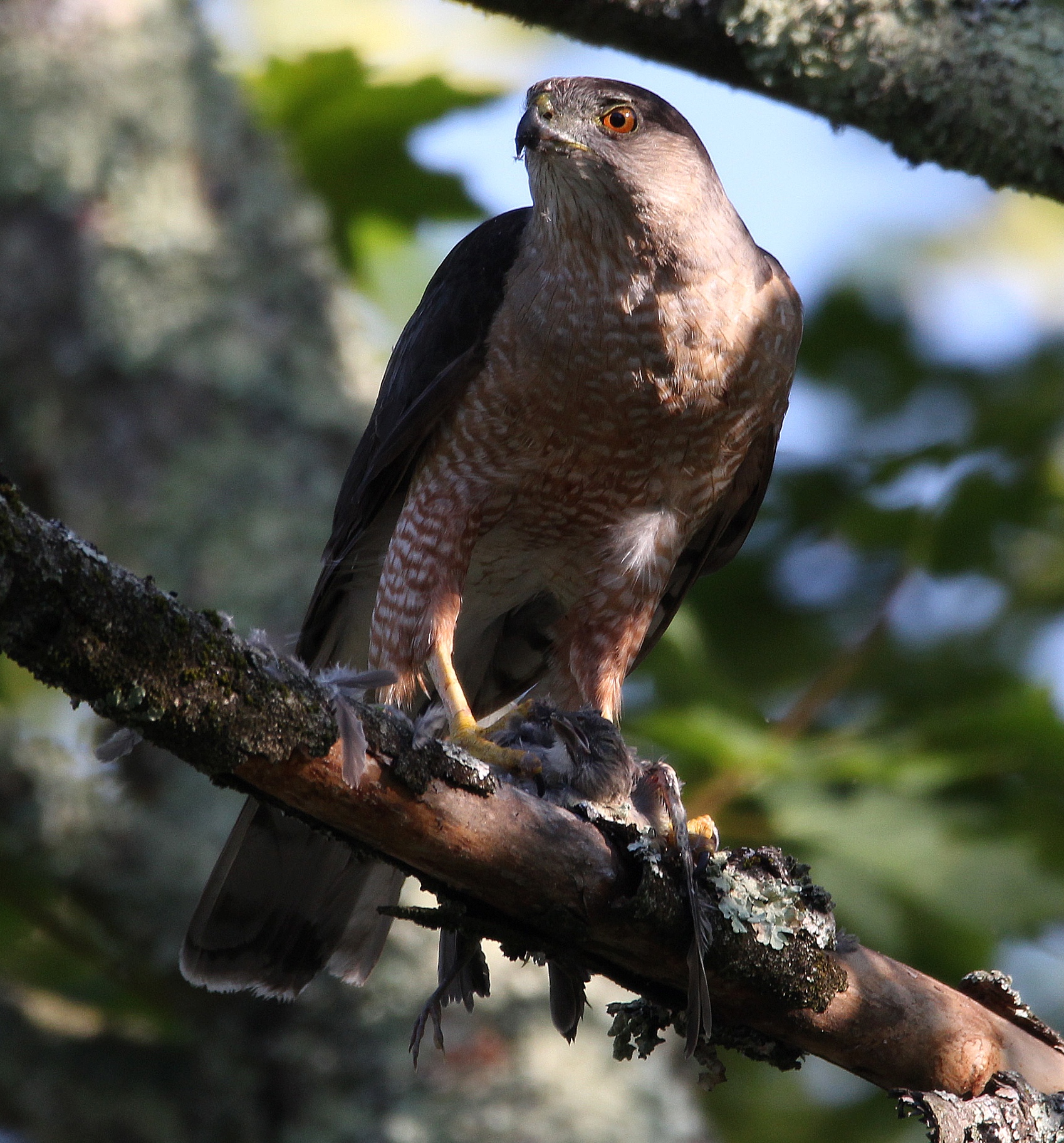
Photo by Chris Bosak
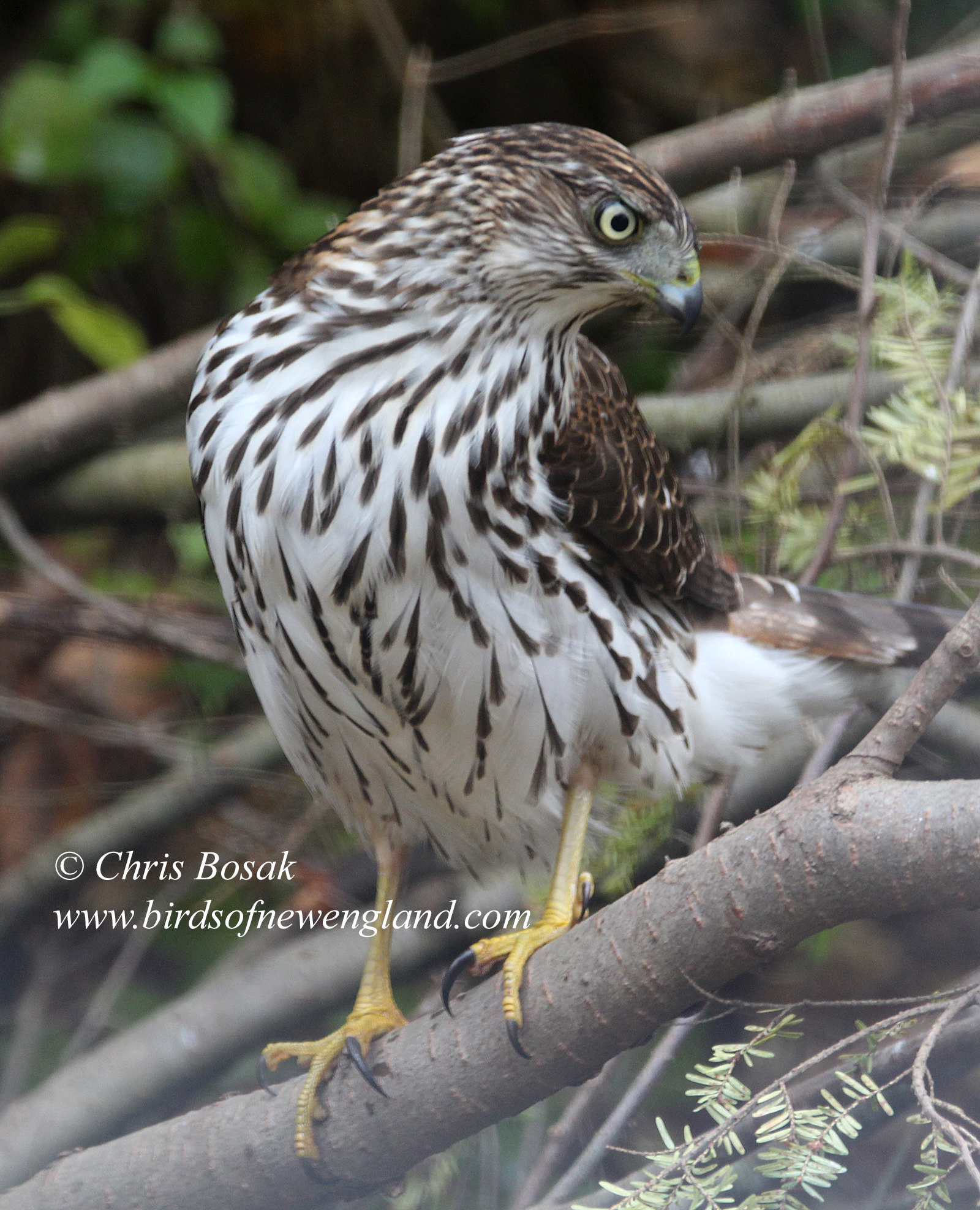
Young Cooper’s hawk in New England.

Last week’s For the Birds column highlighted the results of this year’s fall hawkwatches with a particular focus on Pack Monadnock in Peterborough. The column was heavily focused on data and the number of birds counted.

A number of questions came up in my head as I looked at the results and compiled the data. Not one to let questions go unanswered in my head, I turned to the experts for some explanations.

Specifically, I had an enjoyable chat with Phil and Julie Brown of Hancock, N.H. Phil is the Bird Conservation Director and Land Specialist at the Harris Center for Conservation Education. His wife, Julie, is the Raptor Migration and Program Director of the Hawk Migration Association.

The sheer number of broad-winged hawks was the main thing that jumped out at me as I looked at the data last week. Nearly 6,000 of the 8,500 hawks counted during the 2025 fall migration at Pack Monadnock were broad-winged hawks. To me, it was a bit surprising, as I see red-tailed hawks and red-shouldered hawks all the time, but I rarely see broad-winged hawks.

As a quick reminder, “hawkwatch” in this sense includes eagles, ospreys, falcons and vultures as well.

Julie and Phil explained that broad-winged hawks tend to be more elusive during the breeding season and that they more readily form flocks for migration than other raptors. While most hawks pass over the mountain as one or two birds at a time, broad-winged hawks pass over in huge numbers on certain days.

“They are responsible for a lot of the magic of hawkwatches,” Julie said. “Many people say broad-winged hawks are what got them hooked on hawkwatches.”

While the broad-winged hawk migration is truly a spectacle, with as many as 3,000 or more seen on a single day, it is very time specific. September 14-20 is the sweet spot when nearly all of the broad-wingeds pass through. Phil said many people take the entire week off from work to not miss the right day.

Mark your calendars for the middle of next September and keep your eyes out for a forecast that calls for light or variable winds from the north (or northeast or northwest), particularly following a cold front.

As remarkable as 3,000 birds in a single day is, Julie pointed out that critical hawkwatching sites such as Veracruz, Mexico, can get hundreds of thousands of broad-winged hawks in a single day.

I had a similar question about sharp-shinned and Cooper’s hawks, smallish but fierce hawks that often terrorize birdfeeders. While we tend to see more Cooper’s hawks in our daily lives, sharp-shinned hawks far outnumber Cooper’s hawks on counts. Cooper’s hawks have adapted much better to suburban and urban areas, and many overwinter in New England.

Differentiating between these accipiters often leads to debate, as the species are very similar in appearance. Cooper’s hawks are generally larger, but size is not a reliable determining factor. Even experts debate which bird they are looking at.

Seeing one of these hawks from a distance during a hawkwatch makes for an easier identification, Phil said, as their wing-flapping cadence and other behaviors are reliable differentiators.

Despite the seemingly high numbers of sharp-shinned hawks that are counted on hawkwatches, the Browns said the species is in decline. Phil said sharp-shinned hawks, goshawks, American kestrels and northern harriers do not get the attention they deserve for their decline.

Julie said rodenticides are a major factor in the decline of many hawks, and wildlife rehabilitators are often overwhelmed by the number of poisoned hawks that are brought in. Many people who use rodenticides do not realize the consequences, she said, and education is important in reversing the trend.

“It’s so preventable,” she said.

To end on a positive note (it is the holiday season, after all), the Browns actually met during a hawkwatch on Pack Monadnock in 2006. Julie was a seasonal hawk counter for New Hampshire Audubon, and Phil worked for New Hampshire Audubon at the time. They met on the mountain and got to talking about their love of nature and the boreal forest. Their main goal that day was to see a golden eagle, and sure enough, one of the magnificent birds flew over.

Their wedding bands are adorned with etchings of a golden eagle and the profile of Pack Monadnock.

For the Birds: Surrounded by juncos

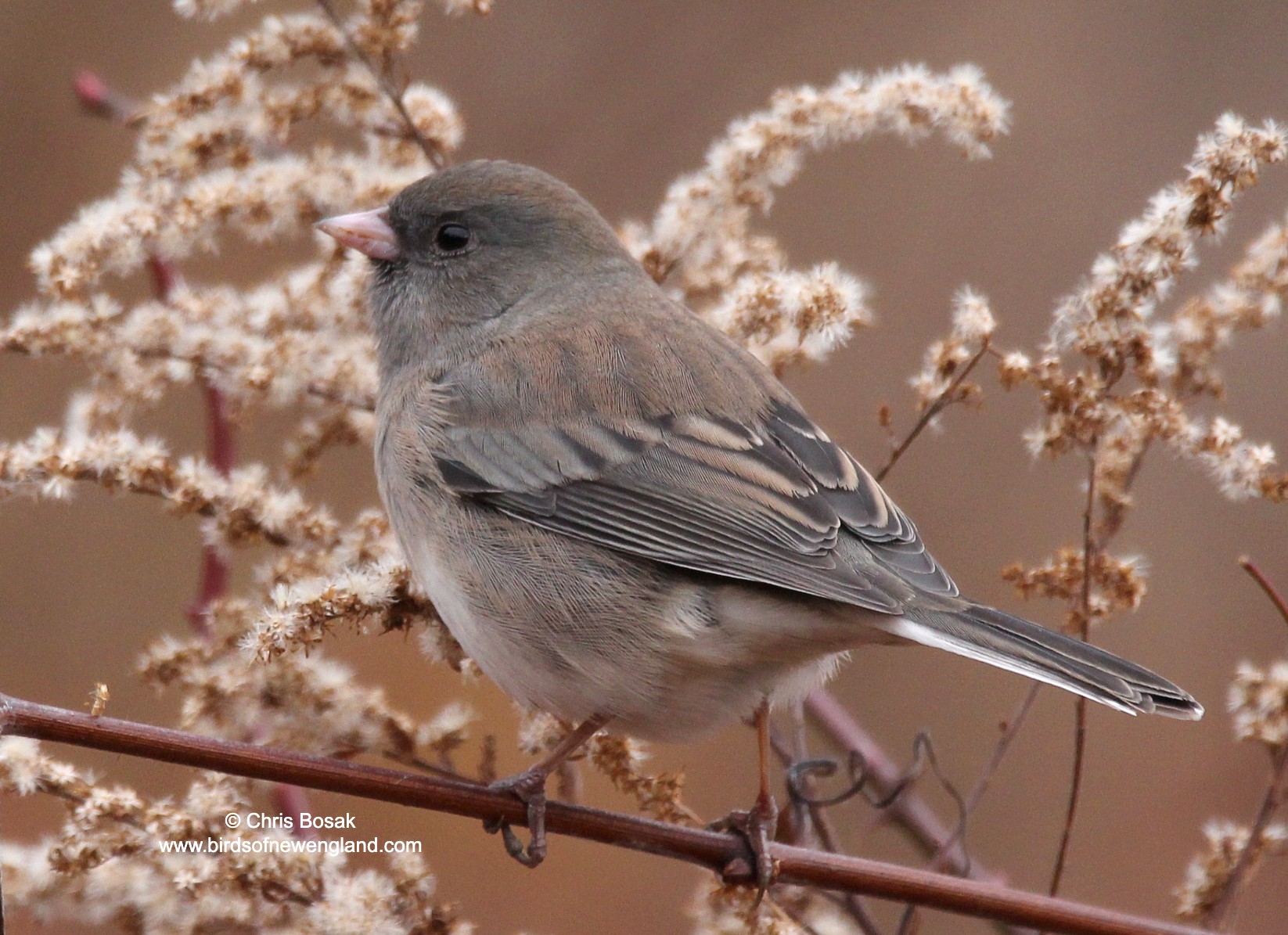
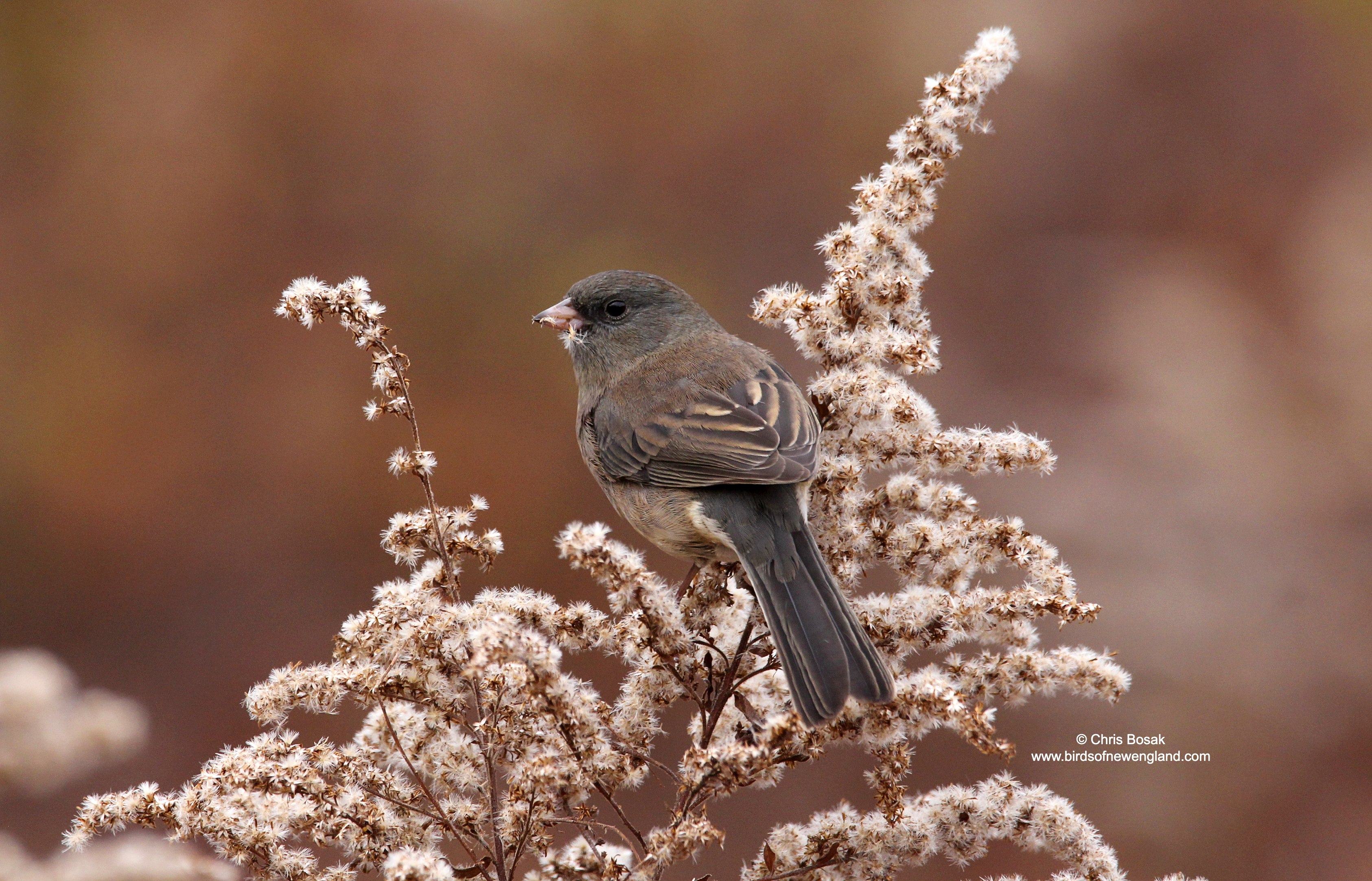
Photo by Chris Bosak – A dark-eyed junco eats goldenrod seeds at Huntington State Park in Redding, Connecticut, November 2025.

Have you seen any videos of kayakers being surrounded by whales? 

I’ve seen a few such videos. I’m not sure where they were filmed, but I’m reasonably sure they are real and not AI-generated. Of course, it’s getting harder to tell these days.

While being surrounded by whales would be a moment you’d never forget, I’m not sure I’d want to experience it. I didn’t get into bird- and wildlife-watching for extreme, brush-with-destiny experiences. 

I did, however, have a similar experience last week. Granted, this was far less risky and would never go viral on social media, but for me, it was a moment I won’t soon forget.

I came to the part of the trail where it exits the woods and cuts through the middle of a smallish meadow, about the size of a football field. Like most meadows, it looks vastly different depending on the season. In the spring, it is lush green and the flowers, weeds and grasses seem to grow by the hour. In the summer and early fall, colorful blooms take over the scene, and the growth is so thick that the trail becomes impassable. I tried plowing through the trail once in the summer and was covered with ticks by the time I reached the other side. I’m not doing that again.

In the fall, after the goldenrod has faded but before winter applies its death grip, the field is a pleasing palette of subtle brown and yellow notes. Fall foliage from the woods and brushy areas around the perimeter of the meadow paints the background with vibrant shades of red, orange and yellow.

Such was the scene the other day when I entered the meadow. I immediately noticed a ton of bird activity among the browned grasses and weeds. A lone palm warbler flew off into the brush, and a small group of white-throated sparrows followed suit. But the juncos remained.

I got about 15 steps into the meadow and stopped. I looked around and realized I was surrounded by juncos. The little black or dark gray and white birds went about their business of eating goldenrod seeds while I took in the scenery. It was difficult to get an accurate count because many of the birds preferred to do their seed hunting toward the middle of the plant instead of the top. I would guess there were at least 30 juncos total in all directions from where I stood, some as close as 10 feet away.

Again, not quite like being surrounded in a kayak by whales, but I’ll take it any day. 

On top of everything else, it was a perfect late fall morning. It was about 50 degrees, enough to need a sweatshirt but nothing more, and light cloud cover kept the harsh sun at bay. As I get older, I am much more appreciative of moments like this. I was outdoors, the temperature was ideal (for me anyway), and dozens of birds surrounded me. 

In this day of virulent political division, social media dumpster fires, and animosity toward fellow man by so many, it’s nice to get lost in moments like these. Leave it to New England nature to provide the perfect escape.

For the Birds: Strong winter for finches forecasted

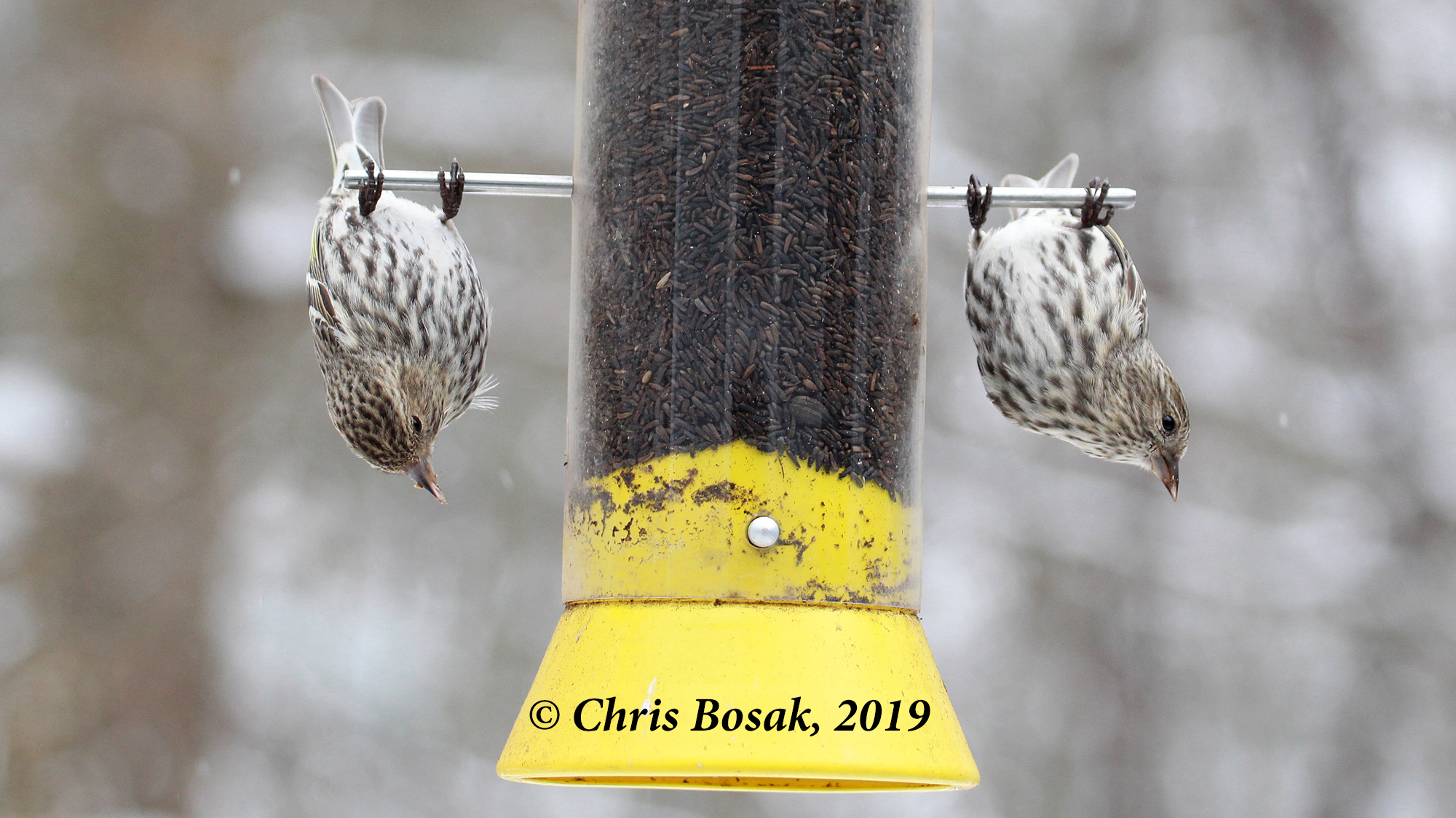
Photo by Chris Bosak Pine siskins visit a feeder in Danbury, Connecticut, March 2019.

My favorite part of winter birdwatching has always been looking for waterfowl on whatever open water remains. Searching for bald eagles in those same areas has become another favorite of mine as the population of our national bird soars, and we see them more frequently.

Winter is also arguably the best time to watch feeders in the yard, although one can easily make a case for spring being the best time when the grosbeaks, buntings and other surprises arrive. Watching the feeders in winter, particularly before a storm, is a constant treat of chickadees, titmice, nuthatches, woodpeckers, cardinals, blue jays, juncos and white-throated sparrows.

In my opinion, an underrated part of winter birding is the finch irruption, or lack thereof, depending on the year. Birds such as siskins, redpolls, purple finches, crossbills, pine grosbeaks and evening grosbeaks sometimes irrupt into our region as food supply dictates. Other birds such as red-breasted nuthatches are also lumped into the category of unpredictable winter bird visitors.

Continue reading

For the Birds: Rails get their turn finally

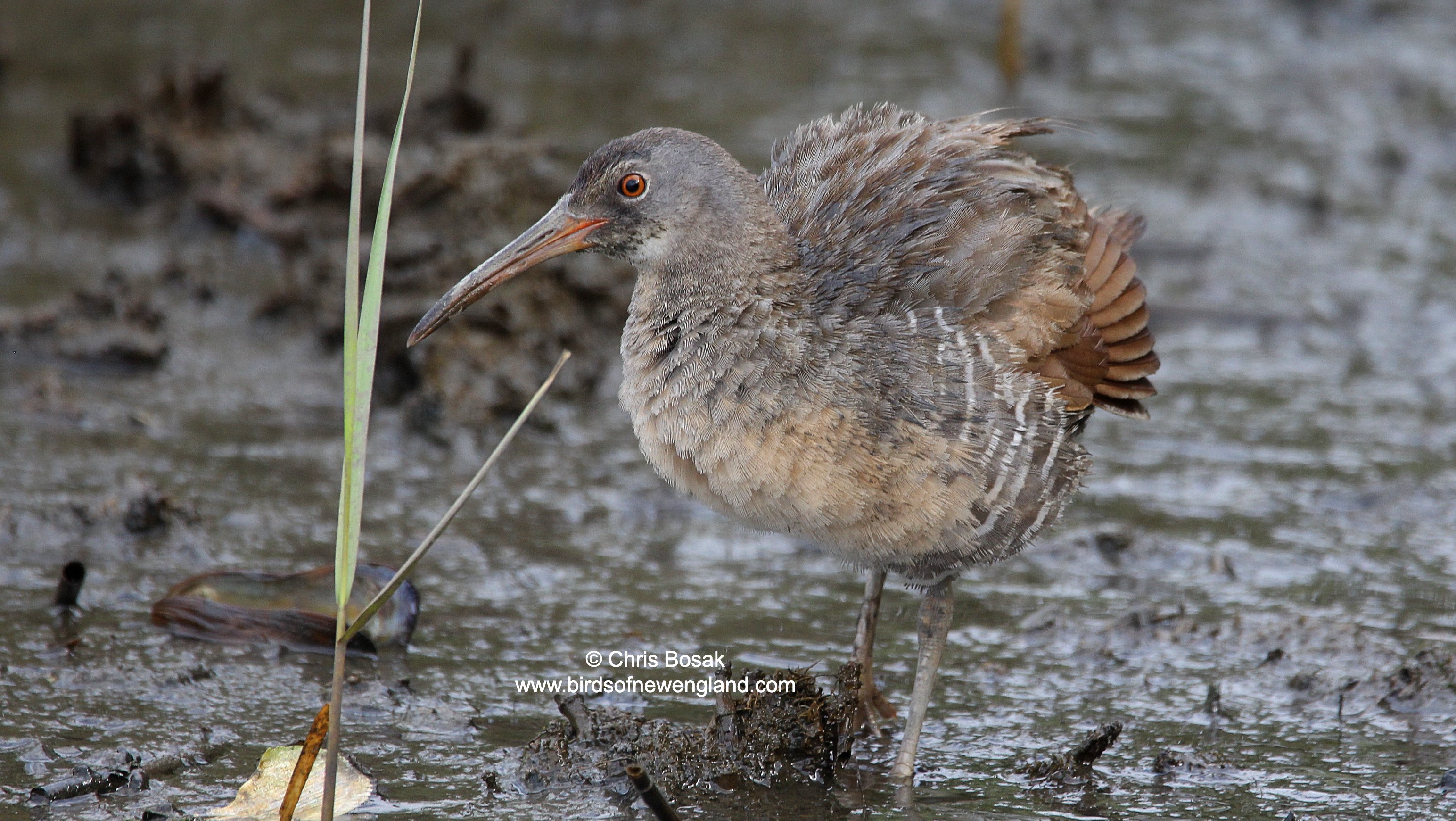
Photo by Chris Bosak Clapper rail in Milford, Connecticut, summer 2025.

I’ve written about a lot of different types of birds over the last 30 years. There are some birds I’ve likely written about hundreds of times, and some only a handful of times.

If I searched my “For the Birds” folder for chickadee, robin or woodpecker, I’d get hundreds of hits. If I searched for vireo or flycatcher, I’d get far fewer hits, but still a decent amount.

There’s one bird family found in New England I’m not sure I’ve ever written about or even mentioned within a column. It’s the rail family. Rails are small to medium-sized chicken-like birds of the marshes. The reasons I haven’t written about them before are fairly obvious: rails are not very common, live in a habitat that is difficult for humans to traverse and are extremely secretive.

New England has a few members of the rail family. Virginia rail is the most common and the one most likely to be seen in New Hampshire. Sora is the other most likely candidate in New Hampshire. Clapper rails may be found along the coastal regions of New England.

There are also yellow rails, black rails and king rails found in New England, but they are rarely seen. Virginia rail is the best bet, but even that is a chore.

Continue reading

For the Birds: Birds sightings can happen anywhere

Photo by Chris Bosak – A Cooper’s hawk eats a meal in New England, summer 2025.

“One of the nice things about birdwatching is …”

I’ve started many sentences with that phrase over the years. The backend of that line may be finished in almost innumerable ways:

… everyone, regardless of age or skill level, can enjoy it.

… it can be done during any time of the day or year.

… no two days are alike.

… there is always something new to learn or discover, regardless of how advanced you are.

… each time of year brings its own delights.

For the purposes of this column, the sentence will read: “One of the nice things about birdwatching is that it can be done anywhere.” Not many hobbies can be enjoyed in the woods, in a canoe or kayak, at a local park, or sitting in the kitchen looking out the window with your morning cup of coffee.

Continue reading

Northern pintail continues “Duck Week”

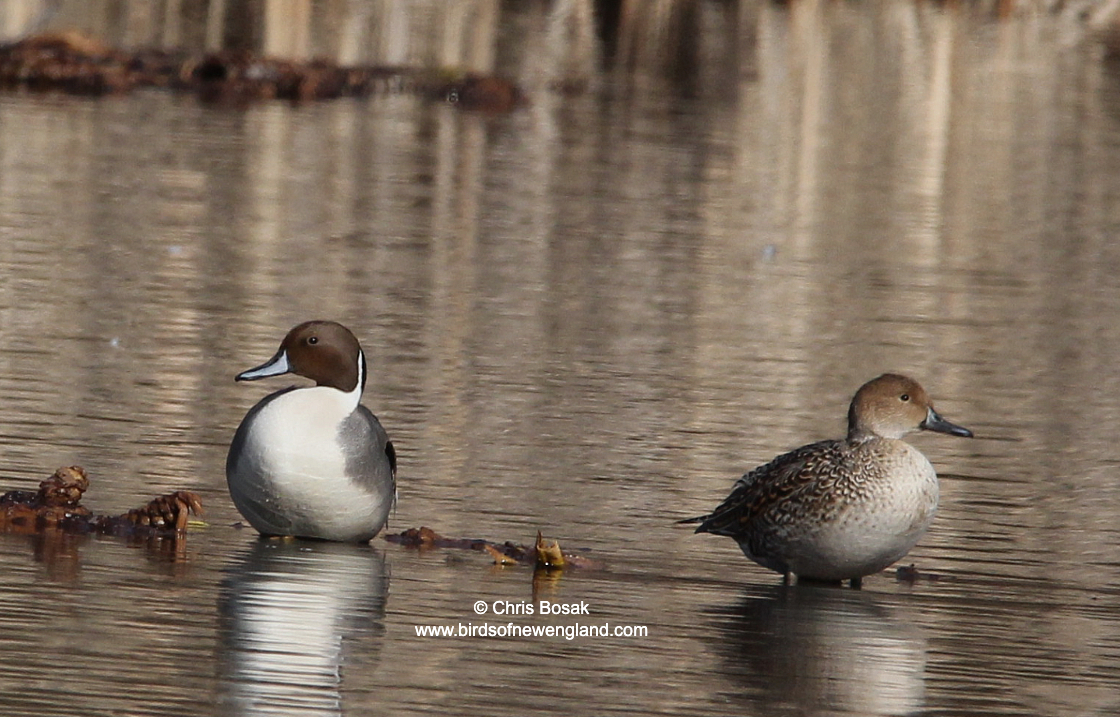
Photo by Chris Bosak Northern pintail pair at a pond in New England, March 2025.

The northern pintail is the next fowl up for birdsofnewengland’s Duck Week, a very unofficial declaration made by me because I have a lot of recent duck photos that need to be shared. Pintail drakes are one of the most handsome ducks we have in New England. If you missed the first Duck Week post, click here to meet the hooded merganser.

For more information about the northern pintail, click here.

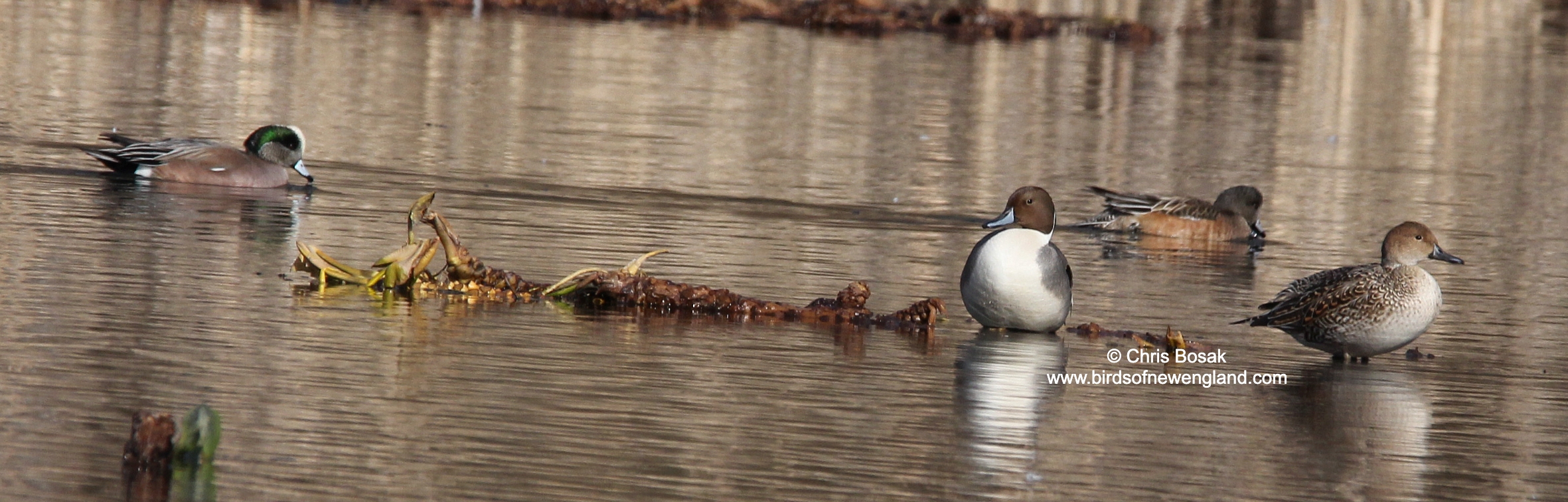
Photo by Chris Bosak
Here is that pintail pair with an American wigeon pair swimming behind them, March 2025.

For the Birds: Phoebes shine in the spring and fall

Photo by Chris Bosak An Eastern Phoebe perches on a branch in Selleck's Woods in Darien, Conn., in late March 2015.

They aren’t the most exciting birds on the planet, or even in New England for that matter. Eastern phoebes, however, are a bright spot in the region’s birdscape.


They don’t have flashy colors, impressive size or beautiful songs — in fact, just the opposite on all counts — but there is a lot to appreciate about eastern phoebes. My favorite thing about eastern phoebes is that they are one of the first migrant birds to return to New England in the spring. While most of the colorful songbirds return in late April or early May, phoebes come back to the region in mid- to late-March.   

Their early spring arrival comes just in time for many birdwatchers. About the time we are going stir crazy and desperate for new birds to arrive following many months of winter, the phoebes return and lift our spirits. Typically, I hear the first phoebe before I see it, and it takes a few seconds for the song to sink in and register. Then, when it hits me, I look frantically for the bird and, upon laying eyes on it, get a jolt of hope that spring is indeed coming. 

Continue reading

For the Birds: Osprey comeback a great conservation story

Photo by Chrisi Bosak An Osprey flies over Veterans Park in Norwalk, Conn., April 29, 2015.

New England’s ospreys left the region weeks ago for warmer temperatures in the south. That doesn’t mean, however, that they are forgotten.

The return of the osprey from dangerously low numbers is another hugely successful conservation story. Last week, in honor of Thanksgiving, I talked about the turkey reintroduction and how wild turkey numbers went from zero to goodness knows how many in New Hampshire over just the last 50 years or so. Ospreys have a similar successful conservation story.

Ospreys were at critically low numbers in the 70s and slowly started making a comeback due to conservation efforts on many fronts. The osprey population is now to the point where it is safe to say it is wildly successful.

I recall working for a newspaper in southern Connecticut in the early 2000s, and a pair of ospreys building a nest on a light tower at a local beach was literally front-page news. Ospreys hadn’t nested in that city in several decades. Now that town, Norwalk, has several dozen osprey pairs nesting in it. A similar story can be told about osprey up and down the Connecticut coast along Long Island sound. Inland osprey numbers are thriving as well.

Continue reading

‘Volunteer’ sunflowers brighten up flower box

Toward the end of last summer, I purchased a few coneflower plants at a greatly reduced price from a hardware store. I planted them in a large flower box on my deck and the plants flourished into late fall.

While in bloom, the plants made for a photogenic setting as birds perched on them before heading to a nearby feeder. Once the flowers died and went to seed, the plants were visited frequently by goldfinches, chickadees, titmice and other small birds. I certainly got my money’s worth from the plants. Here are some photos I took of the plants in action.

https://birdsofnewengland.com/tag/coneflower/

https://birdsofnewengland.com/2018/11/13/goldfinch-on-coneflower/

Here’s an icy shot of the tough plants.

https://birdsofnewengland.com/tag/birdsofnewengland-christmas-card/

Since coneflower is a perennial, I was looking forward to many years of similar success from these $2 plants. Unfortunately, the plants did not come back this spring. I never transported them out of the flower box and the winter’s hard freeze killed the roots.

But something else popped up this year — at an even better price. You can’t beat free. Remember I had mentioned the nearby feeders? Well, a few of the sunflower seeds that got knocked or carried into the box sprouted. I noticed them in the spring and recognized the tiny stems as sunflowers. Wouldn’t it be cool if they grew to become full plants, I thought at the time. Fast forward a few months and I have three healthy, flowering sunflowers in that flower box. They are not towering plants by any means, but that’s probably a good thing considering their location.

The birds are already using them as perches. I just saw a chipping sparrow on one a few hours ago. Now I can’t wait until later this summer and fall when birds start picking seeds out of the flowers. You know I’ll be posting plenty of photos when that starts to happen. Talk about getting your money’s worth out of a bag of sunflower seeds.

Has this or something similar happened in your garden? Drop me a line and let me know. You can comment on this site, Facebook (Birds of New England), or email me at chrisbosak26@gmail.com.

Great Backyard Bird Count personal results

Photo by Chris Bosak A white-breasted nuthatch sits on a bird-shaped birdfeeder during the winter of 2016-17 in Danbury, Conn.

As promised, here are the results of my Great Backyard Bird Count experience this morning. It wasn’t overly successful in terms of finding birds, but it wasn’t too bad either. At any rate, all checklists are valuable, so my 2019 GBBC list is in. Not that participants are limited to one checklist, and I may just do another one tomorrow as the Count runs through Monday.

My species list included: black-capped chickadee, tufted titmouse, white-breasted nuthatch, downy woodpecker, red-bellied woodpecker, dark-eyed junco, pine siskin, American goldfinch, hooded merganser, and ring-necked duck. The waterfowl, of course, I spotted at the pond at the end of the trail behind my house. The pond is 85 percent frozen, but open just enough to hold a small flock of ring-necks.

Feel free to share your highlights by commenting on this site or BirdsofNewEngland.com Facebook.

Since my species list wasn’t so great, here are photos of each bird I saw today. (Note: The photos were not taken today, but these are “file photos.”) Continue reading