Photo by Chris Bosak
A red-winged blackbird sings from the top of a tree at Happy Landings in Brookfield, Conn., spring 2017.
March is a crazy and unpredictable month for wildlife watching.
One day you’re completely absorbed by winter. You bundle up, head outdoors and see all the nature that our coldest months have to offer.
The next day it appears as if spring has the upper hand. The winter birds seem to have disappeared and early migrants, such as red-winged blackbirds and eastern phoebes, fill the warm air with breeding and territorial songs. In the evening, the chorus of spring peepers dominates the airwaves.
In recent years, I have proclaimed our coldest season as the Winter of … whatever bird is being seen in unusually high numbers that winter. I remember the Winter of the Snowy Owl in 2014 and the Winter of the Barred Owl in 2019 (that winter was crazy with all the owls being seen throughout New England.) Juncos and robins have also made the list.
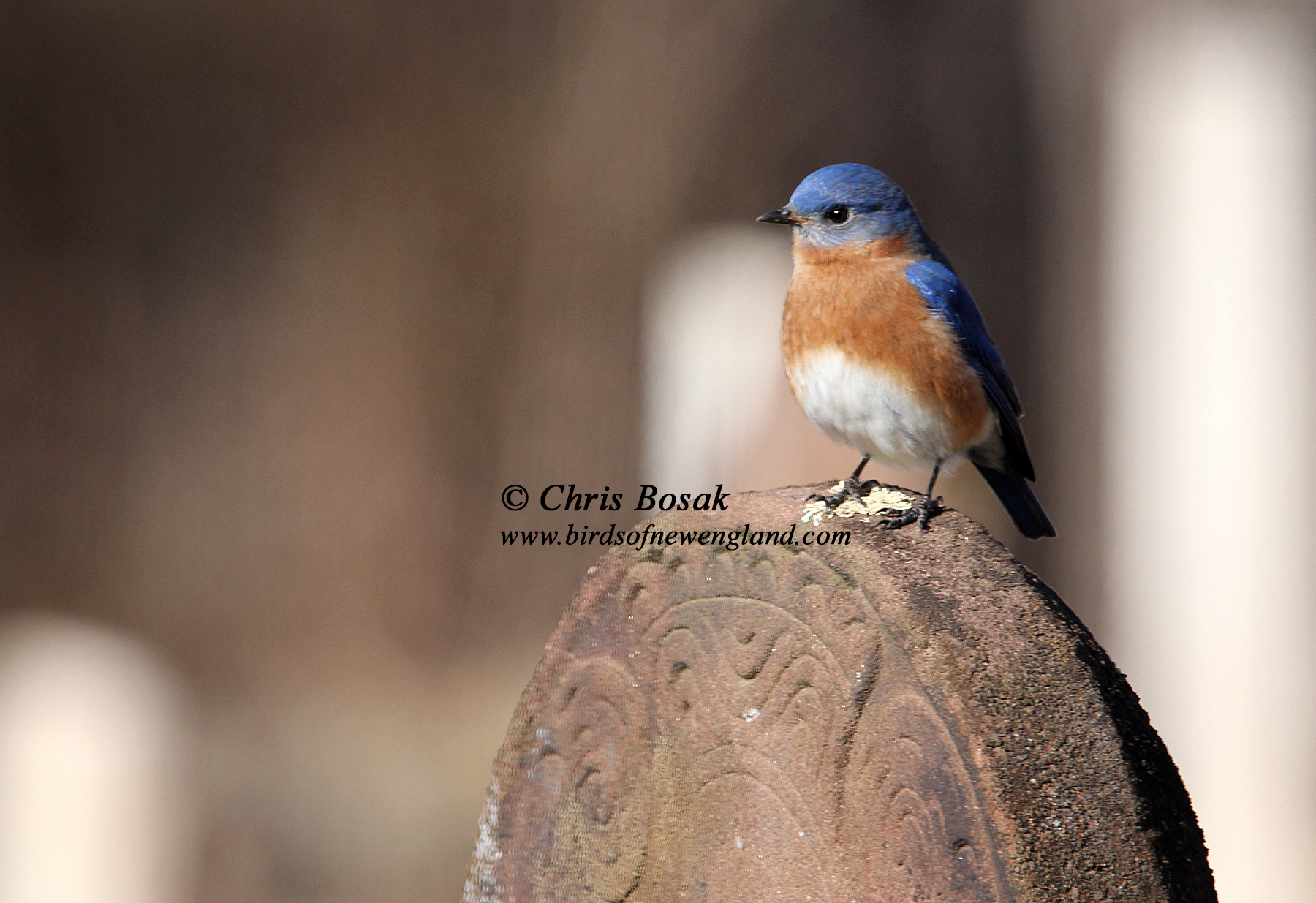
But this year, for the second time in three years, it has to be the Winter of the Bluebird. It is the first repeat selection. I should probably mention here that this is strictly my own proclamation based on my personal experiences and emails received from readers. There is absolutely nothing scientific about this.
I’ve seen bluebirds in a variety of locations this winter. I haven’t been lucky enough to attract them to my house, but I have received several emails from readers who have seen bluebirds in their yards. Many readers have sent along photos, which I appreciate and post to my blog.
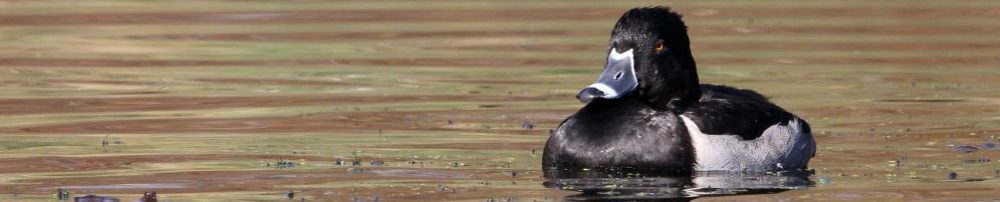
March is a good time to look for ducks, assuming, of course, there is some open water.
I took a short drive the other day to a large reservoir and found that the water was still largely frozen. There were plenty of open spots, however, and one, in particular, caught my attention. I saw mallards from a distance and zeroed in to see if anything else was lurking there.
The mallards I had seen were not mallards at all but a pair of American black ducks. Male and female black ducks resemble female mallards from a distance with their overall bland coloring and similar size and shape. A closer look revealed the black duck’s darker coloration. Male black ducks also have a yellow bill, similar to a male mallard’s bill. The females of both species have duller bills.
American robin on snowy branches in New England, Feb. 2022.
It appears to be a good winter for juncos, blue jays and goldfinches, based on feedback from readers. Other than a few reports of pine siskins, it doesn’t seem to be a particularly strong winter for the typical irruptive species as sightings of redpolls, grosbeaks and red-breasted nuthatches have been scarce.
I’ll add American robin to the list of birds that have been seen in abundance this winter. This doesn’t mean that spring is here already, of course. As I write this, a winter storm is predicted for the next day. Several more weeks of winter-like weather are ahead of us, I’m sorry to say.
Photo by Chris Bosak
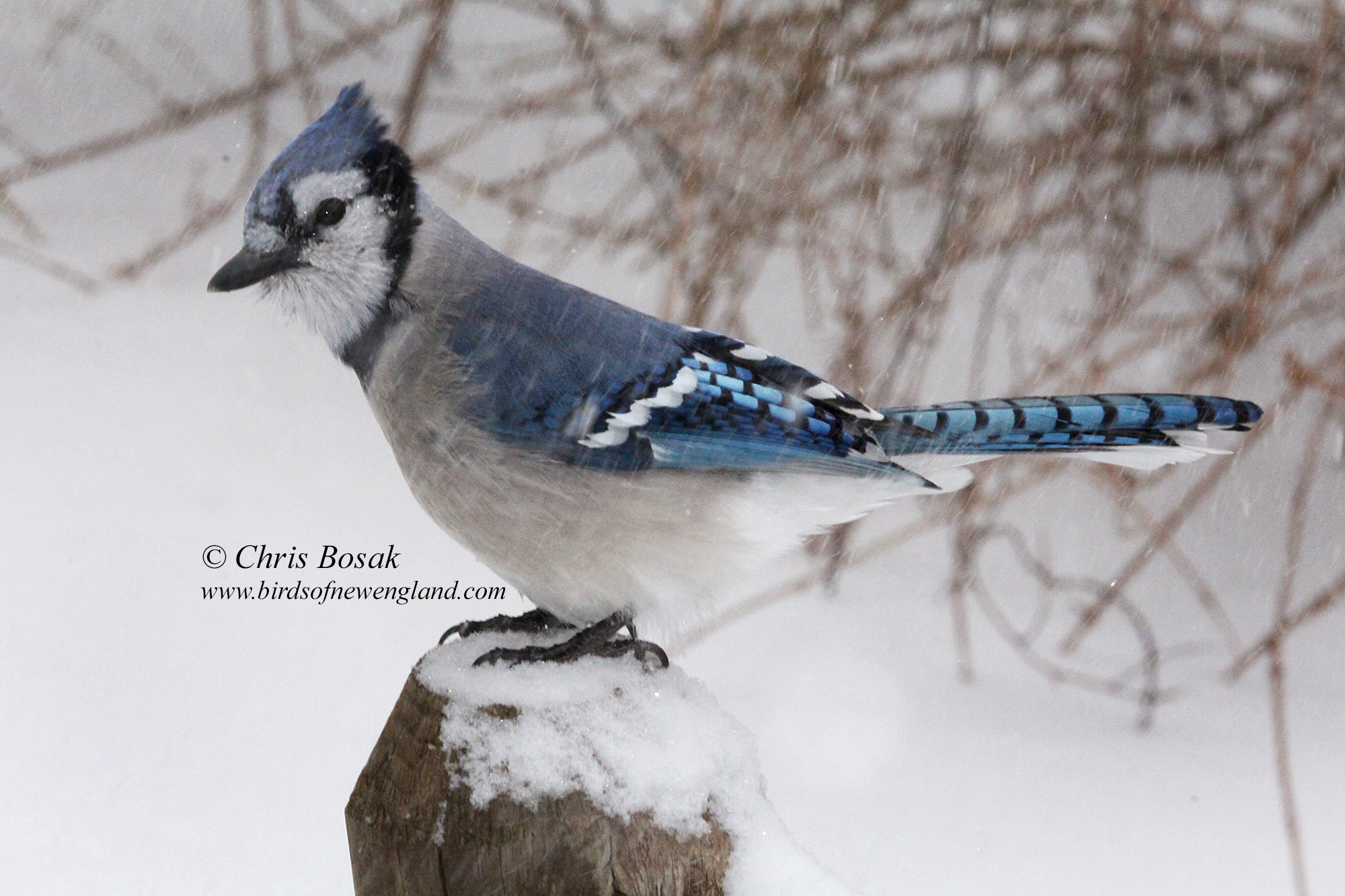
A blue jay stands on a fence post during a snowstorm in New England, Jan. 2022.
The reports keep coming in, so why not dedicate another column to what our neighbors are seeing in their yards?
Eric from Surry wrote to say he can’t keep up with the goldfinches and pine siskins and their appetites for thistle (Nyjer) seed. He said it’s been a while since goldfinches have visited his yard in large numbers, but this winter has been different.
Eric also has a few Carolina wrens that have been around all winter, while juncos have been around in large numbers. The juncos, as well as a handful of cardinals visit early, so Eric has to make sure the feeders are filled before dawn. Now that’s dedication to the birds and this great hobby. He also gets the usual woodpeckers in addition to red-bellied woodpeckers and yellow-bellied sapsuckers.
Photo by Chris Bosak An American goldfinch perches on a coneflower head.
At a certain point, my shared driveway splits in two. My neighbor is off to the right. I’m on the left. A row of about 10 eastern hemlocks separates the driveways.
The other day as I drove down the driveway before it splits, I noticed hundreds of little hemlock cones under the trees. Maybe thousands. It instantly brought me back to one of my favorite winter birding moments.
I was still relatively new to birdwatching when I took a long walk in Pisgah State Park. The park has several entrance points. The one I used on this day was my favorite entrance. The trail from the parking lot leads down a long hill. Once at the bottom of the hill, it’s like the rest of the world is a million miles away. No houses, cars or anything. Just woods and other interesting habitats to explore and enjoy.
Photo by Chris Bosak
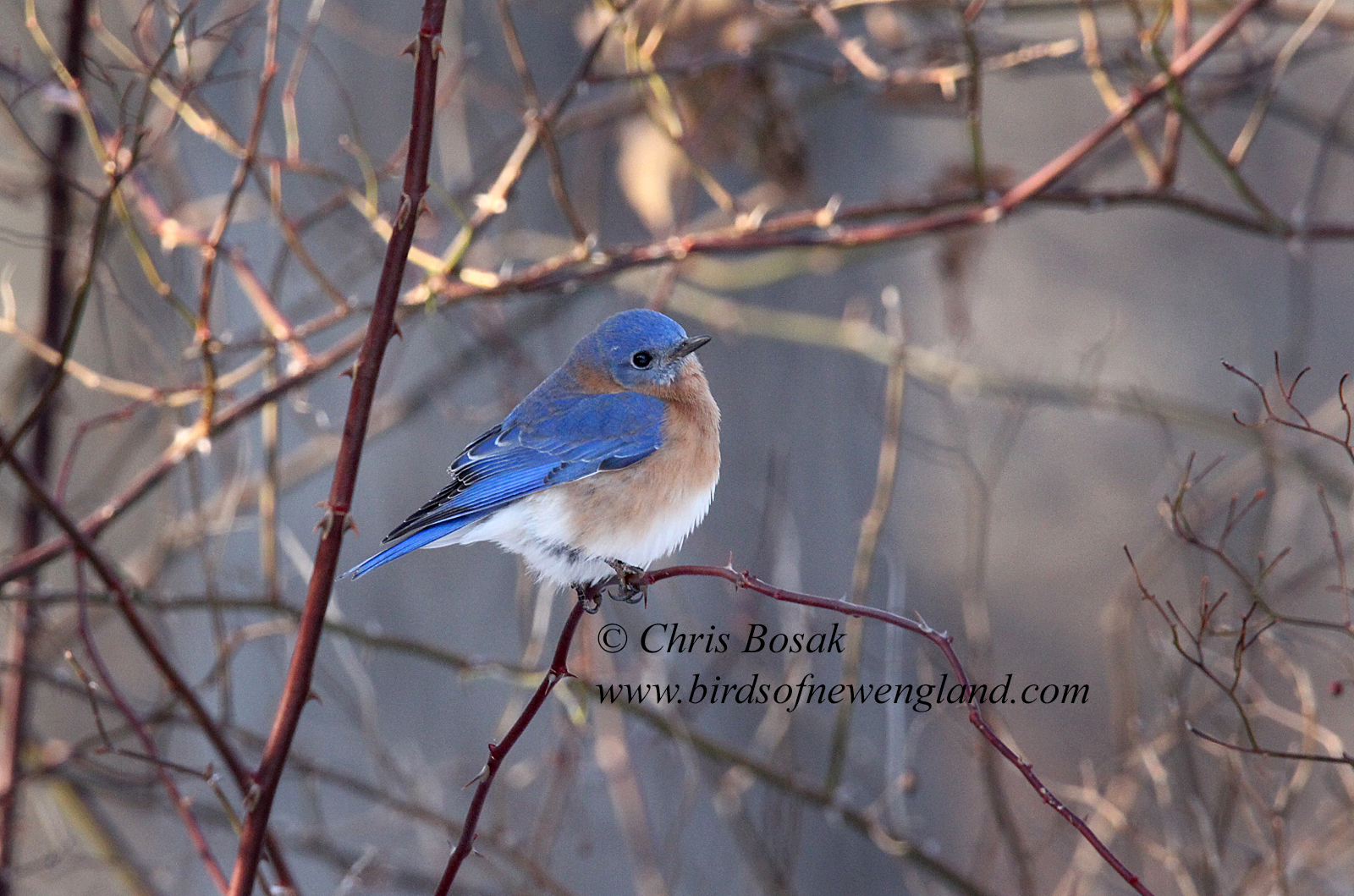
An eastern bluebird perches on a branch in New England, Jan. 2022.
My foot was finally feeling a little better so I figured I’d try a short bird walk. Turns out, it wasn’t ready for prime time. I walked a few hundred yards on the uneven snowy terrain and had to turn back.
The little I did manage to walk was along a wood’s edge with good, thick brush forming a barrier, perfect for birds to hide in. A lone white-throated sparrow and a lone tree sparrow were the only birds I saw, however. There was also a male cardinal, but he never left his protected spot among the bramble and I could spy only specks of red.
On my way back, I noticed a white-breasted nuthatch and a woodpecker in a big tree beyond the truck. I figured it was worth a closer look because I had seen a yellow-bellied sapsucker in that very tree some time ago. It turned out to be a downy woodpecker, and it had flown off to a more distant tree by the time I hobbled over there anyway.
Not all was lost, though, as the detour led me to a small flock of eastern bluebirds. Some were perched in the low branches of a nearby tree, and some were in the brush picking at berries of some sort.
Photo by Chris Bosak
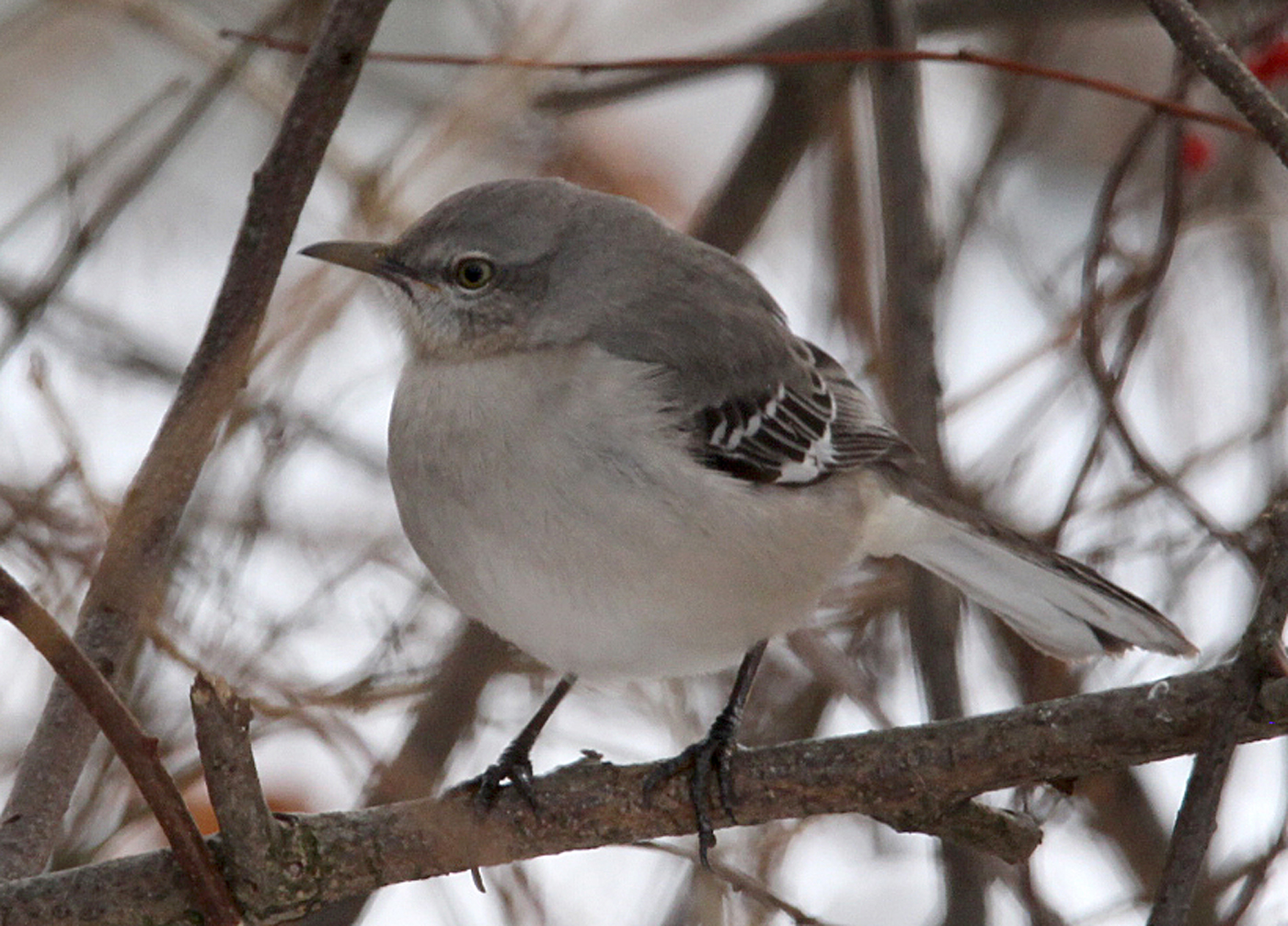
A northern mockingbird perches on a branch following a snowfall in New England, January 2022.
Single-digit temperatures and heavy snow always make me think of the birds that tough out New England winters.
There are many birds that, instead of taking a risky migration journey, opt to stay here and take their chances with the cold. We see these birds at our feeders and in our woods every day. Whether a bird migrates or stays put, there are inherent risks and rewards.
Birds that migrate face an arduous journey fraught with obstacles, including but certainly not limited to tall buildings, wind turbines, cell towers, dangerous weather, exhaustion and destruction of their wintering grounds. Once they get to their destination, however, they are rewarded with abundant food and warm temperatures. Of course, they have to make the trip all over again in the spring.
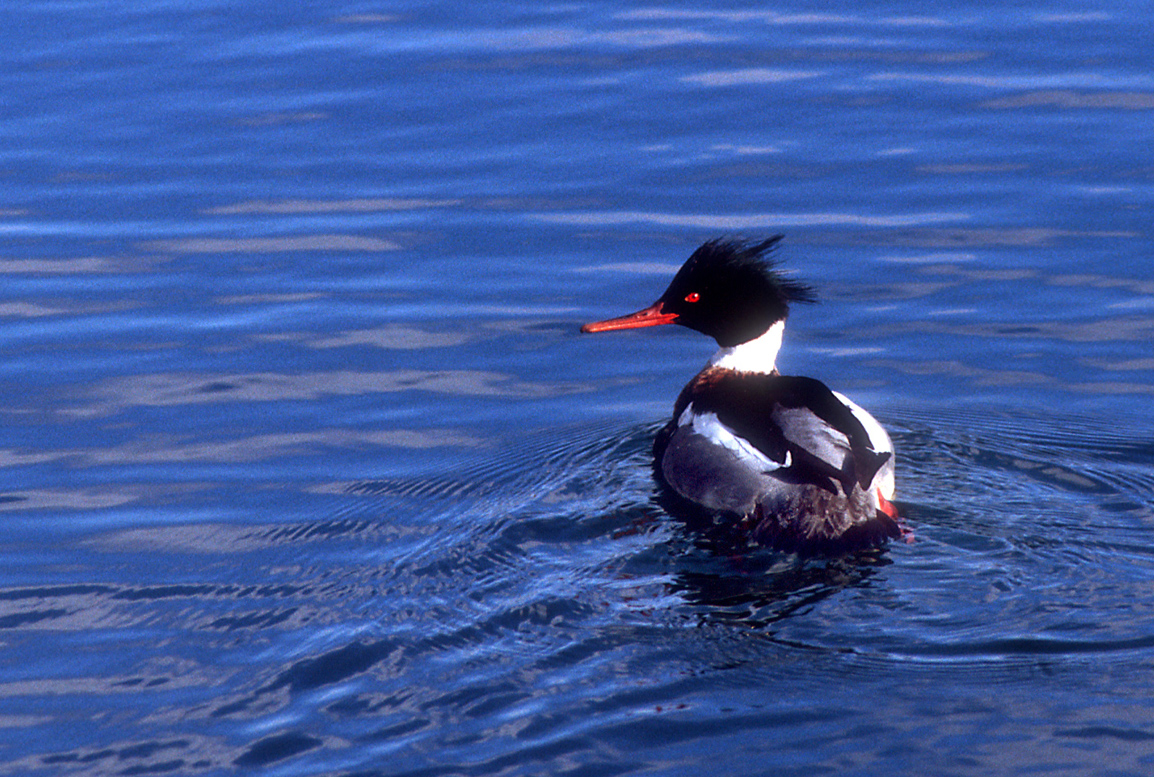
Photo by Chris Bosak Red-breasted mergansers may be seen throughout winter on the ocean or Long Island Sound.
There are always two ways to look at something.
I don’t remember what it was advertising, but I recall an old television commercial wherein one guy says: “Camping? I hate camping. There’s nobody around.”
The next guy on camera, within the same friend group of the first guy but unaware of what he said, says: “Camping? I love camping. There’s nobody around.”
I guess it all depends on your personal preferences and motives.
Photo by Chris Bosak
Ring-billed gulls at a beach in New England.
Gulls? Who would want to write a column about gulls? Or, perhaps more importantly, who would want to read a column about gulls?
Well, I think gulls deserve a little ink considering how easy they are to find and how many of them there are. Nary a visit to any body of water goes by when you don’t see gulls, whether you want to or not. Not many parking lot visits go gull-less either.