Yellow-headed Blackbird in Stamford, CT

Photo by Chris Bosak A Yellow-headed Blackbird perches in a tree at Cove Island Wildlife Sanctuary in April 2014.

Photo by Chris Bosak
A Yellow-headed Blackbird perches in a tree at Cove Island Wildlife Sanctuary in April 2014.

By now you may have heard about a Yellow-headed Blackbird that has been hanging around Cove Island Wildlife Sanctuary in Stamford, Conn. If not, don’t worry. I was a little late to the game, too.

But on Sunday morning I took a trip over there to see if the bird was still around. A birder from Rowayton was already there looking at the bird, which was at the main feeding station within the sanctuary. It remained only a few seconds before taking off to the top of a nearby tree. It returned after a few minutes and fed on the ground under the feeders for several minutes.

Yellow-headed Blackbirds are rare sightings in New England. They are western and Midwestern birds. I love my New England Red-winged Blackbirds, but Yellow-headed Blackbirds are even more colorful and much larger. Having never seen on in New England before, I was very impressed with the bird’s color, size, yellow rump patch and white wing patches.

David Winston arrived and said the bird had been there for several days and it frequented the feeding station. Suddenly the birds all darted off into the woods and other safe areas. While the bird was elsewhere temporarily, David Winston took the opportunity to make sure the feeders were filled and the ground underneath had plenty to offer. David is tireless in his efforts to promote and maintain the sanctuary.

Photo by Chris Bosak David Winston fills the feeders at Cove Island Wildlife Sanctuary this weekend, hoping to keep a rare Yellow-headed Blackbird in the area.

Photo by Chris Bosak
David Winston fills the feeders at Cove Island Wildlife Sanctuary this weekend, hoping to keep a rare Yellow-headed Blackbird in the area.

See more photos of the bird (taken by David Winston) by clicking here.

David spotted a Cooper’s Hawk in a somewhat distant tree, hence the apprehension for the feeder birds to stay at the feeder. Eventually the hawk flew off and the blackbirds came back. By now a few more birders had arrived and the star of the show returned.

In the field guide “Birds of North America” Kenn Kaufman mentions something about the Yellow-headed Blackbird’s “awful attempts to sing.” I can now vouch for that as the Stamford bird vocalized several times while I was there.

I returned very briefly this afternoon (April 28, 2014), but did not see the bird. Truthfully, I didn’t look that hard today. Time was short. Hopefully it’s still around and many other birders will be able to see it.

Another great rarity spotted at Cove Island Wildlife Sanctuary.
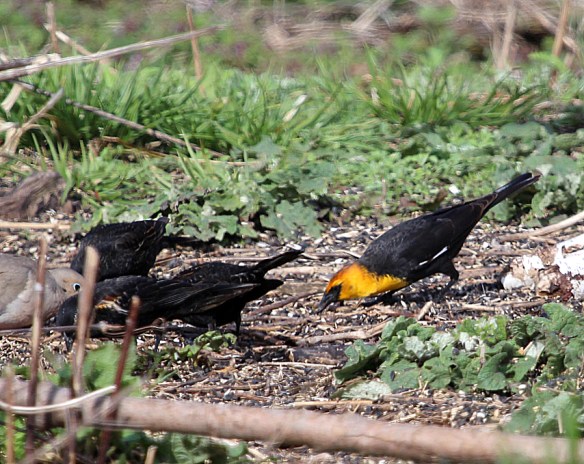
Photo by Chris Bosak A Yellow-headed Blackbird eats seeds under a feeder station at Cove Island Wildlife Sanctuary in April 2014.
Photo by Chris Bosak
A Yellow-headed Blackbird eats seeds under a feeder station at Cove Island Wildlife Sanctuary in April 2014.

Piping Plover monitoring update

Photo by Chris Bosak Piping Plover at Coastal Center at Milford Point, April, 2014.

Photo by Chris Bosak
Piping Plover at Coastal Center at Milford Point, April, 2014.

So I woke up the boys for school, got them breakfast and rushed them to the car for drop off. I turned into the school parking lot: empty. No school. Scheduled “staff development” day. If I had a nickel for every time I’ve done that. Damn.

Oh well. I’ve committed to monitoring Piping Plovers and other shorebirds and, later, Least Terns on a volunteer basis on Monday mornings through the spring and summer. “Boys, we’re going shorebird monitoring.”

They didn’t object and Will was actually excited and wanted to carry the camera with him. I filled them in on what we were looking for and, more importantly, why we were looking for them. Piping Plovers are a threatened species and protecting their nesting areas is critically important.

We saw about 10 Piping Plovers today (Monday, April 21, 2014), including a pair copulating. “That’s how they make babies,” I told Andrew and told him how to spell ‘copulation.’ He was the official note taker for the day.  Wonder if he’ll try to use that word in one of his fifth-grade essays. It’s OK as long as he uses it correctly and age appropriately, I guess.

We also saw eight American Oystercatchers, a pair of Osprey and countless shells, which entertained the boys as much as the birds.

All in all, a good, educational day with the boys. Thank goodness school was out.

Photo by Chris Bosak A Piping Plover preens at Milford Point in spring of 2014.

Photo by Chris Bosak
A Piping Plover preens at Milford Point in spring of 2014.


A few late ducks — and other fowl sightings

Photo by Chris Bosak Horned Grebe at Cove Island Park in Stamford, CT, April 2014.

Photo by Chris Bosak
Horned Grebe at Cove Island Park in Stamford, CT, April 2014.

While watching a small flock of Ruddy Ducks at Cove Island Park in Stamford, CT, a Horned Grebe made an appearance. The grebe was in a transitional plumage and will look quite different a few weeks from now.

Most of our “winter ducks” have flown north already, but some still linger. The Ruddy Ducks were a good sighting and there are still several Red-breasted Mergansers around. Soon, It will be mallards and black ducks for southern New England.

The Ruddy Duck photos are below:

Continue reading

Just a few gratuitous Killdeer photos

Photo by Chris Bosak A Killdeer at a cemetery in Darien, CT, April 2014.

Photo by Chris Bosak
A Killdeer at a cemetery in Darien, CT, April 2014.


I’ve always liked Killdeer. They depend on large, flat open spaces to lay their eggs. As that habitat disappears, Killdeer have proven to be very resourceful. I’ve seen Killdeer nests (really just a small depression in the ground) in places such as parking lots, ball fields and cemeteries. These guys I photographed this week at a cemetery in Darien. I have plenty of Killdeer shots already, but I couldn’t resist.

To add in one fact about Killdeer to make this post at least a little informative — they are one of the species that will use the “broken wing” tactic to keep predators away from their eggs and young. As a predator (or unwitting human) approaches the nest, the parent will walk away from the eggs to divert the attention. To keep the interest of the predator the adult Killdeer will pretend it has a broken wing and limp along the ground. When the predator is sufficiently away from the nest, the adult will fly away, leaving the predator dumbfounded and hungry.

One more quick fact: Killdeer are shorebirds, and are indeed found along the shore at times, but are usually found far from the shore.

Thanks for visiting http://www.birdsofnewengland.com

Photo by Chris Bosak A Killdeer at a cemetery in Darien, Conn., April 2014.

Photo by Chris Bosak
A Killdeer at a cemetery in Darien, Conn., April 2014.

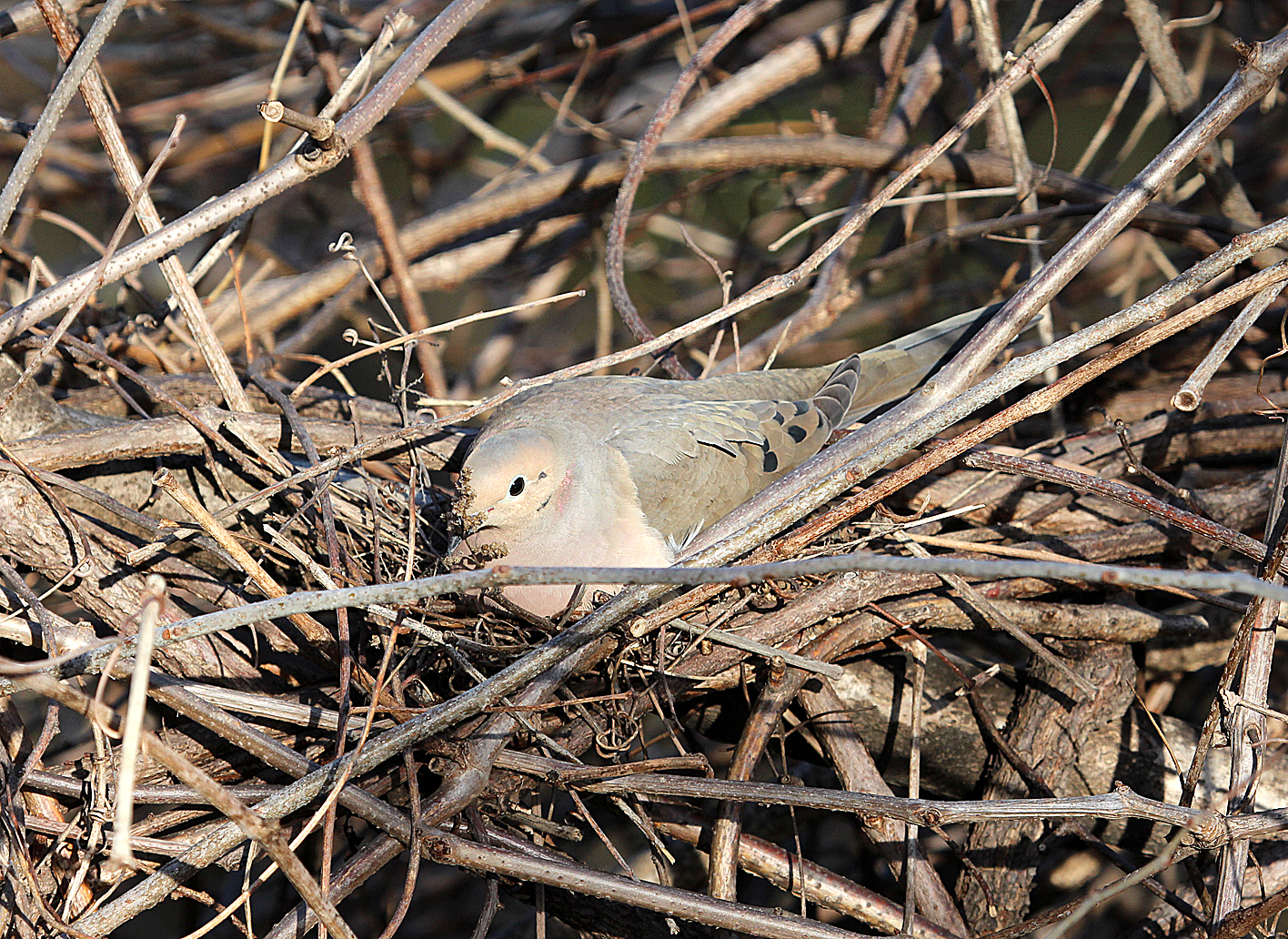
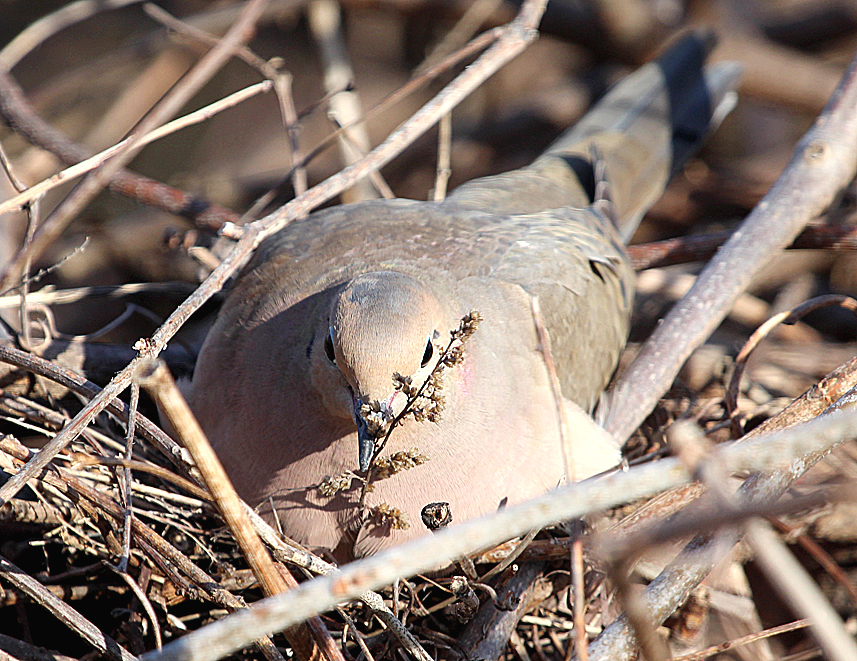
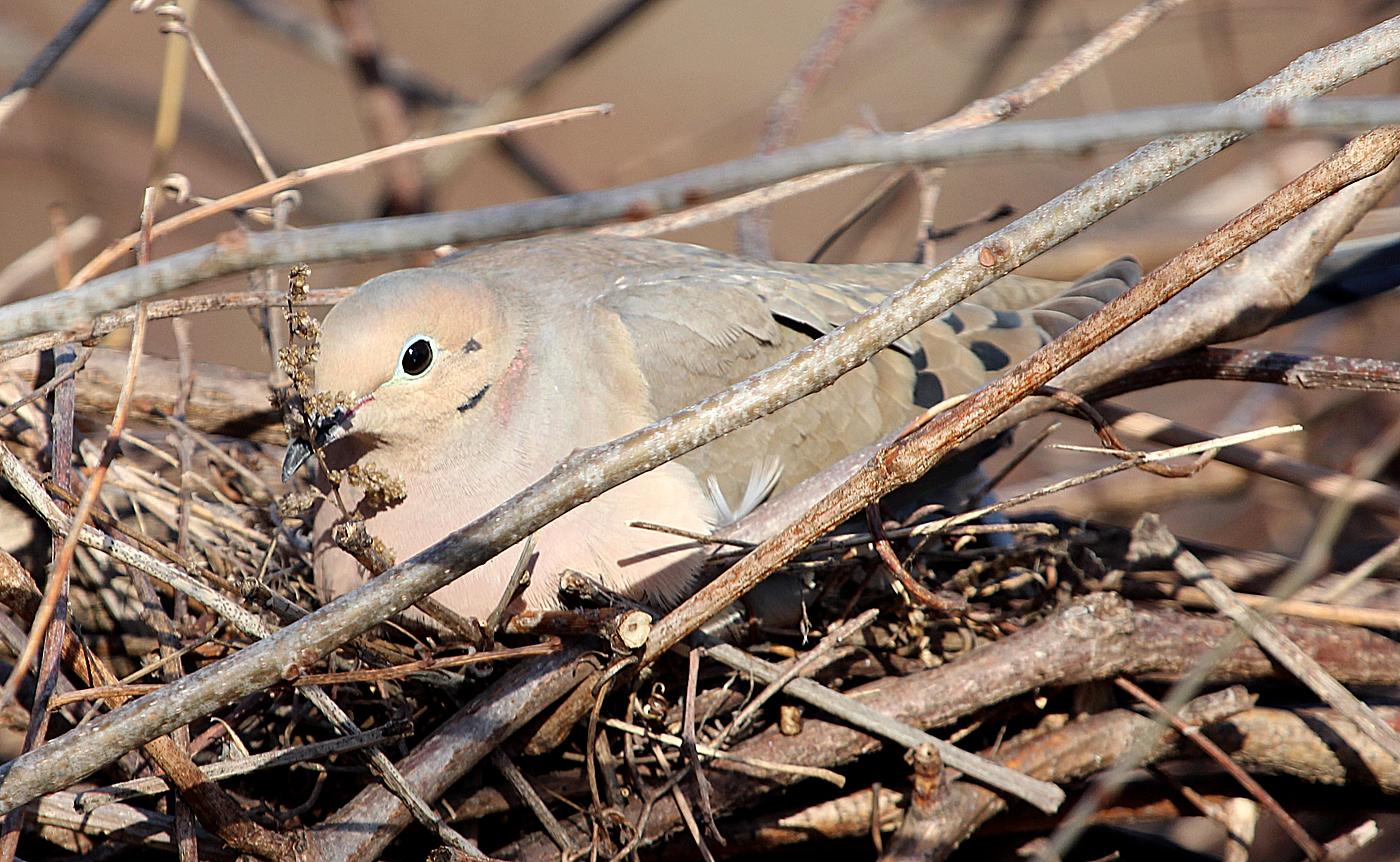
Mourning Dove sitting on nest

Photo by Chris Bosak A Mourning Dove sits on a nest at Oyster Shell Park in Norwalk, CT., April 1014.

Photo by Chris Bosak
A Mourning Dove sits on a nest at Oyster Shell Park in Norwalk, CT., April 1014.

I came across the Mourning Dove during a quick walk through Oystershell Park in Norwalk, Conn., this morning. Yes, despite the late start to spring weather, the birds are right on time with their nesting.

Photo by Chris Bosak A Mourning Dove sits on a nest at Oyster Shell Park in Norwalk, CT., April 1014.

Photo by Chris Bosak
A Mourning Dove sits on a nest at Oyster Shell Park in Norwalk, CT., April 1014.

Check out the camouflage nature of this nest. The tangled, twisted sticks and vines are colored similarly to the dove itself. Amazing that birds can do these things. I did not approach too closely and allowed the bird to remain comfortable on its nest.

Have a bird nesting on your property? Grab a photo and send it along. I’ll use it on my “reader submitted photo” page. Remember to give the birds space and not to be intrusive — they have an important job to do. Send photos to bozclark@earthlink.net

Photo by Chris Bosak A Mourning Dove sits on a nest at Oyster Shell Park in Norwalk, CT., April 1014.

Photo by Chris Bosak
A Mourning Dove sits on a nest at Oyster Shell Park in Norwalk, CT., April 1014.

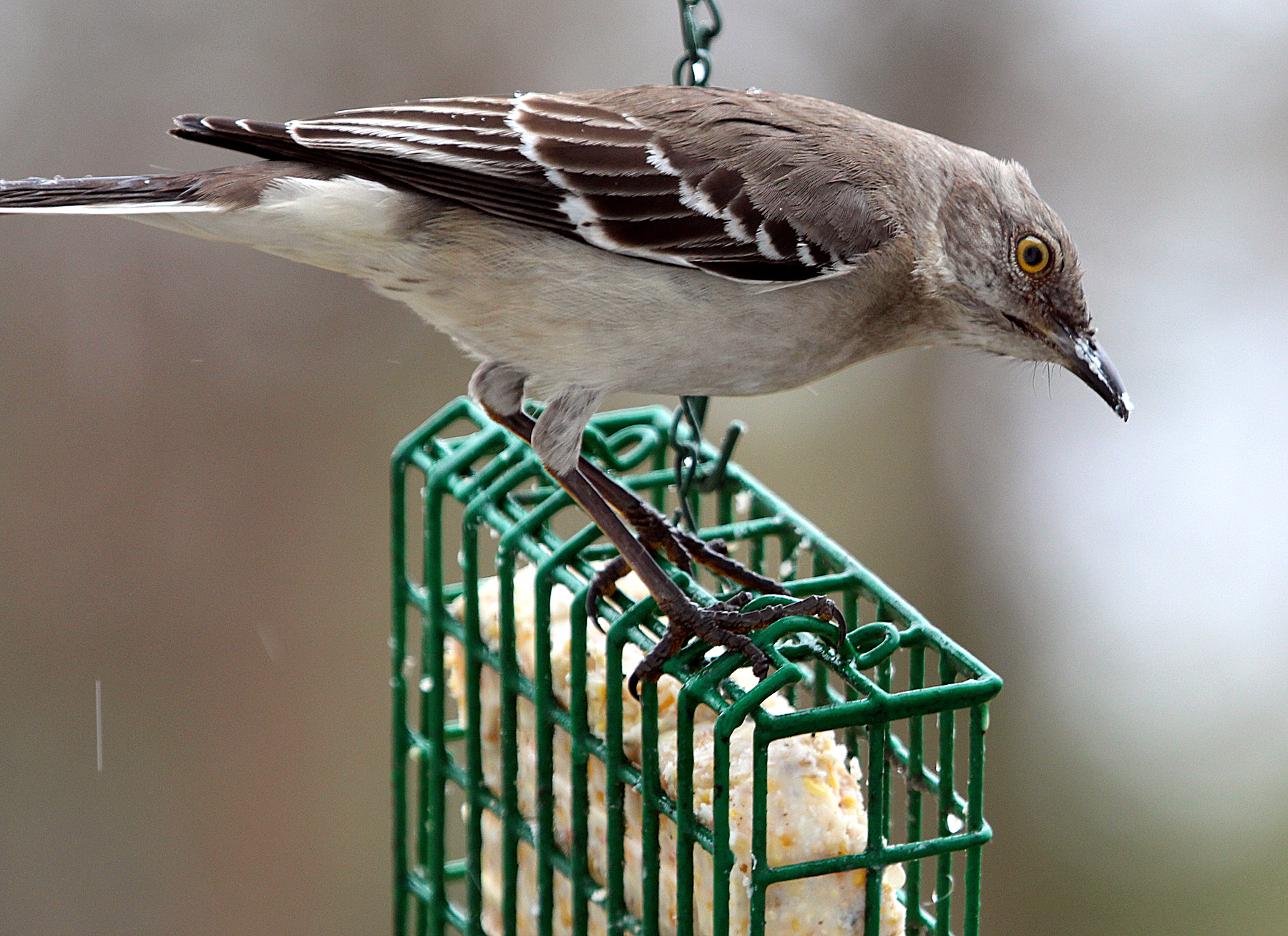
Mockingbirds are liking the suet

Photo by Chris Bosak A Northern Mockingbird visits a suet feeder as snow falls in March 2014 in Stamford, CT.

Photo by Chris Bosak
A Northern Mockingbird visits a suet feeder as snow falls in March 2014 in Stamford, CT.

It’s not often that I see Northern Mockingbirds at my feeders. I see them often enough, just not at the feeders. But for the past week or so, a pair of mockers have been regular visitors to the suet cake feeder. They split time with a pair of Downy Woodpeckers that has been visiting all winter.

Mockingbirds will begin their incredible singing performances soon. They will perch somewhere (often a very conspicuous spot) and sing their hearts out, going over their repertoire over and over. As its name suggests, the song is a long string of other birds’ calls. Personally, I always hear mockers include the Carolina Wren’s “tea kettle” song in their mix.

Have a mockingbird story? Feel free to comment. Thanks for visiting http://www.birdsofnewengland.com

David Allen Sibley talks about the Snowy Owl irruption

Photo by Chris Bosak A Snowy Owl flies across the beach at The Coastal Center at Milford Point in early March 2014.

Photo by Chris Bosak
A Snowy Owl flies across the beach at The Coastal Center at Milford Point in early March 2014.

I’ll post parts of my David Allen Sibley interview throughout the next few weeks. Here he talks about the great Snowy Owl irruption of winter 2013-14.

Why it’s called a Ring-necked Duck (even though ring-billed would make more sense)

Photo by Chris Bosak Ring-necked Duck in Darien, March 2014.

Photo by Chris Bosak
Ring-necked Duck in Darien, March 2014.

It took years for me to start calling this duck by it’s proper name: Ring-necked Duck. I would invariably blurt out “Look, Ring-billed Duck.” But, unlike the Ring-billed Gull, this bird is not named for an obvious ring around its bill.

Instead it is named after a hardly-noticeable ring around its neck. Conditions, including the posture of the duck, need to be right to even see the neck ring. The ring around the bill, however, is obvious in most conditions, unless the duck is sleeping with its bill tucked into its back feathers. Even the female, which is mostly brown in color, has a ring around her bill. (She also has a faint ring around her neck.)

So why Ring-necked Duck? Ornithologists in the 1800s named many birds by studying dead specimens. Apparently with the bird so close the chestnut colored neck band is more obvious, so it was named as such. It doesn’t make a lot of sense to the average birder (like me) in the field, but it is what it is. The above photo shows both the ringed neck and ringed bill of the beautiful duck.

Ring-necked Ducks are seen throughout New England, mostly in fresh-water ponds and lakes, from late fall through early spring.

Photo by Chris Bosak A pair of Ring-necked Ducks rest at a pond in Darien, March 2014.

Photo by Chris Bosak
A pair of Ring-necked Ducks rest at a pond in Darien, March 2014.

An interview with David Allen Sibley

Example of Sibley guide's second edition.

Example of Sibley guide’s second edition.

David Allen Sibley, the renowned birdwatcher and field guide author/artist, was kind enough to grant me and The Hour an interview about his recently released second edition of The Sibley Guide to Birds. I picked him up at the train station, drove to The Hour offices in Norwalk, and did the interview. I was hoping for some time to do some birdwatching, but alas, time was tight and it just didn’t happen. Not really anyway (read the column ((link attached)) for more details.)He sat down with The Hour photographer Erik Trautmann and me and I fired a bunch of random birding questions at him. We started, of course, with the field guides but then, as my interviews normally do, we headed off in all kinds of directions.It was a great time and I’m glad David took the time to do the interview in our office. Click here for the column and accompanying video of a portion of the interview. I will add to this website more audio of the interview in the coming days.

Thanks for visiting http://www.BirdsofNewEngland.com


Oh, and there’s a loon


Photo by Chris Bosak A Red-throated Loon swims in Norwalk Harbor in this March 2014 photo.

Photo by Chris Bosak
A Red-throated Loon swims in Norwalk Harbor in this March 2014 photo.

I drove past Veterans Park the other day and, as is usually the case in winter, I pulled in to see what winter ducks might be around. I immediately spotted a female Red-breasted Merganser swimming somewhat near the shore. It was cloudy and the light was no at all ideal, but I managed to get a few very average photos of the bird.

It kept moving south slowly until it came up on a male Bufflehead. The two birds ignored each other, but for a brief moment they were mere feet away from each other. I snapped a few (again average) photos.  I always like to see birds together that you don’t always see “hanging out” near each other.

As I was photographing the merganser and Bufflehead I noticed out of the corner of my other eye a loon close to the shore. When did that pop up? I wondered. Loons are diving birds (as are mergansers and Buffleheads) and often “pop up” far from where they dove. I refocused and took some shots of the loon. It was a Red-throated Loon, a somewhat common occurrence in the Norwalk Harbor and Long Island Sound. They breed in the Arctic and some spend their winters here in New England. Common Loons, which breed in northern New England and farther north, are also fairly common birds in the winter around here. The loons will be heading north soon so I was happy to get this late sighting.

Soon enough the loon I was photographing dove again. I never did see where it popped up next.

Photo by Chris Bosak A Red-throated Loon swims in Norwalk Harbor in this March 2014 photo.

Photo by Chris Bosak
A Red-throated Loon swims in Norwalk Harbor in this March 2014 photo.

Photo by Chris Bosak A female Red-breasted Merganser swims in Norwalk Harbor in this March 2014 photo.

Photo by Chris Bosak
A female Red-breasted Merganser swims in Norwalk Harbor in this March 2014 photo.


Photo by Chris Bosak A female Red-breasted Merganser and a male Bufflehead swim in Norwalk Harbor in this March 2014 photo.

Photo by Chris Bosak
A female Red-breasted Merganser and a male Bufflehead swim in Norwalk Harbor in this March 2014 photo.