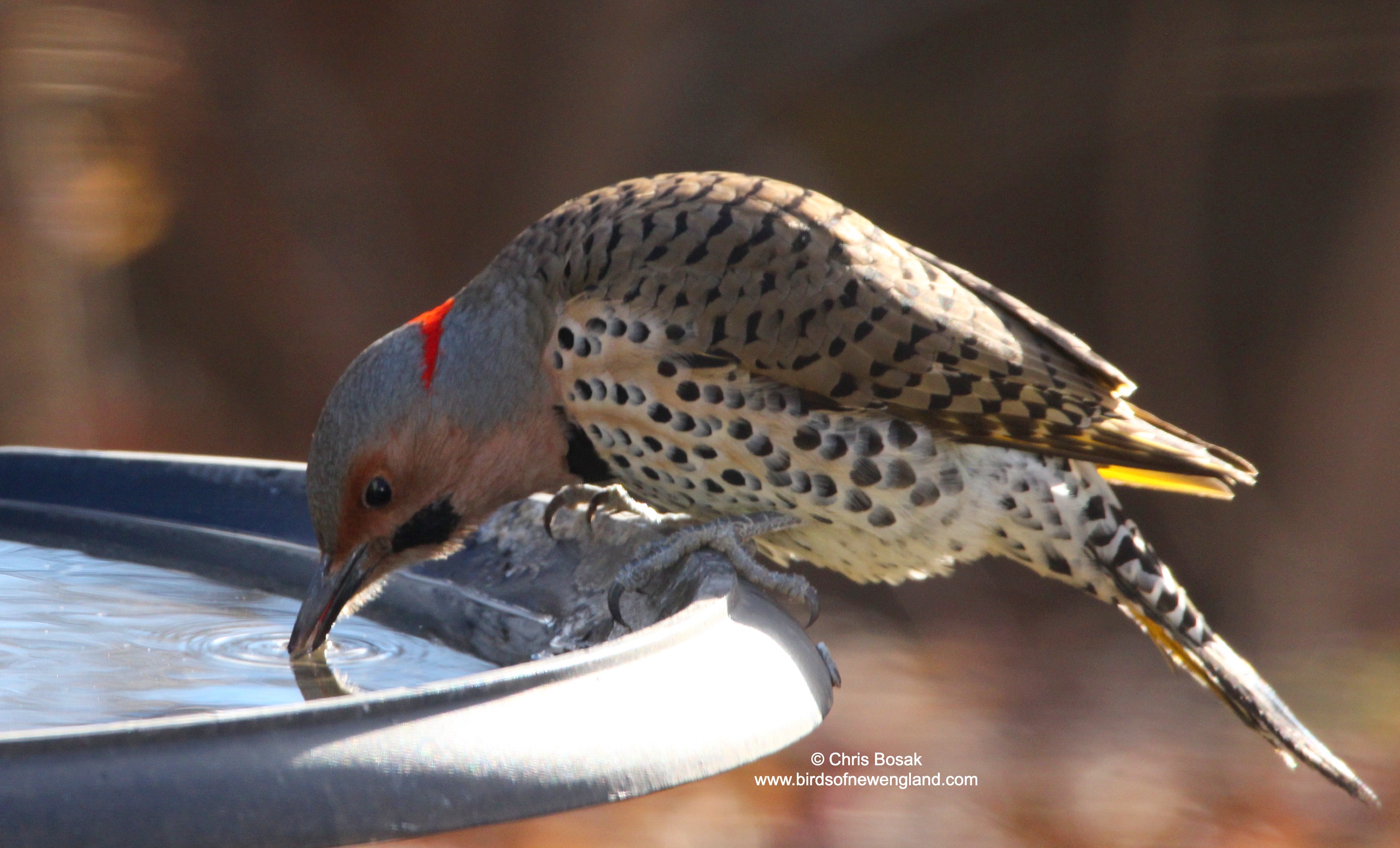
Photo by Chris Bosak A northern flicker sips from a birdbath in New England, fall 2025.
I looked out and saw that the water in the birdbath was a solid block of ice. I poured in enough warm water that the ice broke free, so I tossed the frozen block onto the ground and filled the bath with warm water. Within 10 minutes, a northern flicker arrived and took a few sips. What a design on this bird.
Great blue heron in snow, Christmas Bird Count 2025, Stamford, CT.
It was that type of day for the Christmas Bird Count today (Sunday, Dec. 14, 2025). Frank and I did the Cove area of Stamford (Connecticut) and nearby Darien.
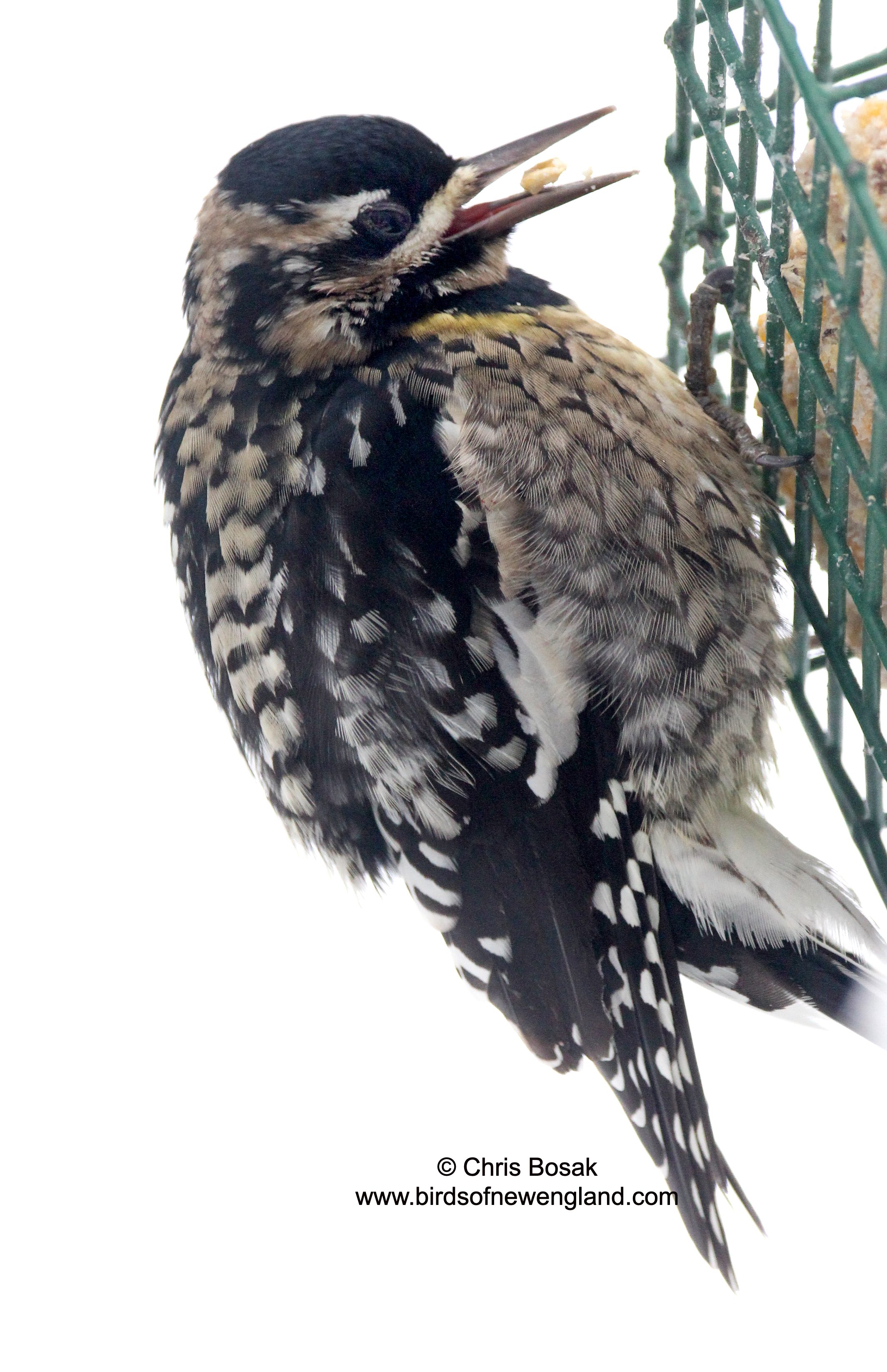
The heavy snow in the morning kept many of the land birds hidden, but many of the water birds were still around, braving the elements. A few highlight species were: harlequin duck (one female), greater white-fronted goose, killdeer, yellow-bellied sapsucker, and snow bunting.
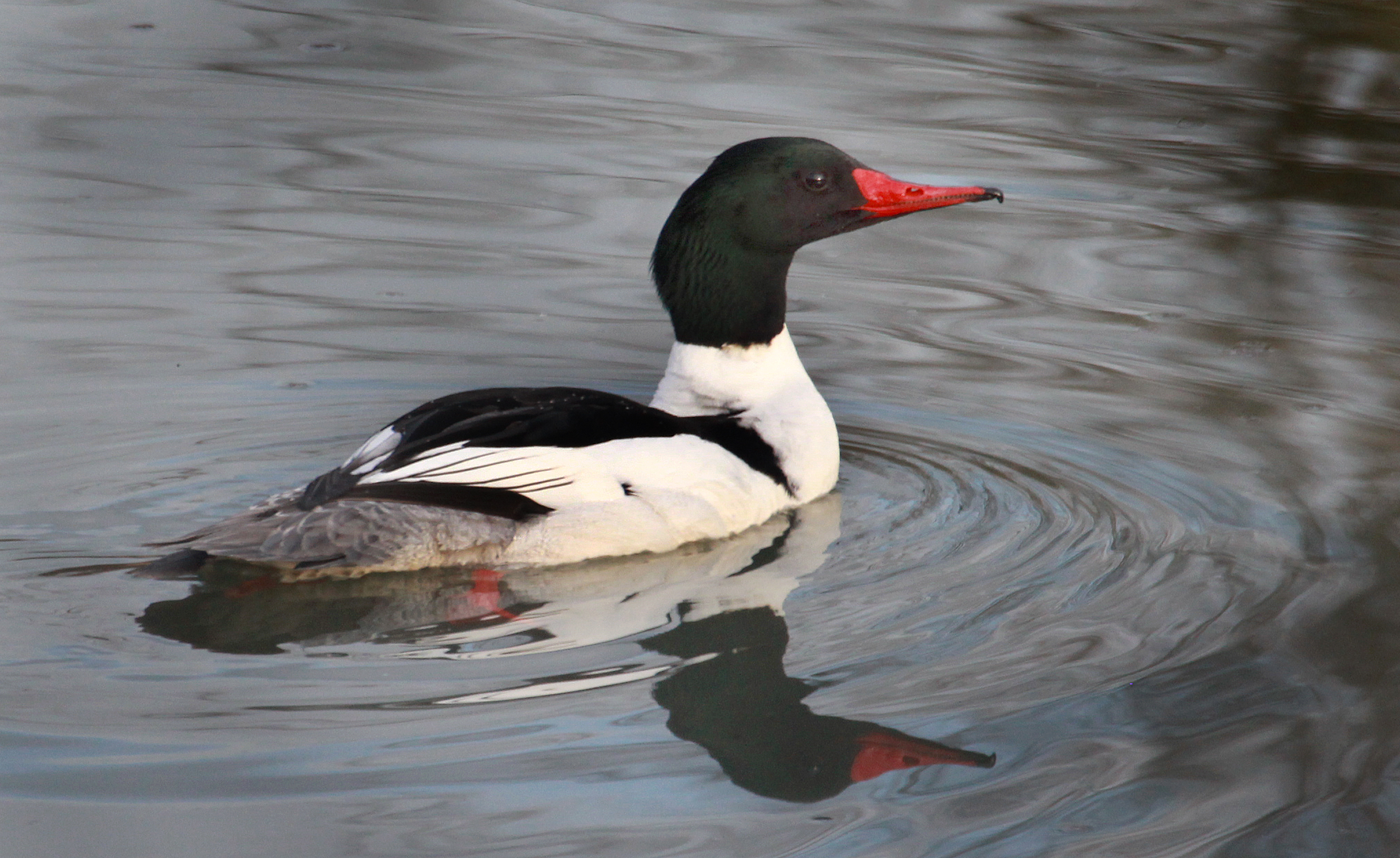
Photo by Chris Bosak Hooded mergansers in the snow, Christmas Bird Count 2025, Stamford, Connecticut.Female harlequin duck, Christmas Bird Count 2025, Stamford, Connecticut.Three greater white-fronted geese with one Canada goose, Christmas Bird Count 2025, Darien, Connecticut.
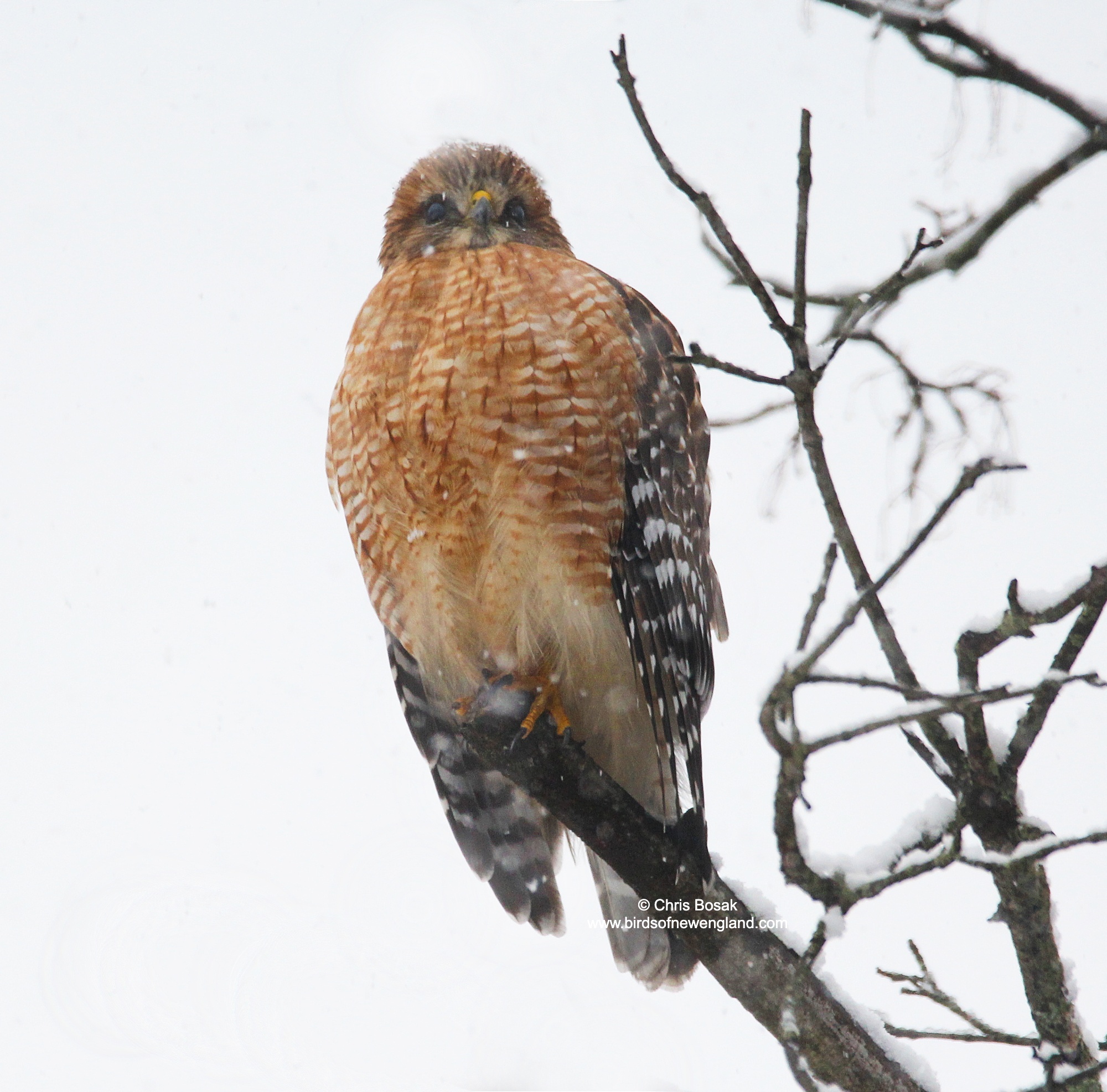
Photo by Chris Bosak Young Cooper’s hawk in New England.
Last week’s For the Birds column highlighted the results of this year’s fall hawkwatches with a particular focus on Pack Monadnock in Peterborough. The column was heavily focused on data and the number of birds counted.
A number of questions came up in my head as I looked at the results and compiled the data. Not one to let questions go unanswered in my head, I turned to the experts for some explanations.
Specifically, I had an enjoyable chat with Phil and Julie Brown of Hancock, N.H. Phil is the Bird Conservation Director and Land Specialist at the Harris Center for Conservation Education. His wife, Julie, is the Raptor Migration and Program Director of the Hawk Migration Association.
The sheer number of broad-winged hawks was the main thing that jumped out at me as I looked at the data last week. Nearly 6,000 of the 8,500 hawks counted during the 2025 fall migration at Pack Monadnock were broad-winged hawks. To me, it was a bit surprising, as I see red-tailed hawks and red-shouldered hawks all the time, but I rarely see broad-winged hawks.
As a quick reminder, “hawkwatch” in this sense includes eagles, ospreys, falcons and vultures as well.
Julie and Phil explained that broad-winged hawks tend to be more elusive during the breeding season and that they more readily form flocks for migration than other raptors. While most hawks pass over the mountain as one or two birds at a time, broad-winged hawks pass over in huge numbers on certain days.
“They are responsible for a lot of the magic of hawkwatches,” Julie said. “Many people say broad-winged hawks are what got them hooked on hawkwatches.”
While the broad-winged hawk migration is truly a spectacle, with as many as 3,000 or more seen on a single day, it is very time specific. September 14-20 is the sweet spot when nearly all of the broad-wingeds pass through. Phil said many people take the entire week off from work to not miss the right day.
Mark your calendars for the middle of next September and keep your eyes out for a forecast that calls for light or variable winds from the north (or northeast or northwest), particularly following a cold front.
As remarkable as 3,000 birds in a single day is, Julie pointed out that critical hawkwatching sites such as Veracruz, Mexico, can get hundreds of thousands of broad-winged hawks in a single day.
I had a similar question about sharp-shinned and Cooper’s hawks, smallish but fierce hawks that often terrorize birdfeeders. While we tend to see more Cooper’s hawks in our daily lives, sharp-shinned hawks far outnumber Cooper’s hawks on counts. Cooper’s hawks have adapted much better to suburban and urban areas, and many overwinter in New England.
Differentiating between these accipiters often leads to debate, as the species are very similar in appearance. Cooper’s hawks are generally larger, but size is not a reliable determining factor. Even experts debate which bird they are looking at.
Seeing one of these hawks from a distance during a hawkwatch makes for an easier identification, Phil said, as their wing-flapping cadence and other behaviors are reliable differentiators.
Despite the seemingly high numbers of sharp-shinned hawks that are counted on hawkwatches, the Browns said the species is in decline. Phil said sharp-shinned hawks, goshawks, American kestrels and northern harriers do not get the attention they deserve for their decline.
Julie said rodenticides are a major factor in the decline of many hawks, and wildlife rehabilitators are often overwhelmed by the number of poisoned hawks that are brought in. Many people who use rodenticides do not realize the consequences, she said, and education is important in reversing the trend.
“It’s so preventable,” she said.
To end on a positive note (it is the holiday season, after all), the Browns actually met during a hawkwatch on Pack Monadnock in 2006. Julie was a seasonal hawk counter for New Hampshire Audubon, and Phil worked for New Hampshire Audubon at the time. They met on the mountain and got to talking about their love of nature and the boreal forest. Their main goal that day was to see a golden eagle, and sure enough, one of the magnificent birds flew over.
Their wedding bands are adorned with etchings of a golden eagle and the profile of Pack Monadnock.
Photo by Chris Bosak
A broad-winged hawk perches in a tree in northern New Hampshire, July 2020.
The fall hawkwatching season is winding down. Raptor sightings at the various dedicated locations are slowing down, with only a handful of birds counted each day as November progresses.
It’s a good time, therefore, to check in to see how the various hawkwatching sites fared this year. New England has several popular sites, but Pack Monadnock at Miller State Park in Peterborough is New Hampshire’s most active and popular site. The hawk count is a project of the Harris Center for Conservation Education in Hancock.
As of November 11, and according to hawkcount.org, overall numbers look good in 2025 at Pack Monadnock and outpace the number of hawks counted in 2024. It may be noted, however, that 2025 numbers are below the several years prior to 2024. With the official count season ending there on November 20, Pack Monadnock will end up with about 8,500 hawks counted for the fall.
The term hawk is used somewhat loosely here as the count includes hawks, eagles, ospreys, vultures and falcons. The hawks are counted by experts and volunteers who sit at the peak of Pack Monadnock and watch the birds soar in from the north. I’ve been to several hawkwatch sites and am always amazed at the skills of the official counters. They see and identify most of the birds long before the bird is even in view of most other people.
Before reading on, can you guess what hawks are counted the most? Hint: One bird stands head and shoulders above the rest in terms of sheer numbers. Another hint: It’s not the red-tailed hawk, which I assume would be many people’s first guess.
That bird is the broad-winged hawk. Of the roughly 8,500 birds counted at Pack Monadnock this fall, nearly 6,000 (5,821 to be precise) were broad-winged hawks. A distant second is the sharp-shinned hawk with 1,133.
Simple math (even though I used a calculator) shows that broad-winged and sharp-shinned hawks account for more than 80 percent of the total birds counted. The number drops sharply again for the third-most-counted “hawk,” the turkey vulture, with 222 individuals counted.
For all you stat geeks out there (like me), the next birds in line are American kestrel (196), Cooper’s hawk (190), osprey (167), bald eagle (159), red-tailed hawk (154) and northern harrier (121). Remember, these are not final numbers, but they will be pretty close.
Although “only” five golden eagles were counted, I’m sure each one elicited some oohs and aahs from the crowd.
According to hawkcount.org, a page that aggregates hawkwatch sites across the country, a few New Hampshire schools performed mini-hawkwatches this September. Concord School District did a week-long program and counted, you guessed it, mostly broad-winged hawks. Turkey vultures were also counted in fairly high numbers.
Interlakes Elementary School in Meredith did a two-day count and found an impressive 1,350 broad-winged hawks, including 1,257 in a single day. Sharp-shinned hawks and turkey vultures were the next highest counts.
The aptly named Hawk Mountain Sanctuary in Kempton, Pennsylvania, is perhaps the most well-known hawkwatch site in the East. Similar to Pack Monadnock, broad-winged hawks were the most numerous, accounting for 9,015 of the 13,436 overall birds counted. Sharp-shinned hawks were next with 1,530.
If you missed this year’s hawk counts, mark your calendars for next year. You don’t want to miss mid-September, which is when the number of broad-winged hawks peaks. More than 3,000 broad-wingeds were counted on September 14 at Pack Monadnock. The conditions must have been right just on that day. October is a good month to see a variety of species, while things start to slow down by November.
The end of hawkwatching season means that winter is right around the corner. Winter may bring out a bah humbug from many, but it is also a great time for birdwatching, just in a different way.
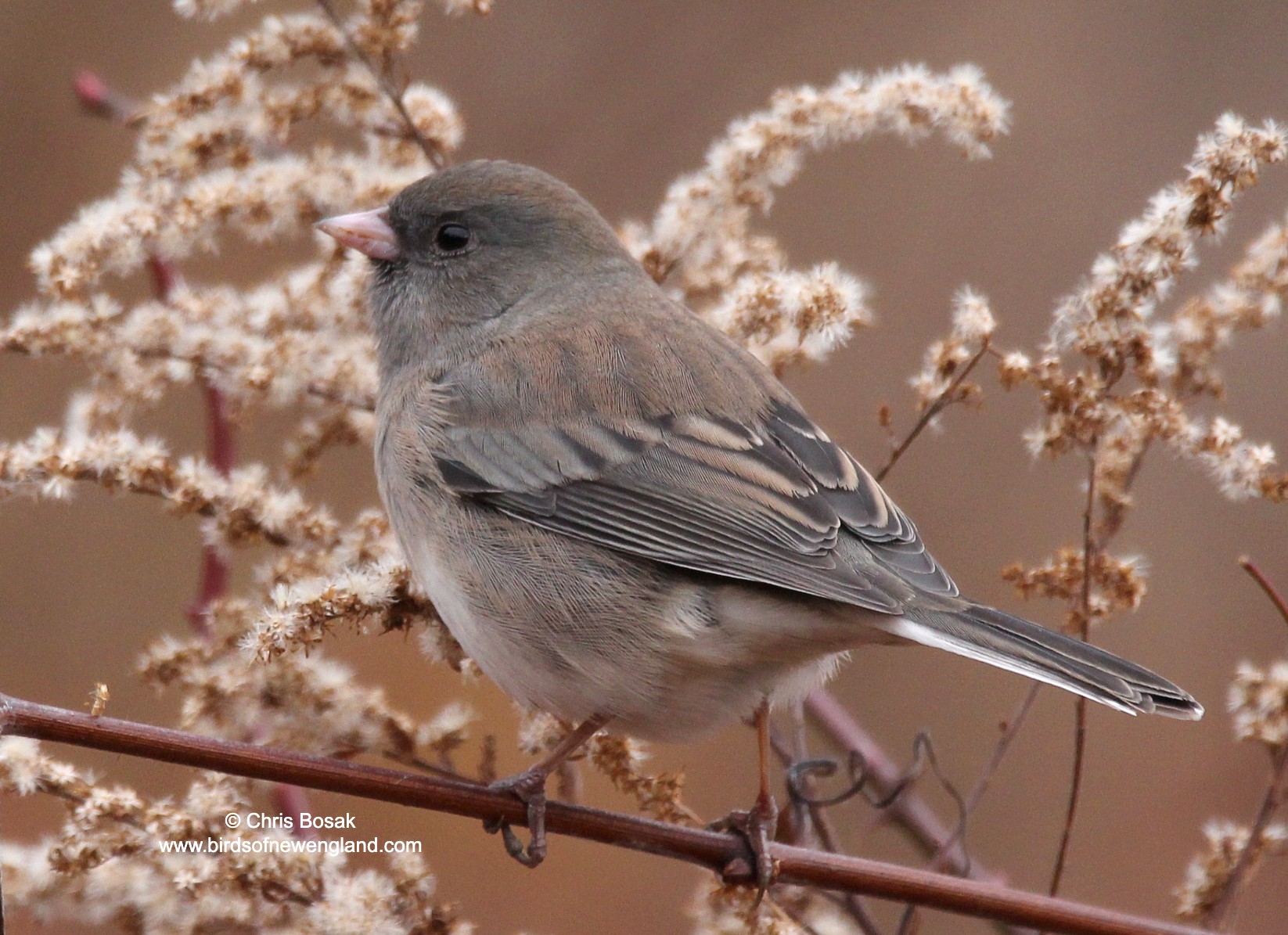
Photo by Chris Bosak – A dark-eyed junco eats goldenrod seeds at Huntington State Park in Redding, Connecticut, November 2025.
Here are a few more photos of my experience with juncos in the goldenrod field recently. See the last “For the Birds” column for the whole story. On a side note, now you know what goldenrod looks like after the yellow flowers die off.
Thanks for your support of Birds of New England.com.
Photo by Chris Bosak – A dark-eyed junco eats goldenrod seeds at Huntington State Park in Redding, Connecticut, November 2025.Photo by Chris Bosak – A dark-eyed junco eats goldenrod seeds at Huntington State Park in Redding, Connecticut, November 2025.Photo by Chris Bosak – A dark-eyed junco eats goldenrod seeds at Huntington State Park in Redding, Connecticut, November 2025.
Photo by Chris Bosak – A dark-eyed junco eats goldenrod seeds at Huntington State Park in Redding, Connecticut, November 2025.
Have you seen any videos of kayakers being surrounded by whales?
I’ve seen a few such videos. I’m not sure where they were filmed, but I’m reasonably sure they are real and not AI-generated. Of course, it’s getting harder to tell these days.
While being surrounded by whales would be a moment you’d never forget, I’m not sure I’d want to experience it. I didn’t get into bird- and wildlife-watching for extreme, brush-with-destiny experiences.
I did, however, have a similar experience last week. Granted, this was far less risky and would never go viral on social media, but for me, it was a moment I won’t soon forget.
I came to the part of the trail where it exits the woods and cuts through the middle of a smallish meadow, about the size of a football field. Like most meadows, it looks vastly different depending on the season. In the spring, it is lush green and the flowers, weeds and grasses seem to grow by the hour. In the summer and early fall, colorful blooms take over the scene, and the growth is so thick that the trail becomes impassable. I tried plowing through the trail once in the summer and was covered with ticks by the time I reached the other side. I’m not doing that again.
In the fall, after the goldenrod has faded but before winter applies its death grip, the field is a pleasing palette of subtle brown and yellow notes. Fall foliage from the woods and brushy areas around the perimeter of the meadow paints the background with vibrant shades of red, orange and yellow.
Such was the scene the other day when I entered the meadow. I immediately noticed a ton of bird activity among the browned grasses and weeds. A lone palm warbler flew off into the brush, and a small group of white-throated sparrows followed suit. But the juncos remained.
I got about 15 steps into the meadow and stopped. I looked around and realized I was surrounded by juncos. The little black or dark gray and white birds went about their business of eating goldenrod seeds while I took in the scenery. It was difficult to get an accurate count because many of the birds preferred to do their seed hunting toward the middle of the plant instead of the top. I would guess there were at least 30 juncos total in all directions from where I stood, some as close as 10 feet away.
Again, not quite like being surrounded in a kayak by whales, but I’ll take it any day.
On top of everything else, it was a perfect late fall morning. It was about 50 degrees, enough to need a sweatshirt but nothing more, and light cloud cover kept the harsh sun at bay. As I get older, I am much more appreciative of moments like this. I was outdoors, the temperature was ideal (for me anyway), and dozens of birds surrounded me.
In this day of virulent political division, social media dumpster fires, and animosity toward fellow man by so many, it’s nice to get lost in moments like these. Leave it to New England nature to provide the perfect escape.
Ruby-crowned kinglet, fall 2025, Huntington State Park, CT.
Two species dominated my latest bird walk.
Perhaps not surprisingly, the white-throated sparrow was the most dominant species. I lost track of how many I had seen early in the walk as dozens of these beautiful native sparrows were around every bend.
The second-most dominant species may be a bit more surprising. While large groups of white-throated sparrows lingered around every corner, singular ruby-crowned kinglets kept me occupied on the straightaways.
They were constant companions during the walk. Little flashes of movement in the bushes or low branches of trees gave away their whereabouts. Not that they were trying to stay concealed, as they can be surprisingly tame for wild birds.
Tame or not, close looks or not, ruby-crowned kinglets are notoriously difficult to photograph, as they are in constant motion, and predicting their next move is a crapshoot. If you see one that sits still for a full second, you’d better be prepared with the camera and not blow the opportunity. (I’ve blown innumerable opportunities, by the way.)
Then comes the real challenge: Getting a photo of one with their namesake crown exposed. Not only do you have to get a kinglet to sit still long enough for a photo, but the bird must be in an excited state. Ruby-crowned kinglets show their colorful crown only when they are unsettled. Otherwise, these birds are mostly olive colored with yellow and black wings and tails, and an eye ring that doesn’t quite make it all the way around the eye.
All the kinglet photos I managed to capture on this particular walk were without the crown exposed. (Although the photo at the top shows just a hint of the red crown.) In fact, in my entire photo collection going back many years, I have very few photos of kinglets with their crowns showing.
Golden-crowned kinglets, a sleeker and slightly more decorated cousin of ruby-crowned kinglets, are the same way. They are difficult to photograph because of their hyperactivity and display their crowns only when agitated. To me anyway, golden-crowned kinglets are even more difficult to photograph because I see far fewer of them than ruby-crowned kinglets.
Kinglets do not typically visit birdfeeders, but they may still be found in yards. Check flowerbeds with dead and dying flowers, as kinglets are often found close to the ground. They are most likely looking for insects and spiders to eat, but they do supplement their diet with seeds and berries. Flowers that linger deep into fall, such as sedum, are good candidates to attract ruby-crowned kinglets. For golden-crowned kinglets, check evergreen trees, particularly those thick with branches and needles.
Kinglets are New England’s smallest birds, apart from hummingbirds. What they lack in size, kinglets make up for in character. (Hummingbirds fit that bill as well.) They are high-energy, exceptionally fun to watch and numerous during certain times of the year. Kinglets may occasionally be found during the winter in New England, but most of them make a relatively short migration to southern U.S. or Mexico.
As a late migrant, the tiny kinglet adds a little pizzazz to a late fall walk.
Ruby-crowned kinglet, fall 2025, Huntington State Park, CT.
Photo by Chris Bosak – A red-bellied woodpecker visits a feeding station in New England, Nov. 2025.
Here are a few photos of a red-bellied woodpecker, taken simply because it was a cool bird that visited my feeder today. Note the faint red on the belly, hence the name.
Photo by Chris Bosak – A red-bellied woodpecker visits a feeding station in New England, Nov. 2025.Photo by Chris Bosak – A red-bellied woodpecker visits a feeding station in New England, Nov. 2025.
Cedar waxwings on crabapple tree, fall 2025, Huntington State Park, CT.
Here are a few more photos of the cedar waxwings eating crabapples, as a follow-up to my recent column.
Cedar waxwings on crabapple tree, fall 2025, Huntington State Park, CT.Cedar waxwings on crabapple tree, fall 2025, Huntington State Park, CT.Cedar waxwings on crabapple tree, fall 2025, Huntington State Park, CT.Cedar waxwings on crabapple tree, fall 2025, Huntington State Park, CT.
Cedar waxwing on crabapple tree, fall 2025, Huntington State Park, CT.
Sometimes, the path less traveled is the way to go. In fact, it almost always is when it comes to birdwatching.
The park I frequent in southern New England features a variety of habitats: ponds, woods, fields and marshlands. The fields are quite large and have a path running through the middle. In the spring and summer, visitors are restricted to the path to protect nesting birds such as bobolinks, field sparrows and red-winged blackbirds.
In fall and winter, however, after the fields have been cut, the restricted signs come down. Most people, in fact almost all people, still stick to the path as it’s the quickest and easiest way to get to the woods. They don’t see (or care about) the tremendous opportunities that exist along the brushy edges of the fields.
Fall is the best time to explore the edges as berries and shelter attract birds and other wildlife. Palm warblers are automatic sightings for a few weeks in October as they devour seeds from the grasses that remain standing. Yellow-rumped warblers are also reliable sightings as they chow down on poison ivy berries and the fruits of other plants.
Eastern bluebirds and eastern phoebes like to hang out around the edges as well. They use the overhanging branches to scan the field for insects.
The other day, I noticed a flock of birds in a distant bare tree. They were flying back and forth to a nearby tree. Assuming they were starlings, I raised my binoculars to confirm. Turns out, they were cedar waxwings. Lots of them.
As I got closer, I realized the tree they were flying to and from was a crabapple tree loaded with red, orange and yellow fruits. I climbed over a stone wall overgrown with all sorts of weeds and grasses for a closer look. I pulled a single deer tick off of my sweatshirt and closed the distance even more.
The waxwings paid me no mind, so I approached within camera range. Surrounded by goldenrod that had gone to fluffy seed, I took some photos and observed the flock. Many of the birds were youngsters, hatched a few months prior. Waxwings nest a bit later than most songbirds, so the immature birds were several weeks younger than the migrating first-year birds that passed through the area in September or early October.
Immature cedar waxwings lack the polished, silky look of the adults. They appear much duller and have streaked undersides. The black mask is not as obvious as in adults, and they lack the trademark waxy, red wingtips. (Not all adults have obvious wing tips either.) They do sport the yellow-tipped tail.
The waxwings feasted on the apples. The apples were small but still much too large for the birds to eat in one gulp. Rather, they contorted themselves and took meaty bites of the fruits until only the stem remained.
I came across an interesting tidbit while researching cedar waxwings recently. According to the Cornell Lab of Ornithology, waxwings specialize in eating fruit and can live on fruit alone for several months. Brown-headed cowbirds that are raised by waxwings often do not survive because of the all-fruit diet.
The remainder of the walk was filled with sightings of white-throated sparrows and ruby-crowned kinglets. They seemed to be around every corner. The highlight of the walk, however, was the waxwings feasting on the apples. Had I stuck to the trail, I would have missed it.