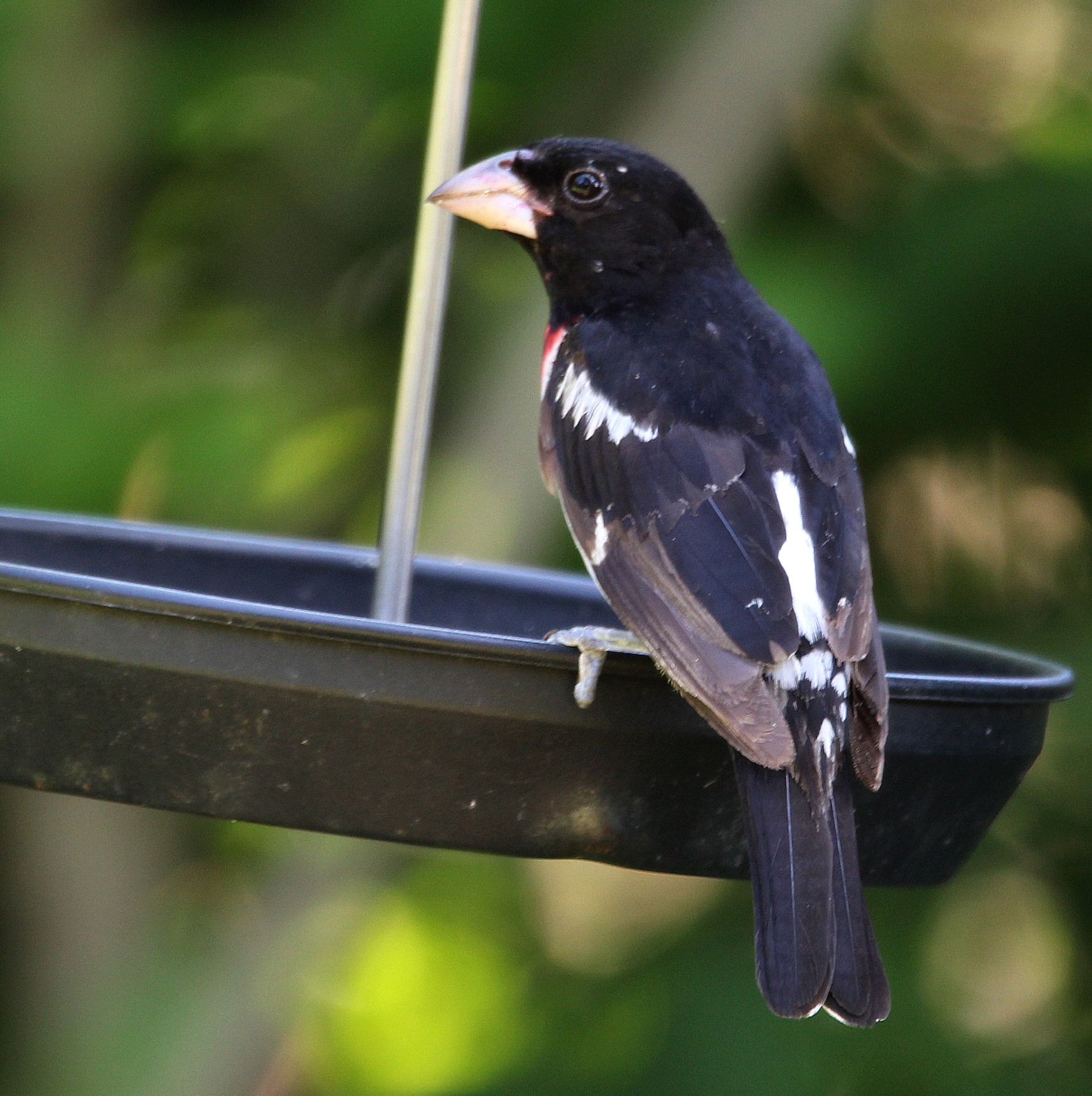
Photo by Chris Bosak – A young male rose-breasted grosbeak visits a feeder in New England, summer 2025. Note the brown feathers on the wings.
I was heading to my car at work when four or five relatively large birds emerged on the ground from around the corner of a building. I didn’t immediately recognize them, as their sudden appearance surprised me and my mind was elsewhere.
I took a few more steps and quickly realized what they were: baby turkeys. By that time, I had progressed enough that the mother turkey was now visible and only a few yards away. Will she attack like a mute swan or Canada goose might? Never get between a mother and her babies, the saying goes. I wasn’t actually between them, but I was certainly close enough to some of the babies that I could be considered a threat.
Photo by Chris Bosak
A yellow-breasted chat sings from a shrub in New England, June 2025.
I was walking along a productive section of a trail in southern New England when a loud birdsong caught my attention. As is often the case, I didn’t recognize it immediately, but knew it was worth stopping for and investigating.
Sometimes when that happens, it turns out to be a seldom-used song or call from a familiar bird. Tufted titmice have a wide variety of sounds and they often throw me off. The same goes for catbirds, robins and orioles. But this time, it was indeed something uncommon.
I used the Merlin app on my phone and it identified it as a yellow-breasted chat. That would be cool, I thought, but let’s get visual confirmation. The Merlin app is a great new tool for birdwatchers, but it’s not 100 percent accurate, and I always like to get visual confirmation.
Photo by Chris Bosak
An American robin eats border privet berries in New England, January 2025.
I was finishing up a bird walk the other day when I came across another birder just starting their day’s adventure. She asked a question common among birdwatchers: “Did you see anything good out there?”
Of course, all birds are good, but the underlying question is whether anything rare or uncommon was spotted. I shared that there were a few warblers and songbirds around, but I hadn’t seen anything too noteworthy.
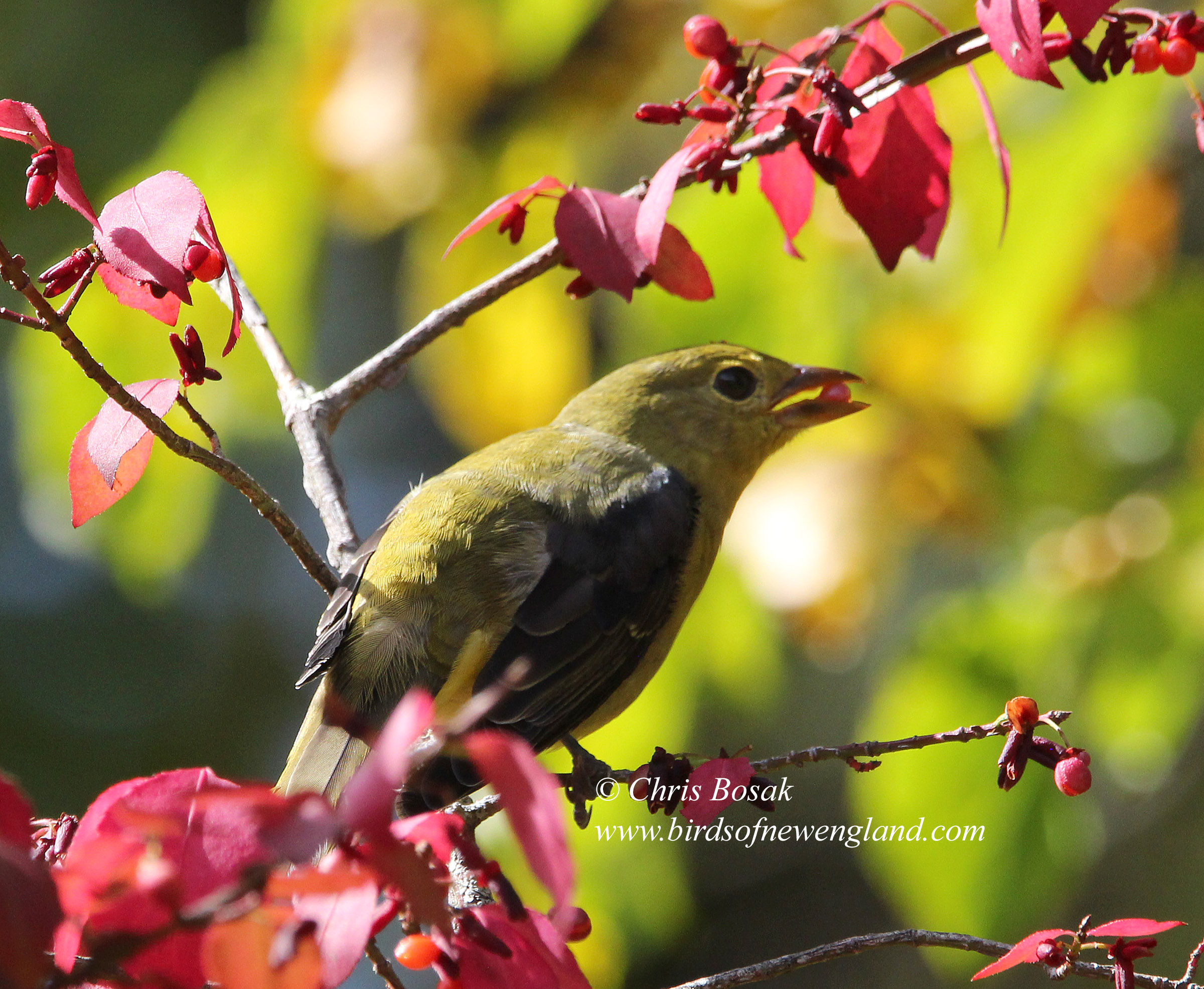
I started naming off some of the highlights. I had found a bluebird nest in a snag (dead tree) and the parents were busy feeding the youngsters. The warblers included American redstart, common yellowthroat, yellow warbler, ovenbird and black-and-white warbler. I had spotted a few rose-breasted grosbeaks and Baltimore orioles, but no scarlet tanagers or indigo buntings.
Photo by Chris Bosak
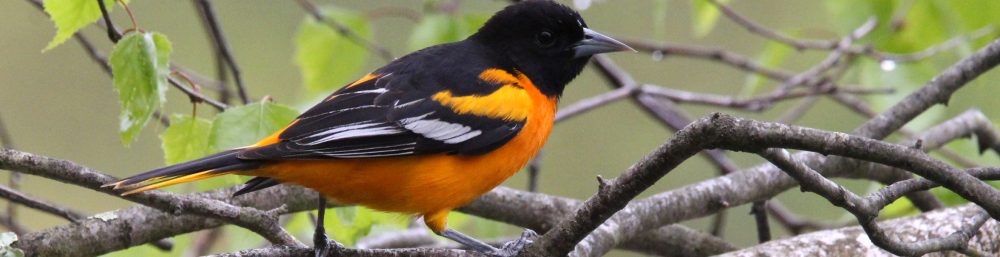
A Baltimore oriole builds a nest at Presque Isle State Park, Erie, Pa., May 2025.
Everything about a Baltimore oriole nest is ingenious. From the design and materials to the location selection, the nest is a perfect haven to raise young birds safely from predators (for the most part).
Fall is the best time to find oriole nests, after the leaves have fallen. Of course, by that time, the orioles are long gone, and the nest is a mere relic of the past breeding season, but it’s still interesting to see one of the pouch-like nests dangling from the end of a branch.
The other week, I was lucky enough to watch a female oriole build one of those remarkable nests. I was walking along a trail that was teeming with yellow warblers, catbirds, and Baltimore orioles when I glanced up and saw an oriole perched at the end of a branch overhead.
Sandhill crane, Presque Isle, Erie, Pa., May 2025.
What is rare and causes excitement in one area is often commonplace and taken for granted in other areas.
For instance, a roseate spoonbill caused quite a stir in southern New England a few years ago. People came from all over the region to see it. If you visit the right places in Florida, however, roseate spoonbills, while I’m sure still appreciated, are no big deal to the locals.
Conversely, there are birds common to New England that sometimes stray into other regions where they are not common and are a thrill for the people in that region.
Last week, while visiting my brother in Erie, Pennsylvania, I had one of those out-of-place bird experiences. We were walking along a trail looking for warblers and other migrating songbirds when I heard in the distance a very loud song from a bird that I did not recognize. Even though I didn’t know what the song was right away, I knew it was something special as I was certain I had never heard it before. The call was extremely distinctive, loud and carried a long way.
My brother had his Merlin app activated and sandhill crane came up. I had no idea that there were sandhill cranes at Presque Isle State Park as we have visited there frequently and had never seen, heard or even heard mention of the large birds being there before.
Photo by Chris Bosak
A warbling vireo sings from a branch in New England, spring 2025.
It’s funny how you can still discover new things after so many years.
I’m sure that applies to most hobbies, but it certainly applies to birdwatching. I have only recently “discovered” the warbling vireo. The small, loquacious bird, of course, has been around for far longer than I have been birdwatching, but I am only recently taking notice of it.
Part of the reason I may not have paid it much mind previously is that it is a small, fairly nondescript bird that typically hangs out in the middle to upper branches among the leaves. It is not like some birds that take an obvious perch somewhat low in the trees or brush and are easily found on a birdwalk.
Over the last couple of years, however, I have come to know warbling vireos not only because the males sing constantly, but I am finding them almost everywhere I go in the spring.
Photo by Chris Bosak – A veery stakes out territory in New England, spring 2025.
Warblers get all the press, but they are hardly the only bird family that passes through in great numbers in the spring.
I’m guilty myself of fixating on warblers, both in my birdwatching and writing. It’s hard not to as they are a fascinating family of birds and a joy to see in the spring. They come in a wide variety of colors, which is a welcome sight after a long, gray New England winter.
But enough about warblers, at least for now. Let’s focus on some of the other families that brighten our spring.
The other day, during a morning walk, I saw a great-crested flycatcher, wood thrush, red-eyed vireo and field sparrow. They are all members of families that have several species that either migrate through or nest in New England.
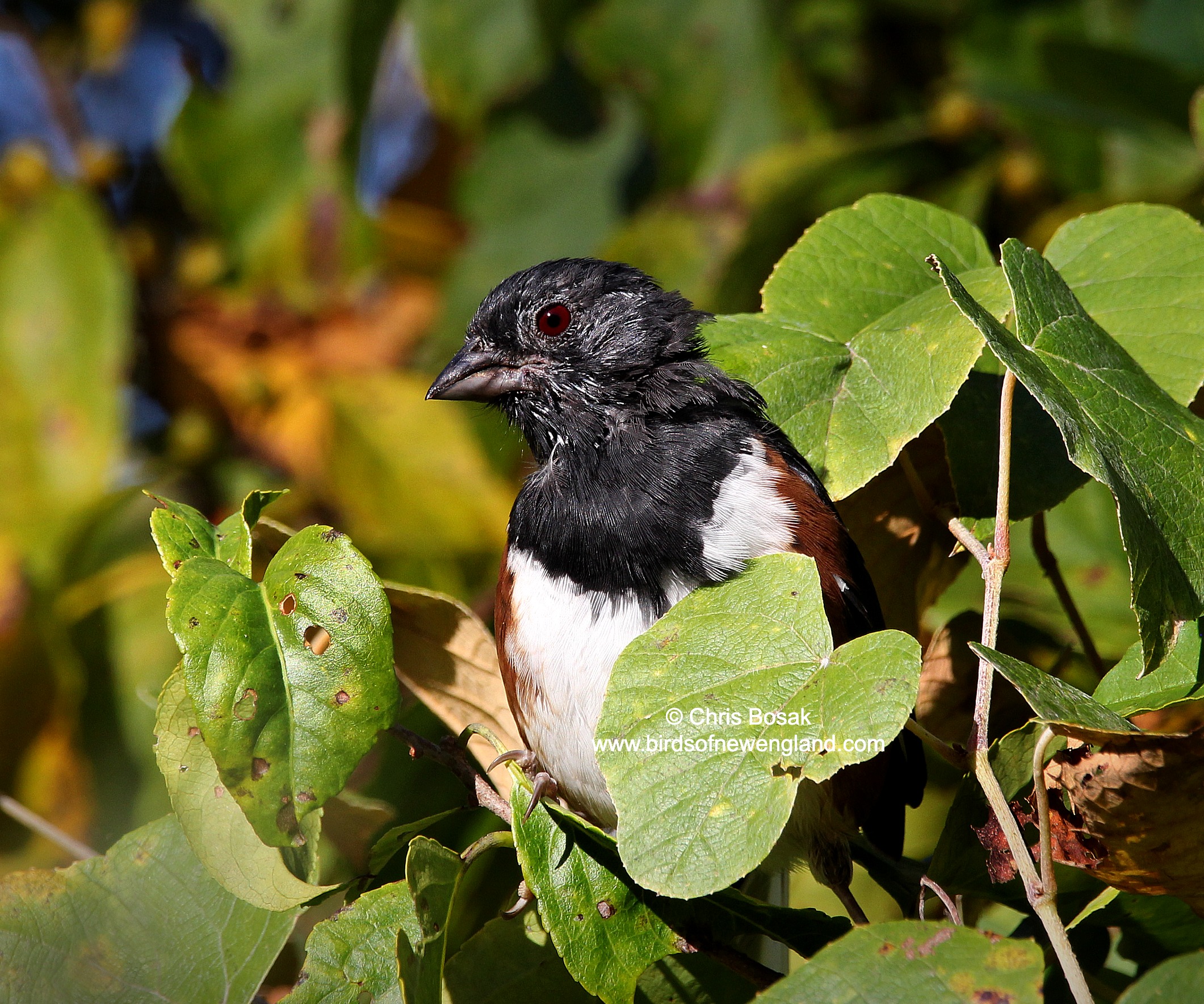
We don’t often think of sparrows as migrants as several types remain here all winter. I also think house sparrows are so ubiquitous that they are the only birds some people think about when they hear the word sparrow. But over the past few days, I’ve seen chipping sparrows, swamp sparrows and field sparrows. Don’t forget that eastern towhees are sparrows too. I’m growing more and more fond of the sparrow family as time goes on – house sparrows excluded.
Photo by Chris Bosak
Yellow-rumped warblers are one of the first warbler species to arrive in New England in the spring.
Birdwatching firsts are usually good things.
A new birdwatcher sees a scarlet tanager for the first time. The first warblers show up in the spring. An evening grosbeak visits a feeder for the first time. (I’m still waiting for that one, by the way.) Witnessing a unique behavior, like an eagle harassing an osprey into dropping a fish, for the first time is always a thrill.
But not all firsts are cause for celebration. Some firsts are best avoided if at all possible. I was reminded of this last week when I woke up and found this year’s first deer tick embedded in my thigh.
I should have known better, of course. But there I was tromping through waist-high grass trying to get a better look at a swamp sparrow. It will be okay, I thought, it’s still early in the season, and it hasn’t really warmed up yet. Every year, it takes this lesson for me to realize that ticks emerge before I think they will.
I returned to the car after my unsuccessful attempt to close in on the swamp sparrow. As I sat down and got ready to turn the key, I noticed a deer tick on my pants, its tiny black-and-red body slowly crawling as it searched for a way to get to my blood.
Photo by Chris Bosak – Dark-eyed junco that did not survive a window strike.
I’ve had the unpleasant experience of finding dead birds under windows several times in my life.
Whether at home, work or elsewhere, it’s always a sad sight to see a lifeless bird that has struck a window and become a statistic. It is estimated that more than a billion birds die each year in window collisions. That’s a billion with a b, as my dad used to say.
It’s even more horrific if you think about the bird’s final moment. One second, the bird is migrating, searching for food, fleeing from a predator, or simply going from point A to point B, and the next second, it’s dead on the ground. That’s if the bird is “lucky.” The unlucky ones are the ones that strike the window, fall to the ground and die painfully and slowly.
Photo by Chris Bosak
American black ducks stand on a frozen pond in New England last month.
The American black duck is, in my opinion, one of the more underrated birds in New England.
While it is true that black ducks are not the most exciting or colorful ducks in New England, I think the black duck is often overlooked because a lot of people assume it is a mallard. Mallards, of course, are extremely common and tame. Black ducks are not as common and certainly not as tame.
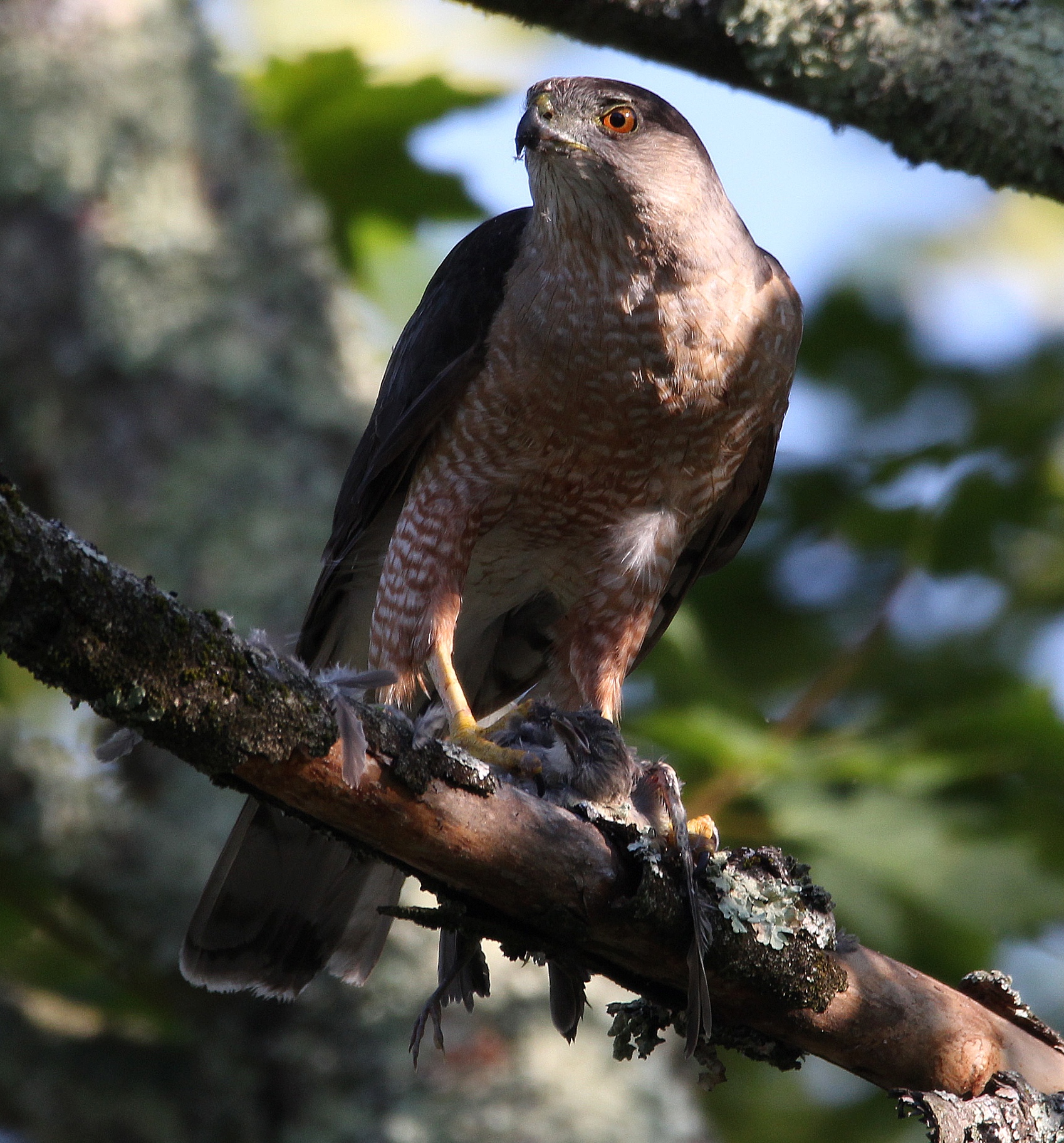
Differentiating an American black duck from a female mallard is one of the more common difficult identifications to make. It is up there with the house vs. purple finch and the sharp-shinned vs. Cooper’s hawk.