A few late warbler photos: redstart and yellowthroat

Photo by Chris Bosak An American Redstart sings from a perch in Selleck's and Dunlap Woods in Darien, Conn., May 2015.

Photo by Chris Bosak
An American Redstart sings from a perch in Selleck’s and Dunlap Woods in Darien, Conn., May 2015.

Here are a few photos of some late migrating warblers I took Monday at Selleck’s and Dunlap Woods in Darien, Conn. The warbler migration still has some strong days ahead, but don’t wait too long if you haven’t been out there looking for them yet. The warbler migration in New England winds down as the month of May winds down. Let me know what you’re seeing out there.

Photo by Chris Bosak A Common Yellowthroat perches on a broken stalk at Selleck's and Dunlap Woods in May 2015.

Photo by Chris Bosak
A Common Yellowthroat perches on a broken stalk at Selleck’s and Dunlap Woods in May 2015.

Cooper’s Hawk eating squirrel

Photo by Chris Bosak A young Cooper's Hawk eats a squirrel in southern New England in Feb. 2015.

Photo by Chris Bosak
A young Cooper’s Hawk eats a squirrel in southern New England in Feb. 2015.

The other day I pulled into my driveway and noticed a clump of brown in my neighbor’s yard. Birders are trained to notice anything out of the ordinary in a scene because it just might be a bird. Often these days it ends up being a plastic bag stuck in a tree, but sure enough, sometimes it is a bird.

Such was the case the other day. That brown clump was a bird, a young Cooper’s Hawk to be exact. Not only that, but the bird was eating (a Gray Squirrel as it turns out.) Cooper’s Hawks eat mainly birds, but small mammals can also fall prey to these quick and agile birds.

I’ll let the pictures tell the rest of the story. (Warning: If you don’t like the bloody side of nature, don’t click “continue reading.” Fair warning.)

Continue reading

The underrated Mourning Dove

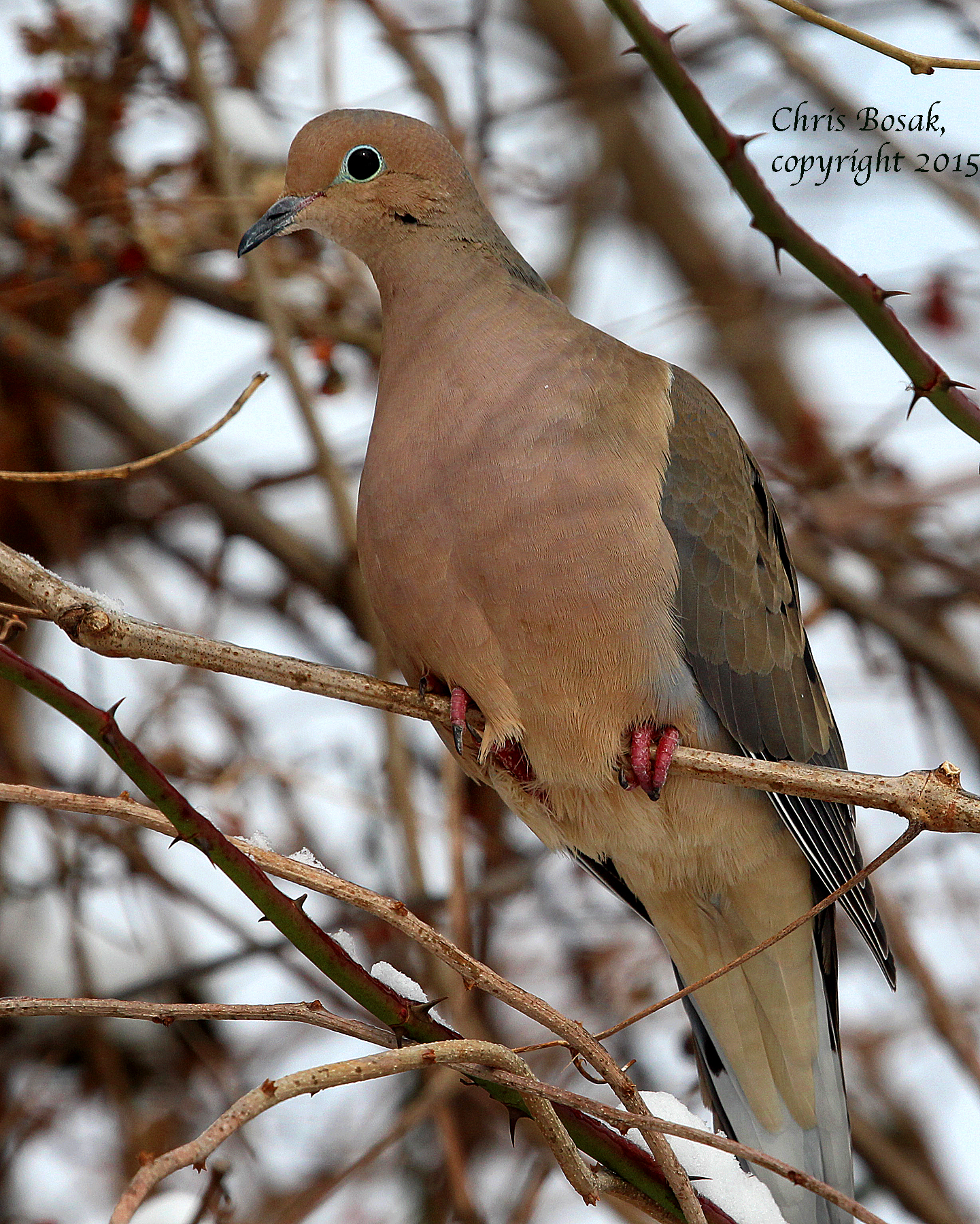
Photo by Chris Bosak A Mouning Dove perches in a tree after a New England snowfall in February 2015.

Photo by Chris Bosak
A Mouning Dove perches in a tree after a New England snowfall in February 2015.

It’s true that many people love Mourning Doves, but in my opinion, the large backyard bird is still way underrated.

I’m just as guilty as anybody by not giving the Mourning Dove its due. Rarely do I write about Mourning Doves (although I have on occasion.) It’s not often I hear about people seeing Mourning Doves, although they are probably being seen by just about everybody on a daily basis.

It’s often overlooked _ again I’m guilty of this too_ when relaying what birds were seen at the feeder that day. Chickadees, juncos, nuthatches, titmice, white-throated sparrows, cardinals. What about Mourning Doves? Surely they were there, too. Mourning Doves are spectacularly beautiful birds when looked at closely. The subtle tones of the plumage change with the light and that blue eye ring never gets old. Also, their song (cooing) _ although it’s a sad song and indeed is the reason for the bird’s name _ always seems to cheer us up when we hear it.

So here’s to the Mourning Dove … with appreciation.

Tiny footprints in the snow: White-throated Sparrow

Photo by Chris Bosak Footprints of a White-throated Sparrow are impressed into the snow of a sidewalk in New England.

Photo by Chris Bosak
Footprints of a White-throated Sparrow are impressed into the snow of a sidewalk in New England.

Not all interesting bird sightings involve birds. Sometimes they involve merely the signs of birds, which are everywhere if you look hard enough. When I opened the door this morning to check the temperature about a dozen White-throated Sparrows took off for shelter. But their signs were everywhere on the ground in the form of tiny footprints in the dusting of snow that fell overnight in parts of New England.

Here’s the grebe

Photo by Chris Bosak A Horned Grebe swims in Long Island Sound off the coast of Darien, Conn., Jan. 2015.

Photo by Chris Bosak
A Horned Grebe swims in Long Island Sound off the coast of Darien, Conn., Jan. 2015.

I mentioned in my last post about seeing a Horned Grebe on my quick trip to the beach the other day. Here’s a photo of the grebe I saw the other day in Long Island Sound from Weed Beach in Darien, Conn. Zoom in and check out its really cool red eye.

There are seven types of grebes in the U.S. and four are regularly seen in New England, although mostly only in the winter in their nonbreeding plumage _ so don’t expect to see a red neck on the Red-necked Grebe. The Pied-billed Grebe is the one most commonly seen in New England, while the Red-necked, Horned and Eared Grebes make occasional visits. The others _ Least, Western and Clark’s _ are not likely to be found in New England, but that doesn’t mean they never show up here.

The grebes we see here in the winter are in their much duller nonbreeding plumage, which can make identification tricky. Loons are another water bird that look much more dull in the winter. Loons are larger and stockier than grebes _ at least the grebes we see in New England.

I like talking about grebes because I get to say the word “grebe” over and over. It’s just one of those words that’s fun say out loud. Anyway, happy birding out there.
A sunny, cold winter’s day for a birdwatcher

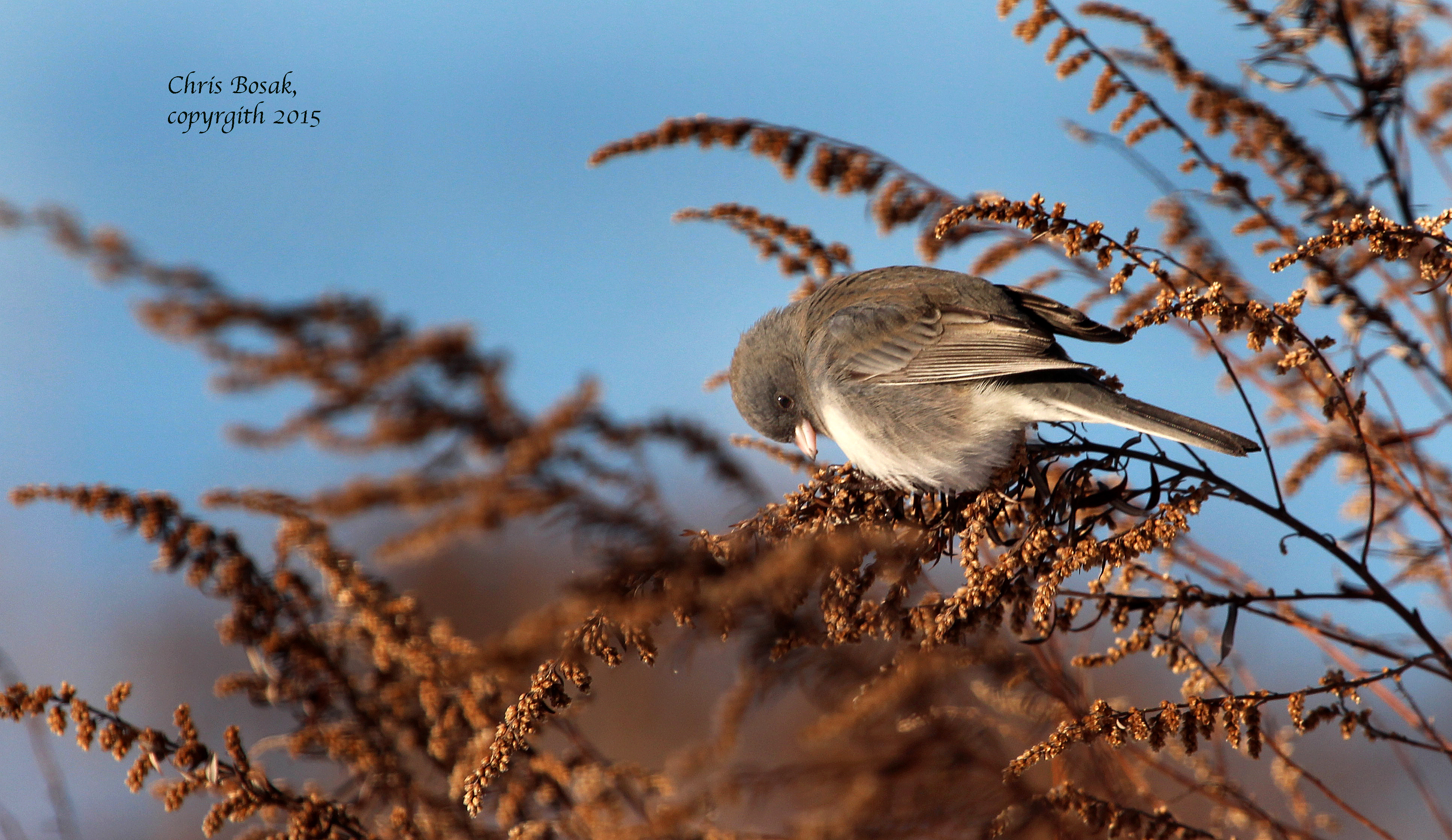
Photo by Chris Bosak A junco looks for seeds on a dried up plant at Weed Beach in Darien, Conn., in Jan. 2015.

Photo by Chris Bosak
A junco looks for seeds on a dried up plant at Weed Beach in Darien, Conn., in Jan. 2015.

Photo by Chris Bosak An American Robin perches on a rock at Weed Beach in Darien, Conn., in Jan. 2015.

Photo by Chris Bosak
An American Robin perches on a rock at Weed Beach in Darien, Conn., in Jan. 2015.

I dropped off my third-grader at school and faced a decision heading out of the parking lot: Take a left to the beach and see what birds might be there; or take a right and basically start my work day earlier than I have to.

Of course I took the left. It’s a good thing, too, because there were some pretty cool birds down at the beach. Nothing too out of the ordinary, but some good photo opps of birds such as Continue reading

Clearing out my 2014 photos, take 7: Northern Cardinal

Photo by Chris Bosak A Northern Cardinal perches on a branch in New England in spring 2014.

Photo by Chris Bosak
A Northern Cardinal perches on a branch in New England in spring 2014.

Here’s my next photo in the series of 2014 photos that I never got around to looking at and posting.

Everybody loves Northern Cardinals. I took this shot in 2014, but to be perfectly honest, I don’t really remember the details. I found it in a random folder and only sort of remembered even taking the photo. Some days of shooting are like that: The action is so fast it’s hard to keep track of what you’re shooting. Other days, of course, not so much.

I believe I took this shot at Cove Island Wildlife Sanctuary, but it was definitely in 2014. Trust me on that one.

Hooded Mergansers handle the snow

Photo by Chris Bosak Four male Hooded Mergansers swim in Norwalk Harbor near Veterans Park in Norwalk, Conn., Jan. 2015.

Photo by Chris Bosak
Four male Hooded Mergansers swim in Norwalk Harbor near Veterans Park in Norwalk, Conn., Jan. 2015.

Much of Norwalk Harbor was frozen on Tuesday afternoon, but the spots that weren’t frozen made for ideal hunting grounds for Hooded Mergansers. It was the first measurable snow of the year for coastal southwestern Connecticut so I figured I’d take a quick drive to see what photographic opportunities presented themselves. Hooded Mergansers are often the only birds around on such days. Ducks, with their down feathers close to their bodies, are supremely adapted to handle such conditions.

Clearing out my 2014 photos, Take 2: Piping Plover preening

Photo by Chris Bosak A Piping Plover preens on the beach at Milford Point, Conn., in April 2014.

Photo by Chris Bosak
A Piping Plover preens on the beach at Milford Point, Conn., in April 2014.

Here’s my next photo in the series of 2014 photos that I never got around to looking at and posting. I ran a similar photo in April, but here’s another look at a Piping Plover _ an endangered bird in New England _ preening at Audubon Coastal Connecticut Center at Milford Point. The photo was taken in April 2014.

Click here to read more about Piping Plovers and to see more photos of this spectacular shorebird.