Unknown's avatar

About Chris Bosak

Bird columnist and nature photographer based in New England.

Good backyard visitors so far this spring

Photo by Chris Bosak A male rose-breasted grosbeak visits a feeder in Danbury, Conn., during the spring of 2018.

Photo by Chris Bosak A male rose-breasted grosbeak visits a feeder in Danbury, Conn., during the spring of 2018.

We still have a few weeks left of peak spring migration, so this list is not inclusive (I hope not anyway), but the feeder has been active recently with the following birds: rose-breasted grosbeak (male and female); chipping sparrow; goldfinch; gray catbird; blue jay; cardinal (male and female); indigo bunting (first spring male); red-bellied woodpecker; white-breasted nuthatch; tufted titmouse; black-capped chickadee; downy woodpecker; hairy woodpecker; mourning dove; house finch; ruby-throated hummingbird (male and female); wild turkey; and probably one or two more that aren’t coming to mind at the moment. I bought a new oriole feeder, but no luck yet with that one. What’s been visiting your feeders? Feel free to comment with your list.

Photo by Chris Bosak  A female rose-breasted grosbeak visits a feeder in Danbury, Conn., during the spring of 2018.

Photo by Chris Bosak
A female rose-breasted grosbeak visits a feeder in Danbury, Conn., during the spring of 2018.

Hummingbirds return to New England

Photo by Chris Bosak A male ruby-throated hummingbird visits a feeder in Danbury, Conn., spring 2018.

Photo by Chris Bosak
A male ruby-throated hummingbird visits a feeder in Danbury, Conn., spring 2018.

I saw my first hummingbird of the year about 10 days ago. It paid my feeder a quick visit in the morning and I never saw it again. He must have been on his way northward and stopped for a quick pitstop. But now, the hummingbirds are back for real. A male has been visiting my feeder about every 20 minutes for the last three days. A few times it had to fight off a few rivals to keep its territory. Hummingbirds are small and cute, but fiercely territorial.

Here’s a shot a took over weekend. Welcome back.

A few snapping turtle iPhone photos

Young snapping turtle, by Chris Bosak

Camera phones have come a long way. They are not necessarily practical for bird photography yet, but if you get a cooperative subject like these snapping turtles and pickerel frog, phones can be great for nature photography. They are handy for when opportunities present themselves in the woods or during a drive.
Speaking of snapping turtles, keep an eye on the roadways during this time of year for those gorgeous reptiles. Remember, if you see a turtle in the road, snapping or otherwise, and are in a position to safely help, move it to the side of the road in the direction it was Continue reading

For the Birds: Wood ducks in the trees — another first

Here is the latest For the Birds column, which runs in several New England newspapers.

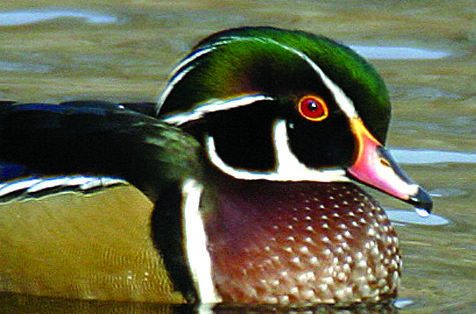
Photo by Chris Bosak Male wood duck.

Photo by Chris Bosak
Male wood duck.

No matter how long you’ve been at it, birdwatching always presents new firsts.

This latest first happened to take place right in my backyard. I’ve watched videos and seen photographs of wood ducks perched in trees before, but I’ve never witnessed it myself. I’ve seen plenty of wood ducks on the water and even under people’s birdfeeders, but never perched high in trees before.

I came close once. I was canoeing within the Bashakill Wildlife Management Area in New York years ago and dozens, maybe even hundreds, of wood ducks could be seen and heard in the distance. I focused my binoculars on a dead tree about 100 yards away and saw a huge gathering of these handsome ducks. Most of them were in the water, but a few of them perched on the snag’s low-hanging branches.

Photo by Chris Bosak A Wood Duck mother swims with one of her babies at Woods Ponds in Norwalk, Conn., spring 2016.

Photo by Chris Bosak
A Wood Duck mother swims with one of her babies at Woods Ponds in Norwalk, Conn., spring 2016.

I don’t count this as having seen them perched in trees because the dead, leafless tree was more an extension of the water than anything.

The other day, though, I walked out of the sunroom and onto the deck to fill the feeders. As the door closed behind me I heard the unmistakable “oo-eek, oo-eek” call of a wood duck coming from a tall oak in the backyard.

Then I noticed two ducks flush from the tree and head into the woods. It was a male and female and they made a big circle weaving through the trees and came back to the large oak. A very cool first, especially since it took place in the backyard.

Despite the proliferation of wood duck boxes on the edges of ponds, many wood Continue reading

For the Birds: Waiting for warblers

Here is the latest For the Birds column, which runs weekly in several New England newspapers.

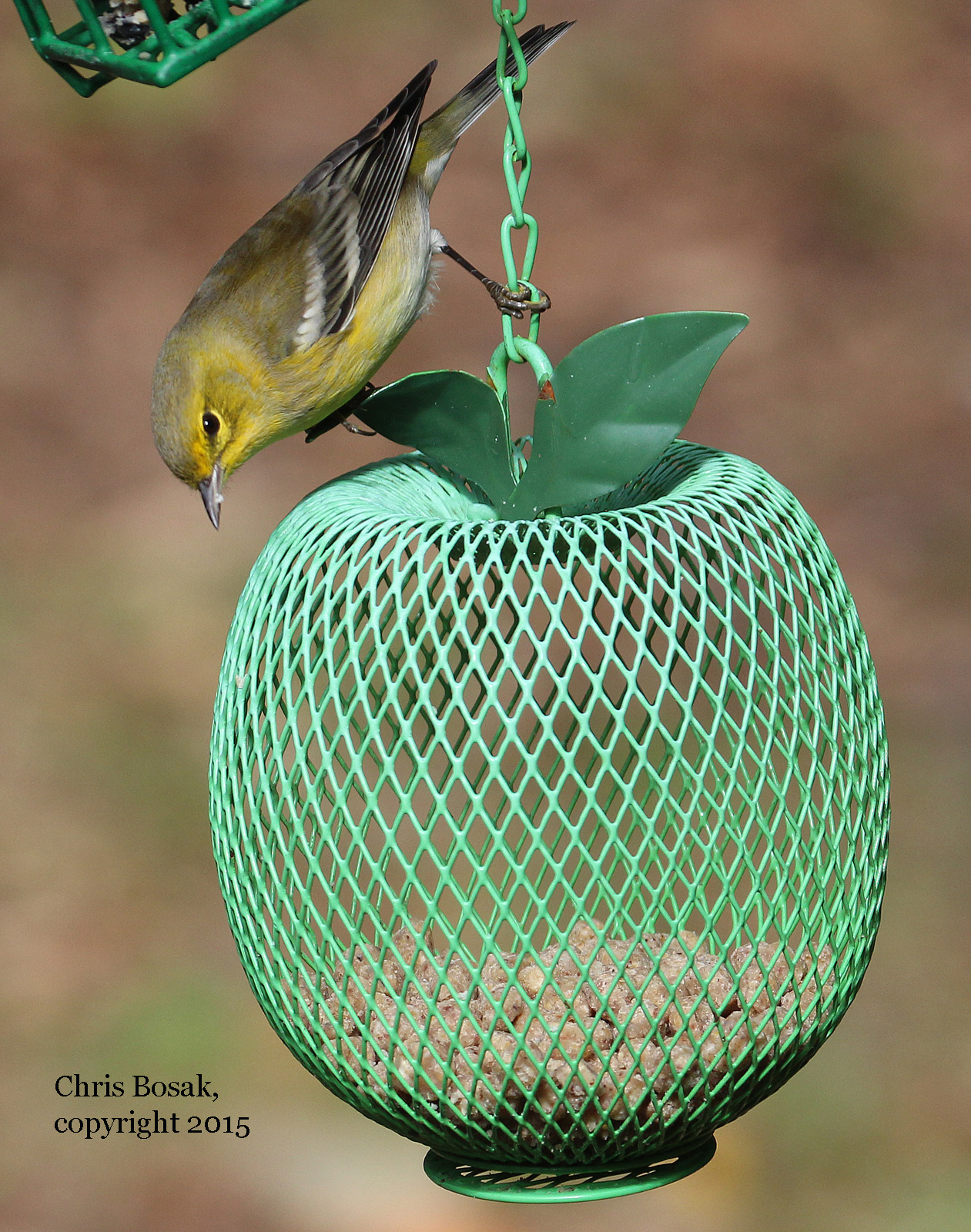
Photo by Chris Bosak A Pine Warbler sits on a deck railing in New England this fall.

Photo by Chris Bosak
Pine Warbler at feeder in Danbury, Conn., fall 2015.

Finally, I thought, a warbler singing in the backyard.

It’s been a long winter and the pine warbler I usually hear by the end of the first week of April never materialized. The first week of April turned into the second week and still no warblers to be seen or heard — at least on my end.

One cool, but bright morning last week, I stepped out onto the deck to fill the feeders and heard a high-pitched, soft and somewhat melodic tune coming from a giant oak. Surely a warbler, I thought, but I wasn’t sure which one.

I grabbed the binoculars, which always hang at the ready just inside the door. Now to find the little bugger. The leaves haven’t popped yet, so this shouldn’t be too tough, I told myself. It was more difficult than I thought, of course, but I finally zeroed in on a little bird high up on the trunk.

As you can probably tell from the build-up, it wasn’t a warbler at all. It was a brown creeper — a small, brown bird seen on tree trunks throughout New England, mostly in the fall, winter and spring. Usually the birds are silent as they look for insects by starting at the bottom of a tree trunk and working their way up.

In fact, I think this may have been the first time I consciously heard the song of a brown creeper. The website AllAboutBirds.org describes the song, sung only by males, as such: “His song is a jumble of high, thin notes that lasts up to 1.5 seconds. It’s sometimes likened to singing the phrase, ‘beautiful trees.’”

You’d think after all these years of birdwatching, I would know all the songs of warblers and be able to distinguish between warblers and non-warblers. There are many types of warblers, however, and I know a lot of the songs, but not all of them. Plus, this song was very warbler-like, as I mentioned. Also — my final excuse, I promise — it’s been 11 months since we’ve heard warblers singing and my birding-by-ear is rusty. It’s only average to begin with, so this guy definitely fooled me.

Not that I’m complaining that it was a brown creeper. I find them extraordinarily interesting birds, despite their small size and rather non-descript appearance. I like how they work up the trunk of a tree and then fly down to the base of a nearby tree to start again.

I’m still waiting on that first warbler, but I’m confident they will arrive soon. As usual, the sightings will start as a trickle — pine warbler here, palm warbler there — and then become a fantastically overwhelming phenomenon of tiny, colorful birds in the trees.

Get your ears ready.

Note: Since this column was originally written, I’ve seen palm and pine warblers. Rejoice!

For the Birds: Fortnite and birds (or lack thereof)

Here is the latest For the Birds column, which runs in several New England newspapers.

Photo by Chris Bosak Black vultures sit on a hill in Danbury, Conn., fall 2017.

Photo by Chris Bosak
Vultures would be a good addition to Fortnite.

Fortnite is the hottest game going.

The survival video game has swept the nation — and world — and eaten up countless hours of kids’ and adults’ time.

But, since it is such a huge phenomenon (with well over 3 million players), I have to somehow relate it to birds, of course. I did something similar in the summer of 2016, when the Pokémon Go craze was at its peak. That was a fun column to write and may be found here.

Here’s a quick description of Fortnite for those who may be unfamiliar. It is a video game that can be played on a computer, PlayStation, Xbox, and now even a mobile device. The most popular way to play is the person-to-person mode — you can play solo or as a duo or squad (four-person team) — and the point is always to be the last one standing.

Other players may be eliminated by a variety of weapons that are picked up in towns and cities on an island where the game takes place. Players can Continue reading

End of winter birding quiz answer

At second look, maybe this one wasn’t so easy. The most popular answers — chickadee and titmouse — are indeed common backyard feeder birds, so they are good guesses. It also does look like a blue jay — the third-most common answer — as it’s hard to gauge how large the bird is in the photo.

Only 10 percent of participants got it right: white-breasted nuthatch. The giveaway is coloration (although it shares blue, black and white with blue jay), especially the rusty red feathers exposed as it flies. Of the options given, it is is only bird that features that rusty red.

The photo above was taken a few seconds before the one of the nuthatch flying off.

Take a look at the original photo again:


Thanks for playing along!

End of winter birding quiz

It’s been a while since I’ve posted a quiz, so let’s get back into the swing of things with a relatively easy one. What was sharing the birdfeeder with this winter-plumaged American goldfinch?

Resourceful blue jay maximizes visit to birdfeeder

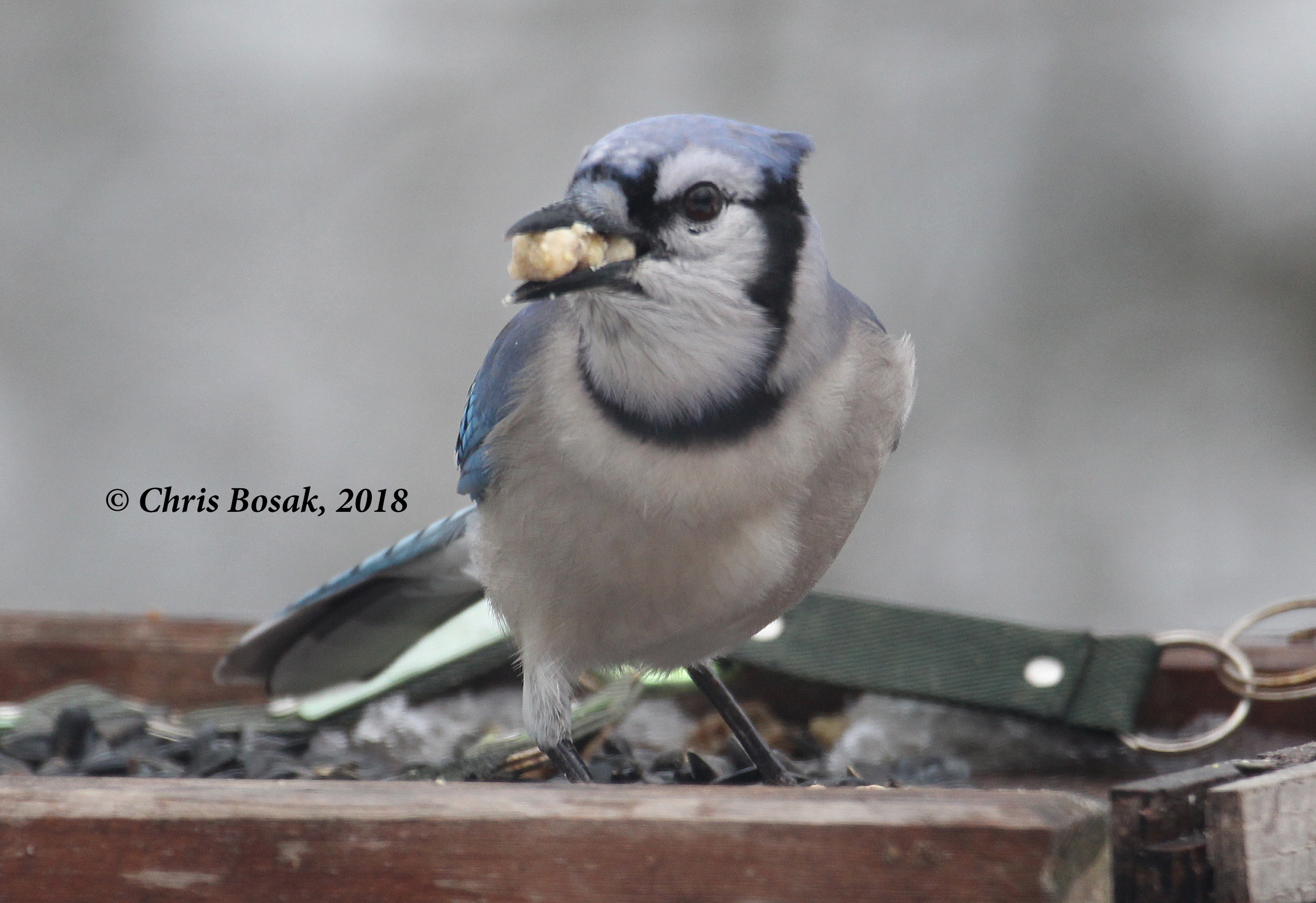
Photo by Chris Bosak A blue jay grabs a third suet nugget from a platform feeder, Danbury, Conn., March 2018.

Photo by Chris Bosak
A blue jay grabs a third suet nugget from a platform feeder, Danbury, Conn., March 2018.

This blue jay reminded me of myself when I return from a trip to the grocery store. Instead of taking two or three trips from the car to the kitchen — which would be exponentially easier and faster — I have to do it all in one trip. I position the handles of the bags all up and down my left arm until only one bag remains. I grab the last bag with my right hand and close the hatch with that hand, dangling whatever groceries happen to be inside.

I don’t distribute the weight of the bags because I’m going to need that right hand to open the front door, so I struggle with nine or 10 bags on my left arm. It gets real dicey when I bought lots of beverages — think gallons of milk and orange juice. But I manage to quick step my way to the door, open it with my relatively free right hand and run hunched over to the kitchen to release the bevy of bags into a mound on the floor. Yes, that gallon of milk is now on top of the hot dog buns. I look at my left arm to inspect the indentations and welts left from the bags and think: Next time I’ll take two trips. But I won’t.

Anyway, back to that blue jay. Instead of grabbing a suet nugget and flying off to eat it or store it, it stuck around to position the little rounds of goodness into its bill to fit in as many as it could. I think it got three, but it may have been four. Here’s a look at how it did it.

Photo by Chris Bosak A blue jay stands on a platform feeder, eyeing up some suet nuggets, Danbury, Conn., March 2018.

Photo by Chris Bosak
A blue jay stands on a platform feeder, eyeing up some suet nuggets, Danbury, Conn., March 2018.

Photo by Chris Bosak A blue jay grabs a suet nugget from a platform feeder, Danbury, Conn., March 2018.

Photo by Chris Bosak
A blue jay grabs a suet nugget from a platform feeder, Danbury, Conn., March 2018.

Continue reading

A flurry of winter bird photos before spring begins

Photo by Chris Bosak A red-bellied woodpecker grabs a peanut from a feeder, March 2018.

Photo by Chris Bosak
A red-bellied woodpecker grabs a peanut from a feeder, March 2018.

Andrew, my 14-year-old going on 21, and I took a walk in the woods together this evening. These walks don’t happen as often as they used to or as much as I’d like, so I was more than happy when he said ‘yes,’ when I asked if he’d like to come along.

The trail behind my house is covered in snow, but it’s been walked on and packed down so it’s not much different than walking on dirt or on a sidewalk. But, as my walks with Andrew almost always go, we veered off the path to check out one thing or another. As we ventured away from the path, the snow at spots was still a foot or more deep. A foot or deeper on March 19, two days away from the official start of Continue reading