I pulled into the tire shop for my appointment the other day, handed over the keys and asked how long it would take. The nice gentleman said it would be at least an hour, but that I was welcome to sit in the waiting area and help myself to coffee.
It was an ideal late summer/early fall day and the fall migration was well underway, so I decided to take a walk instead.
I gave the guy my cell phone number, asked him to give me a call when the truck was ready, and set out to find the nearest place where I might find some birds.
Photo by Chris Bosak
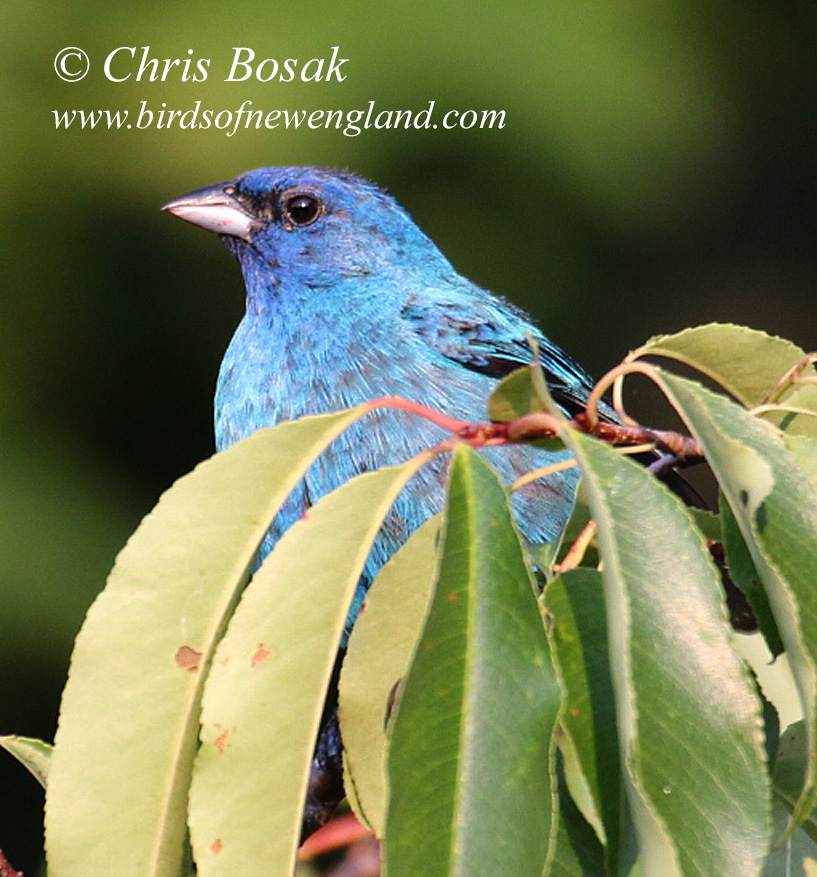
An indigo bunting perches in a tree in New England, July 2021.
I’m not going to try to emulate Dr. Seuss, but I think he would have drawn plenty of inspiration from a walk in the woods in New England in May.
His classic “Oh, the Thinks You Can Think!” comes to mind, but only altered to “Oh, the Colors You Can See.”
A recent walk made me think of this. The majority of the walk was along a wide dirt path with shrubby habitat on both sides. Beyond the thickets on one side was a large field and beyond the thickets on the other side were deep woods. It is perfect habitat for a bird walk.
The first bird I saw was a male eastern towhee. It was once called rufous-sided towhee because of the unique dark orange color of its sides that complement the otherwise white and black plumage of the bird. The bird’s red eyes are visible when it approaches among the shrubs closely enough. I did not see a female towhee on this particular day, but they are lighter brownish-orange where the male is black.
Where to begin? May is a firestorm of birding activity in New England.
I’ll recap a few of my recent highlights and then expand, where necessary or otherwise interesting, in subsequent columns.
A warbler by any other name: Many warblers actually have the name warbler in their name. Yellow warbler, chestnut-sided warbler, worm-eating warbler and so on. Many, however, don’t have warbler in their name. Common yellowthroat, American redstart to name a few.
A few warblers don’t have warbler in their name and look like they belong in the thrush family. The ovenbird and waterthrushes (northern and Louisiana) could easily pass for thrushes with their brown bodies and spotted chests. Heck, the waterthrushes even have thrush in their name. But they are all, indeed, warblers.
That warrants a column unto itself. I’ll dig into that in the coming weeks.
Dueling grosbeaks: I heard a rose-breasted grosbeak singing in a tree during the tail end of one of my recent walks. I paused enough to find its perch. As soon as I spotted the beautiful bird, another male rose-breasted grosbeak dive-bombed the original bird, and they started chasing each other through the woods. The action caught the eye of a third male grosbeak and that one joined in the chase as well. That was a first for me. Rose-breasted grosbeaks, with their white wing bars, are just as impressive-looking in flight as they are perched.
The warblers are back and delighting, confusing, and frustrating birdwatchers throughout New England.
Warblers are small, usually colorful, passerine (perching) birds that migrate into New England every spring. Many nest here while others continue north to nest in Canada. In the fall, they head to points south such as southern U.S., the Caribbean, Central America or South America. The odd warbler shows up on New England Christmas Bird Counts from time to time, but for the most part, they are gone before the snow starts to fly.
To me, the quintessential warbler is the yellow warbler. It is small, brightly colored, numerous throughout the region and sings its ubiquitous song (“sweet sweet I’m so sweet”) over and over from the brush. It is all yellow with some rusty streaking on its chest and belly.
Warblers come in all colors, however. Many are mostly yellow and many others have flashes of yellow in their plumage. Some are black and white, and some are mostly brownish. A few are mostly blue. It’s no wonder that the spring migration, highlighted by warblers, is the favorite time of year for most birdwatchers.
I saw a white-eyed vireo in Florida when I visited my brother in February. I thought it was an interesting bird and was happy to see it.
Well, yesterday morning I saw one in New England for the first time. Southern New England (Connecticut, Rhode Island and southern Massachusetts) is the northernmost range of the bird. It’s a cool-looking bird, but its song is what makes it stand out. I was instantly drawn to the thicket from where the song was coming. You can hear the song here.
Well, if he’s going to sit right outside my window on a rainy day then I’m going to make a YouTube video of him. First hummingbird I’ve seen this year (May 4, 2022, in Bethel, Conn.)
Not as many migrants as I expected, but a good walk nonetheless at Huntington State Park in Redding, Conn. I heard only one warbler (black-and-white), but I have heard and seen dozens of eastern towhees over the last two days. It’s (arguably) the best time of year to be out there. No excuses! (I’m talking to myself too). The bald eagle flyover was a bit of a surprise, hence the lousy photo.
Photo by Chris Bosak – Eastern towhee, April 2022Photo by Chris Bosak – Bald eagle, April 2022Photo by Chris Bosak – field sparrow, April 2022.
Photo by Chris Bosak – A yellow-rumped warbler perches on a branch in New England, spring 2022.
It was a classic early spring walk.
Expectations were high to see a lot of migrants, but those expectations did not match the calendar. Mid-April can be a tough time for birdwatchers. We know the migrants are coming any day, and we have waited so long that the anticipation gets the better of our waning patience. It’s like the feeling children get on December 22 and 23. The decorations and tree have been up for weeks already, but it’s still not time to celebrate.
This is not to say it wasn’t a fruitful walk. I saw a handful of migrants including my first warblers of the season. But instead of dozens of species and 100s of individual birds, as we will get in a few weeks, it was more like a few species and about a dozen individuals.
It was a good warm-up to the upcoming peak of spring migration. Let’s put it that way.
Photo by Chris Bosak
A red-winged blackbird sings from the top of a tree at Happy Landings in Brookfield, Conn., spring 2017.
Late March and early April can be a tough time for birdwatchers as we are in the slow build up to spring migration.
The spring migration actually starts sometime in February when the first male red-winged blackbirds arrive. It’s a nice sight (and sound) when they return to our swamps, but it’s pretty much just a tease as we know winter will continue, and it will be several weeks until other birds start to show up.
American woodcocks and eastern phoebes return to New England around the middle of March. A few weeks later, ospreys arrive. The build up can be excruciatingly
Photo by Chris Bosak
A palm warbler stands on a stone wall in New England, October 2021.
Three species dominated the count total on my morning bird walk today. White-throated sparrows were plentiful and it was great to hear their song again. Yellow-rumped warblers were plentiful, as they often are this time of year. Palm warblers were numerous as well and a flock of five kept me company near a stone wall at Huntington State Park. The fall warbler migration is bittersweet. It’s great to see them, of course, but the crisp air reminds me they will be gone soon and a long winter looms. At least winter is good for birdwatching too.
Photo by Chris Bosak
A palm warbler stands on a stone wall in New England, October 2021.