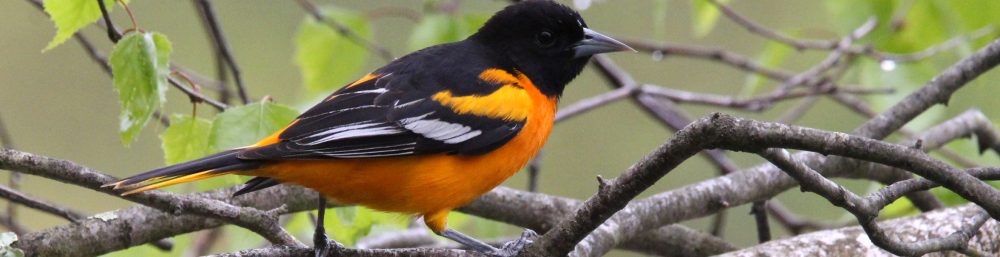
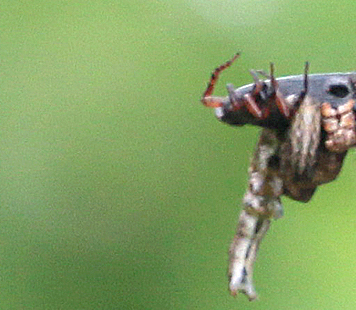
Here’s the answer to the quiz I posted yesterday regarding what bird is holding those insects in its bill. If you missed it, the photo is in the previous post, so just scroll down a bit and see if you know what bird it is — then come back and his “continue reading” below.
Another quick bird quiz — yum

Photo by Chris Bosak
A bird brings a mouthful of goodies back to its young at Selleck’s/Dunlap Woods in spring 2014.
What bird would eat such things??? (Probably lots of them, to be honest.)
This busy parent bird collected a few insect larvae and a few other insects to bring back to a hungry family on Tuesday morning at Selleck’s/Dunlap Woods in Darien, Conn.
So what bird is this? Leave a comment or send me an email (bozclark@earthlink.net) with your guess. I’ll post the full picture sometime on Wednesday (tomorrow) afternoon, so hurry and guess — oh, and don’t forget to tell your birding friends.
Thanks for visiting http://www.birdsofnewengland.com
Find a baby deer? Leave it alone, it’s just fine
Here’s a column I wrote about a year ago that ran in The Hour (Norwalk, Ct.) and The Keene Sentinel (Keene, N.H). It is about finding baby deer that are “abandoned” — but not really abandoned, of course. Since it is that time of year again when people may stumble across baby animals, I figured I’d put this column out there again.
…
What do old tennis balls, my boys’ penchant for baseball, and a nearby school have to do with this nature column?
Hang in there, you’ll find out soon enough.
First, let’s back up to winter. During snowless winter days I like to wander around the woods surrounding tennis courts and collect as many old tennis balls as I can. My boys used to love to join me in this endeavor. Now they kind of just tolerate the venture.
So why would I spend time and put up with the invariable scratches that come with such an outing? To have plenty of fodder for batting practice in the backyard. I live next to a school and the property is divided by a chain link fence about eight feet high. It makes for the perfect home run derby fence. I don’t have the bank account to fix all the broken windows that using a real baseball would cause, so we use old tennis balls.
The boys are getting bigger and stronger so lots of tennis balls go flying over the fence. Sometimes four or five pitches in a row are lost in the small p Continue reading
Guarding their gourd
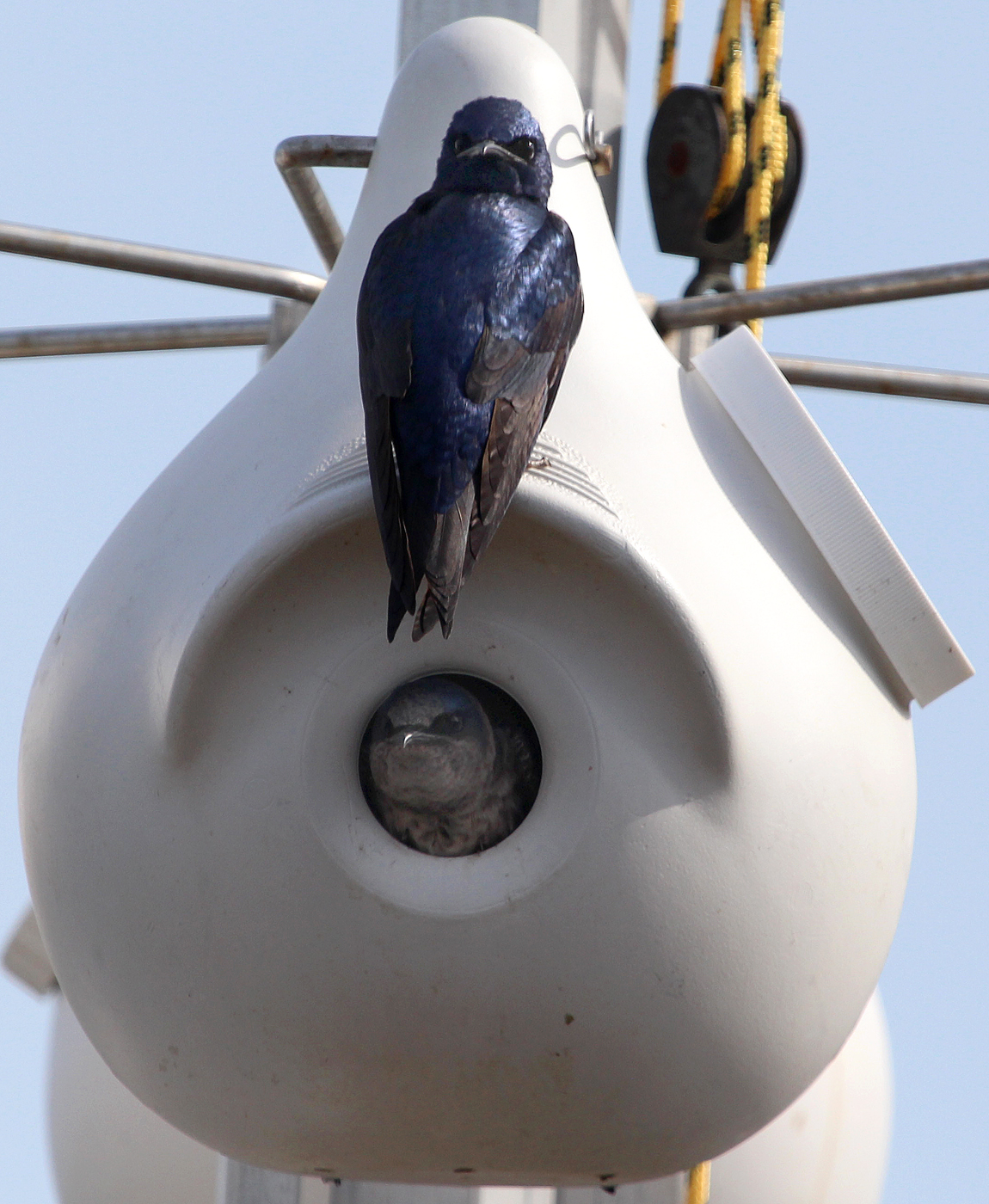
Here’s a shot I took of a Purple Martin pair a few weeks ago keeping watch at their gourd as part of the colony at Milford Point. Purple Martin colonies are excellent for insect control in people’s yards, but the conditions need to be just right to attract them.
On the East Coast, Purple Martins are completely dependent upon human-offered housing.
Check out this website for more information on attracting them.
Northern Mockingbird sings at night

Photo by Chris Bosak
Northern Mockingbird perches before jumping up to a suet feeder in Stamford, Conn.
Here’s the start of a new birding column I wrote for The Hour and Keene Sentinel. It involves listening to a Northern Mockingbirds singing at night — about 11:30 p.m.
“I walked out of work following one of my night shifts here at The Hour. It was about 11:30 p.m. so the last thing I expected was to have an interesting birdwatching experience in the parking lot. The birding world is full of surprises, though. I stepped out the front door of the office building and was greeted by the sound of a Blue Jay calling. Odd time for a Blue Jay to be singing, I thought. Must be raiding a nest or having its nest raided. The Blue Jay called three times and then another bird starting singing. At that point I knew it wasn’t a Blue Jay and another bird at all. It was a Northern Mockingbird. My frame of mind instantly went from wonder to amusement. I walked over to the area where the bird was singing, pulled out my cell phone and started recording. It kept on belting out the tunes even though I was standing right under its tree. Mockingbirds are master imitators. They imitate the song of a bird species three times and then move on to the next imitation. And it goes on and on. It is believed that the more impressive the repertoire, the better chance the bird has of attracting a mate. I like listening to a mockingbird and trying to figure out the birds it is imitating. I almost always get a Carolina Wren and American Robin. This particular mockingbird the other night had an impressive list of at least 15 species that also included Tufted Titmouse, Red-winged Blackbirds and Broad-winged Hawk. Many mockingbirds also mix in non-bird noises, such as squeaky fences or alarm clocks. The songs are not sung half-h
See how many bird species you can pick out from this impressive songster.
Gray Catbird and its red undertail coverts

Photo by Chris Bosak
A Gray Catbird perches on a branch at Selleck’s Woods in Darien, Conn., May 2014.
The Gray Catbird is very aptly named because, well, it’s mostly gray and often sounds like a cat. I say mostly gray because it has a small black cap on its head and has rusty red undertail coverts. That red patch is not seen very often and many casual observers of birds probably don’t even know the Gray Catbird has that patch of red.
Undertail coverts are the area of a bird under the tail and behind the legs. The photo above shows this catbird’s patch of rusty red.
With the spring migration season starting to wind down, much of New England will be left with only its breeding birds to watch for a few months. Thankfully, the charismatic Gray Catbird is among them.
Click “continue reading” for a catbird’s closeup.
Help protect shorebirds on the beaches this Memorial Day Weekend

Photo by Chris Bosak
An American Oystercatcher walks along the beach at Coastal Center at Milford Point this spring.
I’ve been volunteering to monitor shorebirds at a Connecticut beach this spring. This involves looking for Piping Plovers, American Oystercatchers and other birds that rely on coastal areas to raise their families. I’ve found several nests of plovers and oystercatchers and it’s a thrill to know they are using our beaches to raise the next generation of shorebirds. The areas are roped off and nests are further protected by fencing.
Until now, traffic has been fairly light on the beaches. A few beach walkers, some with dogs on leashes, are all I’ve come across. (Of course I monitor the birds on Monday mornings, so beach traffic is expected to be light.) But with the Memorial Day weekend upon us, beach traffic will increase tremendously — just at a time when the birds are most vulnerable with eggs and babies to take care of.

Photo by Chris Bosak
Piping Plover egg. Plovers typically lay four eggs in their nest, which is nothing more than a small depression in the ground.
When you visit beaches this weekend and throughout the summer, please keep in mind that shorebirds may be nesting nearby and to give them a wide berth. The most vulnerable areas along our beaches are roped off, so mind the barriers and keep dogs on leashes (if dogs are even allowed at your favorite beach.) The crowded beaches are not likely to have nesting shorebirds, but be mindful when visiting the less traveled coastal areas.
Thank you and have a great weekend.
Here’s more information from the American Bird Conservancy on protecting shorebirds.
The robins have hatched! Most of them anyway
Love those bluebirds (plenty of photos)

Photo by Chris Bosak
Eastern Bluebird at Mather Meadows, a property of the Darien (Conn.) Land Trust.
Eastern Bluebirds are nesting again at Mather Meadows, a property of the Darien (Conn.) Land Trust. Here are some photos I took during a quick visit on Tuesday morning. (More photos below — click on “continue reading.”)
Eastern Bluebirds have made a strong comeback following a decline due to several factors, including competition for nesting sites with introduced species such as House Sparrows and European Starlings. The comeback has been bolstered in large part to humans offering nesting sites to bluebirds, a.k.a bluebird houses. The houses are built to specific dimensions, including the entry/exit hole sized to keep out sparrows and starlings. Bluebirds still face competition for those homes from Tree Sparrows, but the competition is not as fierce.
Sibley discusses ‘Birdwatching in New England’
Well-known birdwatcher David Allen Sibley visited The Hour newspaper’s office in March 2014 shortly after the launch of the second edition of his Sibley Guide to the Birds. He sat down with Chris Bosak of The Hour and http://www.birdsofnewengland.com to answer a variety of questions of about birds. Here he discusses birdwatching in New England, where he grew up and currently lives.