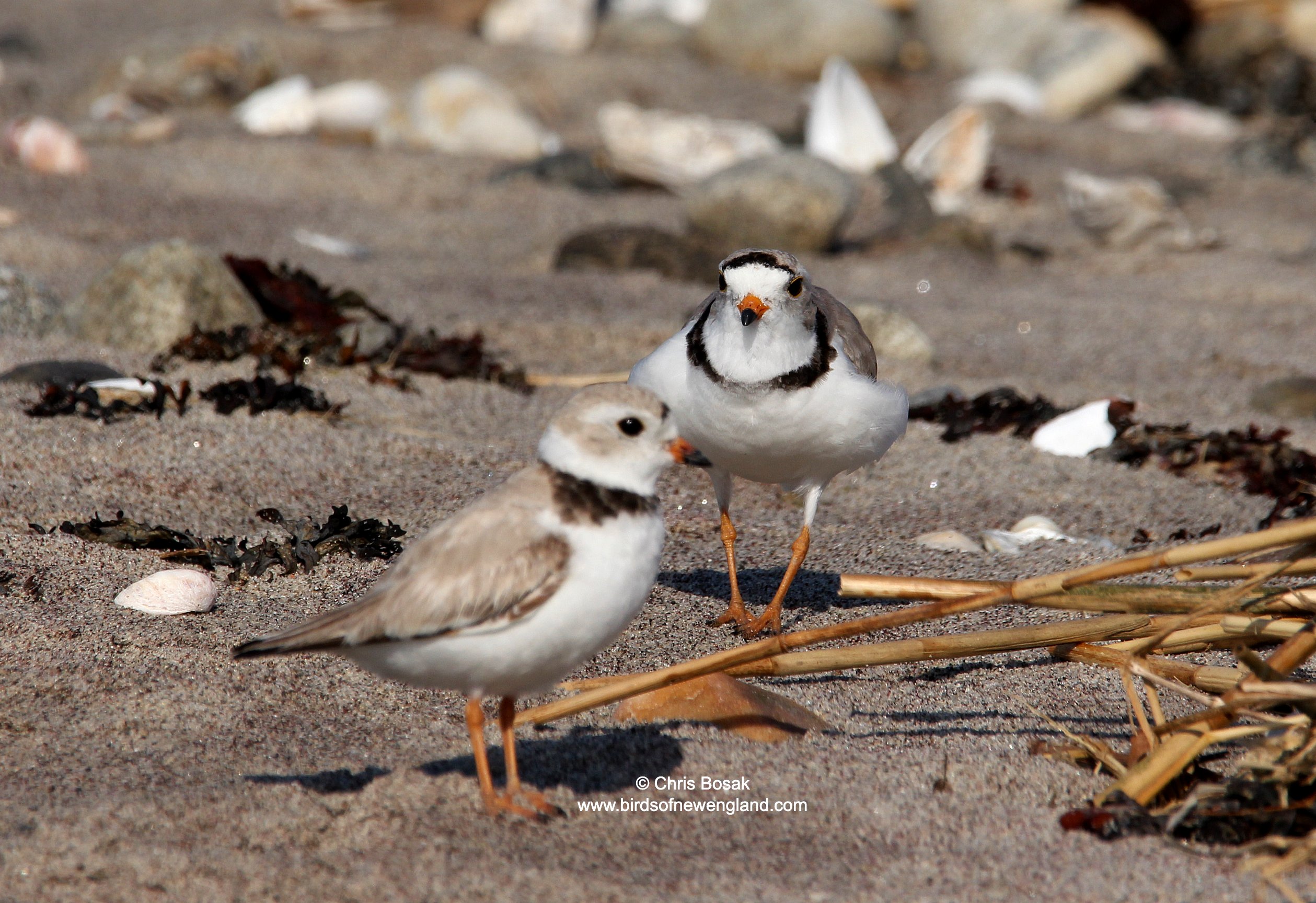
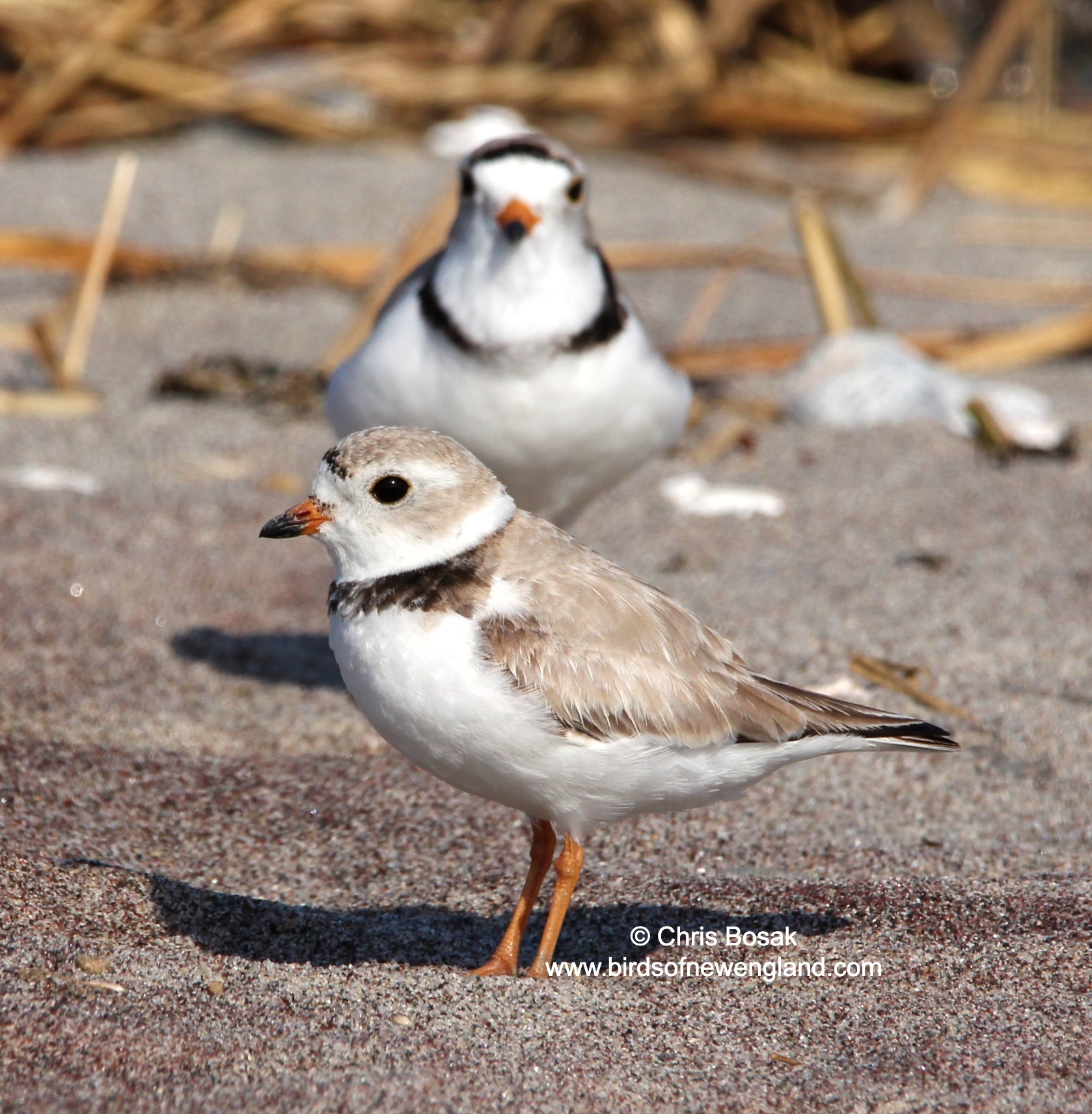
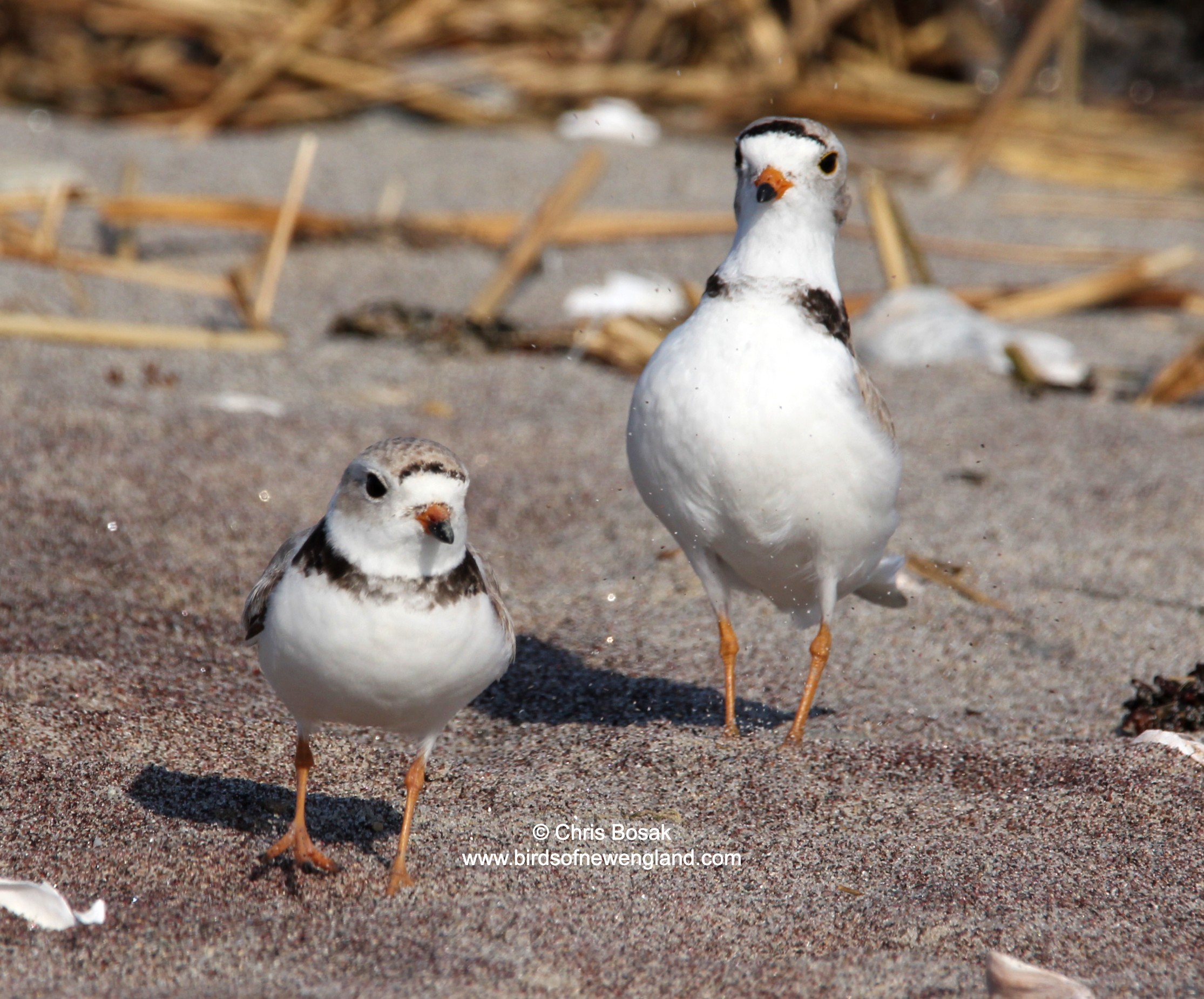
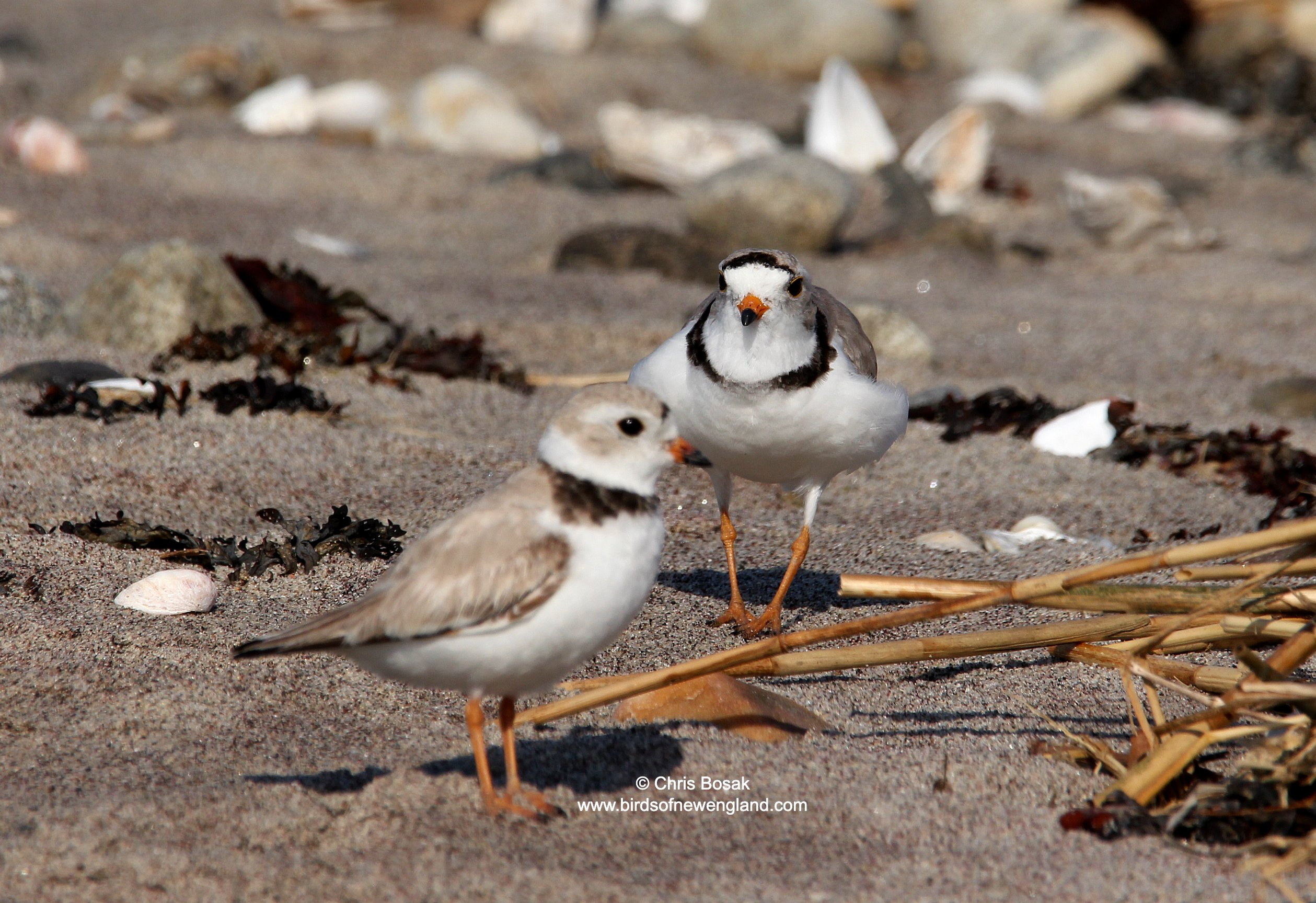
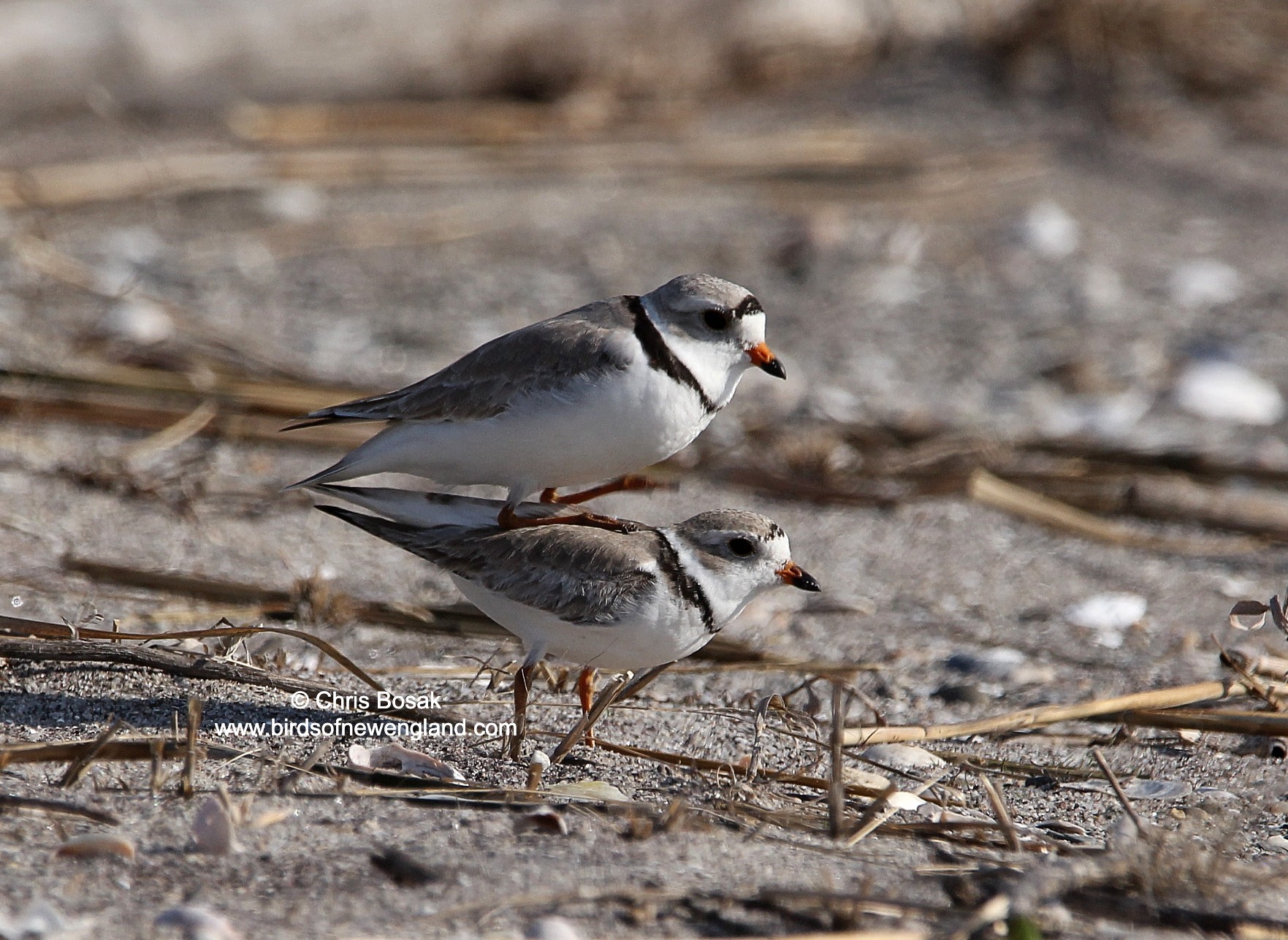
Photo by Chris Bosak – A male piping plover (background) moves toward a female plover at Milford Point, April 2026.
The spring migration has certainly begun, but it is still in the building-up phase.
I took a few walks in the woods over the last few days and saw some very welcomed migrants, such as pine warbler, palm warbler, yellow-rumped warbler and Louisiana waterthrush.
When migration is just picking up, however, the action can be hit or miss. In a few weeks, the action will be all hits all the time, and I’m sure we are all looking forward to that.
While those first migrants are great to see after a long winter, they also whet the appetite to see more spring migrants. The woods will be hit or miss for the next several days anyway, so the other day I went to a spot where I knew I would see a few old feathered friends that I hadn’t seen since last summer.
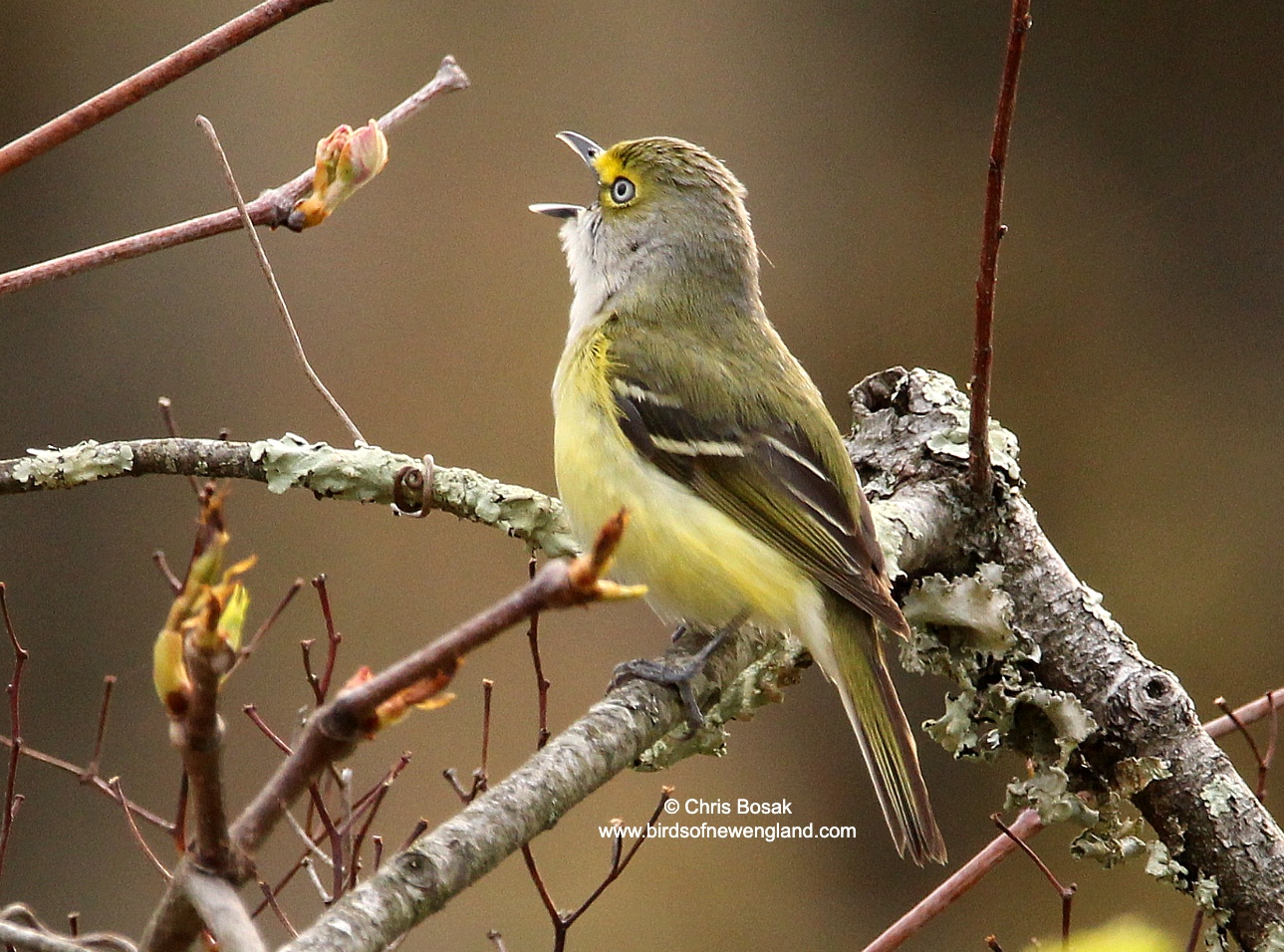
Photo by Chris Bosak White-eyed vireo at Huntington State Park, Redding, Conn., April 24, 2026.
I got up early and headed to Huntington State Park in Redding, Connecticut, and was rewarded with a good mix of migrants I hadn’t seen since last year.
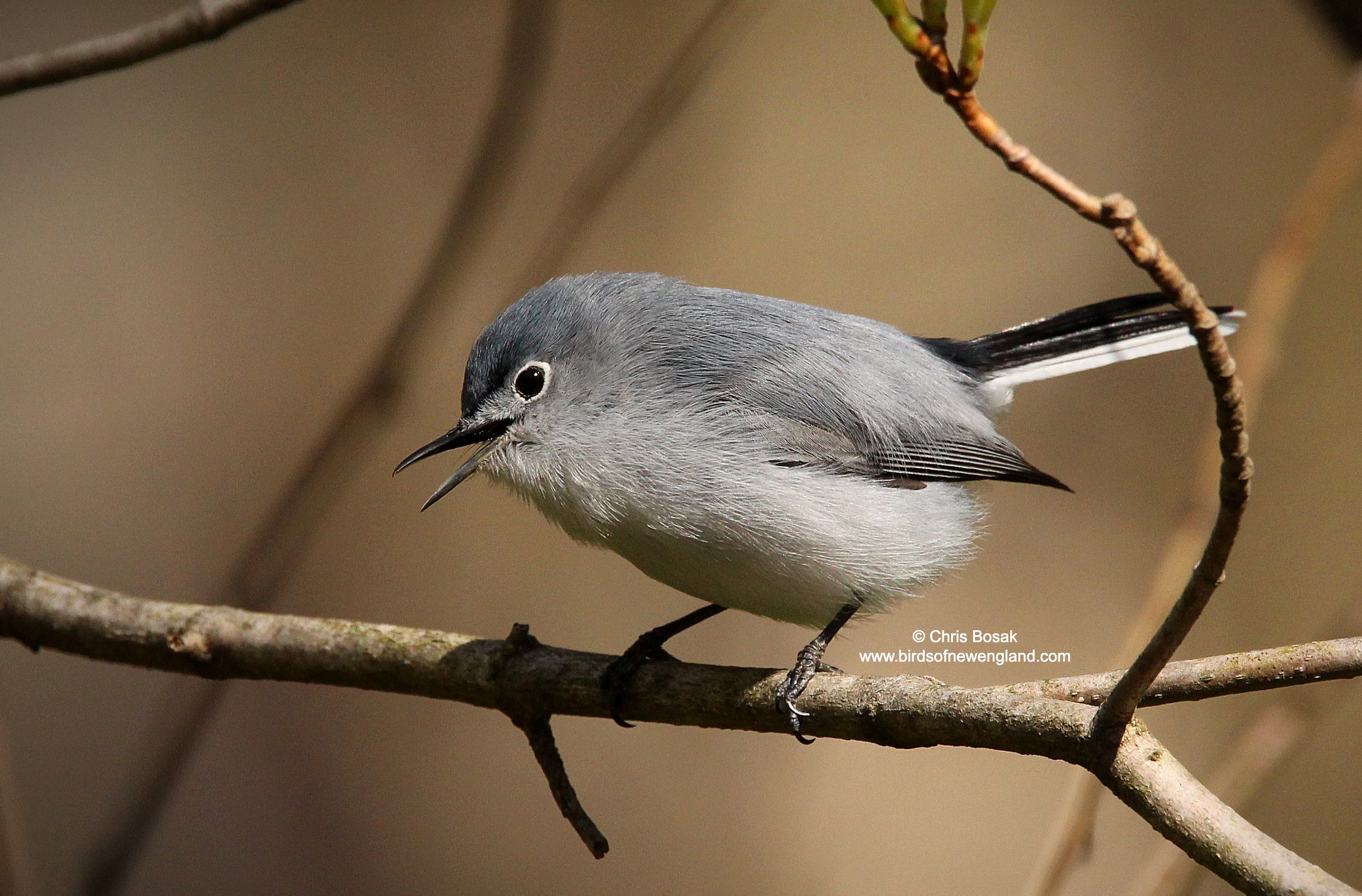
Photo by Chris Bosak Blue-gray gnatcatcher at Huntington State Park, Redding, Conn., April 24, 2026.
Fun, feisty little bird.
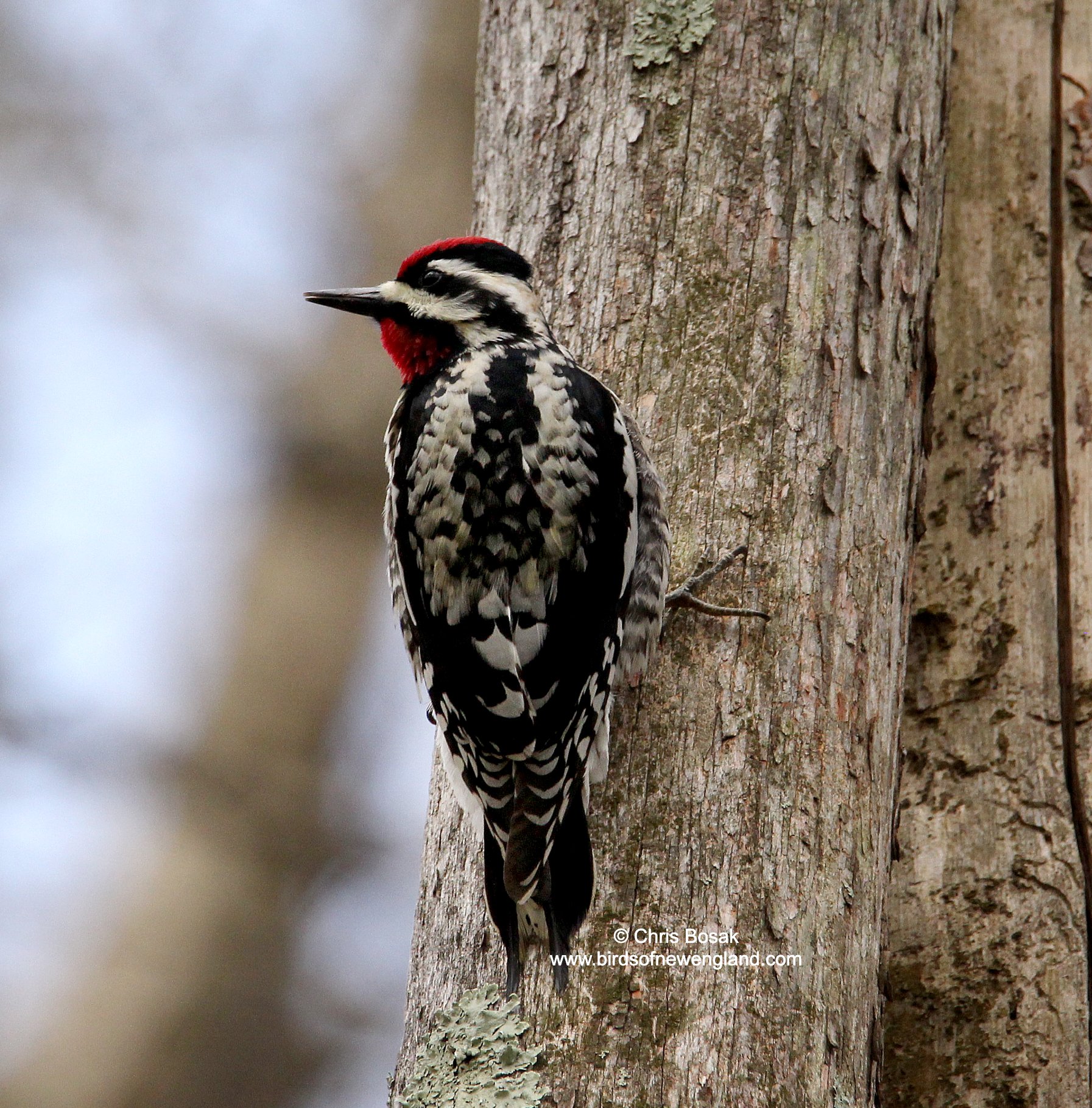
Photo by Chris Bosak Yellow-bellied sapsucker at Huntington State Park, Redding, Conn., April 24, 2026.
Not exactly a migrant, and I had seen sapsuckers all winter, but I had to include this handsome bird anyway. This is a male as indicated by the red throat.
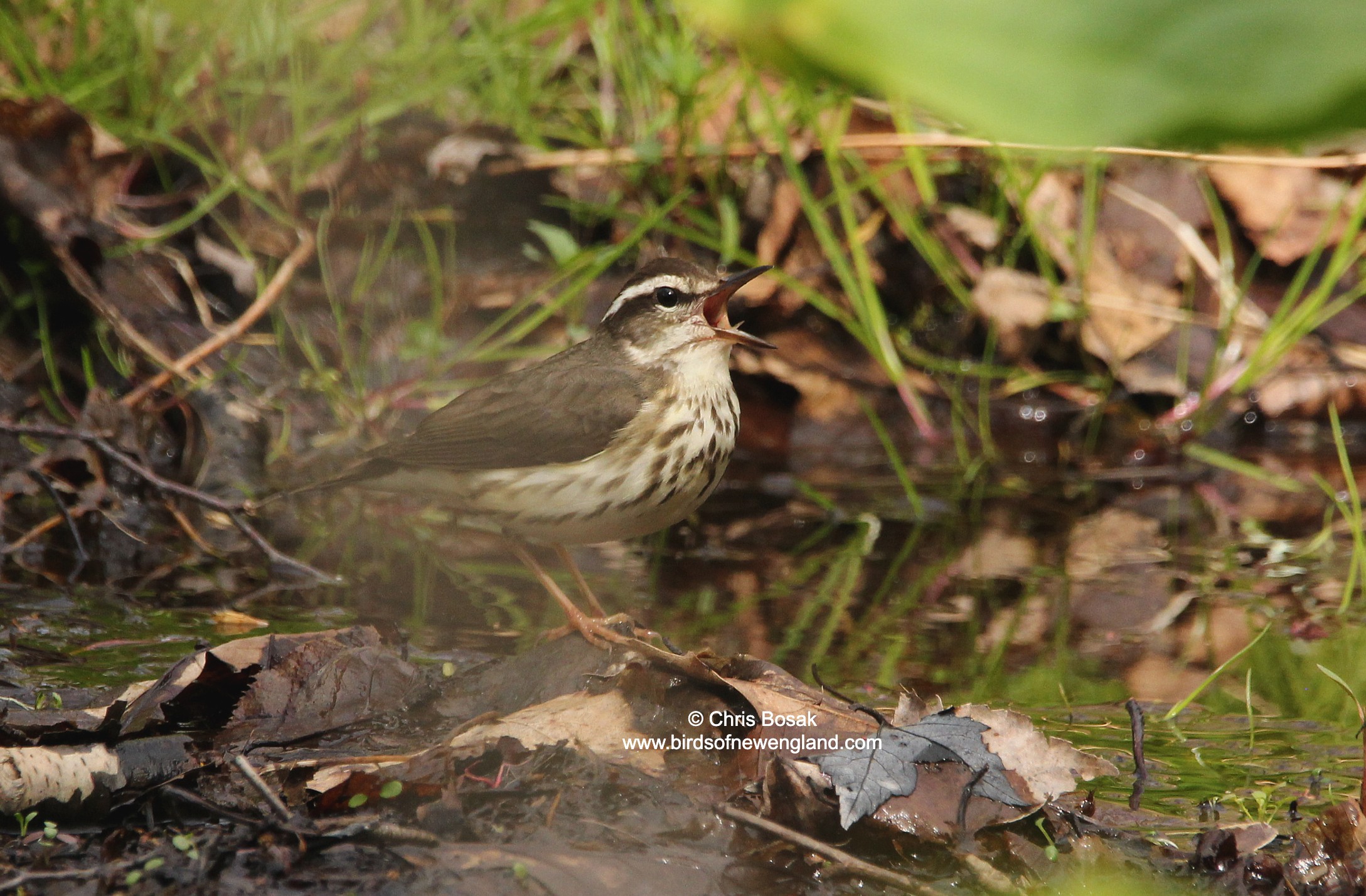
Photo by Chris Bosak Louisiana waterthrush at Huntington State Park, Redding, Conn., April 24, 2026.
I’ve been seeing these for a few weeks now.
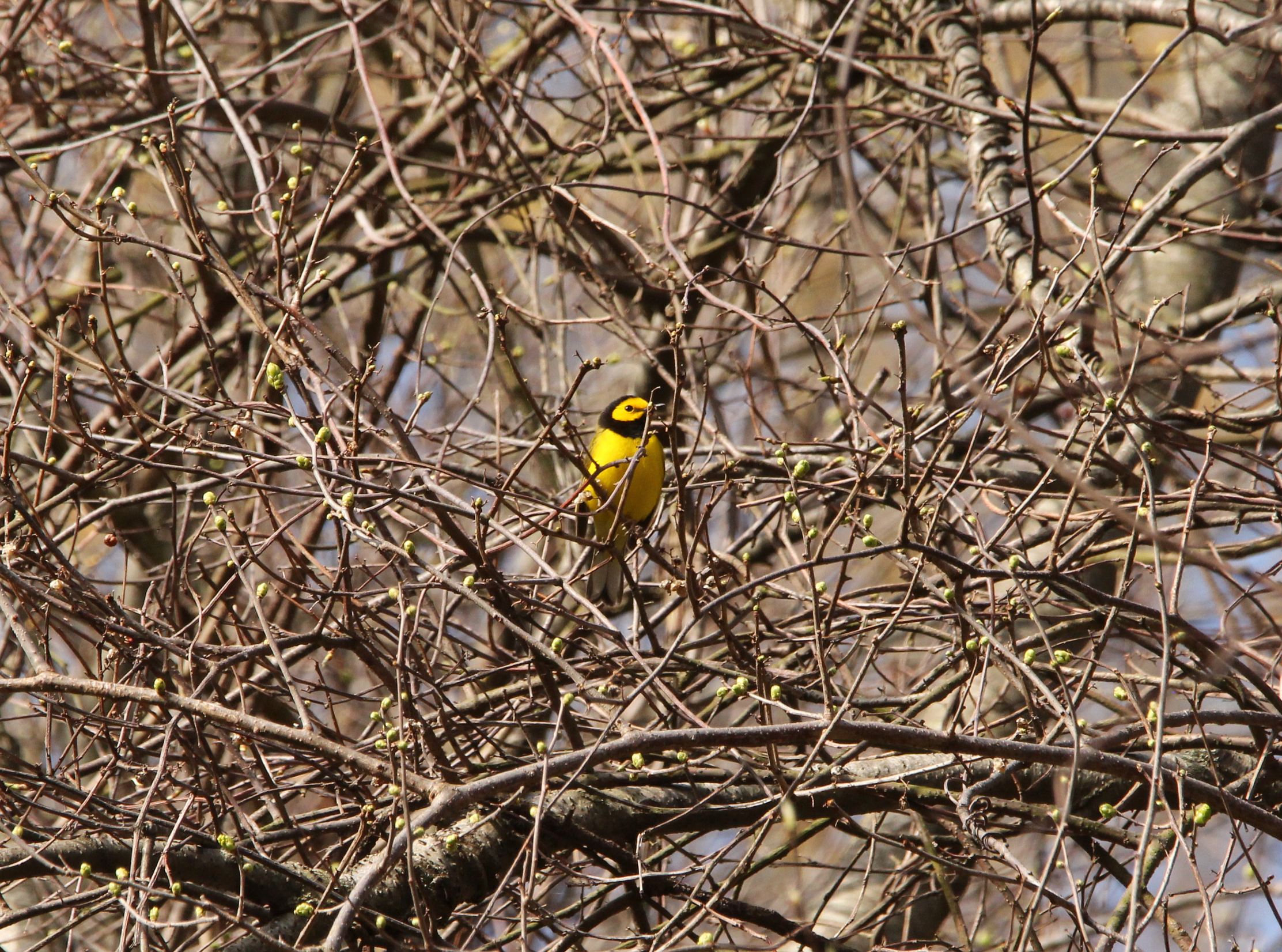
Photo by Chris Bosak Hooded warbler at Huntington State Park, Redding, Conn., April 24, 2026
Not the best photo, of course, but this was as close as I could get. Cool bird though.
Photo by Chris Bosak White-eyed vireo at Huntington State Park, Redding, Conn., April 24, 2026.
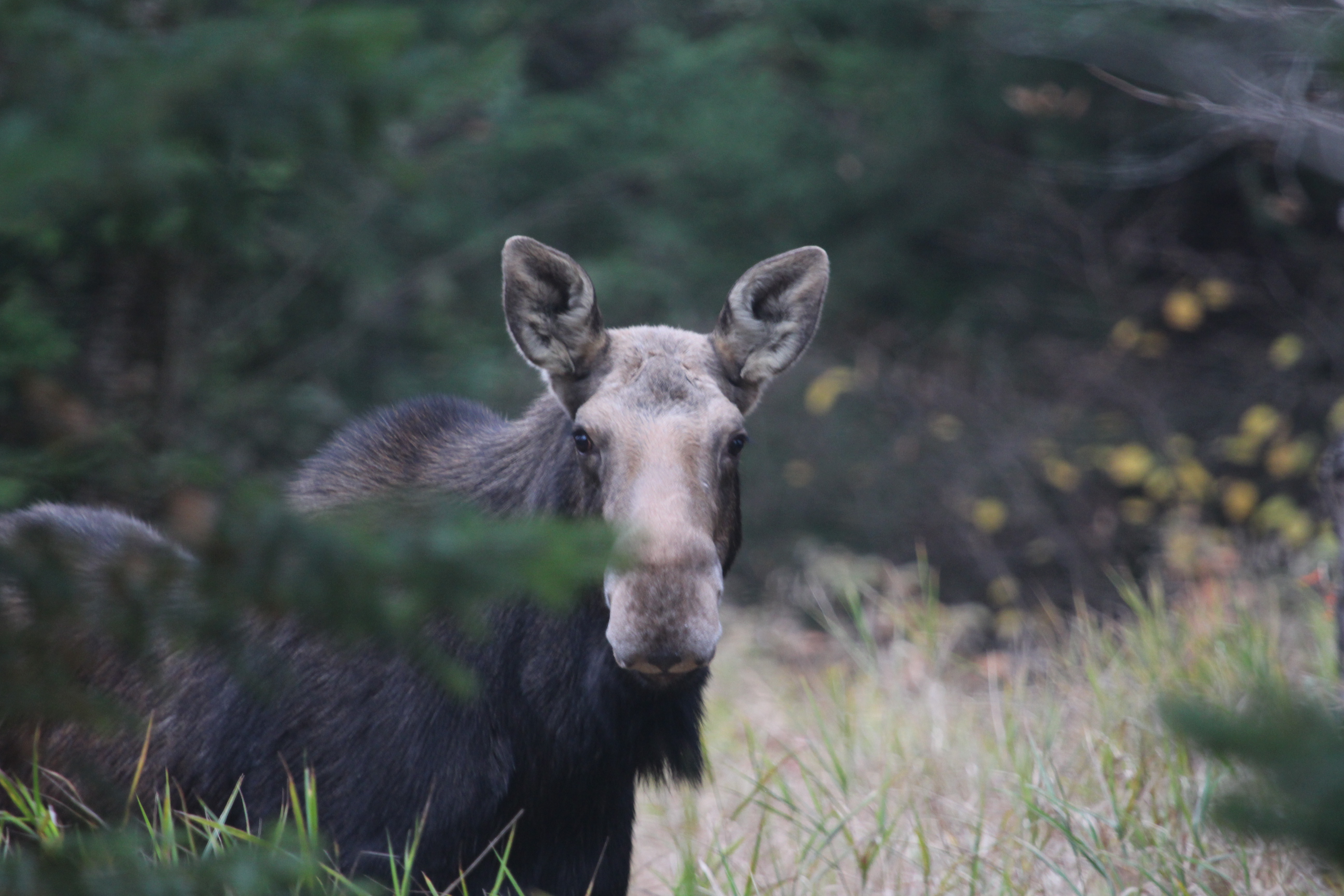
Photo by Chris Bosak – A cow moose in Pittsburg, NH, in the early 2000s.
I was lucky enough to live through New Hampshire’s golden age of moose.
The moose population in the state peaked at somewhere around 7,000 to 8,000 in the mid- to late-1990s. At the time, I worked a four-day week and had Sunday, Monday and Tuesday off each week. Working until midnight on Fridays and Saturdays wasn’t great for my social life, but it was ideal for camping trips. As I headed to northern New Hampshire on Sunday afternoons, most people were packing up and going back home to start the workweek.
I had my choice of campsites at Deer Mountain State Park in Pittsburg, and I had my choice of ponds on which to canoe. Rarely did I see other paddlers on the ponds. But I saw plenty of moose. I won’t exaggerate and say I saw dozens on each trip, but I certainly saw four or five either on the ponds or along the roads each time I went. I can’t recall a trip where I didn’t see at least a few moose.
Photo by Chris Bosak A male piping plover (back) pursues a female at Milford Point in New England, April 16, 2026.
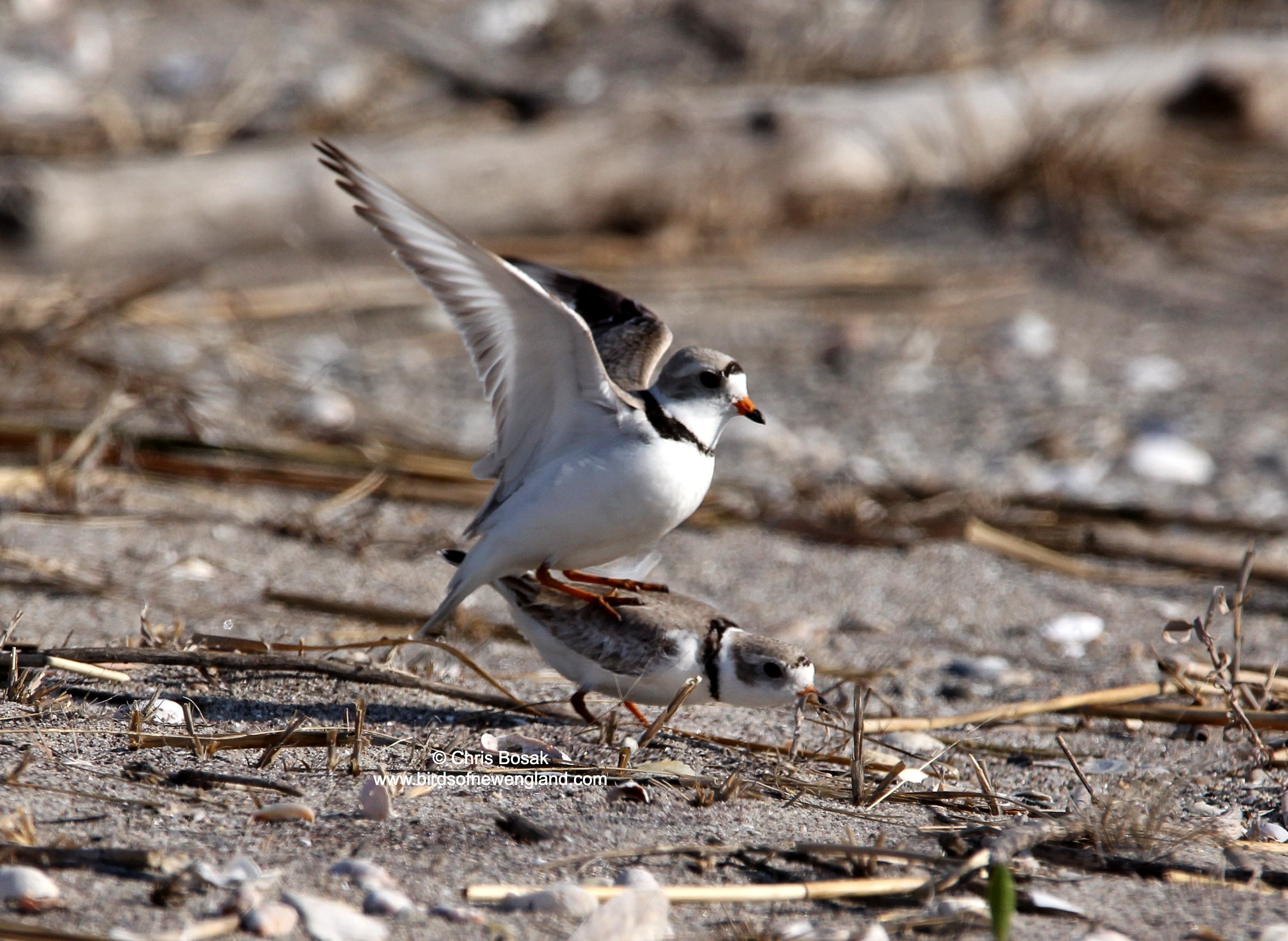
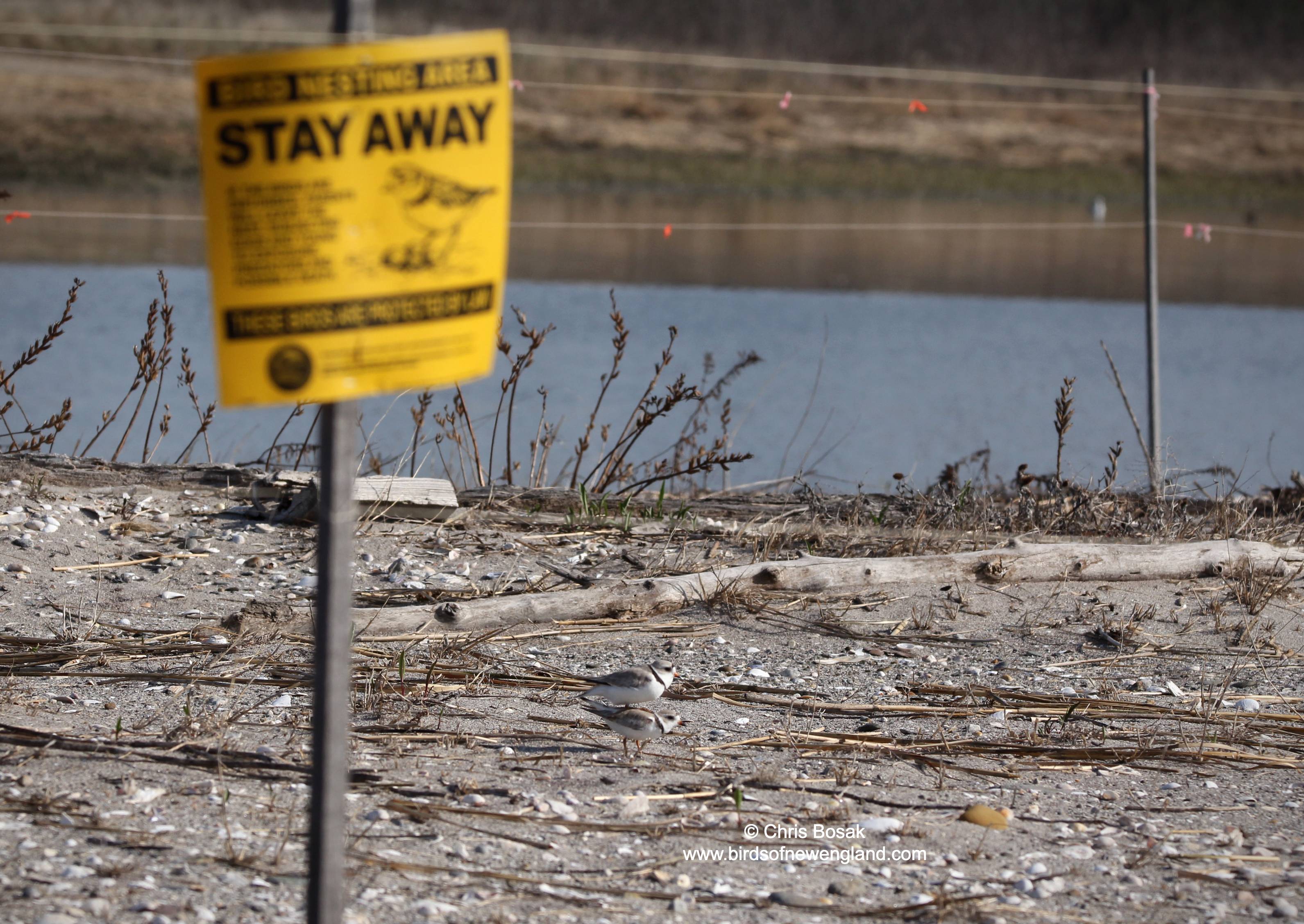
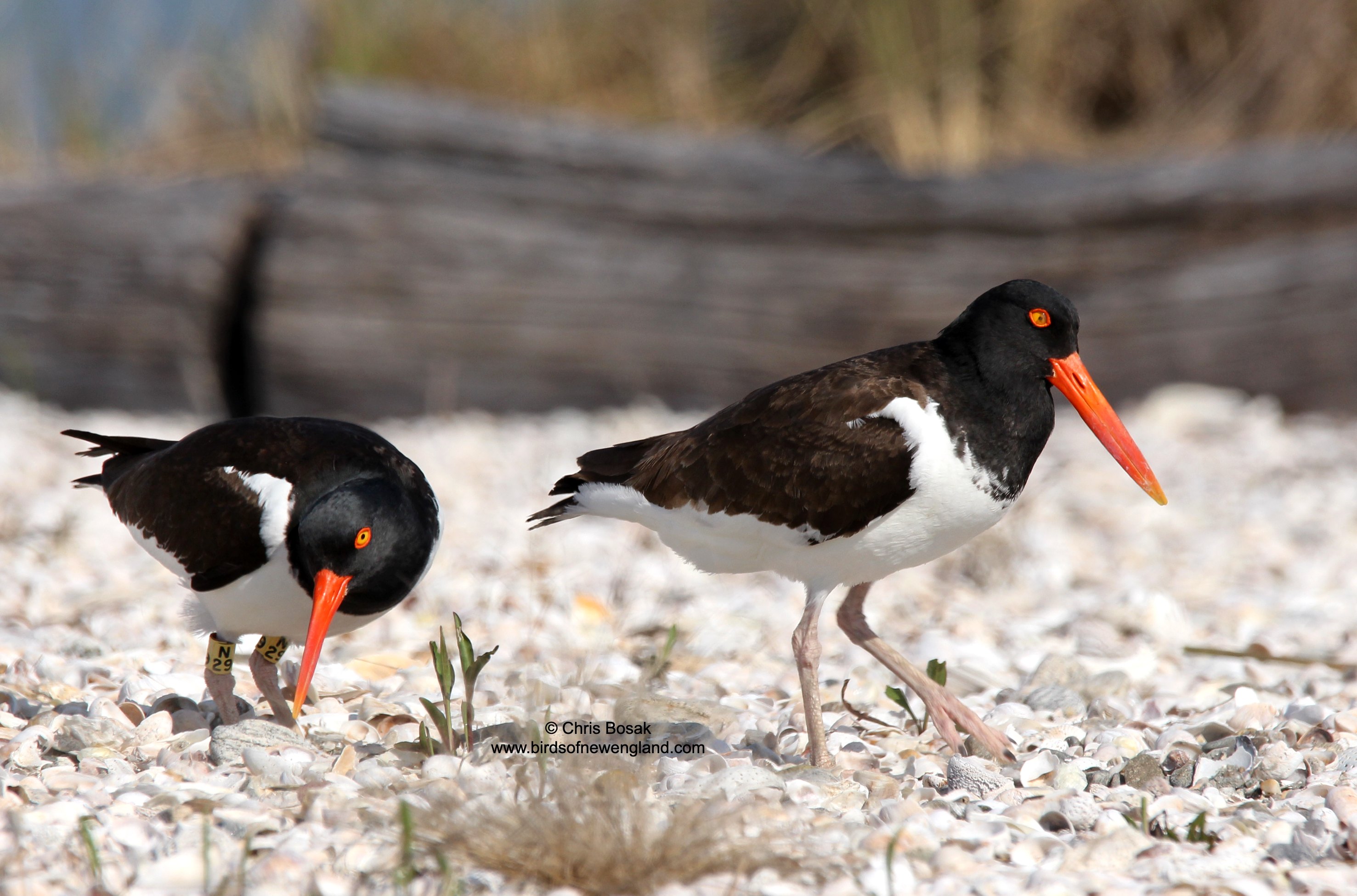
I took a trip to the Connecticut Audubon Society Coastal Center at Milford Point today to see piping plovers, American oystercatchers, and whatever else may be around. I timed it nicely, as I found several piping plover pairs doing their mating ritual and even saw one pair copulating.
The male plovers followed the females around the rocks and sand, standing tall and performing a type of stomp dance with their feet and legs. It was quite entertaining.
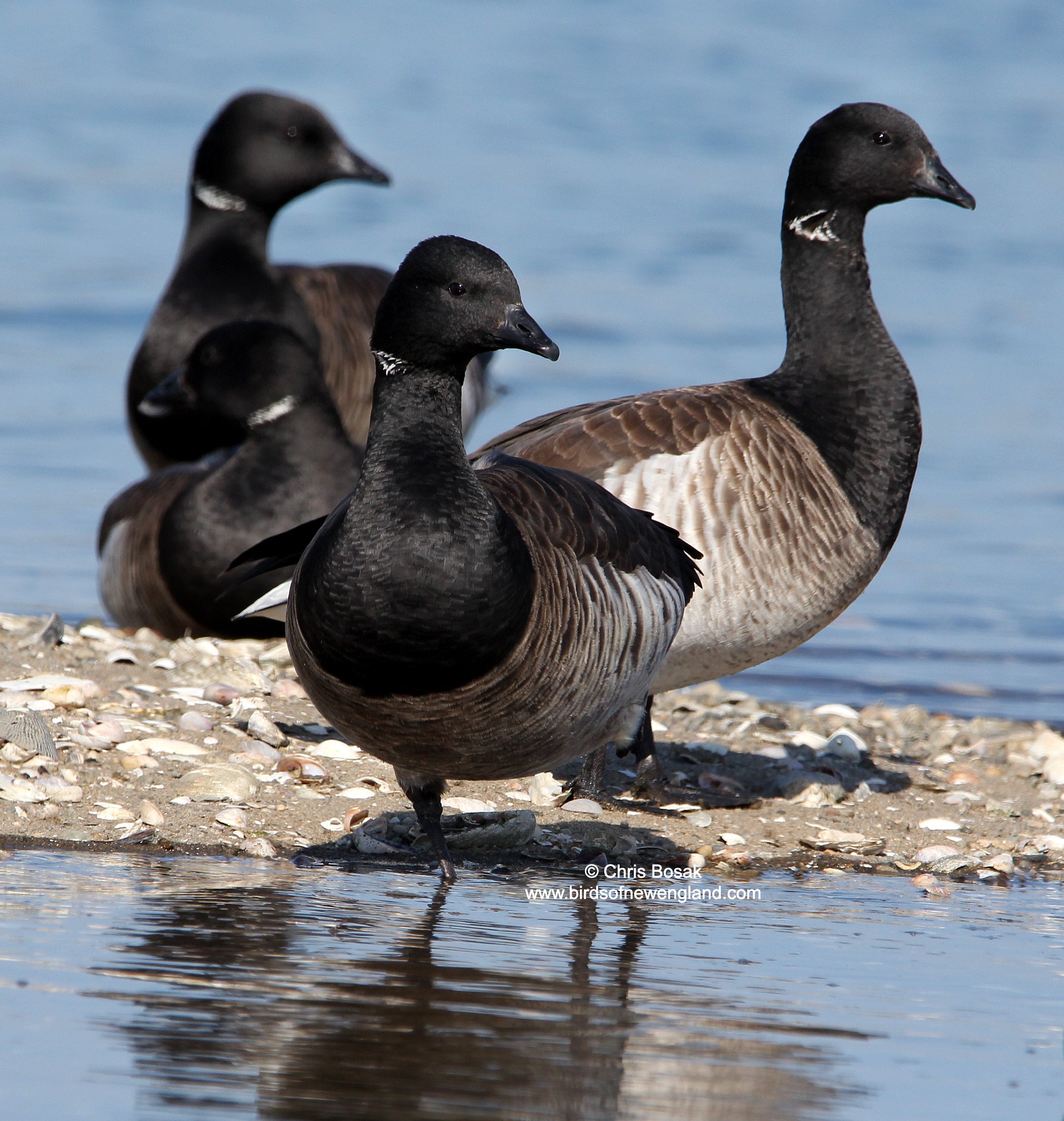
While the plovers and oystercatchers were the highlight, there were dozens (hundreds maybe) of brant still hanging around New England.
Photo by Chris Bosak A male piping plover (back) pursues a female at Milford Point in New England, April 16, 2026.Photo by Chris Bosak A male piping plover (back) pursues a female at Milford Point in New England, April 16, 2026.Photo by Chris Bosak Piping plovers copulate at Milford Point in New England, April 16, 2026.Photo by Chris Bosak Piping plovers copulate at Milford Point in New England, April 16, 2026.Photo by Chris Bosak Piping plovers copulate at Milford Point in New England, April 16, 2026.Photo by Chris Bosak American oystercatcher pair at Milford Point in New England, April 16, 2026.Photo by Chris Bosak Brant at Milford Point in New England, April 16, 2026.Photo by Chris Bosak A male piping plover (back) pursues a female at Milford Point in New England, April 16, 2026.
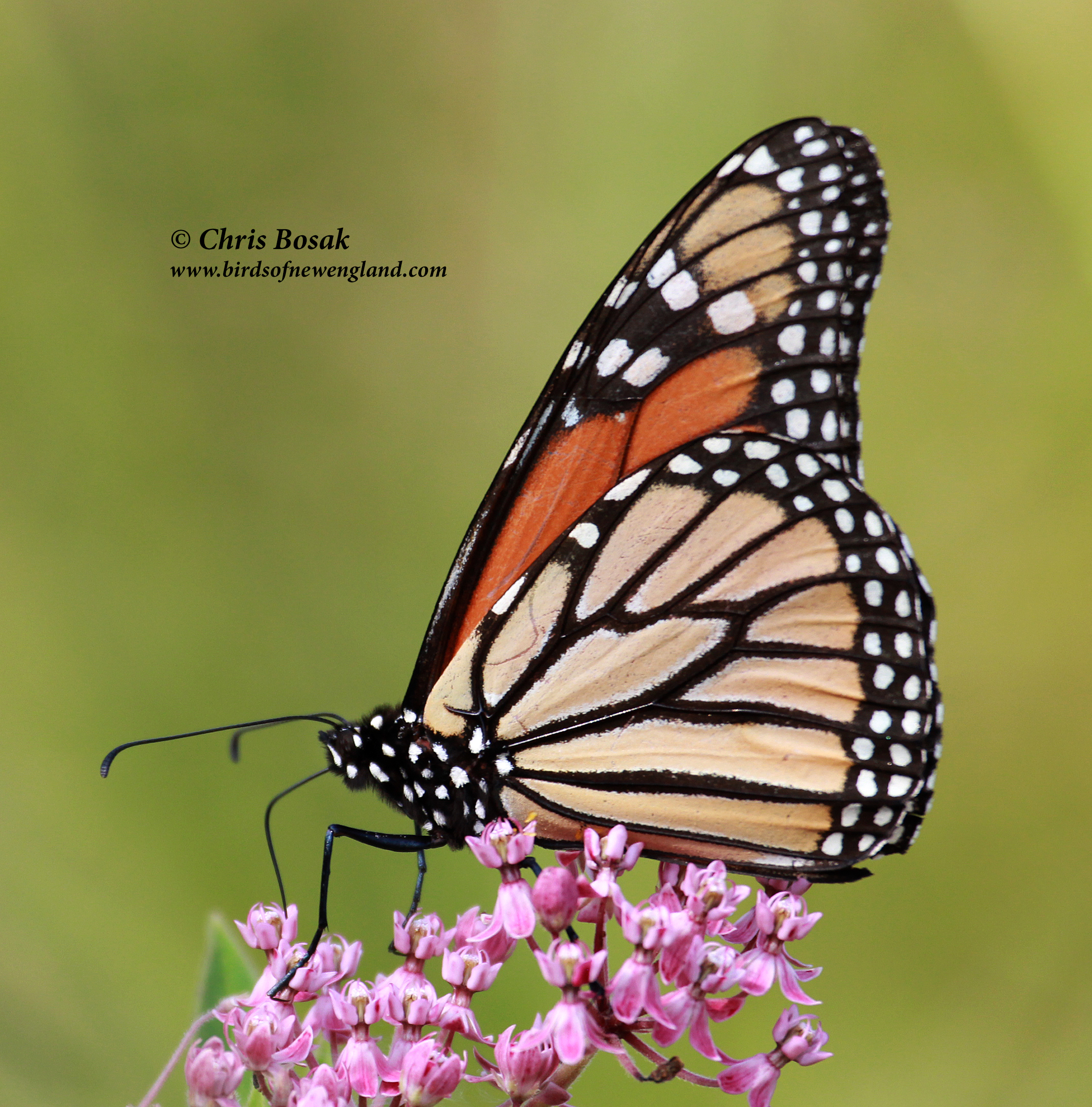
Photo by Chris Bosak Monarch, Brookfield, CT, summer 2019.
Too often, the perils facing a species in serious decline rise to the top of our consciousness through extensive media coverage or other means only to fade into the backs of our minds over time.
Is progress being made to help the species? Has the decline worsened, gotten better or stayed the same?
Here is a look at a few species in peril that were all over the media years ago, but not so much in recent years.
Photo by Chris Bosak A Rose-breasted Grosbeak visits a feeder in Danbury, Conn., May 2016. By not feeding birds, people will miss out on scenes like this.
Here’s my cynical take on a bird article printed on the website of a national nonprofit agency whose mission has nothing to do with birds. I won’t reveal the agency to protect the innocent.
The headline grabbed my attention, which is what headlines are supposed to do, I guess. It read: 7 Reasons to Think Twice Before Getting a Bird-feeder.
Right away, I knew I wouldn’t like the article, but I figured I would read it anyway and at least give it a chance. I was right, of course, but at least I can say I gave it a fair shot.
The article makes some good points, but, in my opinion, it misses the mark for the most part. It basically picks apart the hobby of feeding birds and outlines every possible negative scenario.
It’s like saying you should avoid building model airplanes because you might get glue on your fingers. Well, of course, you might, but you take precautions so that doesn’t happen, and if it does, then you wash your hands.
Or, you should avoid gardening because it might make your back ache, or you might dig up some insects that are scary-looking. Well, if your back starts to hurt, then stop for a while. If you see a scary insect, get over it because you know that’s inherent to the hobby.
Anyway, here are the seven reasons why this article urges you to think twice about feeding birds. I will make my cynical comments after each one.
1. Bird feeders are messy. Birds flick seeds on the ground and leave behind remnants of the seeds they do eat.
No kidding. Clean up the seeds and shells under the feeder if you don’t want to look at them.
2. There’s a lot of upkeep. Bird feeders need to be kept clean just like our dishes and utensils.
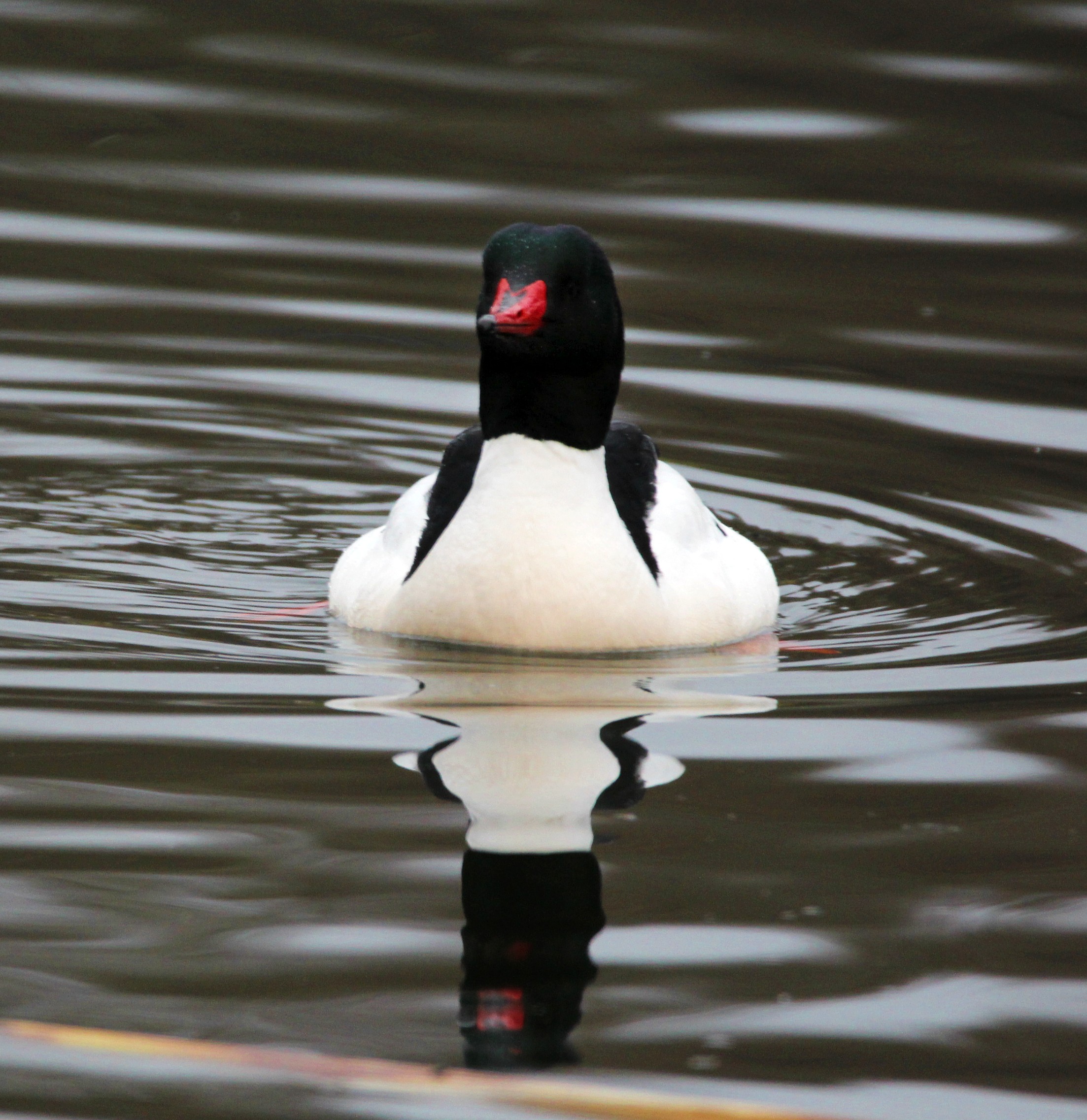
Photo by Chris Bosak – A male common merganser swims on a small pond in New England.
There is a pond 20 minutes from my house that I pass frequently. For 50 weeks of the year, the pond holds little interest for me other than being an aesthetically pleasing landmark to look at as I drive past.
In the summer, a few mallards and Canada geese are the only birds present. It being a small pond in New England, it is frozen for most of the winter, which is great for the skaters who have fun on the ice, but not so much for birdwatchers.
However, during one week in early spring and one week in late fall, the pond holds a surprisingly solid variety of migrating ducks.
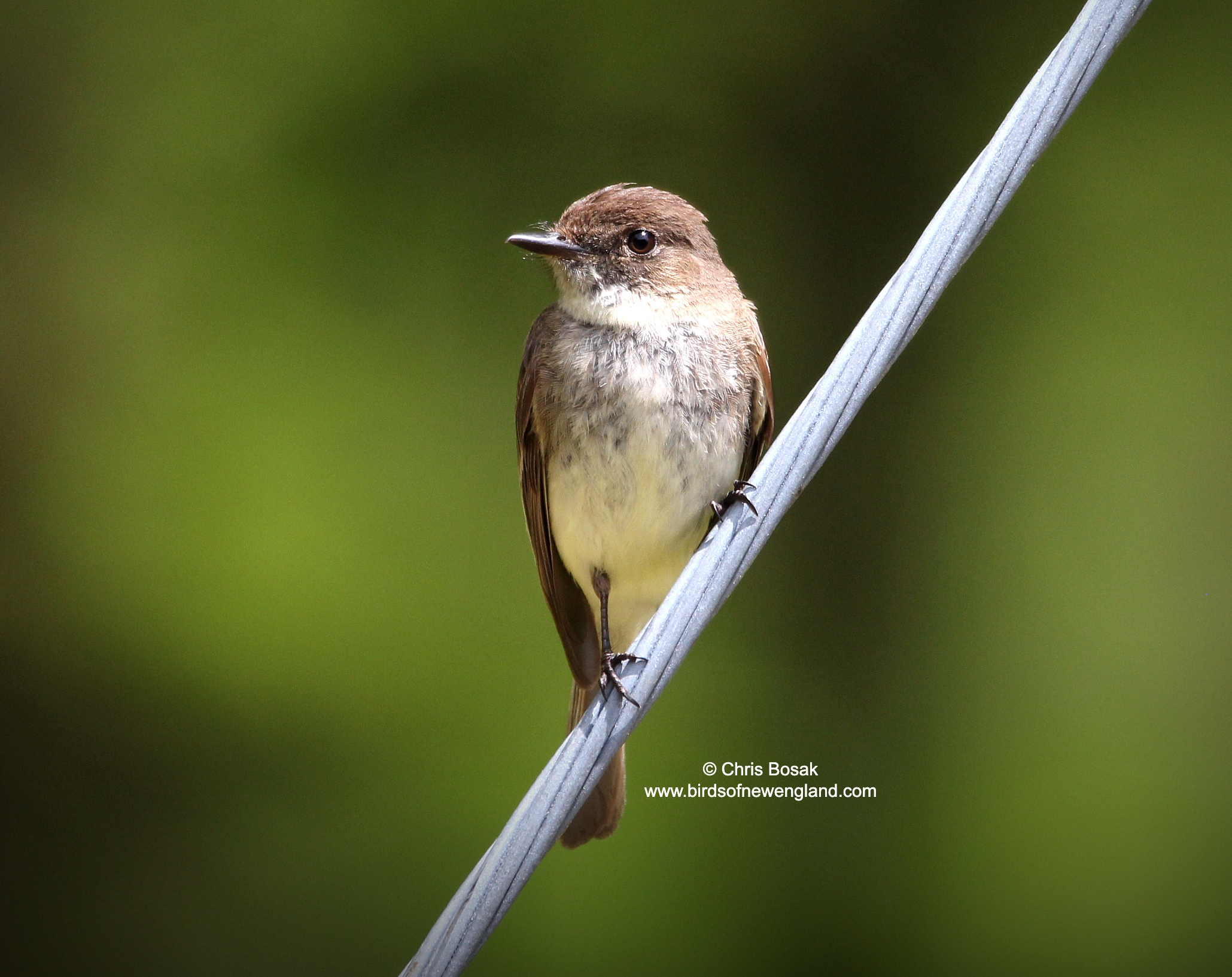
Photo by Chris Bosak Eastern phoebes are one of the first migrants to return to New England in the spring.
The bird world is amazing. If you’re reading this column, you likely already know that, but every once in a while something reminds me of just how incredible birds really are.
The other day, March 11 to be exact, I heard the song I’ve been waiting to hear for months: the unmistakable two-syllable song of the eastern phoebe. Like many birds, phoebes say their name, a raspy “fee-bee.”
I turned my head toward the song and instantly saw the smallish songbird perched on a telephone wire. Of course, the bird was bobbing its tail as phoebes almost always do.
It was the first phoebe I saw this year, or my FOY (first of year) phoebe in birding lingo. It came on one of the unseasonably warm days we had, and I wasn’t overly surprised to see the bird. Still, it seemed a bit early for the phoebe to be back in New England, so I checked my eBird account to see when I saw my FOY last year.
Sure enough, it was March 11. The first phoebe I saw occurred on the same exact calendar day as last year. In October of last year, this bird left New England for southern U.S. or Mexico. Sometime in February it began its journey back north and arrived at my place of work on the same day as last year. Of course, I can’t tell with all certainty it’s the same bird, but I’d like to think so.
Photo by Chris Bosak The eastern towhee used to be called chewink.
Many months ago, or maybe it was years at this point, I promised to do a column on old bird names.
Quite frankly, I forgot about it and never got around to doing the column. I can’t even remember what inspired me to consider such a column, but I must have been writing about a bird with a relatively new name and thought it would be a good idea to look at other somewhat recent bird name changes. Perhaps I wrote about a long-tailed duck and recalled the old name of oldsquaw. Regardless of the impetus, here’s that column I promised so long ago.
Now, I did write a column last summer about the most recent name changes by the American Ornithological Society. In that column, I relayed that the powers that be changed the name of the house wren we see in New England to northern house wren. A year earlier, I wrote that the three redpoll species were lumped into a single species called redpoll.
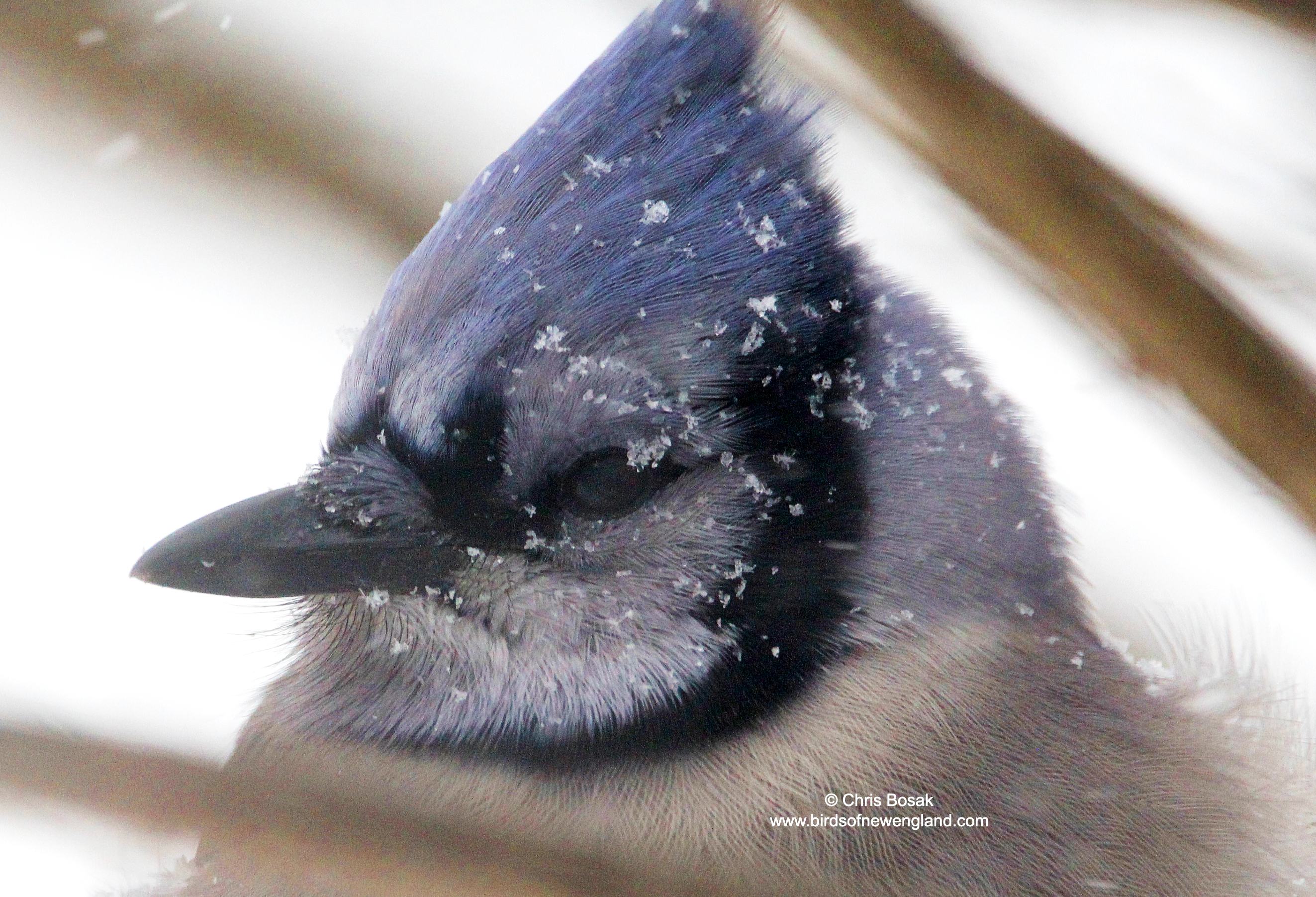
Photo by Chris Bosak Snow gathers on a blue jay’s face during a snowstorm, January 25, 2026, New England. Blue jays, like all corvids, are highly intelligent.
We’ve all heard the expression “birdbrain” to describe someone lacking intelligence or prone to doing dumb things. The definition that pops up when doing an internet search is “a silly or stupid person.”
Birdbrain, of course, is a misnomer because birds are actually very smart.
While everyone has heard of birdbrain, how about birderbrain? I’d be willing to bet not many people have heard that one before. That would be understandable because I just made up the expression for this column.