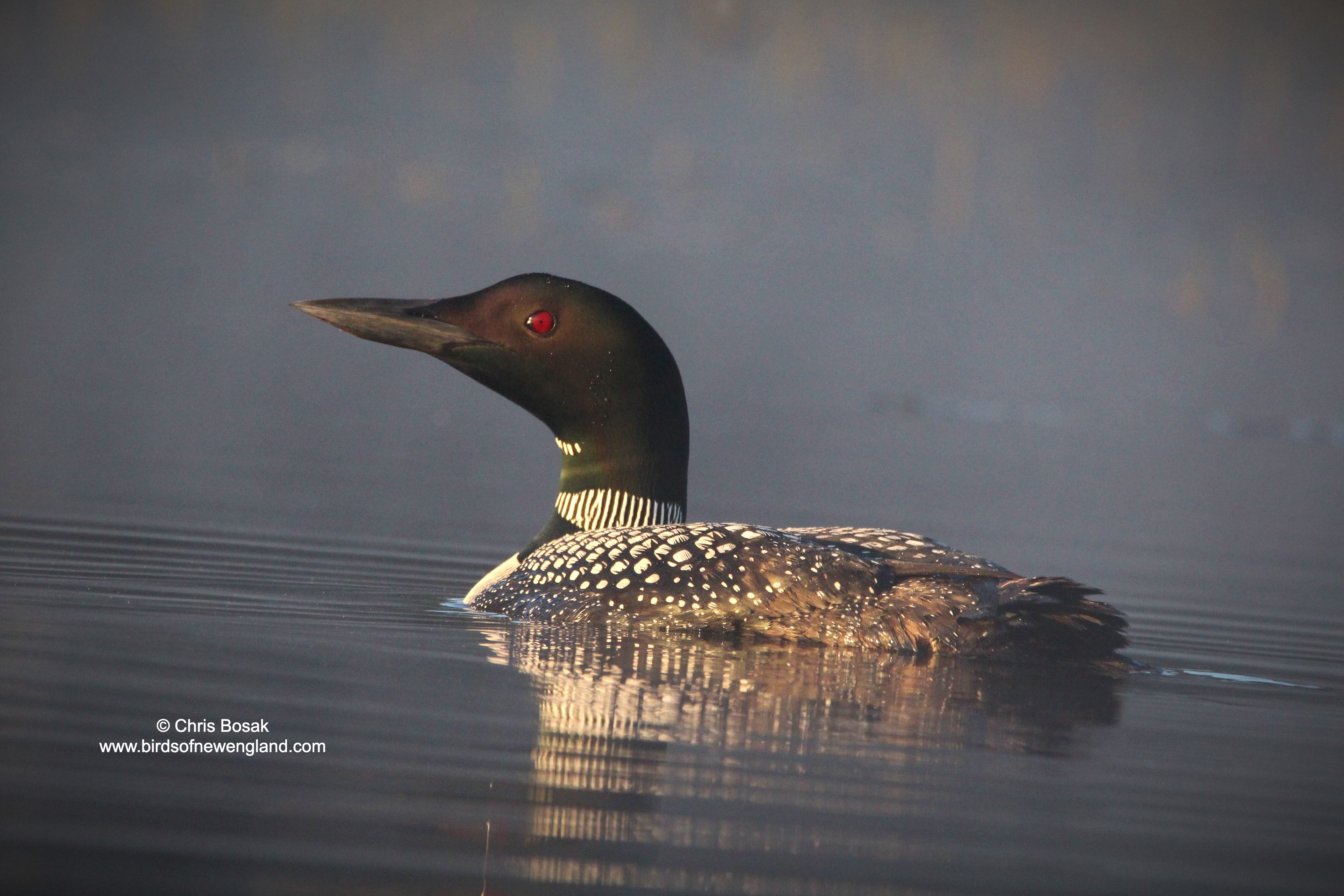
A common loon rests on a pond in northern New Hampshire, summer 2026.
It was a scene you might see in the opening frames of a movie.
The mist was thick coming off the water, and the sunrise peaking over the distant mountain painted the eastern sky a brilliant orange. Tall pines marked the edge of the pond, and a pair of loons silently floated on the mirror-like water.
Heather and I slowly paddled toward the loons but kept a respectable distance so as to not disturb their morning routine, which seemed to be not much more than sitting still on the water. Neither one of the loons made any of their iconic sounds, but the scene was still quintessential New England regardless.
As we paddled east toward the rising and slowly brightening sun, belted kingfishers on either side of the pond rattled simultaneously, creating a stereo effect among the din of birdsong that filled the morning air. Based on what we heard, common yellowthroats, Swainson’s thrushes, red-winged blackbirds and red-breasted nuthatches were the dominant songbirds hiding in the thick woods.
A bald eagle soared overhead and landed in a nearby snag, and a great blue heron stalked the northern shoreline. At the far end of the pond, dozens and dozens of tree swallows zipped around the surface of the water, feasting on mosquitoes and other flying insects.
Only one thing was missing from this early morning canoe ride in northern New Hampshire: moose. We tried the following morning and came up moose-less again.
This is a pond that used to be a moose hot spot. One July evening many years ago, I sat in the middle of the pond while three bull moose stood chest deep in the water eating nutrient-rich aquatic vegetation. I wouldn’t say that every canoe trip on the pond yielded a moose sighting, but very often it did.
Granted, I get up to northern New Hampshire only once or twice a year these days, but it has now been six years since I’ve seen a moose there. New Hampshire’s moose population, of course, has been drastically reduced due to winter tick infestations and other reasons. I’m often guilty of living in the past, hence my steadfast optimism for finding a moose as I make the northward trek.
Despite the fruitless moose searches, it was a great trip all around. Any trip that yields sightings of bald eagles and common loons is a success. In addition to those iconic birds, we saw ruffed grouse, magnolia warblers, Nashville warblers, black-throated green warblers, blue-headed vireos and many golden-crowned kinglets.
I’m also fairly certain I saw an American goshawk, but it flushed from a pine tree before I spotted it, offering only a brief glimpse as it flew off. It was a large, light-colored hawk, but I can’t say for sure what it was. As a side note, the American goshawk was known as the northern goshawk until 2023 when it was split from the goshawk that occurs in Eurasia.
The moose may have remained hidden, but the birds put on a show that more than made up for it. That’s the beauty of wildlife watching. Even when your target species doesn’t cooperate, there’s almost always something else waiting to steal the spotlight.

 Birds of New England.com